For decades, HER2 testing divided breast cancer into two broad groups: HER2-positive disease eligible for established HER2-directed therapy and HER2-negative disease managed according to hormone receptor status, stage, and other biomarkers.
That binary framework is no longer sufficient.
The emergence of HER2-directed antibody-drug conjugates has made lower levels of HER2 expression clinically actionable. Tumors previously grouped together as “HER2-negative” may now be described as HER2-low, HER2-ultralow, or HER2-null, with the distinction influencing treatment eligibility in metastatic breast cancer.
The change is not simply new terminology. It affects pathology reporting, tissue selection, treatment sequencing, multidisciplinary communication, and the timing of antibody-drug conjugates.
These practical questions will be examined during a dedicated section at the OncoDaily Community Oncology Global Congress, where breast oncologists, pathologists, and community-based clinicians will discuss how HER2-low and HER2-ultralow classifications translate into everyday treatment decisions.
What Do HER2-Low and HER2-Ultralow Mean?
Traditional HER2 testing remains based on immunohistochemistry and, when required, in situ hybridization.
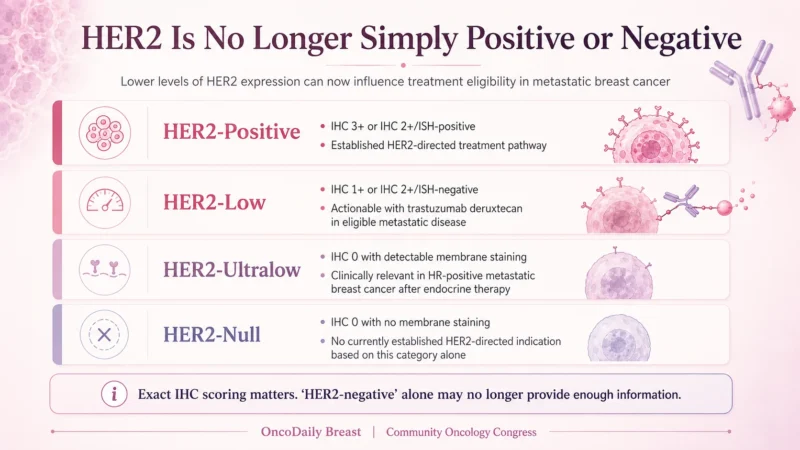
HER2-positive breast cancer is generally defined as IHC 3+ or HER2 gene amplification detected by ISH.
HER2-low breast cancer is defined as IHC 1+ or IHC 2+ without HER2 amplification by ISH.
HER2-ultralow breast cancer refers to tumors scored as IHC 0 but with detectable membrane staining.
By contrast, HER2-null describes IHC 0 disease in which no membrane staining is observed. The distinction between ultralow and null expression has become clinically relevant because the current US indication for trastuzumab deruxtecan includes HR-positive, HER2-ultralow metastatic breast cancer after progression on endocrine therapy.
Importantly, the 2023 ASCO–College of American Pathologists update retained the established HER2 scoring system rather than declaring HER2-low a separate biological subtype. The terms are most useful as treatment-selection categories, identifying tumors with sufficient HER2 expression for antibody-mediated delivery of a cytotoxic payload.
How DESTINY-Breast04 Made HER2-Low Actionable
The clinical importance of HER2-low disease was established by the phase 3 DESTINY-Breast04 trial.
The study included 557 patients with unresectable or metastatic HER2-low breast cancer who had received previous chemotherapy in the metastatic setting or experienced early recurrence after adjuvant chemotherapy. HER2-low expression was defined as IHC 1+ or IHC 2+/ISH-negative.
Trastuzumab deruxtecan significantly improved progression-free and overall survival compared with physician’s choice of chemotherapy. The benefit was observed predominantly in the hormone receptor–positive population, although the trial also enrolled a smaller hormone receptor–negative cohort (Modi et al., 2022).
The trial changed the meaning of a HER2-negative result. An IHC 1+ result was no longer simply negative for conventional HER2 overexpression. It could identify a patient eligible for an effective HER2-directed antibody-drug conjugate.
The subsequent FDA indication covered adults with unresectable or metastatic HER2-low disease who had received previous chemotherapy in the metastatic setting or developed recurrence during or within six months of completing adjuvant chemotherapy.
How DESTINY-Breast06 Moved Treatment Earlier
The phase 3 DESTINY-Breast06 trial extended this strategy into an earlier treatment position and introduced HER2-ultralow disease into clinical decision-making.
The trial enrolled 866 patients with HR-positive, HER2-low or HER2-ultralow advanced breast cancer that had progressed after one or more endocrine-based regimens. Patients had not received chemotherapy for advanced or metastatic disease.
Among patients with HER2-low tumors, median progression-free survival was 13.2 months with trastuzumab deruxtecan versus 8.1 months with physician’s choice of chemotherapy, corresponding to a hazard ratio of 0.62.
In the overall HER2-low and HER2-ultralow population, median progression-free survival was also 13.2 versus 8.1 months. The HER2-ultralow subgroup demonstrated a consistent numerical signal, although that analysis was exploratory and involved fewer patients (Bardia et al., 2024).
Based on DESTINY-Breast06, the FDA approved trastuzumab deruxtecan in January 2025 for unresectable or metastatic HR-positive, HER2-low or HER2-ultralow breast cancer that had progressed after one or more endocrine therapies in the metastatic setting.
For eligible patients, this means trastuzumab deruxtecan can now be considered before conventional metastatic chemotherapy, rather than only after chemotherapy exposure.
Why “HER2-Negative” Is No Longer Enough
A pathology report that states only “HER2-negative” may no longer provide enough information for treatment planning.
The oncologist needs to know whether the tumor was:
IHC 0 without membrane staining, IHC 0 with membrane staining, IHC 1+, or IHC 2+ with a negative ISH result.
Each result remains negative for traditional HER2 overexpression or amplification, but the therapeutic implications are no longer identical.
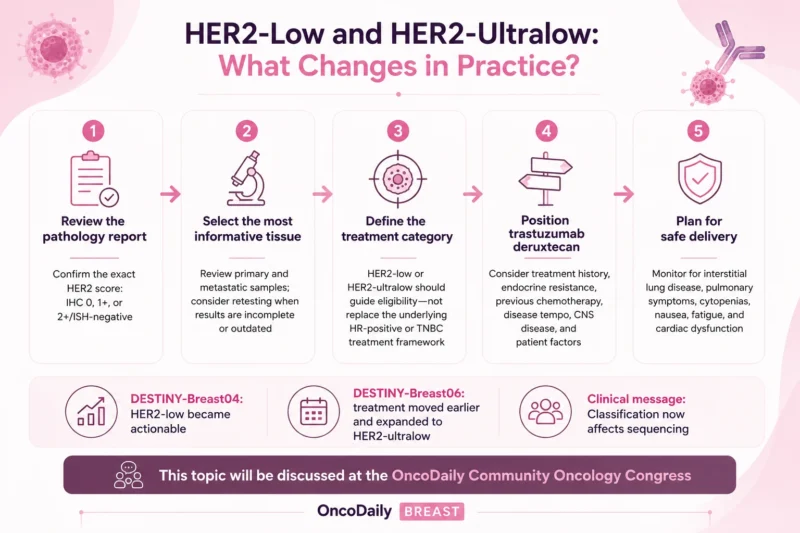
A patient reported only as HER2-negative several years earlier could have an IHC 1+, IHC 2+/ISH-negative, or IHC 0 with membrane staining result hidden within that broader category. Reviewing the original report, requesting the precise score, or reassessing available tissue could reveal eligibility for an antibody-drug conjugate.
This is particularly important at the boundary between IHC 0 and 1+, where staining intensity is low and interpretation can be difficult. Expert pathology recommendations have emphasized validated assays, appropriate controls, standardized interpretation, and focused training to improve reproducibility at these lower expression levels.
Which Tissue Sample Should Be Used?
HER2 expression is not necessarily identical across every tumor sample.
Differences may appear between the primary tumor and a metastatic biopsy, between separate metastatic sites, or between samples obtained at different stages of treatment. Pre-analytic conditions, tissue fixation, assay selection, tumor heterogeneity, and interpretation can also influence the reported score.
In practical terms, clinicians need to review all available HER2 results rather than relying automatically on the oldest specimen.
When clinically feasible, a contemporary metastatic biopsy can provide valuable information, particularly when the original report lacks an exact IHC score or when prior testing was performed before HER2-low and ultralow treatment eligibility became relevant.
Retesting does not guarantee a different result, and biopsy decisions must consider accessibility, safety, tissue availability, and whether the result would change management. The essential step is to ensure that the most informative specimen has been assessed with an appropriate, validated method.
Do These Categories Represent Different Diseases?
HER2-low and HER2-ultralow should not automatically be interpreted as new intrinsic breast cancer subtypes.
Most HER2-low and ultralow tumors remain biologically driven by their underlying hormone receptor status, genomic alterations, endocrine sensitivity, proliferation, and prior treatment history.
An HR-positive/HER2-low tumor is still primarily managed through an HR-positive disease framework. Endocrine therapy, CDK4/6 inhibition, PI3K–AKT pathway alterations, ESR1 status, germline BRCA status, disease tempo, and previous treatment continue to influence sequencing.
Similarly, HER2-low triple-negative breast cancer remains triple-negative disease. The HER2-low result creates a potential treatment opportunity but does not erase the biological and clinical features of TNBC.
The practical value of the classification is therefore not that it completely redefines the cancer. It identifies a therapeutic vulnerability that can be exploited by an antibody-drug conjugate.
Does HER2 Expression Alone Determine Sequencing?
A HER2-low or ultralow result opens a treatment option, but it does not make the sequencing decision by itself.
For HR-positive metastatic disease, clinicians still need to determine whether meaningful endocrine-based options remain. Treatment history, endocrine resistance, visceral disease, symptoms, molecular alterations, previous CDK4/6 inhibitor exposure, performance status, and patient preferences remain central.
The current FDA indications distinguish between two clinical situations. HR-positive HER2-low or ultralow disease can be treated with trastuzumab deruxtecan after progression on one or more metastatic endocrine therapies. HER2-low disease, irrespective of hormone receptor status, is also included after previous metastatic chemotherapy or early recurrence following adjuvant chemotherapy.
The choice becomes more complex when several antibody-drug conjugates are potentially available. The optimal sequence may depend on target expression, previous payload exposure, toxicity history, disease tempo, brain metastases, access, and the strength of evidence in the specific setting.
HER2 status is therefore one part of sequencing, not the entire algorithm.
Safety Remains Central to Patient Selection
The expansion of treatment eligibility increases the importance of toxicity recognition and management.
Trastuzumab deruxtecan carries a boxed warning for interstitial lung disease and pneumonitis, including severe and fatal events. New cough, dyspnea, fever, or other respiratory symptoms require prompt investigation. The current prescribing information recommends permanent discontinuation for symptomatic grade 2 or higher ILD or pneumonitis.
Nausea, fatigue, cytopenias, alopecia, and gastrointestinal adverse events also affect treatment burden. Cardiac function requires assessment because left ventricular dysfunction can occur with HER2-directed treatment.
The decision to use trastuzumab deruxtecan must therefore consider more than HER2 staining. Baseline pulmonary health, previous thoracic radiotherapy, renal function, respiratory symptoms, performance status, competing comorbidities, and the patient’s ability to report symptoms quickly are clinically relevant.
In community oncology, clear pathways for radiology review, toxicity education, treatment interruption, pulmonary evaluation, and corticosteroid initiation are especially important.
What Do the Categories Change in Early Breast Cancer?
The immediate therapeutic impact of HER2-low and HER2-ultralow classification is greatest in unresectable or metastatic breast cancer.
These labels do not automatically create an indication for HER2-directed treatment in every patient with early-stage disease. Standard early breast cancer decisions continue to follow stage, hormone receptor status, genomic risk, chemotherapy indication, and the established definition of HER2-positive disease.
Ongoing trials are evaluating whether antibody-drug conjugates can improve outcomes in earlier disease settings. Until those studies establish a benefit and regulatory indications change, HER2-low or ultralow status alone should not be used to extend metastatic treatment strategies into routine early-stage care.
What Will Be Discussed at the Community Oncology Congress?
The OncoDaily Community Oncology Congress will bring the HER2-low and ultralow discussion into the context of real clinical cases.
The session will examine how to interpret IHC 0, 1+, and 2+ results; when ISH testing is required; how to distinguish ultralow from HER2-null disease; and when an older pathology report needs further review.
Faculty will also address tissue selection, repeat testing, sequencing after endocrine therapy, the changing position of trastuzumab deruxtecan, and the management of ILD and other clinically important toxicities.
The goal is to move beyond definitions and focus on the questions community oncology teams face every day: Which result is actionable? Which specimen should guide treatment? When should an antibody-drug conjugate enter the sequence? And how can treatment be delivered safely outside a large academic center?
The Bottom Line
HER2-low and HER2-ultralow classifications have changed the clinical meaning of HER2 testing in metastatic breast cancer.
HER2-low includes IHC 1+ and IHC 2+/ISH-negative tumors. HER2-ultralow identifies IHC 0 tumors with detectable membrane staining. These categories remain negative for traditional HER2 overexpression or amplification, but they can determine eligibility for trastuzumab deruxtecan.
DESTINY-Breast04 established HER2-low disease as an actionable treatment category after chemotherapy. DESTINY-Breast06 moved trastuzumab deruxtecan earlier for HR-positive disease after endocrine therapy and expanded treatment eligibility to HER2-ultralow tumors.
For community oncology, the practical message is clear: exact HER2 scoring matters, multidisciplinary communication matters, and “HER2-negative” alone may no longer provide enough information.
These issues, and the treatment decisions behind them, will be discussed at the OncoDaily Community Oncology Congress.
References
- Modi S, Jacot W, Yamashita T, et al. Trastuzumab deruxtecan in previously treated HER2-low advanced breast cancer. New England Journal of Medicine. 2022;387:9–20.
- Bardia A, Hu X, Dent R, et al. Trastuzumab deruxtecan after endocrine therapy in metastatic breast cancer. New England Journal of Medicine. 2024;391:2110–2122.
- Wolff AC, Somerfield MR, Dowsett M, et al. Human epidermal growth factor receptor 2 testing in breast cancer: ASCO–College of American Pathologists guideline update. Journal of Clinical Oncology. 2023;41:3867–3872.
- US Food and Drug Administration. FDA approves fam-trastuzumab deruxtecan-nxki for unresectable or metastatic HR-positive, HER2-low or HER2-ultralow breast cancer. 2025.