Published in The Lancet Oncology, the multicenter randomized trial compared the historical standard schedule of 40 Gy in 15 fractions over 3 weeks with two shorter regimens: 27 Gy in 5 fractions over 1 week and 26 Gy in 5 fractions over 1 week. The main message from the long-term analysis is clinically important: 26 Gy in 5 fractions over 1 week maintained excellent disease control with late normal tissue effects similar to the 3-week standard schedule.
Why FAST-Forward Matters
Radiotherapy after surgery is a central part of treatment for early-stage breast cancer. It reduces local recurrence and contributes to long-term breast cancer control. Historically, adjuvant radiotherapy was delivered over several weeks, creating a major time burden for patients and radiotherapy services.
Hypofractionation changed this landscape by showing that fewer treatments with slightly larger daily doses could maintain efficacy and safety. A 3-week schedule of 40 Gy in 15 fractions became a standard approach after earlier trials confirmed that it was comparable to longer 5-week schedules. However, the FAST-Forward trial was designed around a more ambitious question: could treatment be shortened further to just 5 fractions in 1 week without compromising long-term outcomes?
Study Design
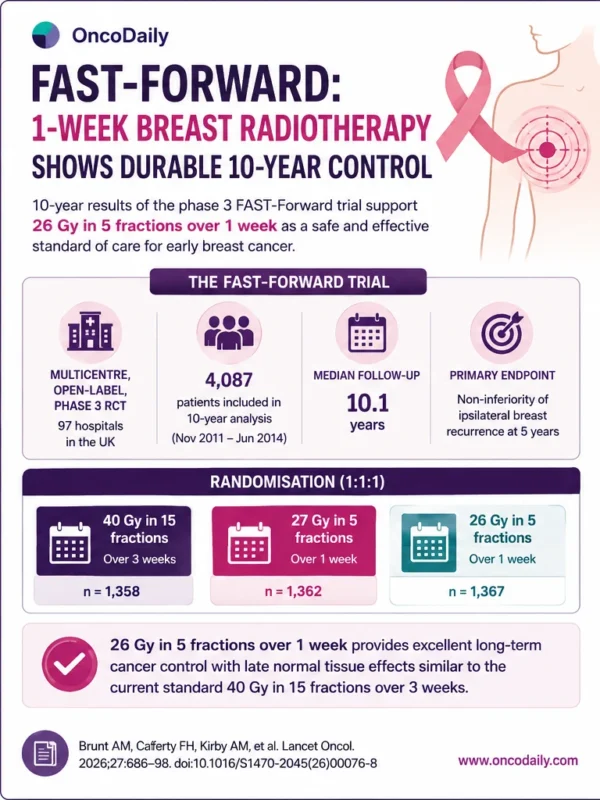
FAST-Forward was a multicenter, open-label, non-inferiority, phase 3 randomized controlled trial conducted across 97 hospitals in the UK, including radiotherapy centers and referring hospitals. Eligible patients were adults with invasive breast carcinoma after breast-conserving surgery or mastectomy, with pT1–3, pN0–1, M0 disease. Patients were randomized to receive 40 Gy in 15 fractions, 27 Gy in 5 fractions, or 26 Gy in 5 fractions to the whole breast or chest wall.
The primary endpoint of the main trial was non-inferiority of ipsilateral breast recurrence at 5 years. The current publication reports the planned 10-year analysis of the main trial, along with 5-year efficacy outcomes from the axillary nodal substudy.
Patient Population And Follow-Up
Between November 2011 and June 2014, 4,110 participants were enrolled in the main FAST-Forward trial. After exclusions for withdrawal of consent, 4,087 participants were included in the intention-to-treat population for the 10-year analysis. Patients were assigned to 40 Gy (n=1,358), 27 Gy (n=1,362), or 26 Gy (n=1,367). Median follow-up was 10.1 years.
This length of follow-up is essential because both breast cancer recurrence and late radiotherapy-related effects can emerge years after treatment. Short-term radiotherapy schedules need long-term validation before they can be considered routine standards of care.
Local Control Remained Excellent At 10 Years
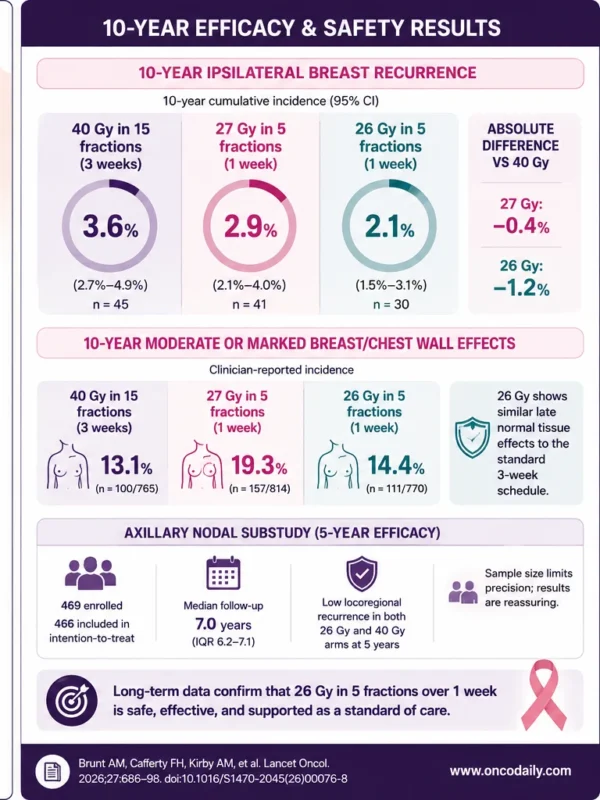
The 10-year efficacy results were reassuring. Ipsilateral breast recurrence occurred in 116 participants overall: 45 in the 40 Gy group, 41 in the 27 Gy group, and 30 in the 26 Gy group.
The 10-year cumulative incidence of ipsilateral breast recurrence was 3.6% with 40 Gy, 2.9% with 27 Gy, and 2.1% with 26 Gy. The estimated absolute difference versus 40 Gy was −0.4% for 27 Gy and −1.2% for 26 Gy.
These results show that both 1-week schedules maintained disease control at 10 years. Importantly, the 26 Gy schedule had numerically lower ipsilateral breast recurrence than the 40 Gy control arm, although the trial’s long-term analysis focused on estimation rather than new formal non-inferiority testing.
Locoregional recurrence was also low. In the main trial, 10-year locoregional recurrence was 4.5% with 40 Gy, 4.0% with 27 Gy, and 3.4% with 26 Gy. Any recurrence rates were also similar across treatment groups, supporting the durability of disease control with the 1-week approach.
The 26 Gy Schedule Had The Best Balance Of Efficacy And Safety
The key distinction between the two 1-week schedules was late normal tissue effect.
At 10 years, clinician-reported moderate or marked breast or chest wall effects occurred in 13.1% of patients in the 40 Gy group, 19.3% in the 27 Gy group, and 14.4% in the 26 Gy group.
This is one of the most clinically relevant findings of the trial. While both 1-week schedules provided strong local control, 27 Gy was associated with more late normal tissue effects, including higher rates of breast shrinkage and induration. By contrast, 26 Gy appeared similar to the 40 Gy standard schedule, making it the preferred 1-week regimen.
The authors’ research context summary states that 10-year moderate or marked patient-reported and clinician-reported breast or chest wall side effects were similar between 40 Gy in 15 fractions and 26 Gy in 5 fractions, while late effects were slightly higher with 27 Gy, suggesting that the 27 Gy schedule is suboptimal.
What About Axillary Radiotherapy?
FAST-Forward also included a nodal substudy evaluating the same schedules in patients requiring axillary radiotherapy. The substudy was smaller and not powered for definitive efficacy conclusions, but the results were reassuring.
In the nodal substudy, 469 participants were enrolled, and 466 were included in intention-to-treat analyses. Median follow-up was 7.0 years. The publication reports that 5-year efficacy results for axillary treatment were consistent with the main trial, with low locoregional recurrence for both 26 Gy in 5 fractions and 40 Gy in 15 fractions.
The authors emphasize that the sample size limits precision for the axillary subgroup, so uncertainty should be discussed during shared decision-making. Still, the data support 26 Gy in 5 fractions as a reasonable option for selected patients requiring axillary radiotherapy, especially when balancing treatment burden and access.
Clinical Meaning
FAST-Forward is a practice-shaping trial because it addresses a question that matters not only for oncologic outcomes but also for patient life.
A 3-week radiotherapy course can be difficult for patients who live far from treatment centers, work full-time, have caregiving responsibilities, or face financial and travel barriers. A safe and effective 1-week schedule can reduce treatment burden while preserving excellent cancer control.
The long-term data now support 26 Gy in 5 fractions over 1 week as a standard adjuvant radiotherapy schedule for the breast or chest wall in early breast cancer. The results are especially important because they provide mature evidence beyond the initial 5-year analysis, confirming that the shorter schedule does not appear to compromise long-term local control or increase late toxicity compared with 40 Gy in 15 fractions.
Key Takeaway
The 10-year FAST-Forward results confirm that 26 Gy in 5 fractions over 1 week is a safe and effective adjuvant radiotherapy schedule for early-stage breast cancer.
At 10 years, ipsilateral breast recurrence remained low with 26 Gy, at 2.1%, compared with 3.6% with 40 Gy in 15 fractions. Late normal tissue effects were also similar between the 26 Gy and 40 Gy schedules, while 27 Gy was associated with more late breast or chest wall effects.
These data support 1-week breast radiotherapy with 26 Gy in 5 fractions as a standard-of-care option for adjuvant treatment to the breast or chest wall, with reassuring but less precise data for axillary radiotherapy.