Treatment selection after progression on endocrine therapy plus a CDK4/6 inhibitor remains a complex part of managing estrogen receptor–positive, HER2-negative advanced breast cancer.
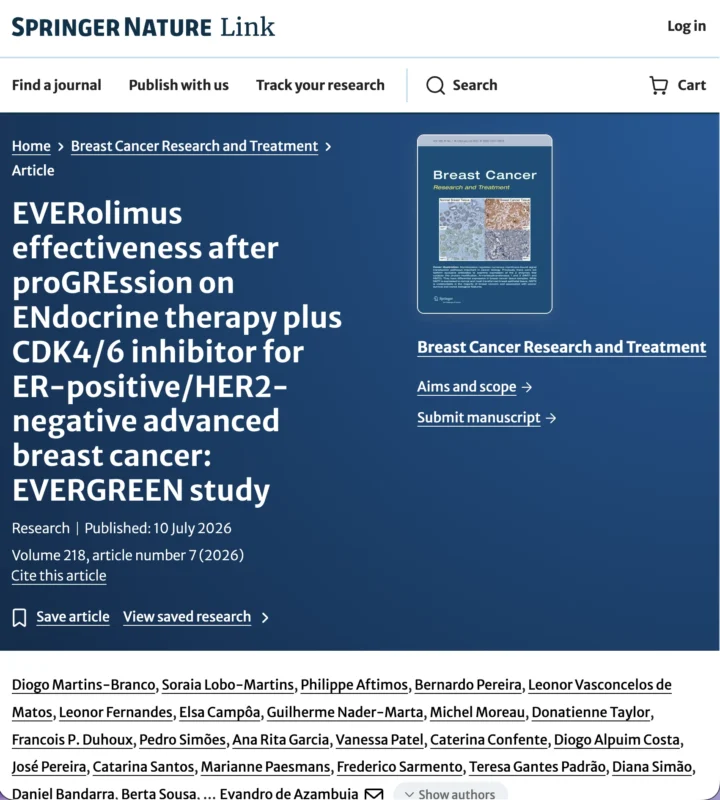
The international EVERGREEN study examined whether adding everolimus to the immediate next line of endocrine therapy could improve outcomes in women whose disease had progressed during CDK4/6 inhibitor–based treatment.
Among 207 women, median real-world progression-free survival was 5.0 months with everolimus plus endocrine therapy compared with 4.3 months with endocrine therapy alone. The adjusted hazard ratio was 0.68, indicating a statistically significant reduction in the risk of progression or death.
However, the absolute difference in median progression-free survival was limited, and the study found no statistically significant improvement in time to chemotherapy or overall survival. The investigators concluded that everolimus produced a modest clinical benefit and that its toxicity profile requires careful assessment of the individual risk–benefit balance (Martins-Branco et al., 2026).
Why Was EVERGREEN Needed?
Everolimus is an oral inhibitor of the mammalian target of rapamycin, or mTOR, pathway. Its role in endocrine-resistant advanced breast cancer was established by the phase 3 BOLERO-2 trial, which compared everolimus plus exemestane with exemestane alone in patients previously treated with nonsteroidal aromatase inhibitors.
BOLERO-2 demonstrated a significant progression-free survival improvement with the addition of everolimus, but the trial was conducted before CDK4/6 inhibitors became widely incorporated into the treatment of ER-positive, HER2-negative advanced breast cancer. The final analysis did not demonstrate a statistically significant overall survival advantage (Baselga et al., 2012; Piccart et al., 2014).
This created an important evidence gap. Results obtained before routine CDK4/6 inhibitor exposure could not automatically establish how effectively everolimus would perform after progression on a CDK4/6 inhibitor and endocrine therapy.
Subsequent published studies have shown that everolimus retains activity in this setting, but most of the evidence has come from prospective cohorts or retrospective real-world analyses rather than randomized comparisons against endocrine therapy alone. EVERGREEN was designed to provide comparative evidence in this post-CDK4/6 population.
How Was the EVERGREEN Study Conducted?
EVERGREEN was a multicentre, international, retrospective quasi-experimental study.
It included women with ER-positive, HER2-negative advanced breast cancer who began an immediate next line of endocrine therapy after progression on a CDK4/6 inhibitor by December 31, 2022.
The investigators compared outcomes according to the standard treatment policy of the participating centres. Patients treated at centres where everolimus plus endocrine therapy was the standard approach formed the everolimus group. Those treated at centres where endocrine therapy alone was standard formed the comparison group.
A total of 207 women were included:
- 150 received everolimus plus endocrine therapy
- 57 received endocrine therapy alone
The primary endpoint was real-world progression-free survival. Secondary endpoints included time to everolimus failure, time to chemotherapy, and overall survival.
Median follow-up was 31.8 months. Baseline characteristics were generally balanced, although patients in the everolimus cohort had received a higher number of previous treatment lines (Martins-Branco et al., 2026).
Did Everolimus Improve Progression-Free Survival?
Median real-world progression-free survival was:
- 5.0 months with everolimus plus endocrine therapy
- 4.3 months with endocrine therapy alone
The adjusted hazard ratio was 0.68, with a 95% confidence interval of 0.47 to 0.99.
The result met statistical significance, but the difference between the median values was 0.7 months.
The hazard ratio and the difference between the medians describe different aspects of the treatment effect. The hazard ratio incorporates progression or death events throughout follow-up, while the median identifies the time at which half of the patients in each group have experienced an event.
Both measures are therefore relevant. In EVERGREEN, they support the interpretation that everolimus provided additional disease control, but that the average magnitude of benefit was modest (Martins-Branco et al., 2026).
Did Everolimus Delay Chemotherapy or Improve Survival?
EVERGREEN found no statistically significant difference between the groups in either time to chemotherapy or overall survival.
Median time to everolimus failure was 4.2 months.
These findings are important because the progression-free survival improvement did not translate into a demonstrated change in the timing of chemotherapy or into longer overall survival within this analysis.
The absence of a statistically significant overall survival difference does not establish that both treatments are equivalent. EVERGREEN was a retrospective, nonrandomized study, and the control group included only 57 patients. Nevertheless, the available results support the investigators’ description of the treatment effect as limited rather than transformative.
How Do the Results Compare With Earlier Studies?
The median real-world progression-free survival of 5.0 months reported with everolimus in EVERGREEN is broadly consistent with several previously published post-CDK4/6 inhibitor studies.
A 2024 prospective study evaluated fulvestrant plus everolimus in 57 patients who had progressed after CDK4/6 inhibitor treatment. Median progression-free survival was 6.8 months. The study also investigated circulating tumour DNA and found that detectable ctDNA at baseline and PIK3CA mutations were associated with poorer outcomes, although these findings were prognostic and did not establish a validated biomarker for selecting everolimus treatment (Vasseur et al., 2024).
A Spanish real-world cohort included 161 patients who received everolimus plus endocrine therapy after CDK4/6 inhibitor progression. Median progression-free survival was 6.0 months. Longer progression-free survival was reported among patients whose previous CDK4/6 inhibitor treatment lasted more than 18 months, those without visceral metastases, and those who had not received chemotherapy for metastatic disease (Sánchez-Bayona et al., 2024).
A separate multicentre retrospective study published in 2025 included 325 patients, of whom 75 had previously received a CDK4/6 inhibitor. Median progression-free survival with everolimus-based therapy was 5.3 months in the CDK4/6-pretreated group, compared with 6.7 months among patients without previous CDK4/6 inhibitor exposure. In the pretreated group, 16% remained progression-free for more than 12 months, showing that a minority experienced prolonged disease control despite the lower overall median benefit (Dutheil et al., 2025).
These studies cannot be directly compared because their designs, populations, treatment partners, previous therapies, and assessment methods differed. Together, however, they consistently place median progression-free survival with everolimus-based therapy after CDK4/6 inhibitor exposure at approximately five to seven months.
Why Is EVERGREEN Different From Earlier Real-World Studies?
Most earlier studies evaluated only patients who received everolimus and described their outcomes without a concurrent endocrine-therapy-alone comparison group.
EVERGREEN compared two centre-level treatment strategies: endocrine therapy plus everolimus and endocrine therapy alone. This provides additional information about the contribution of everolimus beyond the endocrine partner in a contemporary post-CDK4/6 population.
However, the study was not randomized. Treatment exposure was determined by each centre’s standard practice, and unmeasured differences between centres or patients could have influenced the results.
The groups were also unequal in size, and patients receiving everolimus had undergone more previous lines of treatment. Statistical adjustment can reduce the effect of measured differences, but it cannot eliminate all possible confounding in an observational analysis.
What Did the Study Report About Safety?
EVERGREEN reported that the safety profile was consistent with previous experience, but the publicly available abstract did not provide detailed adverse-event rates.
Established everolimus safety findings from earlier published studies include stomatitis, infections, rash, noninfectious pneumonitis, and hyperglycaemia. These adverse events were reported in studies conducted in different treatment settings and should not be interpreted as the specific event rates observed in EVERGREEN.
In the 2025 retrospective cohort reported by Dutheil and colleagues, 28% of the overall study population discontinued everolimus because of toxicity rather than progression or death. That study covered a broader population treated between 2012 and 2022 and was not the EVERGREEN cohort, but its findings illustrate why tolerability remains important when considering a treatment associated with a modest median benefit.
Can Patients Most Likely to Benefit Be Identified?
EVERGREEN supports careful patient selection but does not establish a validated clinical or molecular biomarker that identifies who should receive everolimus.
Other observational studies have reported associations between longer progression-free survival and clinical features such as the absence of liver or visceral metastases, no previous chemotherapy for metastatic disease, better performance status, lower tumour grade, or longer benefit from the preceding CDK4/6 inhibitor.
These associations are hypothesis-generating. They were identified in nonrandomized cohorts and cannot independently prove that these characteristics predict a specific benefit from everolimus rather than reflect a generally more favourable prognosis (Sánchez-Bayona et al., 2024; Dutheil et al., 2025).
The prospective ctDNA study by Vasseur and colleagues also found poorer progression-free and overall survival among patients with detectable baseline ctDNA or PIK3CA mutations. However, the study described these as adverse prognostic factors and did not establish them as validated markers for selecting or excluding everolimus therapy.
What Does EVERGREEN Add to the Evidence?
EVERGREEN provides comparative real-world evidence that adding everolimus to endocrine therapy can improve progression-free survival after CDK4/6 inhibitor progression.
The study also defines the limits of that benefit:
- Median real-world progression-free survival increased by 0.7 months
- The adjusted hazard ratio was 0.68
- Median time to everolimus failure was 4.2 months
- No statistically significant improvement was observed in time to chemotherapy
- No statistically significant overall survival benefit was demonstrated
The findings do not show that everolimus lacks activity. Instead, they indicate that its effectiveness varies and that the overall benefit across the study population was modest.
This conclusion is consistent with earlier published post-CDK4/6 inhibitor cohorts, which reported median progression-free survival of approximately five to seven months while also documenting substantial variation among individual patients.
The Bottom Line
In the international EVERGREEN study, everolimus plus endocrine therapy produced a statistically significant but modest improvement in real-world progression-free survival after progression on endocrine therapy and a CDK4/6 inhibitor.
Median real-world progression-free survival was 5.0 months with everolimus plus endocrine therapy versus 4.3 months with endocrine therapy alone, with an adjusted hazard ratio of 0.68.
The study did not demonstrate statistically significant improvements in time to chemotherapy or overall survival. Its nonrandomized design also means that residual differences between the treatment groups cannot be excluded.
EVERGREEN strengthens the evidence that everolimus remains active after CDK4/6 inhibitor exposure, but it does not support a uniform benefit across all patients. The modest outcome and established toxicity profile reinforce the study authors’ conclusion that treatment decisions require careful evaluation of the expected benefit and risk for each patient.
References
- Martins-Branco D, Lobo-Martins S, Aftimos P, et al. EVERolimus effectiveness after proGREssion on ENdocrine therapy plus CDK4/6 inhibitor for ER-positive/HER2-negative advanced breast cancer: EVERGREEN study. Breast Cancer Research and Treatment. 2026;218:7. doi:10.1007/s10549-026-08012-5.
- Dutheil J, Pereira V, Boisson C, et al. Efficacy of everolimus in patients with hormone receptor-positive, HER2-negative metastatic breast cancer pretreated with CDK4/6 inhibitors. Breast Cancer Research. 2025;27:220. doi:10.1186/s13058-025-02109-3.
- Vasseur A, Cabel L, Hego C, et al. Fulvestrant and everolimus efficacy after CDK4/6 inhibitor: a prospective study with circulating tumour DNA analysis. Oncogene. 2024;43:1214–1222. doi:10.1038/s41388-024-02986-6.
- Sánchez-Bayona R, Lopez de Sa A, Jerez Gilarranz Y, et al. Everolimus plus endocrine therapy beyond CDK4/6 inhibitor progression for HR-positive/HER2-negative advanced breast cancer: a real-world evidence cohort. Breast Cancer Research and Treatment. 2024;206:551–559. doi:10.1007/s10549-024-07324-8.
- Baselga J, Campone M, Piccart M, et al. Everolimus in postmenopausal hormone-receptor-positive advanced breast cancer. New England Journal of Medicine. 2012;366:520–529. doi:10.1056/NEJMoa1109653.
- Piccart M, Hortobagyi GN, Campone M, et al. Everolimus plus exemestane for hormone-receptor-positive, HER2-negative advanced breast cancer: overall survival results from BOLERO-2. Annals of Oncology. 2014;25:2357–2362.