






The European Society for Medical Oncology has released an updated ESMO Clinical Practice Guideline for metastatic breast cancer, published in Annals of Oncology as an article in press. The guideline, led by E. de Azambuja, C.H. Barrios, R. Bartsch, G. Curigliano, R. Dent, A. Gennari, S. Loi, S. Paluch-Shimon, B. Pistilli, C. Saura, P. Schmid, T. Spanic, M. Toi, S.M. Tolaney, and N. Harbeck on behalf of the ESMO Guidelines Committee, supersedes the 2021 version and reflects the rapidly changing treatment landscape in metastatic breast cancer.
The updated guideline provides recommendations and treatment algorithms for diagnosis, staging, molecular testing, systemic therapy, site-specific management, monitoring, survivorship, and the patient perspective. It also integrates ESMO-MCBS scores, ESCAT scores, and levels of evidence to support treatment prioritization in clinical practice.
Why This Guideline Matters
Metastatic breast cancer is no longer managed a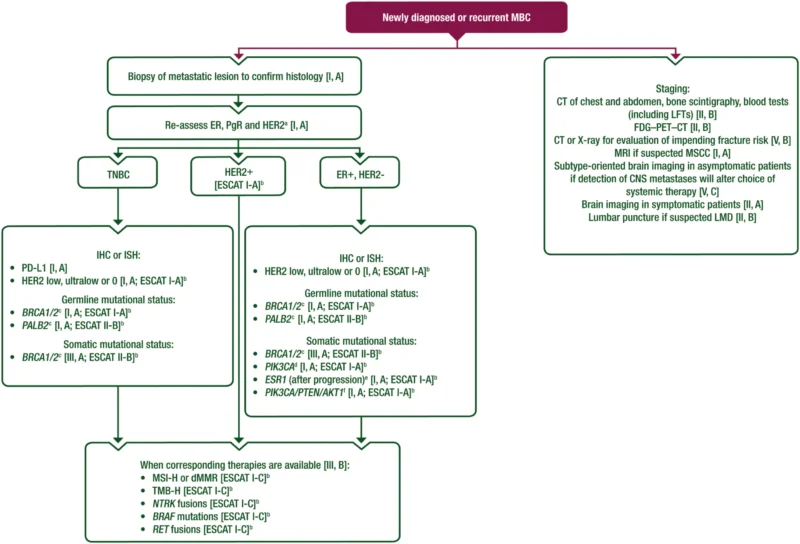 s one disease. Treatment decisions now depend on receptor status, genomic alterations, prior therapy exposure, disease tempo, metastatic sites, patient preferences, and access to specific agents.
The new ESMO guideline reflects this complexity. It emphasizes that care must begin with accurate reassessment of disease biology, followed by subtype-specific treatment selection. In clinical practice, this means the first step is not simply choosing a drug. It is confirming the biology of the metastatic disease and identifying actionable targets that can guide therapy.
The guideline also reinforces shared decision-making. ESMO states that all recommendations need to be discussed with patients in a shared decision-making approach, highlighting that metastatic breast cancer care must balance survival benefit, toxicity, quality of life, and personal goals.
Diagnosis Starts With Re-Biopsy And Receptor Reassessment
A major recommendation is that, at first diagnosis of metastatic breast cancer, biopsy should be performed when feasible to confirm histology and reassess tumor biology, including estrogen receptor, progesterone receptor, and HER2 status. If receptor status differs between the primary tumor and the recurrence, patients can generally be managed according to the receptor status of the recurrent disease biopsy.
This is clinically important because receptor conversion can change treatment strategy. A tumor initially classified as HER2-negative may later show HER2-low or HER2-positive biology. Similarly, hormone receptor status may change, affecting the role of endocrine therapy.
The guideline also recommends PD-L1 testing in metastatic triple-negative breast cancer and germline BRCA1/2 and PALB2 testing in HER2-negative metastatic disease when specific treatments are available. Somatic BRCA1/2 testing is also recommended in HER2-negative disease if treatment options depend on the result.
Molecular Testing Becomes Central In ER-Positive/HER2-Negative Disease
For ER-positive, HER2-negative metastatic breast cancer, the guideline gives a clear role to molecular testing. Evaluation of PIK3CA mutations is recommended if PI3K inhibitors are available. Evaluation of ESR1 mutations using circulating tumor DNA or tumor tissue is recommended after progression on an aromatase inhibitor with or without a CDK4/6 inhibitor. Testing for PIK3CA pathway alterations, including PIK3CA, PTEN, and AKT1, is recommended mainly in the endocrine-resistant setting when specific treatments are available.
This reflects how ER-positive metastatic breast cancer treatment has shifted from broad endocrine sequencing to increasingly biomarker-selected therapy. ESR1 mutation testing now informs use of oral SERDs such as elacestrant or imlunestrant, while PIK3CA, AKT1, and PTEN alterations can guide targeted combinations.
The guideline also recommends reassessing HER2 status as HER2-low, HER2-ultralow, or HER2-0 in patients who are not candidates for endocrine therapy, because HER2 expression level can influence antibody-drug conjugate selection.
First-Line ER-Positive/HER2-Negative Disease: CDK4/6 Inhibitors Remain Core
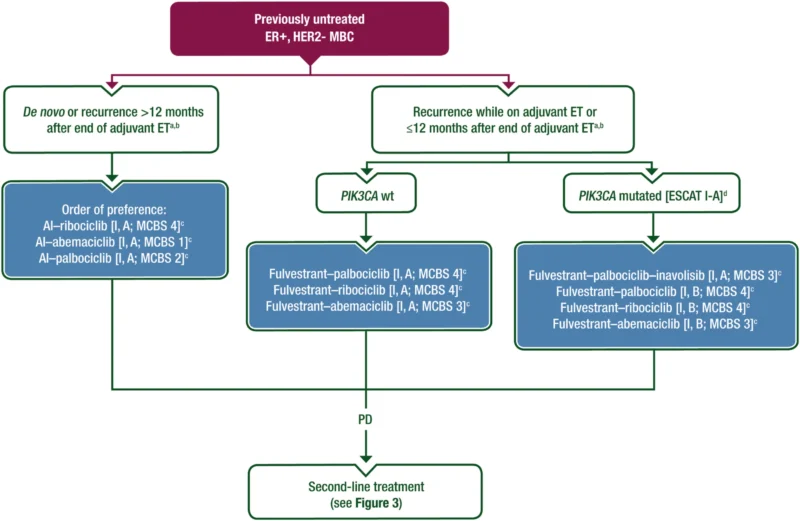
For patients with de novo ER-positive, HER2-negative metastatic breast cancer or recurrence more than 12 months after adjuvant endocrine therapy, ESMO recommends an aromatase inhibitor plus a CDK4/6 inhibitor. The guideline lists AI–ribociclib first by preference, followed by AI–abemaciclib and AI–palbociclib.
For patients who recur while on adjuvant endocrine therapy or within 12 months of completing it, fulvestrant plus a CDK4/6 inhibitor is recommended in PIK3CA-wild-type disease. In PIK3CA-mutated disease, the guideline recommends fulvestrant–palbociclib–inavolisib, while fulvestrant plus a CDK4/6 inhibitor remains an option.
The guideline also emphasizes ovarian function suppression or ablation for premenopausal and perimenopausal women receiving endocrine-based therapy.
After Progression: Targeted Therapy Before Chemotherapy When Appropriate
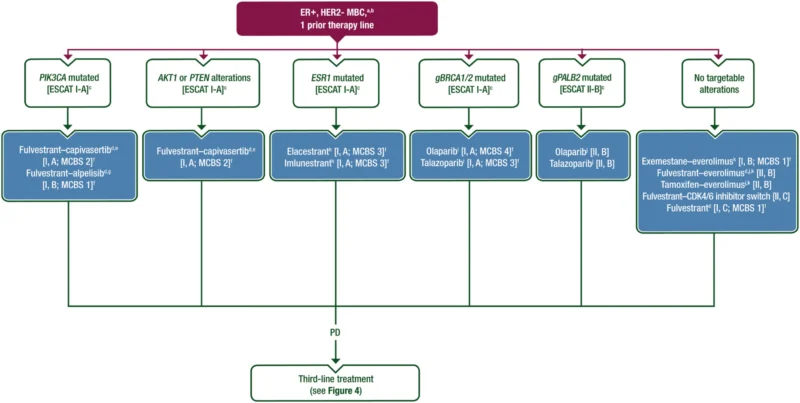
In second-line ER-positive/HER2-negative disease, ESMO recommends selecting therapy based on disease aggressiveness, extent of disease, organ function, prior endocrine sensitivity, molecular profile, and toxicity. Fulvestrant–capivasertib is recommended for tumors with PIK3CA, AKT1, or PTEN alterations after progression during or after aromatase inhibitor therapy. Fulvestrant–alpelisib can be recommended for PIK3CA-mutated tumors in selected patients.
For ESR1-mutated metastatic breast cancer after at least one line of endocrine therapy, elacestrant or imlunestrant are recommended, preferably in patients who had a prolonged response to prior CDK4/6 inhibitor therapy.
PARP inhibitors are recommended for germline BRCA1/2-mutated disease, with olaparib and talazoparib listed as options. The guideline also supports PARP inhibitor use in germline PALB2-mutated disease and somatic BRCA1/2-mutated tumors in selected settings, although some of these indications are not EMA or FDA approved.
ADCs Move Further Into ER-Positive Metastatic Breast Cancer
The updated guideline reflects the growing role of antibody-drug conjugates in ER-positive, HER2-negative metastatic breast cancer.
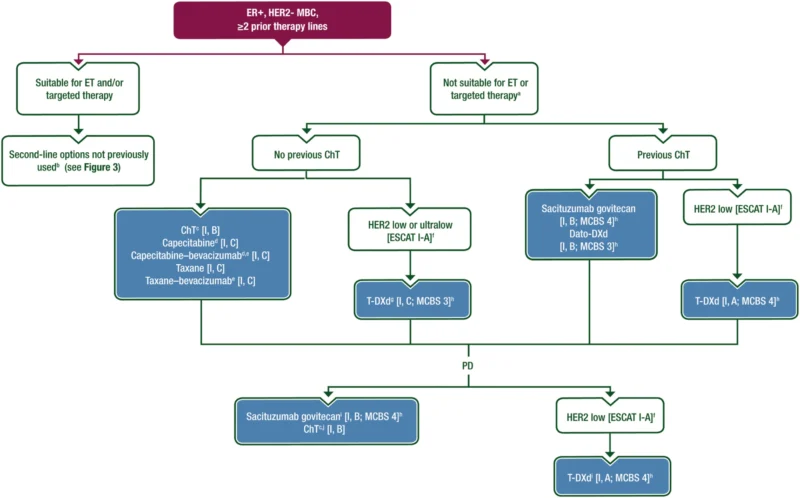
For patients who have previously received chemotherapy, sacituzumab govitecan is recommended after at least one prior line of chemotherapy, and datopotamab deruxtecan is also recommended after at least one prior chemotherapy line. Trastuzumab deruxtecan is recommended for HER2-low metastatic breast cancer after at least one prior line of chemotherapy if not already used.
For patients who have not yet received chemotherapy, trastuzumab deruxtecan may be considered for HER2-low or HER2-ultralow disease after at least two lines of endocrine therapy for metastatic disease, or earlier in patients with endocrine-resistant disease patterns.
This is one of the clearest signs that metastatic breast cancer treatment is being reshaped by HER2 expression beyond the traditional HER2-positive category.
HER2-Positive Disease: T-DXd And Tucatinib Are Central Across Lines
For HER2-positive metastatic breast cancer, ESMO continues to recommend docetaxel–pertuzumab–trastuzumab as a first-line option regardless of ER status. The guideline also recommends trastuzumab deruxtecan plus pertuzumab as a first-line option, noting regulatory differences between FDA and EMA approval.
After progression on taxane–trastuzumab, trastuzumab deruxtecan is the preferred second-line option when available, regardless of the presence of brain metastases, if not used in the first-line setting. Tucatinib–trastuzumab–capecitabine is also recommended in the second line, and T-DM1 remains recommended if trastuzumab deruxtecan is not available.
The guideline also addresses intracranial progression. For patients with intracranial progression without extracranial progression, local treatment of brain metastases and continuation of the same anti-HER2 treatment can be recommended.
Triple-Negative Breast Cancer: PD-L1, BRCA, And ADCs Guide Treatment
For metastatic triple-negative breast cancer, immune checkpoint inhibitor plus chemotherapy is the preferred option for PD-L1-positive disease. ESMO recommends pembrolizumab–sacituzumab govitecan for patients with PD-L1 CPS ≥10 and disease-free interval of at least 6 months after adjuvant treatment, while pembrolizumab plus chemotherapy remains recommended for the same PD-L1 CPS ≥10 group. Atezolizumab–nab-paclitaxel is recommended for patients with immune cell PD-L1 positivity of at least 1% and disease-free interval of at least 12 months after adjuvant treatment, with regulatory caveats.
For germline BRCA1/2-mutated, PD-L1-negative metastatic TNBC, olaparib, talazoparib, or carboplatin-based chemotherapy are recommended. For germline BRCA1/2-wild-type and PD-L1-negative disease, or for patients who are not candidates for immunotherapy, treatment depends on prior exposure, disease-free interval, disease presentation, and patient considerations. In this group, datopotamab deruxtecan or sacituzumab govitecan are recommended for most patients if available.
In later lines, sacituzumab govitecan is the preferred recommended option if not used previously, and trastuzumab deruxtecan can be recommended as a third-line option in HER2-low metastatic TNBC.
Brain Metastases: Local Therapy And Systemic Selection Need Integration
The guideline provides detailed recommendations for brain metastases and leptomeningeal disease. ESMO recommends brain imaging for symptomatic patients, with MRI as the preferred technique. Routine brain imaging is not recommended for asymptomatic patients at initial metastatic diagnosis or during monitoring, although subtype-oriented brain imaging may be considered if detection of CNS disease would change systemic therapy choice, particularly in HER2-positive disease and TNBC.
For brain metastases, stereotactic radiotherapy is recommended over whole-brain radiotherapy. The guideline also states that simultaneous administration of stereotactic radiotherapy and ADCs cannot be recommended.
In HER2-positive breast cancer with brain metastases, trastuzumab deruxtecan is recommended as the preferred second-line option, with tucatinib–trastuzumab–capecitabine recommended if trastuzumab deruxtecan is not available or not indicated.
Monitoring Should Be Individualized, Not Intensified Without Evidence
The guideline recommends CT of the chest and abdomen and bone scintigraphy as minimum baseline imaging work-up, with blood tests including liver function tests. FDG-PET/CT can also be recommended. An interval of 4 weeks or less between baseline imaging and treatment initiation can be recommended, and the same imaging modality used at baseline should generally be used for disease monitoring.
Treatment response evaluation is recommended every 2–4 months depending on symptoms, disease dynamics, metastatic burden, location, and treatment type. Importantly, ESMO states that shortening monitoring intervals cannot be recommended because there is no evidence of an overall survival benefit and there is potential for emotional and financial harm.
This is a practical and patient-centered recommendation. More frequent scans may feel reassuring, but without evidence of benefit, they can add anxiety, cost, radiation exposure, and logistical burden.
Survivorship And Quality Of Life Are Part Of Metastatic Care
The guideline places strong emphasis on supportive care and survivorship. ESMO recommends a multidisciplinary approach, including specialized oncology nurses to proactively identify and manage patient needs and treatment-emergent toxicities. Patients should receive detailed information about treatment options, potential side effects, and side-effect management.
Electronic patient-reported outcomes are recommended to help assess side effects, and quality-of-life assessments should be incorporated into treatment efficacy evaluations. Proactive symptom management, patient education, sexual health care, management of genitourinary symptoms, fertility counseling, and contraception counseling are also included.
This is a critical point. In metastatic breast cancer, treatment success is not measured only by radiographic response or progression-free survival. It must also include symptom control, toxicity burden, daily function, and patient-defined goals.
Key Takeaway
The 2026 ESMO Clinical Practice Guideline for metastatic breast cancer reflects a rapidly evolving field in which treatment is increasingly defined by biology, biomarkers, disease subtype, prior therapy, metastatic site, and patient priorities.
The guideline reinforces biopsy and receptor reassessment at metastatic diagnosis, expands the role of molecular testing, clarifies subtype-specific systemic therapy sequencing, integrates ADCs across HER2-positive, HER2-low, ER-positive, and TNBC settings, and places greater emphasis on brain metastases, oligometastatic disease, monitoring, survivorship, and shared decision-making.
For clinicians, the message is clear: metastatic breast cancer care in 2026 is no longer a linear treatment pathway. It is a dynamic, molecularly informed, patient-centered strategy that must adapt as the disease and therapeutic landscape evolve.
