
The story of HER2-targeted treatment began in breast cancer.
For decades, HER2 status has helped guide therapy across early and metastatic HER2-positive disease. It has shaped the use of trastuzumab, pertuzumab, antibody–drug conjugates, tyrosine kinase inhibitors, and treatment sequencing strategies that have substantially changed outcomes for many patients.
More recently, breast cancer has also shown that HER2 cannot always be understood as a simple positive-or-negative marker. The emergence of HER2-low and HER2-ultralow disease has expanded the role of HER2-directed antibody–drug conjugates and reshaped the way clinicians think about target expression, tumor heterogeneity, and biomarker-driven care.
Now, that shift is extending beyond breast cancer.
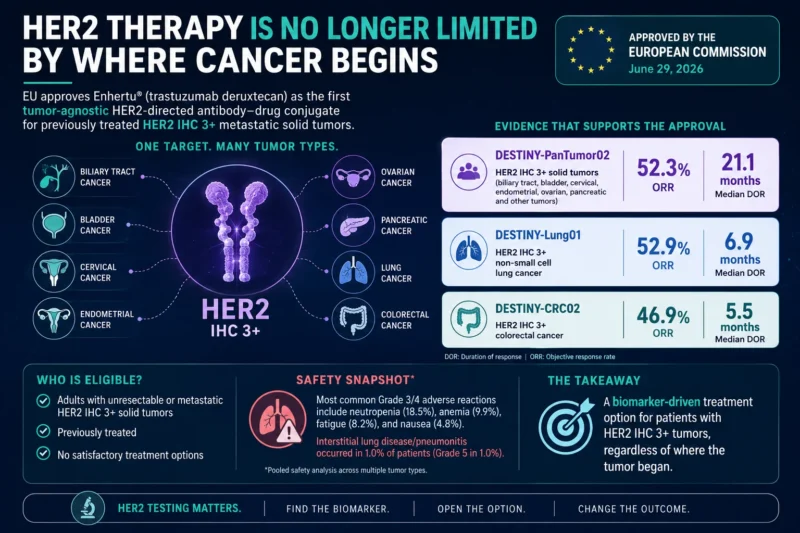
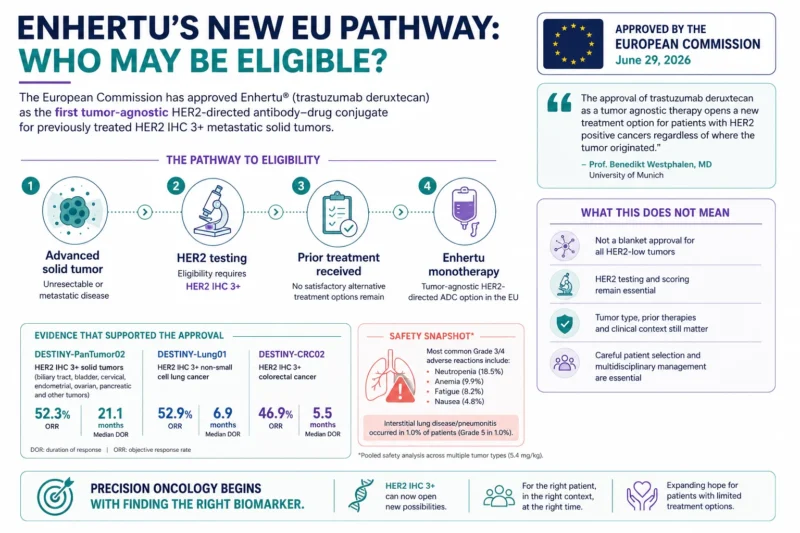
The European Commission has approved Enhertu (trastuzumab deruxtecan) as monotherapy for adults with unresectable or metastatic HER2-positive solid tumors, defined as immunohistochemistry IHC 3+, who have received prior treatment and have no satisfactory treatment options.
The approval establishes the first tumor-agnostic HER2-directed therapy and antibody–drug conjugate indication in the European Union.
It represents an important move toward a model of oncology in which treatment eligibility can be defined not only by where a cancer originated, but also by a shared molecular feature.
What Does the New EU Approval Cover?
The new European indication applies to adults with:
- Unresectable or metastatic solid tumors
- HER2-positive disease, specifically IHC 3+ expression
- Prior systemic treatment exposure
- No satisfactory remaining treatment options
The indication is tumor-agnostic. Eligibility is based on high HER2 protein overexpression rather than on a specific primary tumor site.
This may create a new treatment option for selected patients with HER2-positive malignancies such as biliary tract, bladder, cervical, colorectal, endometrial, ovarian, pancreatic, and lung cancers.
However, the scope of the approval is specific.
It is not a broad indication for all HER2-expressing cancers. It is not a tumor-agnostic approval for HER2-low disease. The criterion is HER2 IHC 3+.
That distinction will be central to clinical implementation.
Why Is This an Important Development?
HER2 overexpression occurs across multiple solid tumors, but HER2 testing and HER2-directed treatment have historically been developed unevenly across cancer types.
In breast and gastric cancer, HER2 testing is embedded in routine clinical decision-making. In other tumors, including gynecologic, biliary, colorectal, and pancreatic cancers, HER2 assessment may be less consistent or used mainly in selected molecular-testing pathways.
The new approval changes the implications of a HER2 IHC 3+ result.
For a patient with heavily pretreated metastatic disease and limited treatment alternatives, HER2 overexpression may now represent an actionable treatment feature regardless of the organ in which the tumor began.
This is particularly relevant in rare cancers and later-line settings, where therapeutic options are often limited and where a broad genomic or biomarker workup can identify clinically meaningful opportunities.
What Is Enhertu?
Enhertu is the brand name for trastuzumab deruxtecan, a HER2-directed antibody–drug conjugate.
The treatment combines a HER2-targeted monoclonal antibody with a topoisomerase I inhibitor payload, known as DXd, linked through a cleavable linker.
After binding to HER2 on the surface of cancer cells, the ADC is internalized. The cytotoxic payload is then released intracellularly, where it can induce DNA damage and cell death.
This platform has already become established in multiple breast cancer settings, including HER2-positive and HER2-low metastatic disease. It is also used in other HER2-driven malignancies, including gastric cancer and HER2-mutant non-small cell lung cancer.
The new tumor-agnostic approval builds on the same principle: high HER2 expression can serve as a treatment target across different tumor histologies.
Which Studies Supported the Approval?
The European Commission decision was based on HER2 IHC 3+ subgroup results from three phase 2 studies:
- DESTINY-PanTumor02
- DESTINY-Lung01
- DESTINY-CRC02
These were not randomized, tumor-agnostic phase 3 trials. Instead, they were phase 2 studies that evaluated trastuzumab deruxtecan across selected HER2-expressing tumor cohorts.
The evidence therefore supports clinically meaningful activity in a biomarker-defined population, but it does not establish direct superiority over disease-specific standard treatments in every tumor type.
DESTINY-PanTumor02: A Broad Signal Across Multiple Tumor Types
DESTINY-PanTumor02 was a global, multicenter, open-label phase 2 study evaluating trastuzumab deruxtecan in previously treated HER2-expressing solid tumors.
The study enrolled patients with several malignancies, including biliary tract, bladder, cervical, endometrial, ovarian, pancreatic, and other cancers.
Among 111 patients with HER2 IHC 3+ tumors, trastuzumab deruxtecan produced a confirmed objective response rate of 52.3%.
The median duration of response was 21.1 months.
The duration-of-response result is particularly notable. In a heavily pretreated population, achieving a response is important, but sustained disease control is often equally relevant. A median response duration approaching two years suggests that some patients may derive prolonged benefit.
Still, results should be interpreted in the context of a single-arm phase 2 cohort. The study was not designed to compare trastuzumab deruxtecan directly with chemotherapy, targeted therapy, or other standards in each individual cancer type.
DESTINY-Lung01: HER2 IHC 3+ Non-Small Cell Lung Cancer
DESTINY-Lung01 evaluated trastuzumab deruxtecan in patients with unresectable or metastatic non-small cell lung cancer with HER2 overexpression or HER2 mutations.
For the tumor-agnostic EU approval, the relevant subgroup included 17 patients with centrally confirmed HER2 IHC 3+ non-small cell lung cancer.
The confirmed objective response rate was 52.9%.
Median duration of response was 6.9 months.
The subgroup was small, which limits precision. However, the result supports the broader observation that high HER2 protein expression can identify a treatment-responsive subset outside traditional HER2-driven cancer pathways.
It should also be distinguished from HER2-mutant non-small cell lung cancer, which is biologically and clinically different from HER2 overexpression.
DESTINY-CRC02: HER2 IHC 3+ Metastatic Colorectal Cancer
DESTINY-CRC02 evaluated two dose levels of trastuzumab deruxtecan in previously treated HER2-positive metastatic colorectal cancer.
Among 64 patients with centrally confirmed HER2 IHC 3+ colorectal cancer, the confirmed objective response rate was 46.9%.
Median duration of response was 5.5 months.
HER2-positive colorectal cancer has become an increasingly relevant molecular subgroup, particularly in patients whose disease has progressed after standard chemotherapy and biologic treatment. The approval provides an additional treatment pathway for patients meeting the specific HER2 IHC 3+ criterion.
As with the other supporting cohorts, the clinical context remains important. HER2 status does not replace the need to consider RAS, BRAF, prior therapies, performance status, disease burden, and other molecular features.
Why Is HER2 IHC 3+ the Key Eligibility Threshold?
The approval is deliberately defined by high HER2 expression.
HER2 IHC 3+ indicates strong, complete membrane staining in tumor cells. In general, this represents the highest category of HER2 protein overexpression and is associated with a greater likelihood of effective target engagement by HER2-directed agents.
The distinction matters because HER2 biology differs across tumor types.
In breast cancer, trastuzumab deruxtecan has demonstrated activity in HER2-low disease, creating a treatment role for IHC 1+ and IHC 2+/ISH-negative tumors in specific breast cancer settings.
That evidence cannot automatically be applied to all solid tumors.
The EU tumor-agnostic indication is not a HER2-low indication. It is specifically for HER2 IHC 3+ metastatic solid tumors after prior treatment when no satisfactory alternatives remain.
This means accurate pathology assessment will be essential.
What Does This Mean for HER2 Testing?
The approval increases the clinical importance of HER2 testing beyond breast, gastric, and selected lung cancer settings.
For some tumor types, HER2 assessment is already part of established molecular pathways. For others, it may not be routinely ordered unless there is a specific clinical reason.
The new indication may encourage broader consideration of HER2 testing in patients with advanced solid tumors, especially when standard treatment options have been exhausted.
However, biomarker testing should not be viewed as a simple checkbox.
Clinicians and pathologists will need to consider:
- The appropriate timing of testing
- Tissue adequacy and tumor heterogeneity
- IHC scoring standards
- Potential discordance between primary and metastatic tissue
- Whether repeat testing is needed after progression
- The relationship between HER2 status and other relevant genomic alterations
The central message is not that every patient should receive every test at every stage. It is that HER2 IHC 3+ now has broader treatment implications than before.
Safety Considerations Remain Essential
Trastuzumab deruxtecan has an established safety profile that requires close monitoring.
In pooled safety data across multiple tumor types, grade 3 or 4 adverse reactions included:
- Neutropenia: 18.5%
- Anemia: 9.9%
- Fatigue: 8.2%
- Leukopenia: 5.8%
- Thrombocytopenia: 5.2%
- Nausea: 4.8%
- Lymphopenia: 4.2%
- Hypokalemia: 3.6%
- Increased transaminases: 3.6%
Interstitial lung disease and pneumonitis remain among the most clinically important toxicities associated with trastuzumab deruxtecan.
Grade 5 adverse reactions occurred in 1.1% of patients in the pooled analysis, including fatal interstitial lung disease or pneumonitis in 1.0%.
This risk requires careful patient selection and proactive toxicity management.
New respiratory symptoms, including cough, dyspnea, fever, or unexplained oxygen desaturation, should prompt early evaluation. Treatment interruption, imaging, pulmonary assessment, and corticosteroid use may be necessary depending on the clinical situation and toxicity grade.
The expansion of trastuzumab deruxtecan into additional tumor types also means that clinicians outside traditional breast cancer treatment settings will need familiarity with its specific safety considerations.
What Are the Main Limitations of the Evidence?
The approval is clinically important, but several questions remain.
The supporting evidence comes from phase 2 studies, and some tumor-specific cohorts were small. The studies were primarily single-arm, meaning there were no direct randomized comparisons with standard treatment options.
Response rates and response duration also varied substantially by tumor type.
This is expected. A shared biomarker does not make every tumor biologically identical.
The future development of tumor-agnostic HER2 therapy will need to clarify:
- Which tumor types derive the greatest benefit
- How trastuzumab deruxtecan should be sequenced after prior therapy
- Whether HER2 heterogeneity influences response
- The role of HER2 gene amplification, mutation, and protein expression
- Whether additional biomarkers can better predict benefit
- How to manage treatment resistance after HER2-directed ADC exposure
The current approval answers an important access question. It does not resolve every treatment-selection question.
What Does This Mean for Breast Cancer?
Breast cancer remains central to the Enhertu story.
It was in breast cancer that the therapeutic potential of HER2-directed ADCs became widely established. It was also in breast cancer that HER2-low disease became clinically actionable.
The EU’s tumor-agnostic approval does not change breast cancer-specific treatment pathways. It does not replace existing breast cancer indications or alter the criteria for HER2-positive, HER2-low, or HER2-ultralow breast cancer.
But it reinforces a broader lesson from breast oncology: biomarkers can evolve.
HER2 began as a breast cancer target. It has become a treatment-defining feature in gastric cancer, lung cancer, colorectal cancer, and now a wider range of HER2 IHC 3+ solid tumors.
The Bottom Line
Enhertu is now approved in the European Union as a tumor-agnostic monotherapy for adults with previously treated, unresectable or metastatic HER2 IHC 3+ solid tumors who have no satisfactory treatment options.
The decision is supported by phase 2 data showing confirmed objective response rates of:
- 52.3% in HER2 IHC 3+ tumors in DESTINY-PanTumor02
- 52.9% in HER2 IHC 3+ non-small cell lung cancer in DESTINY-Lung01
- 46.9% in HER2 IHC 3+ colorectal cancer in DESTINY-CRC02
For patients with advanced cancer, the approval creates a new biomarker-defined treatment path.
For oncology, it is another step away from organ-based treatment silos and toward precision medicine guided by the molecular features that cancers share.