
For more than a decade, the first-line treatment of HER2-positive metastatic breast cancer has been anchored by the combination of a taxane, trastuzumab and pertuzumab. That standard has now changed in Europe.
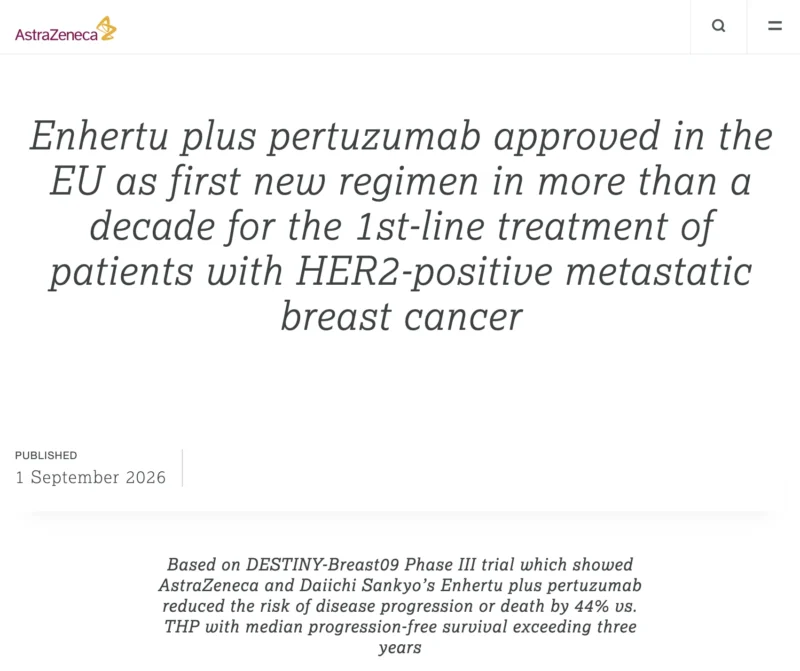
On September 1, 2026, the European Commission approved trastuzumab deruxtecan (Enhertu) plus pertuzumab for the first-line treatment of adults with unresectable or metastatic HER2-positive breast cancer. The decision is based on the phase III DESTINY-Breast09 trial and represents the first new first-line regimen approved in the European Union for this population in more than a decade.
The magnitude of progression-free survival improvement is substantial. In DESTINY-Breast09, trastuzumab deruxtecan plus pertuzumab reduced the risk of disease progression or death by 44% compared with taxane, trastuzumab and pertuzumab (THP).
Median PFS by blinded independent central review reached 40.7 months versus 26.9 months, respectively:
- HR 0.56; 95% CI, 0.44–0.71; P<.00001.
For a disease in which THP has defined first-line care for more than a decade, a median PFS exceeding three years represents more than an incremental change.
It signals a fundamental repositioning of antibody-drug conjugates in HER2-positive metastatic breast cancer, from treatment after progression to treatment at the very beginning of metastatic disease.
From CLEOPATRA to DESTINY-Breast09
The trastuzumab–pertuzumab–taxane strategy transformed HER2-positive metastatic breast cancer and established dual HER2 blockade as the first-line standard. But despite major improvements in outcomes, progression remained expected for most patients.
The source notes that most patients treated with first-line THP historically experience progression within approximately two years, and that roughly one in three patients may never reach a subsequent treatment line because of progression or death. This is why first-line therapy matters disproportionately.
The earlier an effective therapy is introduced, the greater the proportion of patients who can actually receive it. DESTINY-Breast09 challenges the traditional sequencing model by moving trastuzumab deruxtecan, already established in later-line HER2-positive disease, directly into first line.
The result is a clinically striking extension of disease control. 40.7 months of median PFS versus 26.9 months with THP means an absolute difference approaching 14 months.
That changes the first-line benchmark.
Why the Combination Makes Biological Sense
Trastuzumab deruxtecan (Enhertu) is a HER2-directed antibody-drug conjugate composed of a HER2 monoclonal antibody linked to a topoisomerase I inhibitor payload through a cleavable linker.
Pertuzumab, meanwhile, provides complementary HER2 blockade. The combination therefore joins two distinct therapeutic concepts:
- potent ADC-mediated intracellular cytotoxic delivery
with
- continued extracellular HER2 pathway blockade.
The clinical result suggests that HER2-positive metastatic disease may benefit from beginning treatment with one of the most active available HER2-directed ADCs rather than reserving it for later progression. That represents an important philosophical shift in sequencing.
Historically, highly active agents were often preserved for later lines. Increasingly, modern oncology asks a different question: If the most effective therapy is available, why wait until the disease has already demonstrated resistance?
DESTINY-Breast09 provides powerful evidence in support of earlier ADC use in HER2-positive metastatic breast cancer.
DESTINY-Breast09 Was a Large Global Phase III Trial
DESTINY-Breast09 enrolled 1,157 patients across Africa, Asia, Europe, North America and South America.
Patients had HER2-positive metastatic breast cancer and had not received prior chemotherapy or HER2-targeted treatment for metastatic disease. Patients who had previously received neoadjuvant or adjuvant HER2-directed therapy could participate if more than six months had elapsed before development of advanced or metastatic disease.
Participants were randomized 1:1:1 to:
- trastuzumab deruxtecan (Enhertu) plus pertuzumab,
- trastuzumab deruxtecan (Enhertu) monotherapy with a pertuzumab-matching placebo,
- or standard THP.
Randomization was stratified according to de novo versus recurrent metastatic disease, hormone receptor status and PIK3CA mutation status. The primary endpoint is BICR-assessed PFS for both trastuzumab deruxtecan (Enhertu) -containing arms.
Importantly, the trastuzumab deruxtecan (Enhertu) monotherapy comparison remains blinded and is continuing to its final PFS analysis. That detail is highly relevant.
We now know that trastuzumab deruxtecan (Enhertu) plus pertuzumab outperforms THP. We do not yet know from this source whether pertuzumab is necessary to achieve the full first-line benefit of trastuzumab deruxtecan(Enhertu) .
That may become one of the most interesting unresolved questions from DESTINY-Breast09.
The 44% Reduction in Progression Risk Changes the First-Line Discussion
The headline result deserves careful interpretation. The hazard ratio of 0.56 represents a 44% relative reduction in the risk of progression or death compared with THP.
But the absolute difference is also clinically meaningful. Median PFS increased from 26.9 months to 40.7 months. That means median disease control now extends beyond three years with the experimental regimen.
In metastatic breast cancer, where every progression potentially reduces future treatment options and functional reserve, delaying progression by this magnitude may have consequences beyond the first treatment line.
Longer initial disease control may:
- preserve performance status,
- delay exposure to subsequent systemic therapies,
- reduce cumulative treatment transitions,
- potentially allow more patients to remain clinically well for longer.
The ultimate impact on overall survival, however, remains an important consideration, and this press release does not provide mature comparative OS results.
The PFS result is sufficiently strong to support regulatory approval, but long-term survival data will remain important in defining the full clinical value of the strategy.
The Approval Applies Regardless of Hormone Receptor Status
The European approval is for adults with unresectable or metastatic HER2-positive breast cancer, rather than being restricted according to hormone receptor status.
The source also notes that the trastuzumab deruxtecan–pertuzumab combination has been incorporated into the ESMO Clinical Practice Guidelines as a Category IA first-line treatment option regardless of HR status. This is important because HER2-positive breast cancer is biologically heterogeneous.
HR-positive/HER2-positive disease and HR-negative/HER2-positive disease may differ in endocrine sensitivity and biological behavior, but HER2 remains the dominant therapeutic driver of the metastatic first-line strategy.
DESTINY-Breast09 reinforces that HER2-directed ADC therapy can occupy the first-line position across that spectrum.
Safety Will Remain Central When Moving an ADC Into First Line
The source reports that the safety profile of trastuzumab deruxtecan plus pertuzumab was consistent with the known safety profiles of the individual agents, with no new safety concerns identified.
That is reassuring, but first-line use changes the context in which toxicity is evaluated. Patients may now potentially remain on trastuzumab deruxtecan-based therapy for years. Therefore, cumulative tolerability becomes especially important.
When an ADC moves from later lines into first line, treatment decisions are no longer simply about maximizing response in heavily pretreated disease. They must also account for the feasibility of prolonged therapy. The benefit-risk assessment therefore becomes increasingly focused on long-term disease control with sustainable toxicity management.
The current source does not provide a detailed adverse-event breakdown, so conclusions beyond the reported absence of new safety signals should wait for the complete trial dataset and publication.
Is Pertuzumab Necessary?
This may ultimately become one of the most important scientific questions arising from DESTINY-Breast09. The trial included a third arm evaluating trastuzumab deruxtecan without active pertuzumab. That arm remains blinded and is continuing to its final PFS analysis.
Therefore, the current approval answers one question:
Is trastuzumab deruxtecan plus pertuzumab superior to THP?
Yes.
But another question remains:
How much of that benefit comes from trastuzumab deruxtecan itself, and how much does pertuzumab add?
The answer has implications for efficacy, toxicity, cost, treatment burden and future sequencing. If trastuzumab deruxtecan monotherapy ultimately produces similar disease control, clinicians may eventually need to consider whether dual HER2 targeting is necessary for every patient.
If the combination proves clearly superior, the biological rationale for maintaining pertuzumab alongside the ADC will become even stronger. That analysis could refine the new first-line standard further.
The ADC Is No Longer a “Later-Line” Drug
Perhaps the most important strategic implication of the approval is the continued dismantling of the traditional treatment-line hierarchy for ADCs.
Trastuzumab deruxtecan has progressively expanded across HER2-defined breast cancer settings. The source notes approvals in previously treated HER2-positive metastatic disease, HER2-low and HER2-ultralow HR-positive disease, and several other HER2-expressing or HER2-driven cancers.
Now it has moved to the front of the metastatic HER2-positive treatment sequence in Europe. This reflects a broader trend in oncology.
The question is becoming less:
Which therapy should we save for later?
and more:
Which therapy provides the greatest probability of deep and durable disease control when the patient is most likely to receive and tolerate it?
For HER2-positive metastatic breast cancer, DESTINY-Breast09 provides a compelling answer.
A New First-Line Benchmark
The historical first-line benchmark was approximately two years of median PFS with THP. DESTINY-Breast09 pushes that benchmark beyond three years. The European Commission approval therefore represents more than another regulatory expansion for trastuzumab deruxtecan.
It marks a change in the fundamental sequencing of HER2-positive metastatic breast cancer. A HER2-directed ADC is no longer positioned only as rescue therapy after conventional HER2 blockade fails.
It can now be deployed from the beginning of metastatic treatment. And if durable PFS translates into meaningful long-term survival benefit with acceptable cumulative toxicity, this may become one of the most consequential changes in HER2-positive metastatic breast cancer since the introduction of pertuzumab itself.
The Bottom Line
The European Commission has approved trastuzumab deruxtecan plus pertuzumab as first-line treatment for adults with unresectable or metastatic HER2-positive breast cancer.
In DESTINY-Breast09, the regimen produced:
- Median PFS: 40.7 months vs 26.9 months with THP
- HR 0.56; 95% CI, 0.44–0.71
- 44% reduction in the risk of progression or death
- P<.00001
No new safety concerns were identified relative to the known profiles of the individual drugs. The result establishes a new first-line PFS benchmark for HER2-positive metastatic breast cancer in Europe.
But one particularly important question remains open:
Does every patient need pertuzumab with trastuzumab deruxtecan, or could the ADC alone eventually deliver comparable benefit?
The still-blinded monotherapy arm of DESTINY-Breast09 may help answer that. For now, however, the first-line HER2-positive metastatic breast cancer landscape has decisively changed. After more than a decade of THP dominance, the ADC era has moved into first line.
Reference
- AstraZeneca. Enhertu plus pertuzumab approved in the EU as first new regimen in more than a decade for the 1st-line treatment of patients with HER2-positive metastatic breast cancer. Published September 1, 2026. The approval is based on the phase III DESTINY-Breast09 trial.
- Tolaney SM, et al. Trastuzumab Deruxtecan plus Pertuzumab for HER2-Positive Metastatic Breast Cancer. New England Journal of Medicine. 2026;394:551–562, as cited in the source.