
A new patient-reported outcomes analysis from the phase III EMBER-3 trial suggests that imlunestrant, either as oral monotherapy or in combination with abemaciclib, maintains global health status, quality of life, and function in patients with estrogen receptor-positive, HER2-negative advanced breast cancer.
Published in ESMO Open, the analysis provides an important patient-centered complement to the previously reported efficacy and safety findings from EMBER-3.
EMBER-3 PRO evaluated imlunestrant, a next-generation, brain-penetrant, oral selective estrogen receptor degrader, in patients with ER-positive/HER2-negative advanced breast cancer who had progressed after endocrine therapy. The main trial showed that imlunestrant improved progression-free survival compared with standard endocrine therapy in patients with ESR1-mutated disease. The combination of imlunestrant plus abemaciclib also improved outcomes compared with imlunestrant alone, regardless of ESR1 mutation status.
This new report focused on how patients felt and functioned during treatment.
Why Patient-Reported Outcomes Matter
In advanced breast cancer, treatment decisions are not based only on tumor control.
Patients often remain on therapy for months or years, and the burden of treatment can affect daily life, physical function, emotional well-being, and adherence. This is especially important in ER-positive/HER2-negative advanced breast cancer, where sequential endocrine-based strategies are commonly used and quality of life is a central goal.
Patient-reported outcomes help capture symptoms and treatment effects directly from patients, rather than relying only on clinician-reported adverse events.
This matters because clinicians and patients may report the frequency or burden of symptoms differently. For example, injection site reactions or gastrointestinal symptoms may be more visible when measured directly from the patient perspective.
EMBER-3 Study Background
EMBER-3 was a phase III, multinational, open-label, randomized trial in patients with ER-positive/HER2-negative advanced breast cancer.
Patients had disease recurrence or progression during or after aromatase inhibitor therapy, either alone or with a CDK4/6 inhibitor.
Participants were randomized to receive one of three approaches:
- Imlunestrant monotherapy
- Standard endocrine therapy, with fulvestrant or exemestane
- Imlunestrant plus abemaciclib
Imlunestrant was given orally at 400 mg once daily. Abemaciclib was given orally at 150 mg twice daily. Fulvestrant was administered by intramuscular injection.
In the main EMBER-3 efficacy analysis, imlunestrant improved median progression-free survival versus standard endocrine therapy in patients with ESR1-mutated tumors. Median PFS was 5.5 months with imlunestrant compared with 3.8 months with standard endocrine therapy. Imlunestrant plus abemaciclib improved median PFS compared with imlunestrant alone in the concurrently randomized population, with median PFS of 9.4 months versus 5.5 months.
What This PRO Analysis Studied
The current analysis evaluated patient-reported outcomes using the EORTC QLQ-C30 and PRO-CTCAE items.
The EORTC QLQ-C30 measured global health status and quality of life, functional domains, and symptoms. A 10-point change was considered clinically meaningful.
The PRO-CTCAE items assessed diarrhea frequency and injection site reactions. Injection site reactions were assessed only in patients receiving fulvestrant.
The study also included qualitative interviews with a subset of EMBER-3 participants to better understand patient experiences and treatment preferences.
These interviews explored how patients felt before treatment, what they liked or disliked about treatment administration, and how the treatment affected daily life.
Patient Population
In EMBER-3, 874 patients were randomized.
A total of 331 patients received imlunestrant monotherapy, 330 received standard endocrine therapy, and 213 received imlunestrant plus abemaciclib.
Among patients in the standard endocrine therapy arm, most received fulvestrant.
Baseline characteristics were generally balanced across treatment arms. Median age was around 61 to 62 years across groups. Many patients had received prior CDK4/6 inhibitor therapy.
The PRO analysis was conducted at the primary analysis data cut-off of June 24, 2024.
Quality of Life Was Generally Maintained
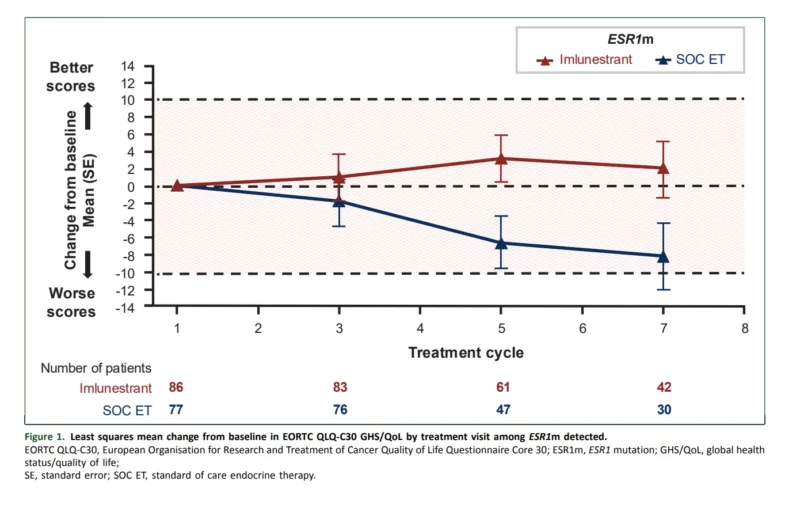
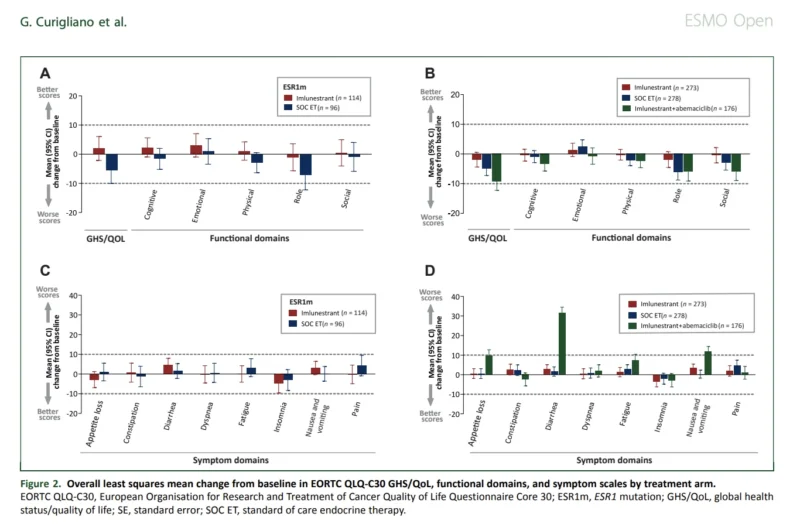
Global health status and quality of life were generally maintained over time across treatment arms.
Among patients with ESR1-mutated disease, treatment differences numerically favored imlunestrant over standard endocrine therapy. Time to deterioration of global health status and quality of life also numerically favored imlunestrant.
Median time to deterioration was 5.6 months with imlunestrant compared with 3.8 months with standard endocrine therapy.
Although this was exploratory, the finding is clinically relevant because the ESR1-mutated population is the group in which imlunestrant monotherapy showed a progression-free survival benefit in EMBER-3.
Function Was Preserved Across Treatment Arms
Functional domains were also generally maintained.
These included physical, role, emotional, cognitive, and social functioning.
Among patients with ESR1-mutated disease, fewer patients in the imlunestrant arm reported deterioration in global health status, quality of life, and most functional domains compared with standard endocrine therapy.
In the intention-to-treat population, deterioration in global health status and most functional domains was also numerically lower with imlunestrant than with standard endocrine therapy.
This suggests that oral imlunestrant did not add a meaningful quality-of-life burden compared with available endocrine therapy options.
Diarrhea Was Higher With Imlunestrant Plus Abemaciclib
The main symptom difference was diarrhea in the imlunestrant plus abemaciclib arm.
This finding was expected because diarrhea is a known toxicity of abemaciclib.
At baseline, most patients across all treatment arms reported diarrhea as never, rarely, or occasionally occurring.
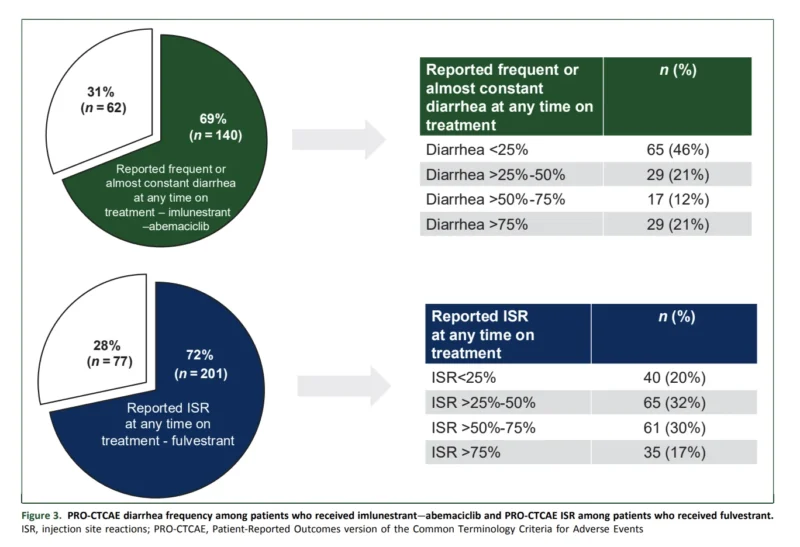
During treatment, 69% of patients receiving imlunestrant plus abemaciclib reported frequent or almost constant diarrhea at any time. About one-third of those patients reported frequent or almost constant diarrhea for at least half of their PRO-CTCAE assessments.
The mean proportion of assessments with frequent or almost constant diarrhea was low and similar for imlunestrant monotherapy and standard endocrine therapy, but higher with imlunestrant plus abemaciclib.
Despite this higher diarrhea burden, global health status, quality of life, and function were generally maintained in the combination arm.
Injection Site Reactions Were Common With Fulvestrant
The analysis also highlighted the burden of intramuscular fulvestrant administration.
Among 278 patients treated with fulvestrant, 72% reported injection site reactions at any time while on treatment. Among those who reported injection site reactions, 47% experienced them during the majority of their assessments.
This is important because physician-reported injection site reaction rates in trials may underestimate what patients actually experience.
The finding supports the value of direct patient reporting, especially for symptoms that may not always require medical intervention but can still affect comfort, treatment experience, and patient preference.
What Patients Said in Interviews
The qualitative interview study included 12 eligible EMBER-3 participants, all women.
Eight patients had received imlunestrant and four had received fulvestrant.
Overall, patients in both groups described their treatment experience positively. Many felt that the treatments were effective, had no systemic or only minor side effects, and had limited impact on daily life.
Patients receiving imlunestrant most often identified two favorable attributes: the ability to take treatment at home and the simplicity of taking an oral pill.
The main unfavorable attribute of imlunestrant was the fasting requirement before and after taking the medication.
For patients receiving fulvestrant, favorable attributes included once-monthly administration and having the injection given by qualified staff.
The main unfavorable attributes were the time burden of traveling to treatment appointments and pain at the injection site.
Importantly, patients generally said they would accept either oral or injectable treatment if it was effective and recommended by their doctor.
Clinical Meaning
This analysis supports imlunestrant as a patient-centered endocrine therapy option in advanced ER-positive/HER2-negative breast cancer.
For imlunestrant monotherapy, the PRO findings are consistent with a favorable quality-of-life profile, particularly in patients with ESR1-mutated disease.
For imlunestrant plus abemaciclib, the combination added more diarrhea, but quality of life and function were still generally maintained. This is important because the combination also showed a progression-free survival advantage in EMBER-3.
For fulvestrant, the study highlights an important patient-experience issue: injection site reactions were common when reported directly by patients.
Together, the findings show that treatment route, symptom burden, convenience, and patient preference should be part of shared decision-making in advanced breast cancer.
Why Oral SERDs May Matter
Fulvestrant has been an important endocrine therapy option, but it requires intramuscular administration and has limitations in bioavailability.
Oral SERDs such as imlunestrant may offer a more convenient approach for some patients, especially when efficacy is supported by randomized phase III data.
However, oral therapy also has its own practical considerations, including daily adherence and, in this case, fasting requirements.
The qualitative interviews show that patients can adapt to either treatment approach when they understand its purpose and potential benefit.
Limitations
This analysis was exploratory.
PRO data were not collected after treatment discontinuation, limiting understanding of quality of life at and after stopping therapy.
The qualitative interview sample was small and included only 12 participants. Patients who were doing well or satisfied with treatment may have been more likely to volunteer, which could make the interview findings more positive.
Patients receiving imlunestrant plus abemaciclib were not included in the qualitative interviews, so their perspectives on the all-oral combination regimen were not captured.
Despite these limitations, the study provides valuable patient-centered data from a large phase III trial.
Key Takeaway
The EMBER-3 patient-reported outcomes analysis showed that global health status, quality of life, and function were generally maintained with imlunestrant, standard endocrine therapy, and imlunestrant plus abemaciclib in ER-positive/HER2-negative advanced breast cancer.
Imlunestrant monotherapy numerically favored standard endocrine therapy for several quality-of-life and functional measures in patients with ESR1-mutated disease.
The combination of imlunestrant plus abemaciclib was associated with more diarrhea, but overall quality of life and function were generally maintained.
Fulvestrant-treated patients frequently reported injection site reactions, highlighting the importance of direct patient reporting.
These findings complement the efficacy and safety results from EMBER-3 and support imlunestrant as an oral endocrine therapy option, alone or with abemaciclib, for patients with ER-positive/HER2-negative advanced breast cancer after progression on endocrine therapy.