
The therapeutic problem after progression on endocrine therapy plus a CDK4/6 inhibitor in ER-positive, HER2-negative advanced breast cancer is no longer a shortage of active drugs.
It is how to choose among an increasingly fragmented set of endocrine-targeted strategies shaped by ESR1, PIK3CA, AKT1, PTEN and other resistance mechanisms.
The phase 1b/2 ELEVATE study introduces a different possibility.
Instead of selecting patients for one resistance alteration, investigators combined the oral selective estrogen receptor degrader elacestrant with the mTOR inhibitor everolimus, simultaneously targeting estrogen receptor signaling and a major downstream pathway implicated in endocrine resistance.
In the phase 2 cohort, the combination produced a median progression-free survival of 8.3 months in patients who had all previously received a CDK4/6 inhibitor. Notably, activity appeared broadly similar regardless of whether tumors carried an ESR1 or PIK3CA mutation.
The result does not yet establish a new standard. ELEVATE is a small, single-arm phase 2 study without a randomized comparator. But its significance may extend beyond the 8.3-month PFS figure.
The study asks whether the next generation of endocrine therapy can serve not simply as another monotherapy, but as a platform on which multiple resistance pathways can be therapeutically layered.
The Post-CDK4/6 Setting Is Becoming Biologically Fragmented
The first-line treatment of ER-positive/HER2-negative advanced breast cancer has become relatively well established around endocrine therapy plus CDK4/6 inhibition.
What happens after progression is considerably more complex.
Resistance can remain primarily ER-driven, emerge through ESR1 mutations, involve activation of the PI3K/AKT/mTOR pathway, or reflect several overlapping mechanisms at once.
This has increasingly produced biomarker-defined treatment pathways. ESR1 mutations may support use of an oral SERD. PIK3CA alterations can direct PI3K-targeted therapy. AKT1, PIK3CA or PTEN alterations may identify candidates for AKT inhibition.
Other patients may undergo CDK4/6 rechallenge, transition to antibody-drug conjugates, or eventually require chemotherapy. ELEVATE approaches this problem from another direction.
Its central hypothesis is that dual blockade of ER signaling and mTOR may remain relevant across several genomic states rather than requiring one predefined resistance mutation.
That is biologically plausible because endocrine resistance rarely represents a single isolated pathway.
ER and PI3K/AKT/mTOR signaling communicate extensively, and activation of downstream proliferative signaling can allow tumors to escape estrogen dependence even while ER remains therapeutically relevant.
Elacestrant degrades ER directly, while everolimus inhibits mTORC1 downstream of PI3K/AKT signaling. The rationale is therefore not simply to add two active drugs, but to suppress two cooperating components of endocrine resistance.
From EMERALD Monotherapy to a Combination Strategy
Elacestrant entered clinical practice through the phase 3 EMERALD trial, which established activity of the oral SERD particularly in ESR1-mutated ER+/HER2− advanced breast cancer after prior endocrine treatment.
ELEVATE moves the drug into a broader strategic role.
The question is no longer only:
- Which patients benefit from elacestrant alone?
It becomes:
- Can elacestrant replace older endocrine partners as the backbone for targeted combinations?
This distinction matters.
Fulvestrant has served as the endocrine backbone for many modern combination studies. But its intramuscular administration, pharmacologic limitations and reduced activity in some ESR1-mutant settings create an opportunity for more potent oral ER degraders.
Preclinical models already showed greater tumor-growth inhibition when elacestrant was combined with everolimus than with either agent alone, providing the basis for the ELEVATE strategy.
A Clinically Relevant Post-CDK4/6 Population
ELEVATE is a global phase 1b/2 umbrella study evaluating elacestrant with several targeted agents, including everolimus, alpelisib, capivasertib and CDK4/6 inhibitors.
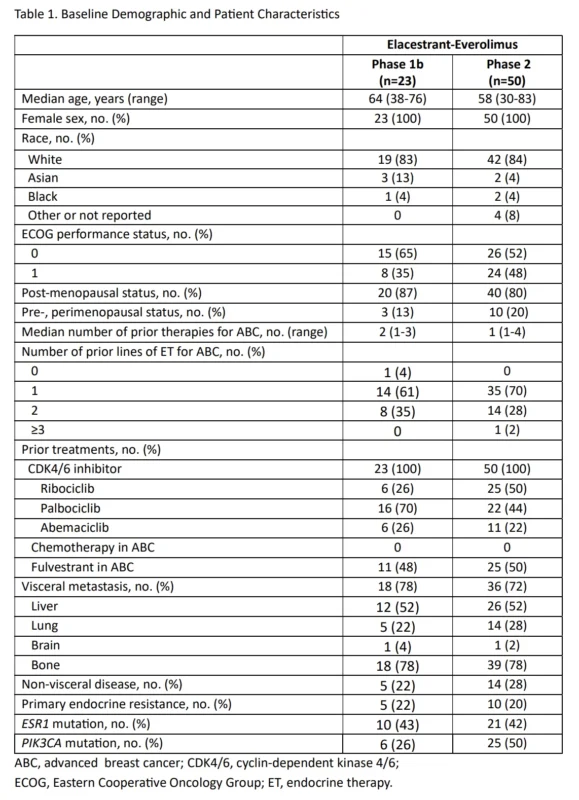
The everolimus phase 2 cohort enrolled 50 patients across 33 centers in 10 countries. Importantly, this was not a treatment-naïve endocrine-sensitive population.
All patients had received a prior CDK4/6 inhibitor. Half had previously received fulvestrant. Seventy-two percent had visceral metastases. Twenty percent had primary endocrine resistance. Forty-two percent had ESR1-mutated disease, while 50% had PIK3CA mutations.
The baseline table on page 20 reinforces this point: 52% of phase 2 patients had liver metastases, 78% had bone involvement, and no patient had previously received chemotherapy for advanced breast cancer.
This makes the cohort particularly relevant to the increasingly crowded therapeutic window between first-line CDK4/6 failure and transition to chemotherapy or antibody-drug conjugates.
Median PFS Was 8.3 Months
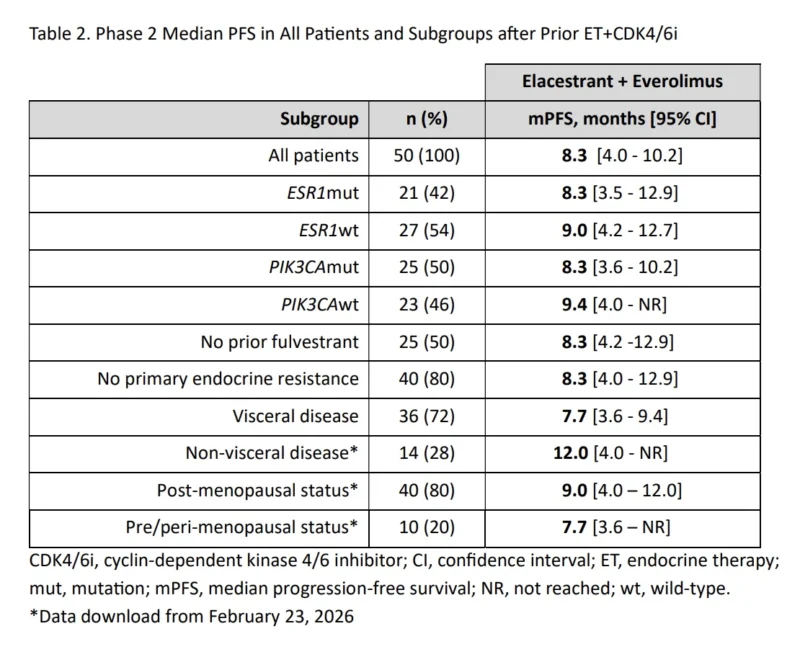
At the reported analysis, median PFS for the phase 2 population was 8.3 months (95% CI, 4.0–10.2).
The Kaplan–Meier curve on page 25 shows 29 PFS events among the 50 treated patients at the time of analysis.
The subgroup pattern may be more interesting than the overall median.
Median PFS was:
- 8.3 months in ESR1-mutated disease
- 9.0 months in ESR1 wild-type disease
- 8.3 months in PIK3CA-mutated disease
- 9.4 months in PIK3CA wild-type disease
Patients with visceral disease had a median PFS of 7.7 months, while those without visceral disease reached 12.0 months.
These data should not be interpreted as proof that mutation status has no influence on efficacy.
The subgroups are small, confidence intervals are wide, and the trial was not powered for genomic comparisons.
But there is no obvious signal that the combination depends exclusively on either ESR1 or PIK3CA alteration.
That is potentially important because many of the current post-CDK4/6 strategies rely heavily on biomarker selection.
The More Interesting Concept May Be “Mutation-Agnostic” Endocrine Intensification
The term mutation-agnostic should be used carefully. ELEVATE does not prove equal efficacy in every molecular subtype.
But it provides an early signal that one endocrine-targeted strategy could potentially operate across several resistance states. This may be particularly relevant when multiple alterations coexist or when no currently actionable alteration is identified.
The combination also creates a biologically intuitive division of labor. Elacestrant targets the ER itself, including mutant ER. Everolimus suppresses mTOR-mediated proliferative escape without requiring a PIK3CA mutation for its mechanism of action.
In practical terms, this could offer a treatment strategy in which the endocrine backbone remains relevant regardless of ESR1 status, while downstream pathway blockade addresses additional resistance signaling.
That is a different model from designing an entirely separate treatment algorithm for every mutation.
And as molecular profiling identifies increasingly complex co-alteration patterns, that type of broadly applicable backbone may become valuable.
Response Rate Was Modest, but Disease Control Was Substantial
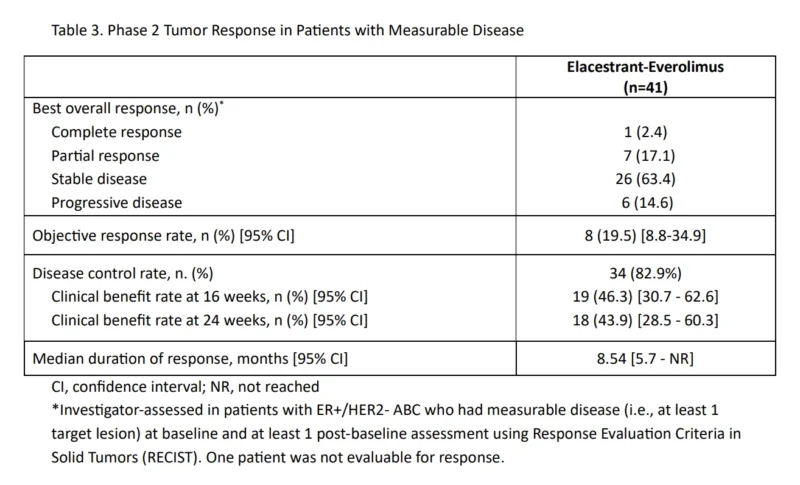
Among 41 patients with measurable disease, the objective response rate was 19.5%. One patient achieved a complete response and seven achieved partial responses.
But the more informative number for an endocrine-based treatment may be disease stabilization. Sixty-three percent of evaluable patients achieved stable disease, producing a disease control rate of 82.9%.
The 24-week clinical benefit rate was 43.9%, and median duration of response was approximately 8.5 months. This pattern is consistent with what is often clinically expected from endocrine-targeted therapy.
The objective is not necessarily dramatic radiographic shrinkage. For appropriately selected patients without rapidly threatening visceral disease, durable disease control while postponing chemotherapy remains a meaningful therapeutic objective.
That may be the clinical niche in which combinations such as elacestrant-everolimus become most relevant.
The 7.5-mg Everolimus Dose May Be More Important Than It First Appears
One of the most interesting aspects of ELEVATE is not efficacy but dosing. Standard everolimus dosing in breast cancer has traditionally been 10 mg daily. In phase 1b, ELEVATE evaluated several dose combinations.
Among four patients receiving elacestrant 345 mg plus everolimus 10 mg, two experienced grade 3 toxicity, including mucositis. By contrast, no dose-limiting toxicities were observed among seven patients treated with elacestrant 345 mg plus everolimus 7.5 mg.
Pharmacokinetic analyses suggested that everolimus exposure at 7.5 mg remained similar to the exposure achieved with 10 mg, leading investigators to select 7.5 mg as the recommended phase 2 dose.
This may have practical significance. A targeted therapy is only useful if patients can remain on it long enough to obtain benefit.
Reducing toxicity without clearly sacrificing pharmacologic exposure could therefore improve the therapeutic index of an established drug.
Toxicity Appeared Manageable, but Everolimus Remains Everolimus
The phase 2 safety profile was broadly consistent with what would be expected from an everolimus-containing regimen. The most frequent adverse events were nausea in 58%, diarrhea in 46%, fatigue in 44%, vomiting in 42%, and stomatitis in 40%.
Most were grade 1 or 2.
The most common grade ≥3 events included anemia in 8% and fatigue, diarrhea and neutropenia in 6% each.
The detailed safety table on page 23 also shows pneumonitis in 18% of patients, although grade ≥3 pneumonitis occurred in only 2%. Hyperglycemia, dyslipidemia, cytopenias and hepatic enzyme elevation remained visible components of the toxicity profile.
Stomatitis deserves particular attention because it has historically been one of the most clinically limiting toxicities of everolimus. In ELEVATE, stomatitis occurred in 40%, with grade 3–4 events in 2%, while prophylactic dexamethasone mouthwash was encouraged.
Only 6% of patients discontinued a study drug because of an adverse event, and dose reduction was reported in 2%. That is encouraging, although larger randomized studies will be required to establish whether the 7.5-mg strategy consistently improves tolerability.
How Should ELEVATE Be Viewed Beside evERA and Other Post-CDK4/6 Strategies?
The post-CDK4/6 landscape is developing quickly. The phase 3 evERA study evaluated another oral SERD, giredestrant, with everolimus and reported a median PFS of 8.77 months in its intent-to-treat population.
EMBER-3 demonstrated activity with imlunestrant plus abemaciclib. CAPItello-291 established a role for capivasertib plus fulvestrant, particularly in tumors with alterations involving PIK3CA, AKT1 or PTEN.
Other programs are evaluating PI3K inhibition, CDK4/6 continuation or rechallenge, and additional oral SERD combinations. ELEVATE therefore should not be interpreted through a simple cross-trial ranking of median PFS values.
Its 8.3-month median cannot validly be declared better or worse than numbers from studies enrolling different populations.
The authors themselves note important differences: ELEVATE included patients with primary endocrine resistance, prior fulvestrant in 50%, and ESR1 wild-type disease in the majority.
The more meaningful question is which biological and clinical populations each strategy ultimately serves best. That question will require randomized trials and increasingly sophisticated biomarker work.
What ELEVATE Does Not Prove
The trial has important limitations. The phase 2 cohort included only 50 patients. It was open-label and single-arm. There was no standard-of-care control group.
Median follow-up at the reported analysis was only 4.1 months, despite the estimated median PFS of 8.3 months, and only nine patients remained on treatment at the time of the reported dataset.
Subgroup analyses are therefore exploratory. The similar PFS values in ESR1-mutant and wild-type disease should not be interpreted as evidence of equivalence.
The same caution applies to PIK3CA-mutant versus wild-type disease. And all comparisons with evERA, EMBER-3, CAPItello-291 or other studies are inherently indirect.
The investigators appropriately acknowledge that differences in eligibility criteria, previous treatments, genomic enrichment and definitions of endocrine resistance can substantially influence cross-trial outcomes.
ELEVATE therefore demonstrates promising activity and feasibility, not comparative superiority.
The Bigger Question: What Should the Endocrine Backbone Be?
The development of oral SERDs has often been discussed as a competition between individual drugs. That may be too narrow a frame.
Their larger importance could be their ability to replace fulvestrant as a more potent and convenient endocrine foundation for combination therapy.
If that occurs, the relevant question may eventually become less:
- Which oral SERD works best alone?
And more:
- Which oral SERD provides the most effective backbone for targeting the specific resistance biology that emerges after CDK4/6 inhibition?
ELEVATE is designed around exactly that concept.
Elacestrant is being combined not only with everolimus but with alpelisib, capivasertib, abemaciclib, ribociclib and palbociclib.
This effectively turns the drug into a platform through which different resistance mechanisms can be attacked while ER blockade is maintained. The everolimus results provide an early proof of concept for this broader strategy.
The Bottom Line
ELEVATE provides an encouraging early signal for elacestrant plus everolimus after progression on endocrine therapy plus CDK4/6 inhibition.
In the 50-patient phase 2 cohort, median PFS was 8.3 months, despite a clinically relevant population in which all patients had prior CDK4/6 exposure, 72% had visceral disease, 50% had received fulvestrant and 20% had primary endocrine resistance.
Activity appeared broadly consistent across ESR1-mutated, ESR1 wild-type, PIK3CA-mutated and PIK3CA wild-type disease.
The 7.5-mg everolimus dose is also noteworthy, potentially preserving pharmacologic exposure while improving tolerability relative to the conventional 10-mg dose.
But the study remains early.
There is no randomized comparator, only 50 phase 2 patients were treated, genomic subgroup analyses are underpowered, and follow-up remains immature.
The most important contribution of ELEVATE may therefore be conceptual rather than immediately practice-changing. Elacestrant may be evolving from a biomarker-selected oral SERD into something broader:
an endocrine backbone capable of being paired with different targeted therapies according to the resistance biology that emerges after CDK4/6 inhibition. If randomized studies validate that strategy, the next phase of ER-positive metastatic breast cancer treatment may not simply be about choosing the next drug.
It may be about building the right combination around the right endocrine backbone.
Reference
- Rugo HS, Tolaney SM, Chan N, et al. Elacestrant in Combination with Everolimus for Estrogen Receptor-Positive, HER2-Negative Previously Treated Advanced Breast Cancer: Results from ELEVATE. Clinical Cancer Research. 2026. doi:10.1158/1078-0432.CCR-26-1816.