Breast oncology this week brought a clear message: progress is increasingly about precision, not simply escalation. From immune biomarkers that may reshape chemotherapy decisions in ER+/HER2− disease to the evolving role of ADCs, genomic testing, treatment de-escalation, and global quality of care, the conversation is moving toward more individualized and equitable breast cancer management.
Here are 10 essential breast oncology posts you can’t miss this week, featuring key insights on immunotherapy, HER2-positive disease, early-career research, access to genomic profiling, supportive care, and the innovations shaping the next phase of breast cancer treatment.
“High stromal CD8+ T-cells in ER+/HER2− breast cancer: a signal to rethink chemotherapy in the intermediate-risk group
A paper published this week in Nature Communications challenges our approach to adjuvant chemotherapy in early-stage ER+/HER2− breast cancer for patients with an intermediate Oncotype DX Recurrence Score (RS 16–25).
The key finding: patients with higher stromal CD8+ TIL density had significantly worse outcomes on chemoendocrine therapy— validated on whole-resection specimens, independent of menopausal status, and potentially affecting treatment decisions in up to 50% of intermediate-risk patients.
Why might chemotherapy be harmful here?
These tumours show features of T-cell exhaustion (TOX, CXCL13), checkpoint expression (CTLA4, TIGIT, VISTA), and ECM remodelling by immunosuppressive SPP1+ macrophages. Chemotherapy may amplify suppressive pathways rather than enhance tumour killing.
Two pathways deserve prospective exploration:
De-escalation: omitting chemotherapy where stromal CD8+ density is high
Checkpoint blockade combination: exhausted progenitor-like T-cells (TCF7+) may respond to ICB, consistent with Checkmate 7FL, KEYNOTE-756, and I-SPY2 data
Validation in the full TAILORx dataset is needed, but the signal is compelling. The immune landscape — not genomic risk alone — must inform chemotherapy decisions in luminal breast cancer.”
“Could the future of immunotherapy in HR+ breast cancer depend more on patient selection than the drug itself?
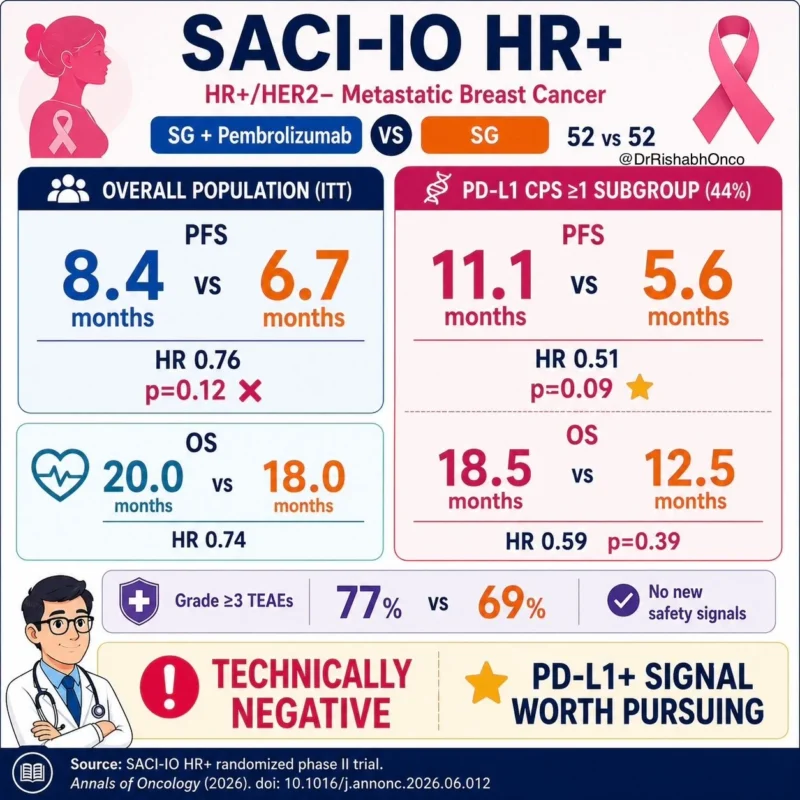
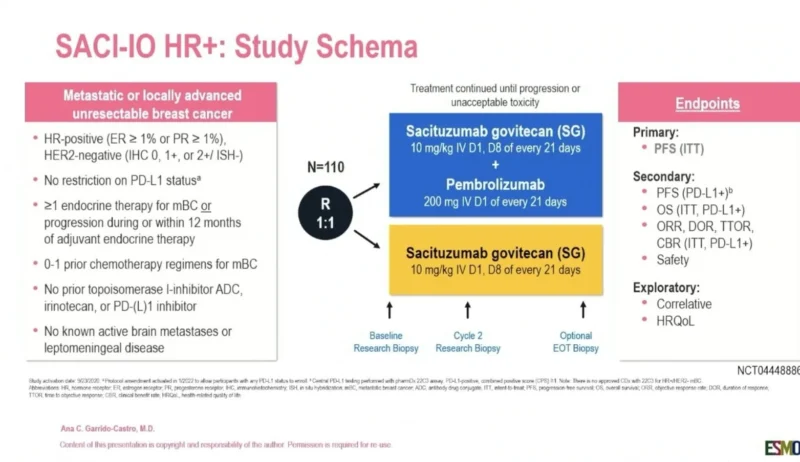
SACI-IO HR+ evaluated:
Sacituzumab Govitecan + Pembrolizumab
Sacituzumab Govitecan
HR+/HER2− metastatic breast cancer
• Endocrine therapy pretreated
• 0-1 prior chemotherapy for metastatic disease
• No prior TOP1 ADC or PD-(L)1 inhibitor
Primary endpoint: PFS
Overall population:
PFS: 8.4 vs 6.7 mo
HR 0.76, p=0.12
OS: 20.0 vs 18.0 mo
HR 0.74
ORR: 28.8% vs 19.2%
PD-L1 CPS ≥1 subgroup (44%):
PFS: 11.1 vs 5.6 mo
HR 0.51
OS: 18.5 vs 12.5 mo
HR 0.59
DOR: 12.9 vs 4.5 mo
Grade ≥3 TEAEs:
76.9% vs 69.2%
No new safety signals.
Verdict:
Formally negative.
But a 5.5-month PFS improvement and 6-month OS improvement in PD-L1-positive disease is hard to ignore.
Maybe the challenge is not finding the right combination.
Maybe it’s finding the right patient.”
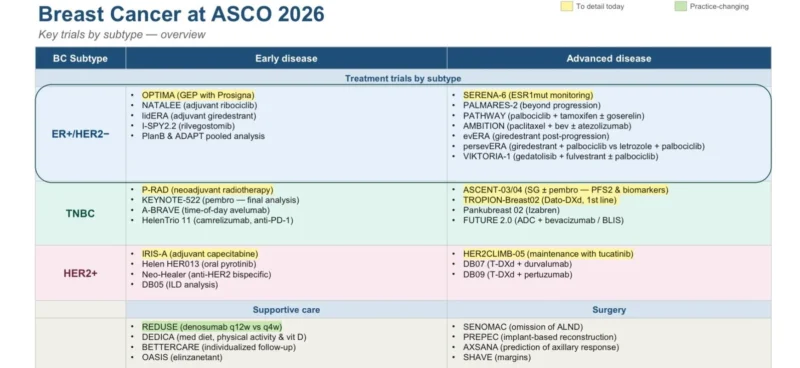
“Breast Cancer at ASCO26: a year of optimization rather than disruption.
At the 29th edition of the post-ASCO meeting for Belgium and Luxembourg, a selection of breast cancer studies were presented and discussed highlighting a common theme: the data were less about practice-changing primary results from pivotal trials and more about refining patient management through biomarkers, treatment sequencing, new strategies, toxicity reduction, supportive care, and a better understanding of the long-term treatment trajectory.
ER+/HER2− disease: OPTIMA provided further support for genomic-guided treatment decisions in early disease, while SERENA-6 explored ctDNA-guided intervention to treat patients at molecular progression in the metastatic setting.
TNBC: TROP2-directed ADCs continue to move earlier in the treatment pathway, with supportive data from PFS2 analyses. However, PFS2 remains a debated endpoint with limited validation as a surrogate for OS, highlighting the need for more sequencing trials such as SONIA. Innovative approaches such as P-RAD also suggest that short-course neoadjuvant radiotherapy may help ‘heat’ tumors and enhance immune response to systemic therapy.
HER2+ disease: IRIS-A highlighted opportunities for treatment de-escalation in selected patients with early-stage disease, while HER2CLIMB demonstrated the benefit of triple HER2 blockade as maintenance therapy in the metastatic setting and reinforced the role of endocrine therapy in patients with ER-positive disease.
Supportive care: REDUSE may be one of the most immediately practice-relevant studies, showing that denosumab every 12 weeks is non-inferior to every 4 weeks for preventing skeletal-related events, with less toxicity and treatment burden.
Overall, ASCO 2026 reminded us that progress is not only about new drugs, but also about optimizing treatment selection, sequencing, and supportive care to improve outcomes and quality of life for our patients.”
“Honored to participate as a panelist in a discussion on HER2-positive breast cancer in Riyadh, Saudi Arabia.
Grateful to my fellow panelists and the organizers for an engaging and insightful exchange of knowledge and experience.”
“We’re asking the wrong question.
Not: “How do we train the next generation of breast cancer researchers?”
But: “Why are we making it so hard for them to stay?”
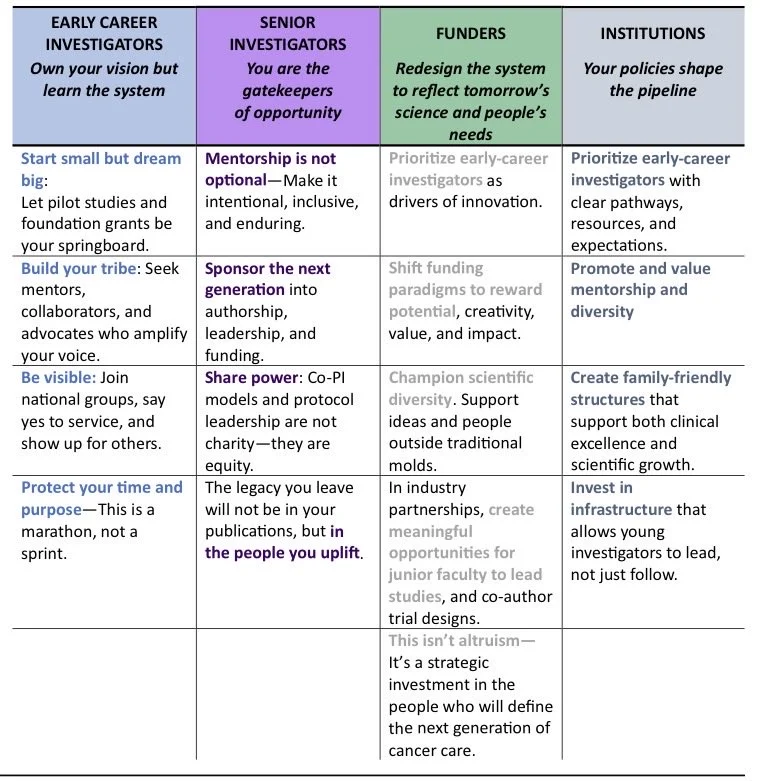
Our new international BIG–NCTN paper outlines practical solutions to support early-career investigators—from protected funding and trial leadership opportunities to mentorship, sponsorship, and equity-focused reforms.
Investing in ECIs isn’t altruism. It’s an investment in the future of cancer research—and in the patients who depend on it!”
“Did you know that in cancer care, quality can be the difference between life and death? We often talk about progress starting with innovation: new medicines, new technologies, new tools. But sometimes the most important question is much more basic.
What happens if a woman is diagnosed too late? If her pathology result is unreliable? If she is referred from one service to another, but no one is really holding the pathway together? If treatment starts, but is not completed?
In breast cancer, quality is not a technical detail. It is survival!
Last week, the second edition of Breast Cancer: Global Quality Care Matters was released, co-authored by C/Can team member Lisa Montel and Benjamin Anderson among others. The book sets out what good breast cancer care looks like across the full pathway.
But the harder question for me is – how to make that quality real in very different health system realities?
That is the work we do every day at City Cancer Challenge (C/Can) in partnership with World Health Organization to turn the Global Breast Cancer Initiative framework into practical, locally led improvements in care.
Why cities?
Because the city is where the health system becomes tangible. It is where hospitals, laboratories, clinicians, patient organizations and health authorities meet. It is where fragmented services can become a pathway a woman can actually follow.
And this is what GBCI in action should be measured by: more cancers found early, timely diagnosis, and treatment completed, not just started.
Thank you to all the co-authors of the book, and to all the editors and contributors behind this important resource.”

“The future of cancer treatment may not be determined by how much we remove, but by how precisely we treat.
Pleased to share my latest editorial in CVIR, developed from the 2025 Andreas Grüntzig Lecture.
A reflection on breast cryoablation, therapeutic de-escalation, and the evolving role of Interventional Oncology.”
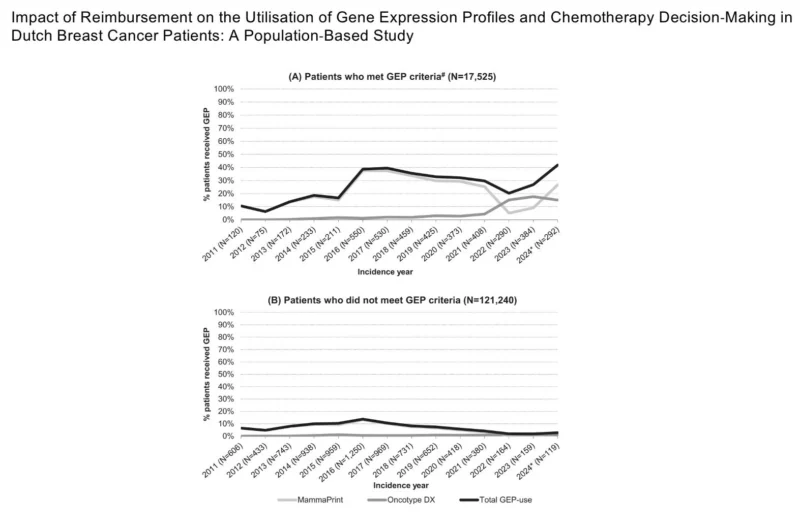
“The Gene Expression Testing Gap in Breast Cancer. Why Are Half of Eligible Patients Getting Chemotherapy Without It?
Gene expression profiling (GEP) tests like MammaPrint and Oncotype DX exist for one core purpose: to spare early-stage breast cancer patients from chemotherapy they do not need.
When results come back low-risk, the data are compelling. In this large Dutch population-based study of over 138,000 patients, 93% of women with a low-risk MammaPrint result avoided chemotherapy. For low-risk Oncotype DX, that figure was 97%. These tests work – and when acted upon, they meaningfully reduce overtreatment.
The problem is not the tests. It is whether patients receive them.
Among 17,525 patients with a clinical indication for GEP, reimbursement status made a difference – but not enough of one. GEP use rose from 9% during periods of no reimbursement to 37% when reimbursement was publicly known. Yet even with full coverage available, only about one in three eligible patients actually received a test.
For the more than 13,000 indicated patients who went untested, over half received chemotherapy anyway – without the genomic information that might have pointed in a different direction.
Regional variation added another layer: GEP uptake differed meaningfully across the Netherlands, suggesting that access and institutional practice patterns – not just policy – are shaping who gets tested.
This study raises a pointed question. If reimbursement removes the financial barrier, what explains the remaining gap? Clinician awareness, referral patterns, patient-level factors, and system inertia all likely play a role – but the data to answer that question are not yet available.
Precision oncology tools are only as powerful as their reach. Coverage is a necessary condition for equitable access. It is clearly not a sufficient one.”
“ESMOBreast26
SACI-IO HR+
Adding pembrolizumab to SG did not significantly improve PFS or OS in the overall HR+/HER2− population. PD-L1+ subgroup looks numerically interesting, but too small for definitive conclusions.”
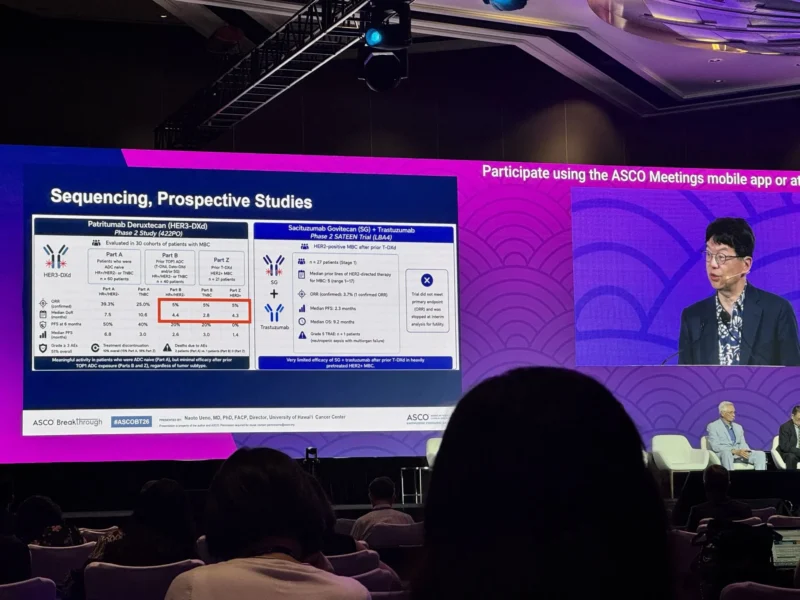
“Outstanding overview of the evolving role of antibody-drug conjugates in breast cancer by Dr. Naoto Ueno at the 2026 ASCO Breakthrough Annual Meeting.
Dr. Ueno delivered a masterful review of the current ADC landscape, highlighting how these therapies are transforming breast cancer treatment while offering valuable perspective on the next wave of innovation.
A privilege to learn from a global leader whose clinical insights and forward-looking vision continue to shape the field.”