
For decades, multiple ipsilateral breast cancers have often been viewed as a reason to recommend mastectomy.
The concern is understandable. When more than one cancer focus is present in the same breast, whether multifocal or multicentric, surgeons must balance complete tumor removal with acceptable cosmetic outcomes and the risk of local recurrence. Breast-conserving surgery has long been established for many patients with early breast cancer, but its role in multiple ipsilateral breast cancers has remained more controversial.
A new systematic review and meta-analysis suggests that breast-conserving surgery may offer comparable oncological outcomes to mastectomy in appropriately selected patients with multiple ipsilateral breast cancers, provided clear margins can be achieved and adjuvant radiotherapy is delivered.
However, the evidence remains largely observational, and patient selection continues to be central.
What Are Multiple Ipsilateral Breast Cancers?
Multiple ipsilateral breast cancers include more than one tumor focus within the same breast.
These cancers are usually classified as multifocal when lesions arise within the same quadrant or close proximity, or multicentric when lesions are present in different quadrants of the breast. As imaging techniques improve, including breast MRI and more detailed pathological assessment, these presentations are being identified more frequently.
Historically, multifocal and multicentric disease has often led to mastectomy because of concerns that breast-conserving surgery might leave behind occult disease or result in higher local recurrence rates.
But treatment decisions are increasingly becoming more individualized. Tumor location, breast size, extent of disease, biologic subtype, response to systemic therapy, surgical feasibility, margin status, and radiotherapy options all influence whether breast conservation may be possible.
What Did the Meta-Analysis Examine?
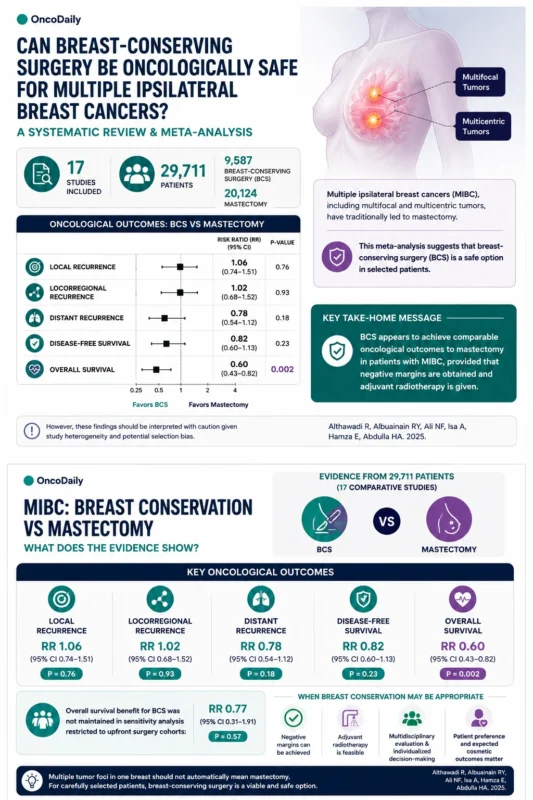
The systematic review included 17 comparative studies involving 29,711 patients with multiple ipsilateral breast cancers.
Of these patients, 9,587 underwent breast-conserving surgery, while 20,124 underwent mastectomy.
The investigators compared several important oncological outcomes between the two surgical strategies, including local recurrence, locoregional recurrence, distant recurrence, disease-free survival, and overall survival.
The aim was to determine whether breast-conserving surgery could provide comparable cancer control to mastectomy in this more complex clinical setting.
Local and Distant Recurrence Outcomes Were Similar
The pooled analysis found no statistically significant difference in local recurrence between breast-conserving surgery and mastectomy.
The risk ratio for local recurrence was 1.06 with a 95% confidence interval of 0.74 to 1.51. This means that the available data did not show a meaningful difference in local recurrence risk between the two approaches.
Locoregional recurrence was also similar. The risk ratio was 1.02, with a 95% confidence interval of 0.68 to 1.52.
Distant recurrence did not differ significantly either. The risk ratio was 0.78, with a 95% confidence interval of 0.54 to 1.12.
Disease-free survival was likewise comparable between groups, with a risk ratio of 0.82 and a 95% confidence interval of 0.60 to 1.13.
Taken together, these findings suggest that breast-conserving surgery does not appear to compromise local, regional, or distant cancer control when compared with mastectomy in selected patients with multiple ipsilateral tumors.
Overall Survival Appeared Better With Breast Conservation, But the Finding Needs Caution
The analysis found that breast-conserving surgery was associated with significantly improved overall survival compared with mastectomy.
The pooled overall survival risk ratio was 0.60, with a 95% confidence interval of 0.43 to 0.82.
At first glance, this may suggest a survival advantage for breast-conserving surgery. However, this result should be interpreted carefully.
When the investigators performed a sensitivity analysis restricted to cohorts treated with upfront surgery, the overall survival difference was no longer statistically significant. In that analysis, the risk ratio was 0.77, with a 95% confidence interval of 0.31 to 1.91.
This is important because patients selected for breast-conserving surgery may differ from patients undergoing mastectomy in ways that are difficult to fully account for in retrospective studies. They may have smaller tumors, more favorable anatomy, less extensive disease, better response to systemic therapy, or other clinical factors associated with prognosis.
Therefore, the survival finding should not be interpreted as proof that breast-conserving surgery is superior to mastectomy.
Negative Margins and Radiotherapy Remain Essential
The study’s conclusion is not that every patient with multiple ipsilateral breast cancers should undergo breast-conserving surgery.
Rather, it suggests that breast conservation can be oncologically reasonable when tumors can be removed with negative surgical margins and when adjuvant radiotherapy is feasible.
Margin status remains one of the most important surgical considerations. If clear margins cannot be achieved without significant compromise of breast shape or function, mastectomy may remain the better option.
Radiotherapy also plays a central role in reducing the risk of local recurrence after breast-conserving surgery. The results of this analysis should therefore be considered in the context of multidisciplinary treatment planning that includes breast surgeons, medical oncologists, radiation oncologists, radiologists, and pathologists.
Why This Matters for Surgical Decision-Making
The management of multiple ipsilateral breast cancers is moving away from a one-size-fits-all approach.
For some patients, mastectomy remains the most appropriate strategy. This may include patients with extensive disease involving multiple quadrants, diffuse calcifications, inability to obtain negative margins, contraindications to radiotherapy, or personal preference for mastectomy.
For others, breast-conserving surgery may be possible without compromising cancer control.
The decision should be based not only on the number of lesions, but also on the total volume of disease, tumor distribution, breast size, imaging findings, tumor biology, anticipated cosmetic outcome, radiotherapy planning, and patient priorities.
What Are the Limitations of the Evidence?
The included studies were heterogeneous, and most were observational rather than randomized.
This creates a risk of selection bias. Patients selected for breast-conserving surgery may differ systematically from those who undergo mastectomy. Surgical techniques, imaging methods, pathology standards, systemic treatment, and radiotherapy approaches may also have varied across studies.
As a result, the findings support breast-conserving surgery as a potential option in selected patients, but they do not establish equivalence in every clinical situation.
Further prospective studies are needed to clarify which patients with multifocal or multicentric breast cancer are most likely to benefit from breast conservation.
The Bottom Line
This meta-analysis suggests that breast-conserving surgery can achieve recurrence and disease-free survival outcomes comparable to mastectomy for selected patients with multiple ipsilateral breast cancers.
The key requirements remain clear surgical margins, appropriate radiotherapy, careful imaging assessment, and multidisciplinary patient selection.
Multiple tumor foci in one breast should not automatically mean that mastectomy is the only surgical option.