
Breast cancer treatment is moving beyond a model in which therapy changes only after a tumor grows, a scan shows progression, or a patient completes a predetermined sequence of treatments.
Several of the most important recent studies point toward a more dynamic approach.
In hormone receptor-positive disease, circulating tumor DNA can reveal endocrine resistance before radiographic progression. In early triple-negative breast cancer, molecular residual disease can become detectable months before clinical relapse. In HER2-positive disease, increasingly effective antibody-drug conjugates are moving into earlier treatment settings, while other studies are asking whether selected patients can safely receive less chemotherapy.
At the same time, increasingly precise treatment is exposing weaknesses in some of breast oncology’s established classifications. HER2 is becoming more difficult to treat as a simple positive-or-negative biomarker, while rare triple-negative histologies challenge the idea that TNBC represents one biologically uniform disease.
Together, these developments are shifting the central question from “What treatment comes next?” toward “What biological change should make us treat differently?”
Changing Endocrine Therapy Before Radiographic Progression
One of the clearest changes comes from SERENA-6.
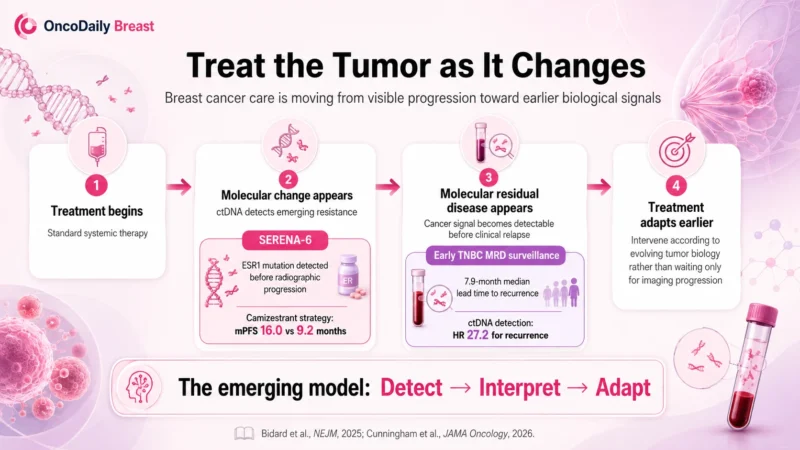
Patients with ER-positive/HER2-negative advanced breast cancer receiving an aromatase inhibitor plus a CDK4/6 inhibitor underwent serial circulating tumor DNA testing for emerging ESR1 mutations.
Rather than waiting for conventional disease progression, patients whose ESR1 mutation appeared in ctDNA while the cancer remained radiographically stable were randomized either to continue the aromatase inhibitor or switch endocrine therapy to the oral SERD camizestrant, while maintaining the same CDK4/6 inhibitor.
Median progression-free survival was 16.0 months with the camizestrant strategy versus 9.2 months with continued aromatase inhibition, corresponding to a hazard ratio of 0.44 (Bidard et al., 2025).
This changes the role of ctDNA.
Historically, molecular testing has often been used to determine what to do after progression. SERENA-6 instead used molecular evolution itself as the signal to change treatment.
That creates a fundamentally different treatment model:
ESR1 mutation emerges → endocrine resistance is identified → therapy changes → radiographic progression has not yet occurred.
The next challenge is determining whether this approach can extend beyond ESR1.
Breast cancers can develop alterations involving PIK3CA, AKT1, PTEN, ERBB2 and other pathways during treatment. But identifying a resistance alteration is not sufficient by itself; prospective evidence is needed to show that acting on that alteration before conventional progression improves outcomes.
SERENA-6 therefore matters beyond camizestrant. It provides proof of concept for molecular interception in metastatic breast cancer.
Detecting Molecular Relapse Months Before Clinical Recurrence
The same principle becomes even more consequential after curative-intent treatment.
A newly published JAMA Oncology analysis evaluated a tissue-free ctDNA assay in 159 patients with moderate- to high-risk early triple-negative breast cancer undergoing surveillance in the c-TRAK TN study.
ctDNA was detected in at least one sample in 34.0% of patients.
Detection was strongly associated with subsequent recurrence:
- HR 27.2; 95% CI, 13.7–54.2; P < .001.
Among patients whose ctDNA became detectable before clinical recurrence, the median molecular lead time was 7.9 months (Cunningham et al., 2026).
That is a clinically important interval.
Instead of discovering recurrence when metastatic disease becomes symptomatic or radiographically visible, ctDNA can potentially identify a period in which cancer is present molecularly but has not yet declared itself conventionally.
The technical question is also evolving.
Most highly sensitive MRD approaches have been tumor-informed, requiring sequencing of the patient’s original tumor to design a personalized plasma assay.
The Cunningham study evaluated a tissue-free approach based on cancer-associated methylation patterns, eliminating the requirement for primary tumor sequencing.
Compared with a multivariant tumor-informed assay, patient-level agreement was high, and median lead times to recurrence were similar: 7.6 months with tissue-free testing and 7.1 months with the multivariant tumor-informed approach. However, the tumor-informed assay identified ctDNA earlier in a greater proportion of patients.
This means tissue-free testing may solve an important practical problem when adequate tumor tissue is unavailable, while highly sensitive tumor-informed testing may retain an analytical advantage at very low disease levels.
A Positive MRD Test Still Does Not Tell Us What Treatment to Give
The ability to detect molecular relapse is advancing faster than the evidence for treating it.
That distinction is essential.
A ctDNA-positive result can identify a patient at very high risk of recurrence. It does not yet prove that starting systemic treatment at that moment prevents metastatic relapse or improves overall survival.
The c-TRAK TN experience itself illustrated this difficulty. Detection can occur close to, or sometimes alongside, clinically detectable metastatic disease, depending on assay sensitivity and surveillance timing.
The new tissue-free analysis improves the detection question, but not yet the intervention question. Cunningham and colleagues explicitly conclude that prospective ctDNA-guided intervention studies are still required to establish clinical utility.
This separates two concepts that will become increasingly important:
MRD for escalation: identifying a patient who may need additional treatment because microscopic disease persists.
MRD for de-escalation: withholding treatment because ctDNA is negative.
The second strategy requires an even higher level of confidence because a false-negative result could lead to undertreatment.
For that reason, increasingly sensitive MRD assays may have very different clinical requirements depending on whether they are being used to add treatment or remove it.
ADCs Moving Earlier Are Creating a New Sequencing Problem
Antibody-drug conjugates have already changed metastatic breast cancer. Their movement into earlier lines is now forcing treatment sequencing to be reconsidered.
In DESTINY-Breast09, first-line trastuzumab deruxtecan plus pertuzumab significantly reduced the risk of progression or death compared with the established taxane-trastuzumab-pertuzumab regimen in HER2-positive advanced breast cancer (Tolaney et al., 2026).
Reported median PFS was 40.7 months with trastuzumab deruxtecan plus pertuzumab versus 26.9 months with THP.
At the other end of the treatment continuum, DESTINY-Breast05 moved trastuzumab deruxtecan into high-risk residual HER2-positive early breast cancer following neoadjuvant therapy.
Three-year invasive disease-free survival was 92.4% with trastuzumab deruxtecan versus 83.7% with T-DM1, with a hazard ratio of 0.47 (Loibl et al., 2025).
These results create a problem produced by therapeutic success.
When a highly active ADC is used earlier, what should be used after resistance develops?
The answer may not depend solely on the antibody target.
Two ADCs can target different surface proteins while delivering payloads from the same drug class. Alternatively, two ADCs can target the same pathway but differ in linker chemistry, drug-to-antibody ratio, internalization, bystander activity and payload.
Future sequencing therefore has to address several different forms of resistance:
- target loss
- heterogeneous target expression
- altered internalization
- payload resistance
- drug-efflux mechanisms
- hanging tumor biology under treatment pressure
As ADCs occupy progressively earlier treatment positions, simply asking whether a patient has “already received an ADC” will become less informative than knowing which target, which payload and what mechanism of resistance followed it.
Giving Less Chemotherapy in HER2-Positive Early Breast Cancer
While ADC development is intensifying therapy for some patients, HER2-positive early breast cancer is simultaneously generating strong interest in de-escalation.
The 2026 long-term analysis of the DAPHNe trial provides an important example.
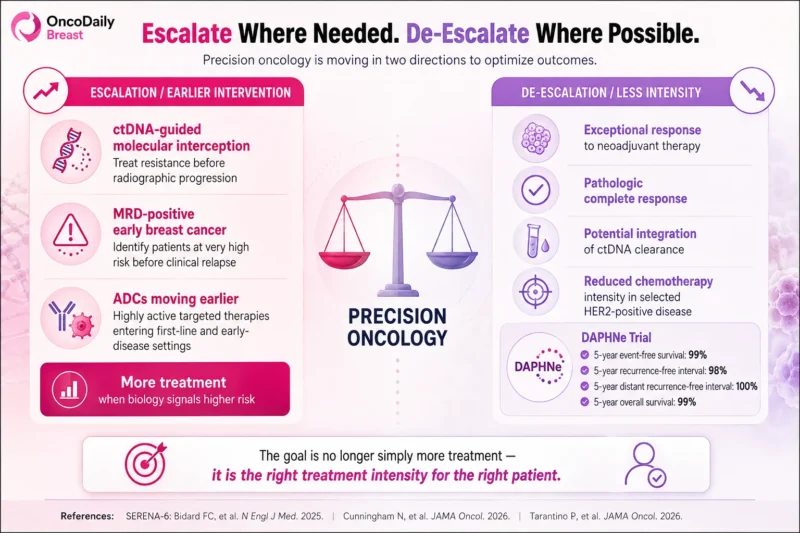
Patients with stage II to III HER2-positive breast cancer received an abbreviated neoadjuvant regimen of paclitaxel, trastuzumab and pertuzumab for 12 weeks, followed by surgery and response-adapted adjuvant treatment.
At a median follow-up of 5.2 years, the study reported:
- 5-year event-free survival: 99%
- 5-year recurrence-free interval: 98%
- 5-year distant recurrence-free interval: 100%
- 5-year overall survival: 99%.
Among patients evaluated with ultrasensitive ctDNA, 96.1% of those with detectable baseline ctDNA cleared it after neoadjuvant THP (Tarantino et al., 2026).
These results come from a relatively small, nonrandomized Phase 2 study and cannot establish a new universal standard.
But they illustrate a different use of precision oncology.
For a patient whose HER2-positive tumor responds exceptionally well to targeted therapy, should conventional chemotherapy intensity remain the same simply because that has historically been the standard?
Pathologic complete response is already an important marker. The emerging question is whether it can eventually be strengthened by additional measures such as ctDNA clearance, imaging response and tumor biology to identify patients who require less cytotoxic treatment.
Precision medicine therefore does not always mean adding a new drug.
Sometimes it means identifying where a drug can safely be removed.
HER2-Low and HER2-Ultralow Are Becoming a Pathology Problem
The expansion of trastuzumab deruxtecan into HER2-low and HER2-ultralow breast cancer has made very low levels of HER2 expression clinically relevant.
That creates an unusual biomarker problem.
Traditional HER2 testing was designed largely to distinguish tumors with HER2 overexpression or amplification from those without it.
Now pathologists increasingly need to distinguish between very subtle levels of membrane staining near the bottom of the assay’s range.
A 2026 npj Breast Cancer analysis involving a multicenter assessment across 45 laboratories reported an overall concordance of 68.89% for HER2 interpretation, with concordance falling to 57.58% for HER2 IHC 1+ cases. The investigators concluded that low-level HER2 assessment remains vulnerable to inter-laboratory and interpretive variability (Dong et al., 2026).
This matters because the difference between HER2-null, ultralow and low expression can now influence treatment eligibility.
The issue is therefore becoming less about whether HER2-low represents a completely separate biological disease and more about whether current pathology methods can reproducibly quantify the amount of HER2 needed for treatment selection.
Tumor heterogeneity adds another layer.
A historical biopsy may not perfectly represent a later metastatic lesion, and different tumor sites may express different levels of the target.
As ADC eligibility becomes increasingly dependent on low levels of antigen expression, biomarker testing may need to become more quantitative, more standardized and potentially more dynamic.
Triple-Negative Breast Cancer Is Being Broken Into Different Diseases
TNBC illustrates another limitation of receptor-based classification.
The diagnosis tells us that ER, PR and HER2 are absent, but it does not tell us that every triple-negative tumor shares the same biology.
A 2026 npj Breast Cancer review highlights that rare histologic subtypes collectively represent approximately 5–10% of TNBC and can differ markedly in molecular drivers, immune biology, natural history and treatment sensitivity (Gouveia et al., 2026).
Classic adenoid cystic carcinoma may behave indolently despite being triple-negative.
Secretory carcinoma can be driven by ETV6-NTRK3, providing a clear molecular target.
High-grade metaplastic carcinoma, by contrast, may display aggressive behavior and frequent TP53 and PI3K/AKT/mTOR alterations.
Triple-negative lobular carcinoma can show enrichment for CDH1, PIK3CA, ERBB2 and ESRRA alterations, together with biology different from conventional basal-like TNBC.
The consequence is important.
A clinical trial dominated by conventional TNBC of no special type may not automatically provide equally applicable evidence for an uncommon secretory, adenoid cystic, apocrine, lobular or metaplastic tumor.
The next generation of TNBC classification may therefore need to integrate:
receptor phenotype + histology + genomic driver + immune phenotype
rather than relying on receptor absence alone.
Breast Cancer Treatment Is Becoming More Dynamic
These developments initially appear unrelated:
- SERENA-6 is an endocrine therapy trial
- MRD surveillance concerns early recurrence
- DESTINY studies involve ADCs
- DAPHNe examines chemotherapy reduction
- HER2-ultralow is partly a pathology question
- Rare TNBC involves histologic classification
But they are converging on the same idea.
Breast cancer treatment is moving away from static categories and fixed sequences.
An ESR1 mutation can emerge before progression and change endocrine therapy.
ctDNA can identify molecular recurrence before imaging.
An ADC used earlier can completely reorganize what is available later.
A deep neoadjuvant response may indicate that additional chemotherapy is unnecessary.
A HER2 result may depend on precisely how much protein is present rather than a simple positive-versus-negative designation.
And two tumors labeled TNBC may have profoundly different natural histories because their histology and molecular drivers are different.
The future treatment pathway may therefore look less like:
- subtype → line of therapy → next line
and increasingly like:
- subtype → treatment → reassessment of evolving biology → adapted treatment.
The Bottom Line
The most consequential shift in breast cancer in 2026 is not one new drug.
It is the movement toward treatment that changes as the tumor changes.
SERENA-6 demonstrates that emerging endocrine resistance can be targeted before radiographic progression.
MRD studies show that molecular relapse may be visible months before clinical recurrence, while simultaneously highlighting how much work remains before ctDNA-guided treatment becomes established.
Earlier use of ADCs is improving outcomes but creating increasingly complex sequencing questions.
HER2-positive early breast cancer is showing that greater therapeutic effectiveness may allow carefully selected patients to receive less chemotherapy rather than more.
HER2-low and ultralow disease are forcing pathology to become more quantitative.
And rare TNBC histologies demonstrate why receptor status alone cannot fully define either prognosis or therapy.
The next step in precision breast oncology is therefore not simply identifying more biomarkers.
It is determining which biological change matters enough to alter treatment, when that change should be measured, and whether acting on it actually improves the patient’s outcome.
References
- Bidard FC, et al. First-line camizestrant for emerging ESR1-mutated advanced breast cancer. New England Journal of Medicine. 2025.
- Tolaney SM, et al. Trastuzumab deruxtecan plus pertuzumab for HER2-positive advanced breast cancer. New England Journal of Medicine. 2026.
- Loibl S, et al. Trastuzumab deruxtecan in residual HER2-positive early breast cancer. New England Journal of Medicine. 2025.
- Cunningham N, Cutts RJ, Swift C, et al. Tissue-Free vs Tumor-Informed ctDNA Assays for Molecular Residual Disease Detection in Early Triple Negative Breast Cancer. JAMA Oncology. Published online August 13, 2026. doi:10.1001/jamaoncol.2026.2833.
- Tarantino P, Li T, Ogayo ER, et al. Neoadjuvant Paclitaxel, Trastuzumab, and Pertuzumab for Stage II to III, ERBB2-Positive Breast Cancer: A Secondary Analysis of the DAPHNe Trial. JAMA Oncology. Published online June 25, 2026. doi:10.1001/jamaoncol.2026.2023.
- Dong YH, Xu YT, Jiang XZ, et al. HER2-low and ultralow expression of invasive breast carcinoma: clinicopathological features and immunohistochemical consistency analysis. npj Breast Cancer. 2026;12:9.
- Gouveia MC, Bonadio RC, Barroso-Sousa R, et al. Beyond a single disease: review of rare histological subtypes of triple-negative breast cancer with implications for prognosis and treatment. npj Breast Cancer. 2026. doi:10.1038/s41523-026-01018-8.