
Adjuvant capecitabine has long been an important option for patients with triple-negative breast cancer who have residual invasive disease after neoadjuvant chemotherapy. Yet the modern treatment landscape has become increasingly biomarker driven, particularly for patients with germline BRCA1 or BRCA2 mutations who may also be eligible for adjuvant PARP inhibition.
A new real-world analysis published in Breast Cancer Research and Treatment on August 12, 2026, raises an important question about whether BRCA-mutated early TNBC derives the same clinical benefit from capecitabine as non-BRCA-mutated disease.
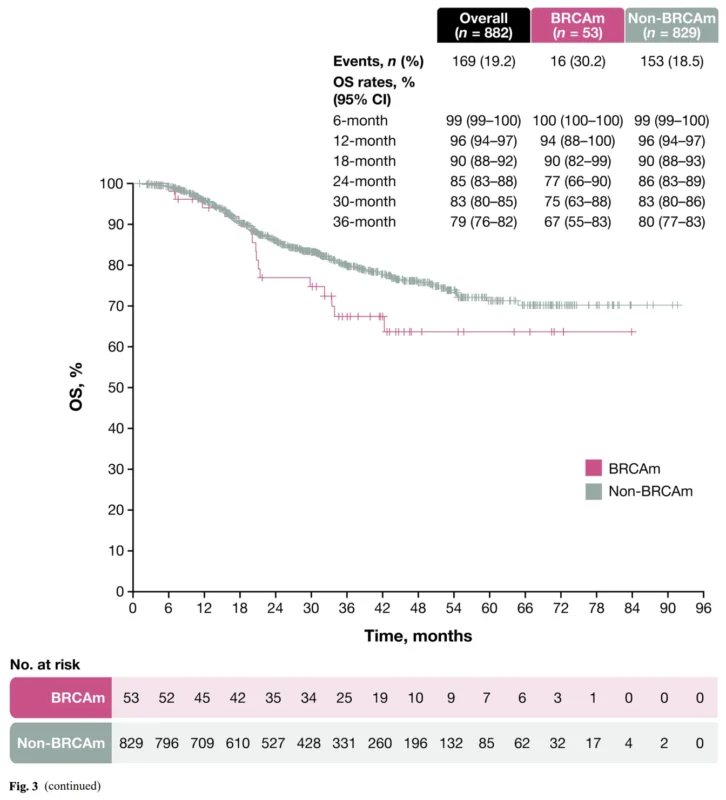
Filipa Lynce, Meng Ru, Linlin Luo, Miguel Miranda, Xiaoqing Xu, and Claudine Isaacs analyzed 882 U.S. patients with early-stage TNBC who received adjuvant capecitabine. Only 53 patients had documented pathogenic or likely pathogenic BRCA1/2 mutations, but their outcomes were consistently poorer than those of patients without BRCA mutations. At 36 months, invasive disease-free survival was 59% versus 72%, distant disease-free survival was 59% versus 73%, and overall survival was 67% versus 80% for BRCA-mutated versus non-BRCA-mutated tumors.
The study is retrospective and descriptive, so it cannot establish that capecitabine is intrinsically less effective in BRCA-mutated disease. Nevertheless, the consistency of the survival differences highlights an important residual-risk population and reinforces the need to identify BRCA mutations early enough to incorporate genotype-directed adjuvant therapy.
Capecitabine Established a Role in Residual TNBC, but BRCA Status Was an Unanswered Question
Residual invasive TNBC after neoadjuvant chemotherapy identifies a population at substantial risk of recurrence. The CREATE-X trial established adjuvant capecitabine as an effective post-neoadjuvant strategy, improving disease-free and overall survival in the TNBC subgroup. However, CREATE-X did not evaluate outcomes according to BRCA mutation status.
That question has become more clinically relevant since the phase III OlympiA trial demonstrated benefit from adjuvant olaparib in patients with germline BRCA-mutated, HER2-negative, high-risk early breast cancer. Current treatment therefore involves several potentially relevant post-neoadjuvant strategies, including capecitabine, pembrolizumab when incorporated before surgery, and olaparib for eligible germline BRCA carriers.
The difficulty is that prospective evidence defining the optimal sequencing or combination of these approaches remains limited. Lynce and colleagues therefore asked a narrower question: what happens in routine practice when patients with BRCA-mutated early TNBC receive adjuvant capecitabine?
A Real-World Cohort of 882 Patients
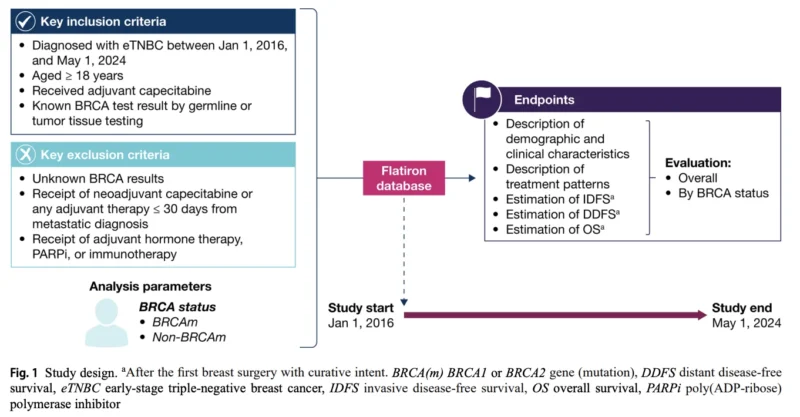
The investigators used the U.S. Flatiron Health database, which contains longitudinal electronic health record data from more than 280 oncology practices.
Eligible adults were diagnosed with early-stage TNBC between January 2016 and May 2024, initiated adjuvant capecitabine within six months of curative-intent surgery, and had documented BRCA testing from germline or tumor tissue. Patients receiving adjuvant hormone therapy, PARP inhibitors, or immunotherapy were excluded so that outcomes could be evaluated in patients whose relevant adjuvant systemic exposure included capecitabine rather than contemporary targeted or immune therapies.
Among 882 patients, 53—or 6%, had a pathogenic or likely pathogenic BRCA1/2 alteration and 829 had confirmed non-BRCA-mutated tumors. Of the BRCA-mutated group, 38 had confirmed germline mutations, while 15 had mutations detected by tumor testing without confirmed germline status.
Patients with BRCA mutations were younger: median age was 47 years versus 55 years in the non-BRCA population.
Treatment Exposure Was Broadly Similar
Most patients had received neoadjuvant systemic therapy before surgery. Neoadjuvant treatment was administered to 92% of the BRCA-mutated group and 91% of patients without BRCA mutations. Chemotherapy alone accounted for most of this treatment, particularly among BRCA-mutated patients.
Adjuvant capecitabine was given as monotherapy in 98.1% of BRCA-mutated patients and 95.3% of non-BRCA-mutated patients. Median capecitabine duration was also similar, at approximately 5.5 and 5.4 months, respectively. This makes the subsequent outcome differences clinically interesting because they cannot readily be explained by a major difference in duration of capecitabine exposure.
However, treatment-era differences remain relevant. Only 2% of BRCA-mutated patients had received neoadjuvant chemotherapy plus immunotherapy compared with 7.8% of patients without BRCA mutations, reflecting the evolving use of pembrolizumab during the study period.
BRCA-Mutated TNBC Had Lower 3-Year IDFS
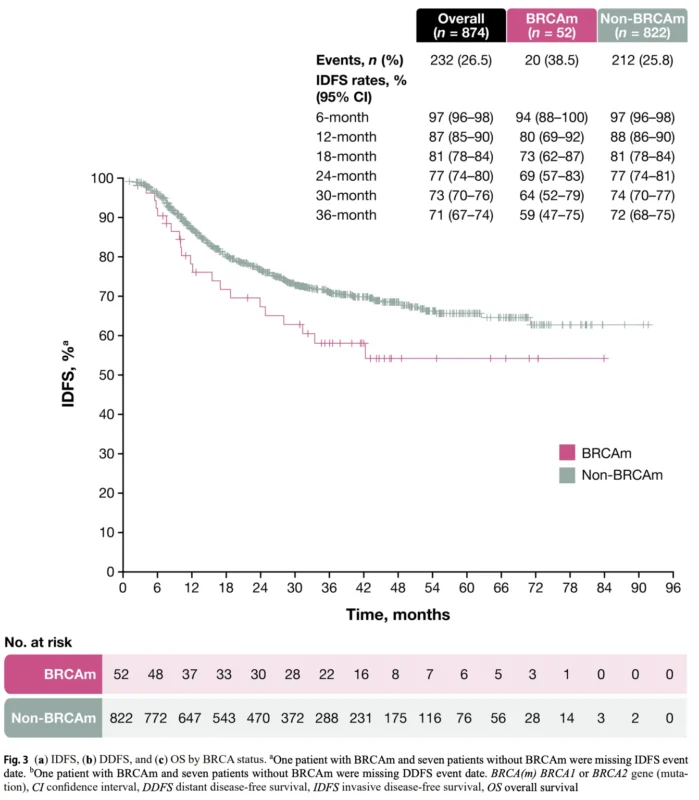
The clearest signal emerged for invasive disease-free survival. At 36 months after surgery, IDFS was 59% in the BRCA-mutated group versus 72% in the non-BRCA-mutated group.
The Kaplan–Meier curve shown in Figure 3 of the paper demonstrates relatively early separation. By 12 months, estimated IDFS was approximately 80% in BRCA-mutated disease versus 88% without BRCA mutation; by 24 months the rates were 69% and 77%, and by 36 months the gap had widened to 59% versus 72%. Importantly, this pattern was not confined to the broader BRCA definition that included tumor-only testing.
A sensitivity analysis restricted to patients with confirmed germline BRCA mutations showed a similar pattern, with lower IDFS than in the non-BRCA-mutated population. The finding was also maintained among patients who did not achieve pCR after neoadjuvant treatment and among those who initiated capecitabine before 2021.
That consistency strengthens the signal, although it does not eliminate confounding.
Distant Recurrence Was Also More Frequent
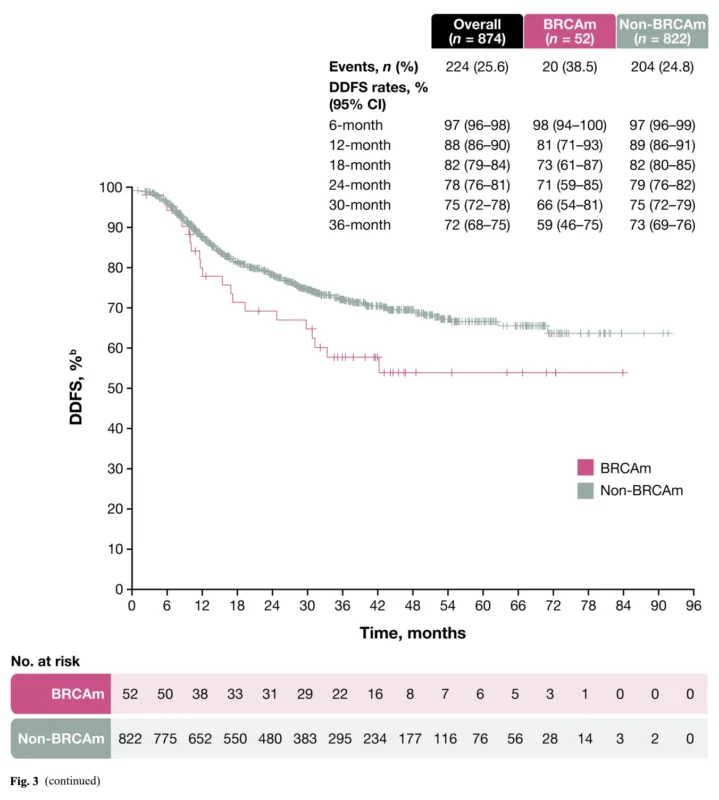
The difference was nearly identical for distant disease-free survival. At 36 months, DDFS was 59% with BRCA-mutated TNBC versus 73% with non-BRCA-mutated disease.
The curves began to separate from approximately 12 months onward, suggesting that the poorer IDFS signal was not driven solely by local recurrence or second primary cancers. For a population receiving curative-intent therapy, this may be the more concerning observation. Distant recurrence is the event most directly associated with transition from potentially curable early TNBC to metastatic disease.
Overall Survival Was 67% Versus 80% at Three Years
The survival difference extended to overall survival. At 36 months after surgery OS was 67% in patients with BRCA-mutated tumors versus 80% in those without BRCA mutations. The difference became apparent later than the IDFS and DDFS differences, with OS curves separating more clearly from approximately 24 months onward.
Median IDFS, DDFS, and OS had not been reached, reflecting the relatively limited follow-up and early-stage nature of the cohort. The median follow-up was approximately 31 months overall, 34.6 months in the BRCA-mutated group, and 30.8 months in the non-BRCA group.
The CREATE-X–Aligned Analysis Showed the Same Direction
Because real-world patients differed from those enrolled in CREATE-X, the investigators conducted a sensitivity analysis designed to more closely approximate the clinical population from that trial.
This analysis included patients who received neoadjuvant chemotherapy followed by adjuvant capecitabine monotherapy and excluded those receiving neoadjuvant immunotherapy or other relevant systemic combinations. It included 47 of 53 BRCA-mutated patients and 667 of 829 patients without BRCA mutations.
The same pattern persisted: BRCA-mutated patients continued to demonstrate lower 36-month IDFS, DDFS, and OS than non-BRCA-mutated patients. This does not reproduce a randomized capecitabine-versus-no-capecitabine comparison. Instead, it suggests that the poorer outcomes were not simply caused by obvious differences between the contemporary real-world cohort and the historical CREATE-X treatment framework.
Does BRCA Mutation Predict Reduced Capecitabine Benefit?
This is the most tempting, but also the most dangerous, interpretation of the study. The authors describe a trend suggesting that patients with BRCA-mutated TNBC may derive less clinical benefit from adjuvant capecitabine than patients without BRCA mutations. They also discuss a possible biological relationship between BRCA1-associated, basal-like biology and reduced capecitabine sensitivity.
However, this study cannot establish BRCA mutation as a predictive biomarker of capecitabine resistance. There was no untreated control group stratified by BRCA status. The analysis therefore compares prognosis among capecitabine-treated patients, not treatment effect between capecitabine and another therapy.
BRCA-mutated TNBC could simply represent a population with different underlying biological risk. The apparent outcome gap could reflect prognosis, treatment-era effects, unmeasured confounders, or a combination of these factors.
The scientifically appropriate conclusion is therefore that BRCA-mutated patients experienced worse outcomes despite receiving capecitabine, not that capecitabine caused inferior outcomes or definitively provides less benefit.
That distinction is essential.
The Study Strengthens the Case for Early BRCA Testing
The most immediate clinical implication is arguably not about capecitabine itself, but about when BRCA status becomes available. Approximately 9%–15% of patients with TNBC harbor pathogenic germline BRCA1 or BRCA2 mutations. Identifying those mutations after all postoperative treatment decisions have already been made risks missing the window for a genotype-directed adjuvant strategy.
The investigators therefore argue for broad and early BRCA testing in TNBC. This is particularly relevant because adjuvant olaparib has demonstrated a survival advantage in high-risk HER2-negative early breast cancer with germline BRCA1/2 mutations, providing a treatment option based directly on the biological vulnerability created by homologous recombination deficiency.
The new real-world data reinforce the idea that BRCA testing should not be viewed only as hereditary-risk assessment. In early TNBC, it is a treatment-selection biomarker.
Capecitabine Use Declined as the Post-Neoadjuvant Landscape Changed
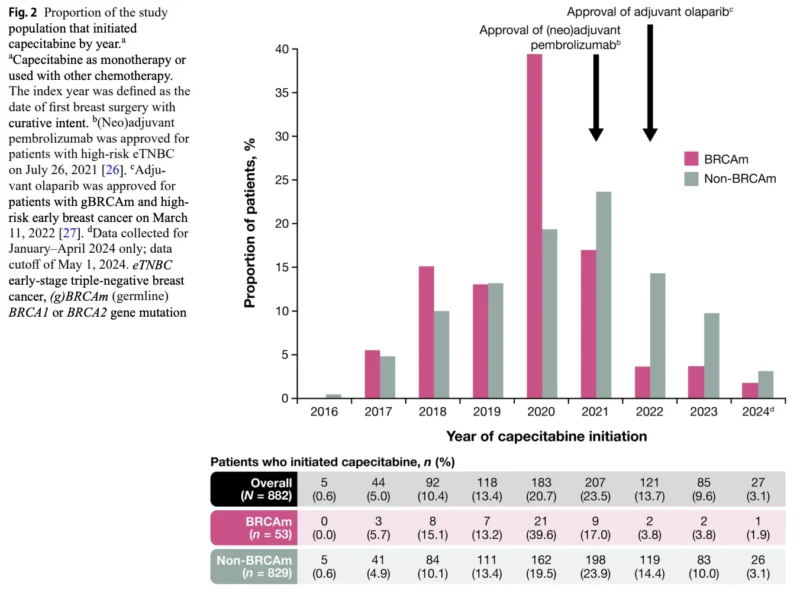
The treatment-period analysis also captures how quickly TNBC practice has evolved. Use of adjuvant capecitabine increased through the earlier years of the cohort, but initiation declined after 2021. The timing overlaps with the adoption of pembrolizumab for high-risk early TNBC and the subsequent approval of adjuvant olaparib for eligible germline BRCA-mutated, high-risk HER2-negative disease.
The authors note that the low number of BRCA-mutated patients receiving capecitabine after 2021 may partly reflect a change in treatment selection as olaparib became available. This is important when interpreting the study.
The cohort spans a period in which post-neoadjuvant TNBC treatment changed substantially. Many contemporary patients would now receive pembrolizumab as part of a neoadjuvant/adjuvant strategy, and patients meeting OlympiA criteria with germline BRCA mutations would be considered for olaparib.
The results therefore describe an important historical and real-world treatment experience but should not be interpreted as a randomized comparison of today’s complete post-neoadjuvant options.
The Real Clinical Question Is Now How to Sequence Therapies
For a patient with residual TNBC after neoadjuvant treatment and a germline BRCA mutation, contemporary decision-making can involve several therapies with different mechanisms and evidence bases. Capecitabine targets residual high-risk disease with cytotoxic chemotherapy.
Olaparib exploits homologous recombination deficiency. Pembrolizumab may be continued after surgery when started as part of the perioperative regimen.
The challenge is that the evidence supporting these therapies comes largely from separate trials, and optimal combination or sequencing strategies have not been comprehensively defined. The paper explicitly notes this evidence gap. The present analysis does not resolve that question.
What it does suggest is that a patient with BRCA-mutated residual TNBC should not be treated as simply another capecitabine-eligible patient without considering the therapeutic implications of BRCA status.
Important Limitations Prevent a Causal Interpretation
Several limitations are central to understanding the results. First, the study was retrospective and observational. Only 53 patients had BRCA-mutated tumors compared with 829 patients in the non-BRCA group, creating a substantial imbalance in sample size.
Most importantly, the analyses were descriptive and unadjusted. Multivariable modeling was not performed because the small BRCA-mutated population prevented statistically robust adjustment for potentially confounding variables such as age, stage, treatment patterns, and other clinical characteristics.
Electronic health record data may also be incomplete or inaccurately documented.
The study combined confirmed germline mutations with pathogenic BRCA alterations detected from tumor testing when germline status was unavailable. It also could not reliably separate BRCA1 from BRCA2 in the primary analysis, even though these alterations may be associated with different tumor biology.
And because all patients received capecitabine, the study lacks the comparator necessary to determine whether BRCA mutation truly modifies the relative treatment effect of capecitabine. These limitations make terms such as “capecitabine resistance” hypothesis-generating rather than clinically established.
Funding Is Relevant to Interpretation
The study was supported by AstraZeneca and Merck Sharp & Dohme, which are co-developing olaparib. Several authors were AstraZeneca employees or stockholders, while other authors reported relevant relationships with industry.
This does not invalidate the findings, but it is relevant context, particularly because the clinical interpretation emphasizes BRCA testing and targeted treatment with olaparib. The primary data should therefore be assessed on their methodological merits: a large real-world capecitabine-treated TNBC population, but a small BRCA-mutated subgroup and no adjusted or randomized comparison.
The Bottom Line
This real-world analysis of 882 patients with early-stage TNBC treated with adjuvant capecitabine identified a clinically important outcome gap according to BRCA status. Among the 53 patients with BRCA1/2-mutated tumors, 36-month outcomes were consistently worse than among the 829 patients without BRCA mutations:
- IDFS: 59% vs 72%
- DDFS: 59% vs 73%
- OS: 67% vs 80%.
The findings remained directionally consistent in CREATE-X–aligned and germline-BRCA sensitivity analyses. But the study should not be interpreted as proof that capecitabine is ineffective in BRCA-mutated TNBC. It is retrospective, unadjusted, and lacks a no-capecitabine comparator. Its strongest clinical message is different.
BRCA-mutated residual TNBC remains a high-risk disease even after adjuvant capecitabine, making early BRCA testing essential so that eligible patients can be identified for genotype-directed treatment rather than relying on chemotherapy alone.
As early TNBC becomes increasingly personalized, BRCA status is moving from hereditary-risk information to a determinant of postoperative systemic therapy. The question is no longer simply whether residual TNBC warrants escalation. It is which escalation strategy best matches the biology of the residual disease.
Reference
- Lynce F, Ru M, Luo L, Miranda M, Xu X, Isaacs C. Real-world clinical outcomes of patients with early-stage TNBC and BRCAm who were treated with adjuvant capecitabine in the United States. Breast Cancer Research and Treatment. 2026;218:41. Published online August 12, 2026. doi:10.1007/s10549-026-08011-6.