
Brain metastases are a major clinical concern in metastatic breast cancer, particularly in HER2-positive and triple-negative disease. Over time, approximately 25% to 50% of patients with these subtypes develop brain metastases, which can lead to neurological disability, cognitive impairment, reduced independence, and substantial deterioration in quality of life.
Despite this risk, routine brain imaging is not consistently recommended for patients without neurological symptoms.
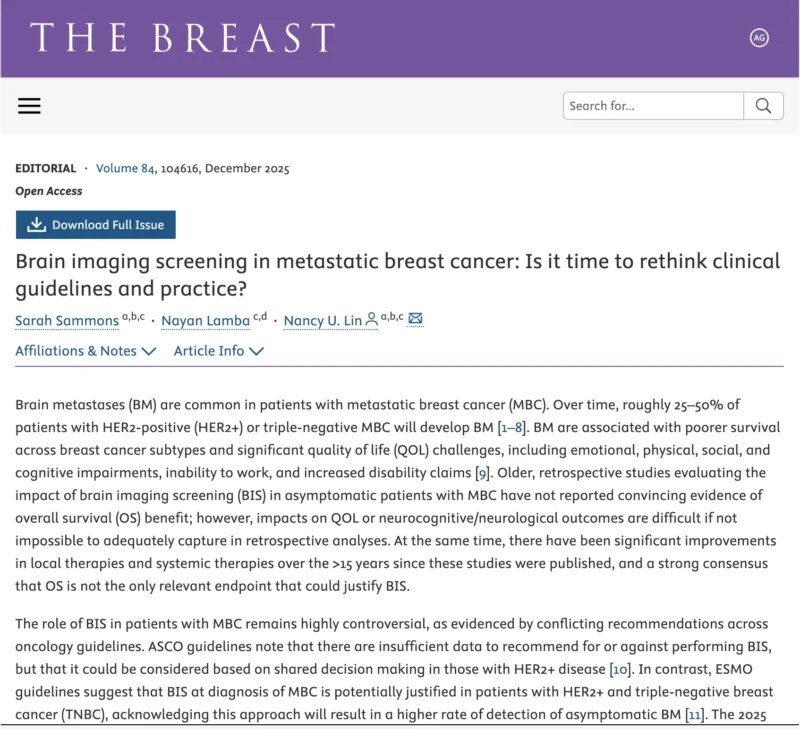
An article published in The Breast argues that it may be time to reconsider this symptom-directed approach. Sarah Sammons, Nayan Lamba, and Nancy U. Lin outline a growing case for brain MRI screening in selected patients with metastatic breast cancer, while also acknowledging that survival benefit, optimal timing, cost-effectiveness, and potential harms remain uncertain.
The central question is no longer limited to whether screening extends overall survival. It is whether earlier detection could preserve neurological function, increase access to less invasive treatments, guide the use of central nervous system–active systemic therapies, and reduce the need for crisis-driven care (Sammons et al., 2025).
Why Are Current Screening Practices Inconsistent?
At the time the article was published, international recommendations differed substantially.
ASCO guidance stated that evidence was insufficient to recommend for or against routine brain imaging screening, although imaging could be considered through shared decision-making in HER2-positive metastatic breast cancer.
ESMO guidance suggested that brain imaging at the diagnosis of metastatic disease could be justified in patients with HER2-positive breast cancer or triple-negative breast cancer because of their elevated risk of asymptomatic brain metastases.
By contrast, the 2025 NCCN guidance described in the article recommended brain MRI when neurological symptoms were suspicious or when imaging was otherwise clinically indicated.
These differences create uncertainty for clinicians and patients. They can also affect insurance reimbursement, because screening without neurological symptoms may not be covered when major guidelines do not clearly recommend it (Sammons et al., 2025).
What Do Patients and Physicians Think About Screening?
An international survey cited in the article revealed a significant difference between formal guidance and real-world preferences.
Among 529 physicians from 50 countries, 65% reported already requesting brain imaging screening in at least some patients with metastatic breast cancer. Imaging was particularly common during extracranial progression or in biologically high-risk subtypes such as HER2-positive and triple-negative disease.
Among clinicians who did not routinely request screening, 91% said they would adopt it if an overall survival benefit were demonstrated. Approximately 79% would screen if imaging could change the treatment strategy, while 57% would adopt screening if international guidelines recommended it.
Patient interest was even stronger. Approximately 85% of surveyed patients wanted brain imaging screening, despite uncertainty regarding clinical benefit, and 91% wanted more information about the risk of developing brain metastases.
However, only 13% of physicians reported routinely discussing brain metastasis development with patients (Matos et al., 2025).
These findings suggest that shared decision-making requires more than asking whether a scan is indicated. Patients need clear information about the potential benefits, uncertainties, emotional consequences, and downstream treatment implications.
How Often Does Screening Find Asymptomatic Brain Metastases?
Prospective studies suggest that brain MRI screening can detect clinically meaningful rates of asymptomatic disease.
In a phase II study using MRI at baseline and again after six months or at systemic progression, brain metastases were detected in approximately 25% of patients with triple-negative disease, 24% with HER2-positive disease, and 23% with hormone receptor-positive/HER2-negative disease (Ahmed et al., 2025).
Another prospective study performed brain MRI at metastatic diagnosis and when patients changed to second- or third-line systemic therapy. Asymptomatic brain metastases were identified in 24% of patients with triple-negative metastatic breast cancer and 17% of those with HER2-positive disease (Kim et al., 2024).
These studies show that clinically silent brain metastases are not rare. However, detection alone does not establish that screening improves survival, neurological function, or quality of life.
The timing of imaging also remains unresolved. Some patients still developed symptomatic brain metastases between scheduled scans, indicating that even structured surveillance may not identify every lesion before symptoms appear.
Could Screening Lead to Earlier and Less Invasive Treatment?
Patients with metastatic breast cancer who are not screened often undergo brain imaging only after developing headaches, seizures, nausea, visual changes, balance problems, weakness, or cognitive symptoms.
By that point, metastases may be larger, more numerous, or located in neurologically sensitive regions.
A retrospective comparison of patients with metastatic breast cancer and non-small cell lung cancer found that breast cancer patients were more likely to present with neurological symptoms and had larger and more numerous brain metastases. They were also more likely to receive whole-brain radiotherapy as their initial local treatment (Cagney et al., 2018).
Earlier detection could increase the number of patients eligible for stereotactic radiosurgery or stereotactic radiotherapy. These approaches deliver focused radiation to individual lesions and generally produce less cognitive toxicity than whole-brain radiotherapy.
Treatment outcomes with stereotactic radiosurgery are usually most favorable when lesions are smaller and fewer. Radiation necrosis risk also increases with lesion size.
The proposed benefit of screening is therefore not simply finding metastases earlier. It is identifying them when the risk-benefit profile of localized treatment may be more favorable.
Could Earlier Detection Prevent Neurological Complications?
Brain metastases can cause irreversible neurological consequences. Seizures, motor impairment, cognitive decline, and loss of independence can profoundly affect daily life even when extracranial disease remains controlled.
Retrospective studies have linked neurological symptoms at brain metastasis diagnosis with poorer outcomes. Other analyses have associated higher lesion burden, high-risk brain locations, and the absence of brain-directed local therapy with an increased seizure risk.
This creates a biologically plausible argument that earlier detection could reduce the risk of neurological emergencies.
However, the hypothesis remains unproven. Prospective studies need to determine whether screening reduces seizures, neurological disability, hospitalizations, corticosteroid use, loss of driving privileges, or cognitive deterioration.
These patient-centered outcomes may be as important as overall survival when evaluating the value of screening.
Why Is Screening Particularly Relevant in HER2-Positive Disease?
The treatment landscape for HER2-positive metastatic breast cancer with brain metastases has changed substantially.
CNS-active systemic treatments such as tucatinib-based therapy and trastuzumab deruxtecan can produce meaningful intracranial responses and improve disease control in patients with brain metastases.
Detecting asymptomatic lesions could therefore influence systemic treatment selection. Clinicians may prioritize a therapy with established intracranial activity even when extracranial disease remains stable.
Earlier identification may also allow systemic therapy and local treatment to be coordinated before neurological deterioration occurs.
The rationale is less certain in triple-negative breast cancer. Although the risk of brain metastases is high, systemic treatment options with proven survival benefit specifically in patients with triple-negative brain metastases remain more limited.
Screening value is therefore likely to differ according to subtype, available therapies, extracranial disease status, and expected survival.
What Are the Potential Harms of Routine Screening?
The case for screening is clinically compelling, but it is not risk-free.
Detecting asymptomatic brain metastases could lead to treatment that would not otherwise have been necessary at that time. A lesion found during systemic therapy may already be responding, yet its discovery could prompt local radiation or an unnecessary change in systemic treatment.
Earlier diagnosis may also increase anxiety without improving meaningful outcomes. Patients could spend more time knowing that brain metastases are present while receiving no clear survival or quality-of-life benefit from that knowledge.
Brain MRI can reveal unrelated findings such as silent infarcts or cerebral aneurysms. These findings may require additional investigations, increase costs, and create further distress.
The diagnosis of brain metastases can also affect eligibility for clinical trials, although the authors argue that trials should adopt more inclusive criteria rather than allowing delayed diagnosis to become an eligibility strategy.
Routine screening would additionally increase healthcare utilization and imaging costs. Its cost-effectiveness has not been established.
Most importantly, no randomized trial has yet demonstrated that routine screening improves overall survival, quality of life, neurological function, or cost-effectiveness in metastatic breast cancer.
Should Overall Survival Be the Only Relevant Endpoint?
Historical screening studies did not demonstrate a convincing overall survival advantage, but many were conducted before the modern era of HER2-directed therapy, antibody-drug conjugates, CNS-active targeted treatments, and expanded stereotactic radiotherapy.
In older studies, many patients died from extracranial progression before intracranial disease became the main clinical problem. That pattern may not reflect contemporary HER2-positive metastatic breast cancer, where systemic disease can remain controlled for extended periods.
The authors argue that screening should also be assessed through neurological quality of life, cognitive preservation, seizure prevention, treatment burden, use of whole-brain radiotherapy, hospitalization, and the ability to continue working and driving.
A screening strategy could be valuable without producing a large overall survival difference if it prevents irreversible neurological deterioration or permits less toxic treatment.
This position remains an argument rather than established evidence, but it broadens the discussion beyond mortality alone.
Which Trials Could Clarify the Role of Screening?
Several prospective studies are evaluating brain MRI screening across breast cancer subtypes and stages.
Their designs vary. Some use MRI at metastatic diagnosis, while others repeat imaging every four to six months or at changes in systemic therapy. Study populations include HER2-positive metastatic breast cancer, triple-negative disease, hormone receptor-positive/HER2-negative disease, inflammatory breast cancer, and selected patients with stage II–III high-risk disease.
Endpoints include the detection of asymptomatic brain metastases, neurological quality of life, incidence of symptomatic disease, lesion number and size, leptomeningeal disease, treatment use, hospitalization, and overall survival.
This variation reflects the central uncertainty: the optimal population, timing, frequency, and clinical endpoint for screening have not yet been defined.
Results from these studies could help determine whether screening should be universal within high-risk subtypes or limited to selected clinical situations, such as metastatic diagnosis, extracranial progression, or systemic treatment changes.
What Could a Risk-Adapted Approach Look Like?
The evidence does not yet support a single MRI schedule for every patient with metastatic breast cancer.
A risk-adapted approach could prioritize patients with HER2-positive or triple-negative disease, longer expected survival, multiple extracranial metastatic sites, systemic progression, or access to CNS-active systemic therapy.
Imaging decisions could also consider patient preferences. Some patients may strongly favor early detection, while others may wish to avoid additional testing when the clinical benefit is uncertain.
Shared decision-making needs to explain that screening may identify smaller and asymptomatic lesions, but it has not yet been proven to extend survival or preserve neurological function.
This approach would allow screening to move beyond a binary choice between routine imaging and waiting for symptoms.
The Bottom Line
Brain metastases are common and clinically devastating in metastatic breast cancer, particularly in HER2-positive and triple-negative disease.
Prospective studies show that screening MRI can identify asymptomatic brain metastases in a substantial proportion of patients. Earlier detection could allow the use of stereotactic radiotherapy, reduce reliance on whole-brain radiation, guide CNS-active systemic treatment, and potentially prevent neurological deterioration.
However, no randomized trial has yet shown that routine screening improves survival, quality of life, cognitive outcomes, or cost-effectiveness. Screening may also produce anxiety, incidental findings, overtreatment, unnecessary treatment changes, and additional healthcare costs.
The available evidence supports serious reconsideration of symptom-directed imaging, particularly in high-risk subtypes. It does not yet define a universal screening standard.
The next step is to determine which patients benefit, when imaging should begin, how often it should be repeated, and which clinical outcomes are most meaningful.
References
- Sammons S, Lamba N, Lin NU. Brain imaging screening in metastatic breast cancer: Is it time to rethink clinical guidelines and practice? The Breast. 2025;84:104616. doi:10.1016/j.breast.2025.104616.
- Matos L, van Ramshorst M, Muller V, et al. Brain imaging screening in metastatic breast cancer: Patients’ and physicians’ perspectives. The Breast. 2025:104558.
- Ahmed KA, Kim Y, Armaghani AJ, et al. Phase II trial of brain MRI surveillance in stage IV breast cancer. Neuro-Oncology. 2025;27(6):1550-1558.
- Cagney DN, Martin AM, Catalano PJ, et al. Implications of screening for brain metastases in patients with breast cancer and non-small cell lung cancer. JAMA Oncology. 2018;4(7):1001-1003.