
Bone-only metastatic disease is often considered one of the more favorable clinical phenotypes of hormone receptor–positive, HER2-negative breast cancer. That description is broadly correct, but incomplete.
Some patients remain confined to the skeleton for prolonged periods, while others eventually develop liver, lung, peritoneal, or central nervous system metastases. That transition from an initially bone-only pattern to visceral disease may represent an important biological turning point, frequently accompanied by greater therapeutic complexity and a less favorable prognosis.
A large multicenter study published in the European Journal of Cancer in August 2026 examined whether routinely available baseline characteristics can identify patients more likely to undergo this visceral conversion while receiving CDK4/6 inhibitor–based therapy.
The analysis included 692 patients with bone-only HR+/HER2− metastatic breast cancer treated with palbociclib, ribociclib, or abemaciclib plus endocrine therapy across 24 Italian centers. Its most reproducible biological signal was surprisingly familiar progesterone receptor expression.
Higher PR expression was consistently associated with a lower risk of visceral conversion. But the study also delivers an equally important caution. PR was biologically informative, but not sufficiently predictive to guide surveillance or treatment decisions by itself.
Bone-Only Disease Is Favorable, but Not Uniformly Indolent
HR+/HER2− metastatic breast cancer has a strong tendency to involve bone, and skeletal-only metastatic disease is generally associated with better outcomes than disease involving visceral organs. That can sometimes create the impression that bone-only disease represents a relatively homogeneous, indolent clinical state.
The current study argues against that simplification. The investigators screened 1,399 patients treated between 2014 and 2023 and identified 692 with radiologically documented bone-only metastatic disease at initiation of CDK4/6 inhibitor therapy.
Patients received CDK4/6 inhibition plus endocrine therapy in the first- or second-line setting. The cohort was assembled across 24 Italian centers. Importantly, visceral conversion was specifically defined as the first subsequent appearance of metastatic disease in the: liver, lung, peritoneum, or central nervous system.
Skin and distant lymph-node progression alone were not considered visceral conversion. This allowed the investigators to study a clinically recognizable transition:
skeletal-only metastatic disease → visceral metastatic disease.
Nearly One in Four Patients Developed Visceral Disease
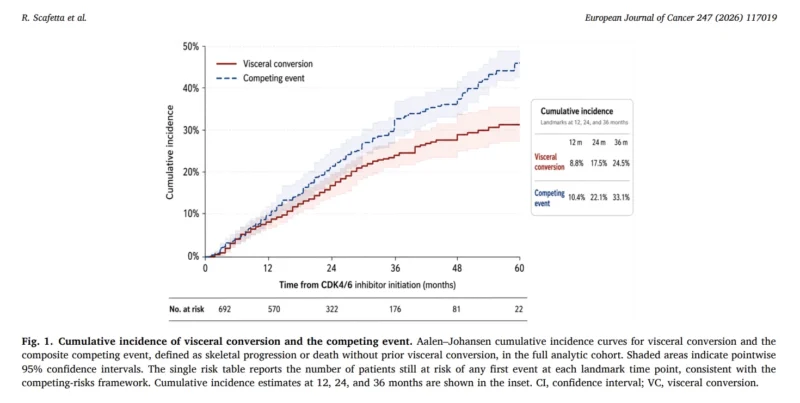
After a median follow-up of 31 months, 162 patients—23.4% of the cohort—developed visceral conversion as their first qualifying event.
Median time to visceral conversion was 17 months.
The cumulative incidence was:
- 8.8% at 12 months
- 17.5% at 24 months
- 24.5% at 36 months.
The cumulative-incidence curve on page 5 illustrates a gradual but persistent increase in visceral involvement over time rather than a plateau after the first year. This is clinically relevant.
A patient who begins CDK4/6-based therapy with bone-only disease may have a relatively favorable phenotype, but that phenotype is not necessarily stable. For a meaningful subgroup, metastatic geography evolves during treatment.
Visceral Conversion Was Followed by a Relatively Short Survival
Among the 162 patients who experienced visceral conversion, median overall survival measured from the time of conversion was 18.0 months. By comparison, median OS after skeletal progression without prior visceral conversion was 28.8 months.
The investigators appropriately avoid claiming that visceral conversion itself independently causes the worse survival. Post-progression treatment was not systematically captured, and the comparison was unadjusted.
Nevertheless, it provides clinically important context. A transition from bone-only to visceral disease appears to mark a population with substantially more difficult subsequent disease behavior. That makes the question of who is at risk of visceral conversion worth investigating.
PR Expression Emerged as the Most Reproducible Biological Signal
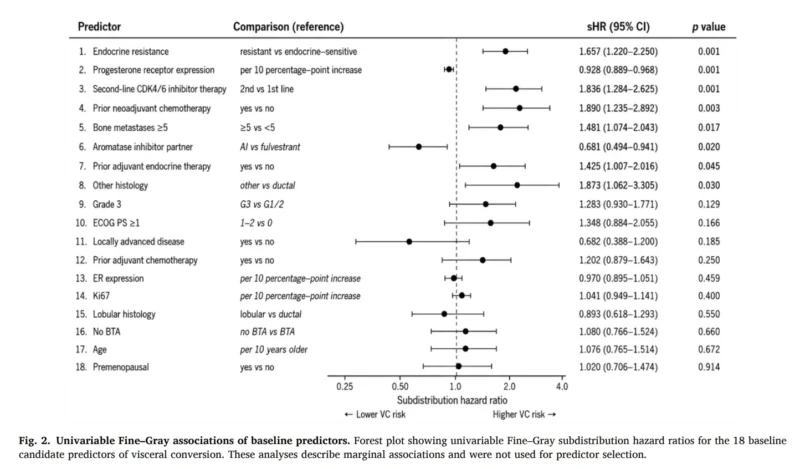
The investigators began with a broad clinical dataset rather than testing a single preconceived biomarker. The source database contained 35 complete variables, from which 18 baseline candidate predictors were evaluated using competing-risk modeling, ridge penalization, bootstrap stability analysis, and complementary cause-specific Cox models.
Several factors were associated with visceral conversion in univariable analysis, including:
- endocrine resistance
- second-line rather than first-line CDK4/6 inhibitor therapy
- lower PR expression
- previous neoadjuvant chemotherapy
- greater skeletal disease burden
- previous adjuvant endocrine therapy
- some histologic characteristics.
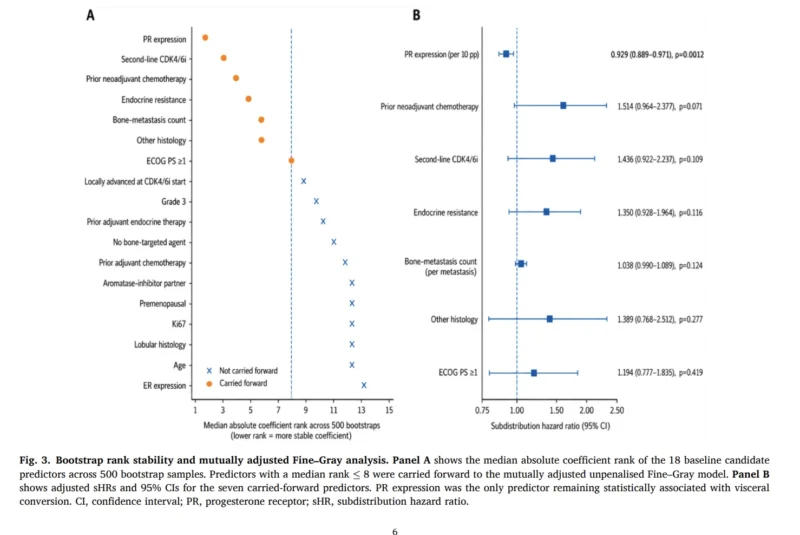
But when the investigators examined the stability of these variables across repeated modeling, PR expression stood out. Across 500 bootstrap samples, PR showed complete directional agreement and the highest coefficient stability, with a median absolute coefficient rank of 1.
In the mutually adjusted Fine, Gray model, PR was the only carried-forward predictor that remained conventionally statistically significant:
- sHR 0.929 for every 10-percentage-point increase in PR
- 95% CI, 0.889–0.971; P=.0012.
In practical terms, higher PR expression was associated with progressively lower risk of visceral conversion.
The Association Was Not Simply a Surrogate for Endocrine Sensitivity
PR is closely linked to functioning estrogen-receptor signaling and luminal biology. Lower or absent PR expression may indicate diminished ER pathway dependence, greater biological plasticity, or features associated with a more aggressive luminal phenotype.
That makes the association biologically plausible. But an important question is whether low PR simply identifies patients already classified clinically as endocrine-resistant. The study suggests that the explanation is not that simple. The inverse association between PR expression and visceral conversion remained similar in both endocrine-sensitive and endocrine-resistant subgroups:
- endocrine-resistant: sHR 0.928 per 10-percentage-point increase
- endocrine-sensitive: sHR 0.929 per 10-percentage-point increase.
The investigators therefore argue that PR may be capturing an aspect of tumor biology not fully represented by conventional clinical definitions of endocrine resistance.
This is potentially the most interesting biological implication of the study. PR may reflect not merely whether endocrine therapy is currently working, but something about the tumor’s underlying luminal differentiation and metastatic behavior.
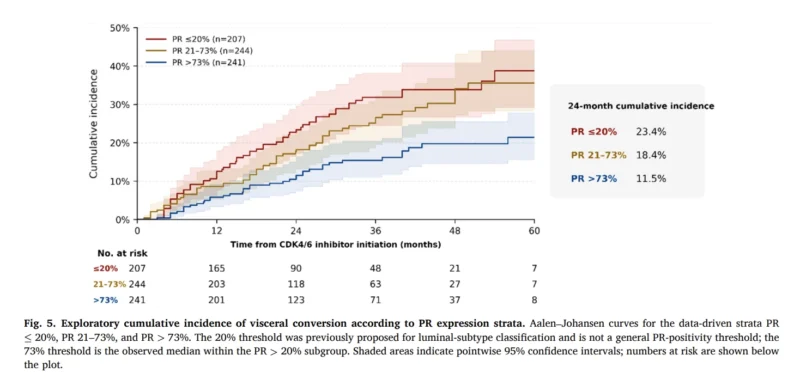
Higher PR Was Associated With a Lower 24-Month Risk of Visceral Conversion
The investigators also explored PR using descriptive strata.
Patients were divided into:
- PR ≤20%
- PR 21%–73%
- PR >73%
At 24 months, visceral-conversion incidence was:
- 23.4% with PR ≤20%
- 18.4% with PR 21%–73%
- 11.5% with PR >73%.
The figure on page 7 visually shows this gradient, with the high-PR group maintaining the lowest cumulative incidence of visceral conversion over follow-up. Within patients whose PR exceeded 20%, PR >73% was associated with a lower subdistribution hazard than PR 21%–73%:
- sHR 0.583; 95% CI, 0.391–0.871; P=.0083.
But these numbers require careful interpretation.
The authors explicitly state that 73% was a data-derived median, not a biologically established cut-off. The analysis does not validate PR 20%, 73%, or any other value as a threshold for clinical decision-making. The more defensible interpretation is that the relationship appears continuous, the higher the PR expression, the lower the observed tendency toward visceral conversion.
Statistical Association Is Not the Same as Useful Prediction
This may be the most important part of the paper. A biomarker can be strongly and reproducibly associated with an outcome while still being poor at predicting that outcome in an individual patient. That is exactly what happened with PR.
When PR expression alone was tested as a prediction model for visceral conversion at 24 months, discrimination was modest:
- AUC: 0.585
- Brier score: 0.142
- improvement in prediction accuracy: only 1.1%
- observed-to-expected ratio: 1.00.
An AUC of 0.585 is far from what would normally be required for a clinically useful standalone prediction tool. The authors therefore make an important distinction: PR appears to be a reproducible biological correlate, not a clinically actionable predictive biomarker. That wording matters.
It would be inappropriate, on the basis of this study, to recommend more frequent imaging simply because PR is low. It would also be inappropriate to intensify systemic therapy or change the CDK4/6 inhibitor strategy according to PR expression alone. The study generates biological insight.
It does not establish a new management algorithm.
Other Risk Signals Were Less Stable
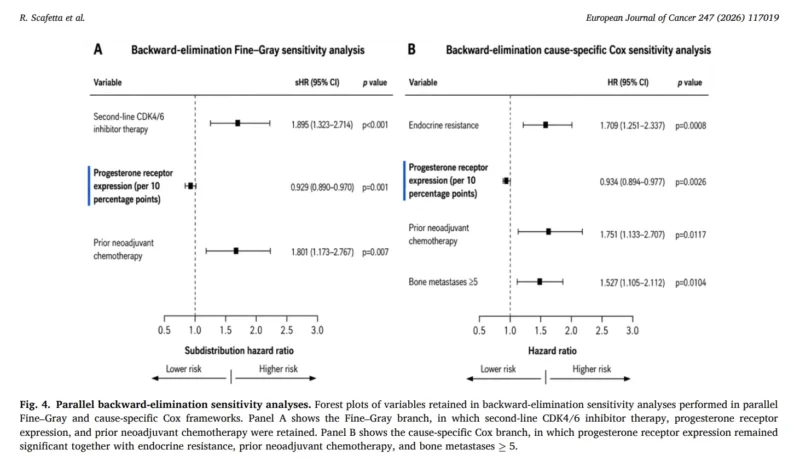
PR was not the only variable associated with visceral conversion. In one Fine–Gray sensitivity model, second-line CDK4/6 therapy and previous neoadjuvant chemotherapy remained associated with greater risk alongside PR.
In the cause-specific Cox model, endocrine resistance, previous neoadjuvant chemotherapy, and having ≥5 bone metastases were retained together with PR. But those associations varied according to the statistical model.
That is important because it demonstrates the danger of taking a single multivariable analysis and converting every significant variable into a clinical “risk factor.” For example, skeletal disease burden clearly appears clinically relevant.
Patients developing visceral conversion had somewhat greater skeletal involvement at baseline, and ≥5 bone metastases was associated with risk in some analyses. But the relationship was not as reproducible across analytical approaches as the PR signal. The paper therefore avoids presenting a simplified bedside score. That restraint strengthens the analysis.
Why a Competing-Risks Model Matters
The methodology also deserves attention. A conventional time-to-event analysis could overestimate visceral-conversion probability because some patients experience another event that prevents visceral conversion from ever being observed.
A patient may first develop further skeletal progression. Another may die before visceral disease is detected. These events compete with the endpoint of interest. The investigators therefore used a competing-risks framework, treating skeletal progression and death without prior visceral conversion as competing first events.
This provides a more clinically realistic estimate of the probability that visceral conversion will actually occur as the first major progression event. However, it also exposed an important methodological challenge.
In 84 of the 162 visceral-conversion events 51.9%, visceral and skeletal progression were documented on the same calendar date. When those same-day cases were conservatively classified as skeletal progression first, the number of visceral-conversion events dropped substantially. The absolute incidence therefore depends meaningfully on how simultaneous progression is defined.
Reassuringly, however, the inverse association between PR and visceral conversion persisted under this alternative classification. That strengthens the biological signal while simultaneously reminding us not to overinterpret the exact absolute event rate.
What Might Low PR Be Telling Us Biologically?
The paper does not establish a mechanistic explanation, but its discussion provides a plausible biological framework. PR expression has traditionally been interpreted as an indicator of intact estrogen-receptor signaling and luminal differentiation.
Loss or reduction of PR may accompany:
- less dependence on ER signaling
- greater endocrine resistance
- increased biological plasticity
- potentially a transition toward more aggressive tumor behavior.
From that perspective, PR may be functioning as a readily available surrogate for a deeper biological state. A highly PR-expressing bone-only tumor may retain a relatively differentiated, endocrine-dependent phenotype. A low-PR tumor may be more capable of evolving away from that skeletal-predominant state toward visceral dissemination.
That hypothesis is compelling. But it remains a hypothesis. Future studies integrating tumor genomics, ctDNA, imaging features and serial biopsies will be needed to determine what biological processes actually accompany visceral conversion.
The Study Points Toward Multivariable Risk Models Rather Than a Single Biomarker
The most productive future direction may therefore not be finding a better PR cut-off. It may be combining PR with other measurements. The authors suggest that future prediction models could integrate:
- routine clinicopathologic variables
- molecular biomarkers
- circulating tumor-derived measures
- quantitative imaging features.
That approach makes sense.
Metastatic evolution is unlikely to be determined by one immunohistochemical variable. A clinically meaningful model could eventually combine luminal differentiation, genomic resistance mechanisms, disease burden, ctDNA dynamics, treatment history and perhaps radiomic features to identify patients whose apparently favorable bone-only phenotype is beginning to evolve.
PR could become one component of that model. But the current study makes clear that it should not be the model itself.
Important Limitations
Several limitations prevent immediate clinical application. The study was retrospective, and imaging schedules were neither protocol-mandated nor centrally standardized. Different institutions may therefore have detected progression at different intervals or through different imaging modalities.
PR and other pathological biomarkers were assessed locally without central pathology review. The endpoint combined liver, lung, peritoneal and CNS metastases rather than examining organ-specific patterns. The high proportion of simultaneous skeletal and visceral progression made absolute incidence estimates sensitive to endpoint classification.
Post-progression treatment information was unavailable, preventing adjusted comparison of survival after skeletal versus visceral progression. Finally, predictor ranking and model refitting occurred in the same cohort, and the study did not include independent external validation.
These limitations are particularly important when considering any potential surveillance application. The study does not demonstrate that patients with low PR should undergo more frequent CT scans, PET imaging, or other intensified monitoring. That hypothesis would require prospective testing.
The Bottom Line
This multicenter European Journal of Cancer study provides one of the more detailed analyses of metastatic evolution in bone-only HR+/HER2− breast cancer during CDK4/6 inhibitor therapy.
Among 692 patients:
- 23.4% developed visceral conversion
- median time to conversion was 17 months
- 36-month cumulative incidence was 24.5%
- median OS after visceral conversion was 18 months.
Across multiple competing-risk and sensitivity analyses, higher progesterone receptor expression was the most reproducible routinely available tumor-biological correlate of a lower visceral-conversion risk. Each 10-percentage-point increase in PR was associated with an adjusted sHR of 0.929.
But PR alone performed poorly as an individualized prediction tool, with a 24-month AUC of only 0.585. That distinction is essential. PR may tell us something important about the biology of metastatic evolution, but it cannot yet tell us reliably which individual patient will develop visceral disease.
The clinical message is therefore not to change treatment according to PR.
It is to reconsider the assumption that bone-only metastatic breast cancer is a biologically uniform state. Some tumors remain skeletal-predominant. Others evolve.
Understanding the biology behind that transition may eventually allow surveillance and treatment to become more individualized. For now, PR provides a signal, but not yet a decision rule.
Reference
- Scafetta R, Troiano R, Guarino A, et al. Broad baseline-variable profiling of visceral conversion in bone-only HR+/HER2− metastatic breast cancer treated with CDK4/6 inhibitors. European Journal of Cancer. 2026;247:117019. Published online August 29, 2026. doi:10.1016/j.ejca.2026.117019.