
First-line treatment with durvalumab plus trastuzumab deruxtecan showed clinically relevant antitumor activity in women with locally advanced unresectable or metastatic hormone receptor-negative, HER2-low breast cancer, according to results from arm 6 of the BEGONIA platform trial published in Nature Cancer.
The multicenter, open-label phase 1b/2 study evaluated durvalumab, an anti-PD-L1 immune checkpoint inhibitor, in combination with trastuzumab deruxtecan, a HER2-directed antibody-drug conjugate, as first-line therapy.
The study included 58 women with locally advanced unresectable or metastatic HR-negative, HER2-low breast cancer. All participants received durvalumab 1,120 mg plus trastuzumab deruxtecan 5.4 mg/kg intravenously every 3 weeks.
At a median follow-up of 20.6 months, the confirmed objective response rate was 62.1%. Median duration of response was 15.2 months, median progression-free survival was 12.6 months, and median overall survival was 30.3 months.
Although the study did not meet the protocol-specified objective of 38 responses among 57 evaluable participants, the efficacy results were considered clinically relevant. No unexpected toxicities were observed.
Why This Study Matters
Triple-negative breast cancer is an aggressive breast cancer subtype defined by the absence of estrogen receptor, progesterone receptor, and HER2 overexpression. It accounts for approximately 15–20% of breast cancers and is associated with a high recurrence rate and greater metastatic potential compared with other breast cancer subtypes.
In metastatic TNBC, chemotherapy has historically remained a central first-line treatment option. Immune checkpoint inhibitors have improved outcomes in PD-L1-positive disease, but many patients have PD-L1-negative tumors and still have limited first-line treatment options.
HER2-low disease has created a new therapeutic category in breast cancer. HER2-low is usually defined as HER2 immunohistochemistry 1+ or 2+ without ERBB2 amplification. Around one third of TNBCs may fall into the HER2-low group.
Trastuzumab deruxtecan has already shown activity in HER2-low metastatic breast cancer, including in hormone receptor-negative disease. The rationale for combining it with immunotherapy is based on the possibility that antibody-drug conjugates may promote antitumor immune activation, potentially improving response when paired with checkpoint blockade.
BEGONIA arm 6 tested this idea in a first-line advanced HR-negative, HER2-low breast cancer population.
Study Design
BEGONIA is an ongoing multicenter, multiarm, open-label phase 1b/2 platform trial evaluating durvalumab-based combinations in locally advanced unresectable or metastatic breast cancer that would be considered triple-negative breast cancer in clinical practice.
Arm 6 specifically enrolled participants with HR-negative, HER2-low breast cancer.
Eligible participants were women aged 18 years or older with untreated unresectable locally advanced or metastatic TNBC. For arm 6, HER2-low status was required by local testing. HER2-low was defined as HER2 IHC 1+/ISH-negative, HER2 IHC 2+/ISH-negative, or HER2 IHC 1+/ISH untested.
Participants received durvalumab 1,120 mg every 3 weeks plus trastuzumab deruxtecan 5.4 mg/kg every 3 weeks.
The primary endpoints were objective response rate and safety. Secondary endpoints included duration of response, progression-free survival, and overall survival.
Patient Population
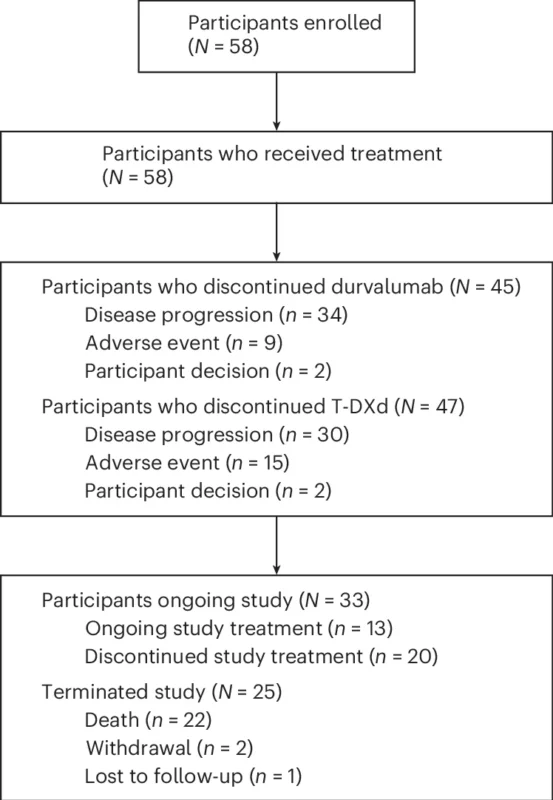
Between May 28, 2020, and March 28, 2022, 58 participants were enrolled in the durvalumab plus trastuzumab deruxtecan arm. All enrolled participants received treatment.
The median age was 54 years. Most participants had an Eastern Cooperative Oncology Group performance status of 0 or 1. Visceral metastases were present in 69.0% of participants.
The study population was predominantly PD-L1-negative. By central retrospective testing using the VENTANA PD-L1 SP263 assay, 79.3% of participants had PD-L1-negative tumors, defined as tumor area positivity score below 10%. Only 12.1% had PD-L1-positive disease, and 8.6% had missing PD-L1 scores.
Nearly 30% of participants had de novo metastatic disease. Around one quarter had received no prior treatment for breast cancer, and prior treatment for earlier-stage breast cancer was permitted if at least 6 months had passed before distant recurrence.
Antitumor Activity
All 58 participants were evaluable for efficacy.
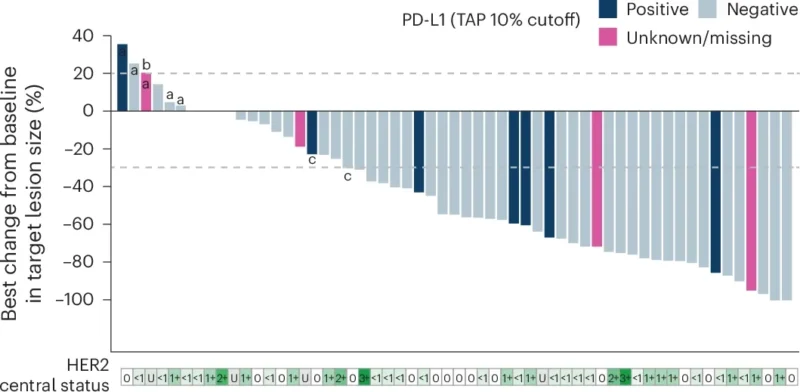
The confirmed objective response rate was 62.1%, with 36 of 58 participants achieving a confirmed response. One participant achieved a complete response and 35 participants achieved partial responses.
The unconfirmed objective response rate was 65.5%.
Responses were observed regardless of PD-L1 status. Among participants with PD-L1-positive disease, ORR was 57.1%. Among those with PD-L1-negative disease, ORR was 65.2%.
This is an important finding because most participants in this cohort were PD-L1-negative. In metastatic TNBC, immunotherapy benefit has generally been stronger in PD-L1-positive disease when combined with chemotherapy. In BEGONIA arm 6, the activity of durvalumab plus trastuzumab deruxtecan appeared not to be limited to PD-L1-positive tumors.
Duration Of Response, PFS And OS
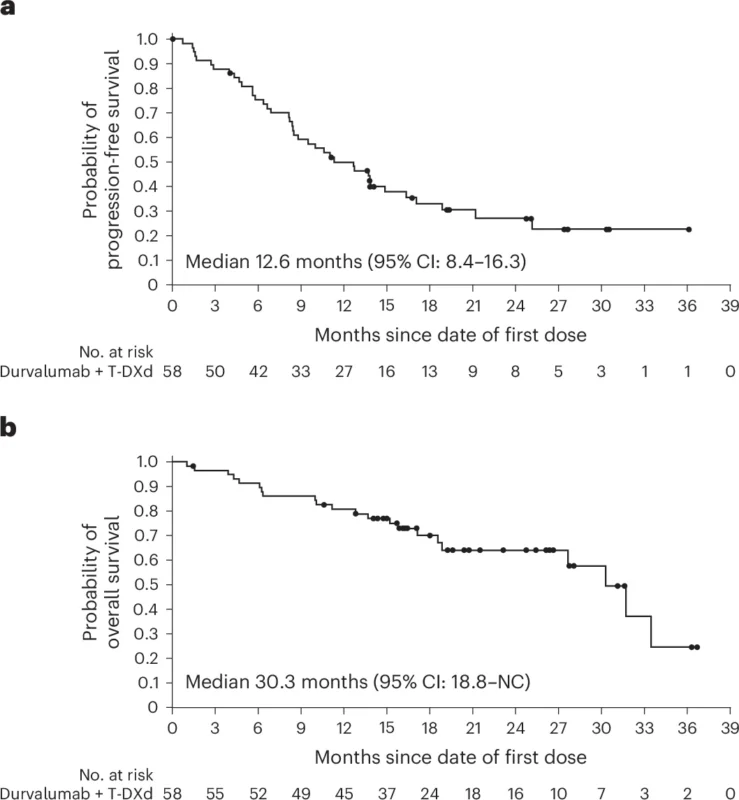
The median duration of response was 15.2 months. At data cutoff, 47.2% of responses were ongoing.
The proportion of responders remaining in response was 83.3% at 6 months and 63.6% at 12 months.
Median progression-free survival was 12.6 months. The PFS rate was 75.2% at 6 months, 50.1% at 12 months, 33.0% at 18 months, and 27.0% at 24 months.
Median overall survival was 30.3 months. OS rates were 91.3% at 6 months, 80.7% at 12 months, 70.0% at 18 months, and 64.1% at 24 months.
The overall survival analysis remains immature, with 62% of participants censored at the time of data cutoff.
HER2 Testing Raised An Important Question
Participants entered the study based on locally assessed HER2-low status. However, central retrospective HER2 testing showed substantial discordance.
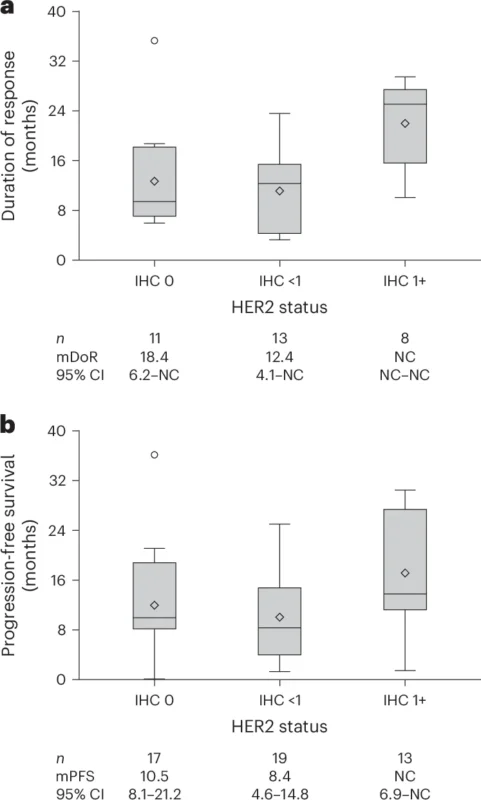
Central HER2 IHC 0 with absent membrane staining was found in 29.3% of participants. HER2-ultralow, defined as IHC 0 with membrane staining, was found in 32.8%. Central HER2 IHC 1+ was found in 22.4%, IHC 2+ in 5.2%, and IHC 3+ in 3.4%. Central testing was not possible in 4 participants.
Despite this discordance, responses were observed across centrally assessed HER2 expression groups, including HER2-ultralow and HER2 IHC 0 absent membrane staining.
This finding is clinically important but should be interpreted cautiously. The analysis was exploratory, and subgroup sizes were small. Still, it highlights a growing issue in breast oncology: HER2-low and HER2-ultralow classification can be affected by intratumoral heterogeneity, interobserver variation, and differences between local and central testing.
As HER2-directed antibody-drug conjugates move into broader breast cancer populations, accurate HER2 assessment is becoming increasingly important.
Safety Profile
The safety profile of durvalumab plus trastuzumab deruxtecan was generally consistent with the known safety profiles of the individual agents.
Almost all participants experienced at least one adverse event. Grade 3 or 4 adverse events occurred in 48.3% of participants.
The most common adverse events of any grade were nausea, fatigue, constipation, neutropenia, and vomiting. The most common grade 3 or 4 adverse events were neutropenia, anemia, and thrombocytopenia.
No febrile neutropenia was reported.
Serious adverse events occurred in 27.6% of participants. Adverse events led to discontinuation of durvalumab in 15.5% and trastuzumab deruxtecan in 25.9%.
ILD And Pneumonitis Remain Key Safety Issues
Interstitial lung disease or pneumonitis is a known adverse event of special interest with trastuzumab deruxtecan and is also relevant to immune checkpoint blockade.
In BEGONIA arm 6, adjudicated drug-related ILD or pneumonitis occurred in 20.7% of participants. Most cases were low grade. Grade 1 ILD occurred in 1.7%, and grade 2 ILD occurred in 17.2%.
There were no grade 3 or 4 adjudicated drug-related ILD or pneumonitis events. One grade 5 adjudicated drug-related ILD event occurred. The investigator reported this as pneumonitis related to COVID-19 after a grade 3 COVID-19 infection.
The study was conducted during the COVID-19 pandemic, and 22.4% of participants had COVID-19 infection recorded. This may have complicated interpretation of pulmonary safety findings.
The authors emphasized the importance of continued monitoring and early management of suspected ILD or pneumonitis.
Clinical Meaning
The study supports the clinical activity of combining an immune checkpoint inhibitor with a HER2-directed antibody-drug conjugate in first-line advanced HR-negative, HER2-low breast cancer.
The results are notable for several reasons.
First, the study population was largely PD-L1-negative, yet responses were observed regardless of PD-L1 status. This may suggest that antibody-drug conjugate-based combinations could extend immunotherapy-containing approaches beyond the traditional PD-L1-positive population.
Second, the median PFS of 12.6 months and median OS of 30.3 months appear clinically meaningful in this difficult-to-treat setting, although cross-trial comparisons should be avoided.
Third, central HER2 testing showed major discordance from local HER2-low classification, raising important questions about HER2-low testing reliability and the potential activity of trastuzumab deruxtecan across lower HER2-expression categories.
Finally, the safety profile was manageable but requires careful attention to ILD and pneumonitis risk.
Limitations
Several limitations should be considered.
This was a single-arm phase 1b/2 cohort with a relatively small sample size. Because all participants received the combination, the individual contribution of durvalumab versus trastuzumab deruxtecan cannot be separated.
The study did not meet its protocol-defined response threshold for an adequate efficacy signal, although the overall activity was still clinically relevant.
The biomarker analyses were exploratory and limited by small subgroup sizes. The study population was also predominantly White, with low representation of Black or African American participants, which may limit generalizability.
In addition, some participants received subsequent therapy before progression, which may have influenced interpretation of duration of response and survival outcomes.
Key Takeaway
In arm 6 of the BEGONIA platform trial, first-line durvalumab plus trastuzumab deruxtecan demonstrated clinically relevant activity in women with locally advanced unresectable or metastatic HR-negative, HER2-low breast cancer.
The combination achieved an objective response rate of 62.1%, median duration of response of 15.2 months, median progression-free survival of 12.6 months, and median overall survival of 30.3 months.
Responses were seen in both PD-L1-positive and PD-L1-negative disease, and across centrally assessed HER2 expression groups, including HER2-ultralow and HER2 IHC 0 absent membrane staining.
The safety profile was consistent with the known toxicities of durvalumab and trastuzumab deruxtecan, with ILD and pneumonitis remaining key adverse events requiring careful surveillance.
These findings support further evaluation of immune checkpoint inhibitor and antibody-drug conjugate combinations in advanced HR-negative, HER2-low breast cancer.