
ASCENT-03, presented at the 2026 ASCO Annual Meeting by Carlos H. Barrios, MD, evaluated the efficacy of sacituzumab govitecan compared with chemotherapy across biomarker-defined subgroups in patients with previously untreated advanced triple-negative breast cancer who were not candidates for PD-(L)1 inhibitors.
The analysis focused on whether the benefit of sacituzumab govitecan was consistent across Trop-2 expression, tumor BRCA status, and HER2 expression subgroups. This is clinically relevant because these biomarkers can influence treatment selection in metastatic breast cancer, and sacituzumab govitecan targets Trop-2, a marker commonly overexpressed in breast cancer.
Study Background
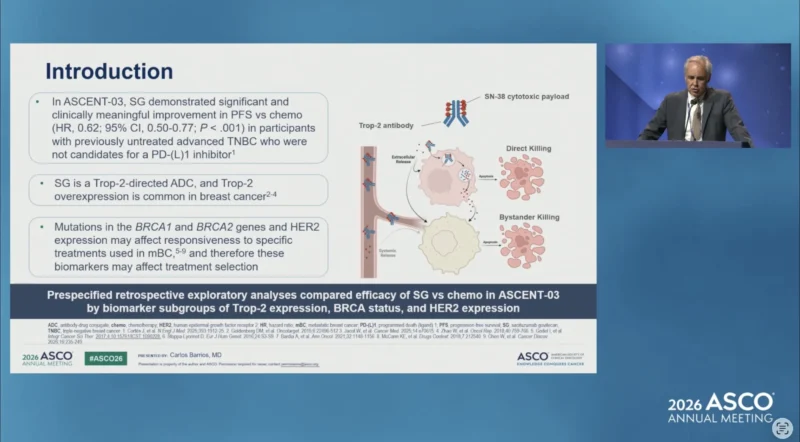
In the primary ASCENT-03 analysis, sacituzumab govitecan showed a significant and clinically meaningful improvement in progression-free survival compared with chemotherapy in patients with previously untreated locally advanced unresectable or metastatic TNBC who were not candidates for PD-(L)1 inhibitors.
The reported PFS benefit in the overall intent-to-treat population was consistent with the current biomarker analysis, with the slides noting a hazard ratio of 0.62 and a 95% confidence interval of 0.50 to 0.77.
Biomarker Analysis Design
ASCENT-03 randomized 588 patients 1:1 to receive either sacituzumab govitecan or chemotherapy. The chemotherapy options included a taxane or gemcitabine plus carboplatin.
This preplanned exploratory analysis assessed PFS by blinded independent central review according to three biomarker groups: Trop-2 expression, tumor BRCA genotype, and HER2 expression. Trop-2 expression was measured by immunohistochemistry. Tumor BRCA status was assessed using whole exome sequencing. HER2 expression was evaluated by in situ hybridization and immunohistochemistry.
Centrally tested tumor samples were used, and 43% of samples came from metastatic sites.
PFS By Trop-2 Expression
Trop-2 expression data were available for 499 patients. The median Trop-2 H-score was 240, and patients were divided into quartiles: Q1 from 0 to 184, Q2 from 185 to 239, Q3 from 240 to 283, and Q4 from 284 to 300.
Median PFS was longer with sacituzumab govitecan than chemotherapy across all Trop-2 expression quartiles. In Q1, median PFS was 8.5 months with sacituzumab govitecan versus 5.5 months with chemotherapy, with an HR of 0.54. In Q2, median PFS was 8.3 months versus 6.8 months, with an HR of 0.62.
In Q3, median PFS was 9.7 months with sacituzumab govitecan versus 7.0 months with chemotherapy, with an HR of 0.84. In Q4, median PFS was 9.9 months versus 8.1 months, with an HR of 0.60.
The slide conclusion noted that PFS was longer with sacituzumab govitecan across all Trop-2 H-score quartile subgroups, with no clear trend showing greater efficacy at higher levels of Trop-2 expression.
PFS By Tumor BRCA Status
Tumor BRCA status was available for 423 patients. Approximately 18% of patients had tumor BRCA mutations, with similar proportions between treatment arms.
In the tumor BRCA wild-type subgroup, median PFS was 8.8 months with sacituzumab govitecan compared with 6.9 months with chemotherapy, with an HR of 0.70.
In the tumor BRCA-mutated subgroup, median PFS was 12.7 months with sacituzumab govitecan versus 8.3 months with chemotherapy, with an HR of 0.59.
These findings suggest that the PFS benefit with sacituzumab govitecan was observed in both tumor BRCA wild-type and tumor BRCA-mutated subgroups, although interpretation remains limited by subgroup size.
PFS By HER2 Expression
HER2 status was available for 551 patients. Patients were analyzed as HER2 IHC 0 or HER2-low, defined as IHC 1+ or IHC 2+/ISH-negative.
In the HER2 IHC 0 subgroup, median PFS was 8.3 months with sacituzumab govitecan versus 5.6 months with chemotherapy, with an HR of 0.63.
In the HER2-low subgroup, median PFS was 9.8 months with sacituzumab govitecan compared with 8.3 months with chemotherapy, with an HR of 0.74.
This supports the activity of sacituzumab govitecan across HER2 expression categories included in the analysis.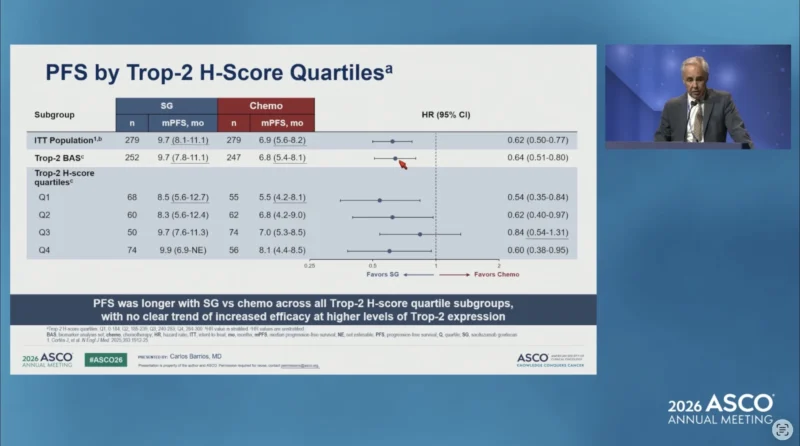
Clinical Meaning
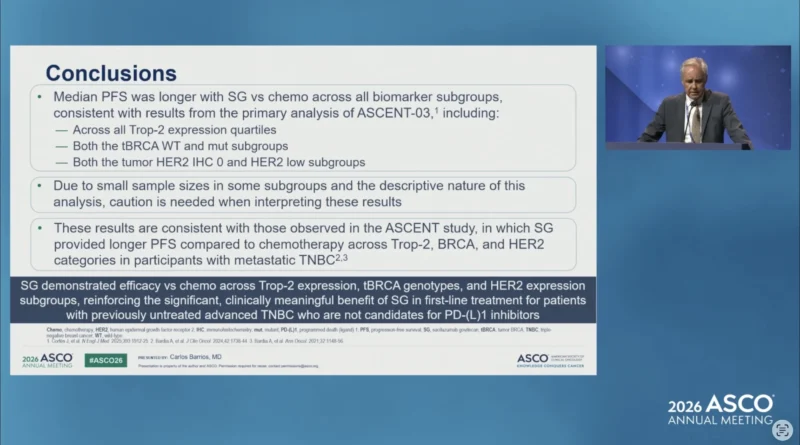
The ASCENT-03 biomarker analysis supports the consistency of sacituzumab govitecan benefit across multiple clinically relevant biomarker subgroups in previously untreated advanced TNBC patients who were not candidates for PD-(L)1 inhibitors.
The findings are aligned with earlier biomarker analyses from the ASCENT study, where sacituzumab govitecan also showed longer PFS than chemotherapy across Trop-2, BRCA, and HER2 categories in later-line metastatic TNBC.
However, the investigators emphasized that this was a descriptive exploratory analysis, and caution is needed when interpreting some subgroup results because of small sample sizes.
Key Takeaway
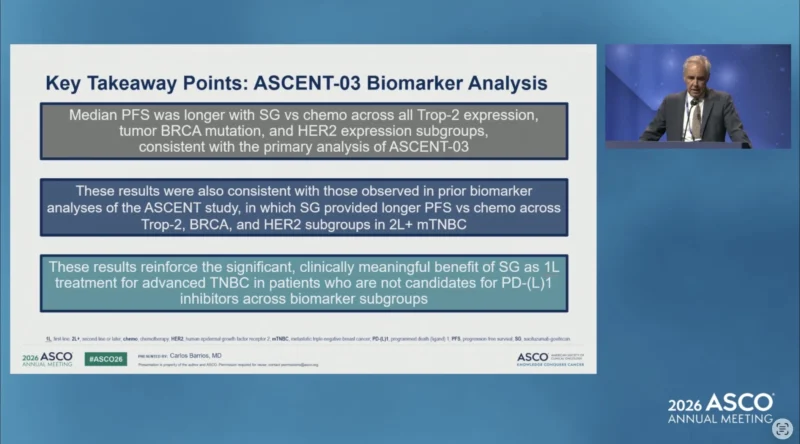
In ASCENT-03, sacituzumab govitecan improved median PFS compared with chemotherapy across Trop-2 expression quartiles, tumor BRCA genotypes, and HER2 expression subgroups. These data reinforce the clinically meaningful benefit of sacituzumab govitecan as first-line treatment for patients with advanced TNBC who are not candidates for PD-(L)1 inhibitors.