
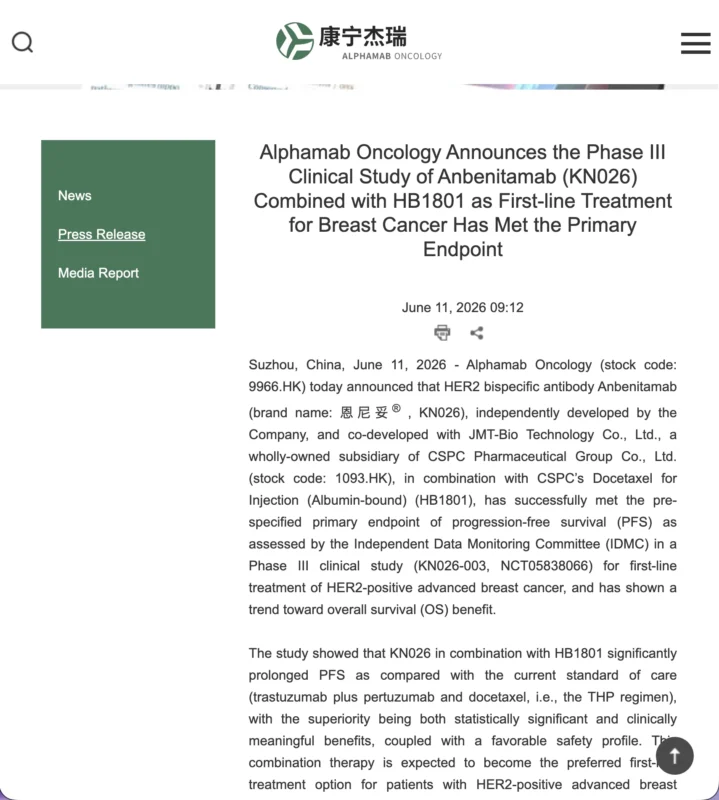
Alphamab Oncology announced that the phase III KN026-003 trial met its primary endpoint in first-line HER2-positive advanced breast cancer, marking a potential new signal for HER2 bispecific antibody-based therapy in this setting.
The randomized phase III study evaluated anbenitamab, also known as KN026, in combination with HB1801, CSPC’s albumin-bound docetaxel, compared with the current standard first-line regimen of trastuzumab plus pertuzumab and docetaxel, known as THP.
According to the company, KN026 plus HB1801 significantly prolonged progression-free survival compared with THP, as assessed by an Independent Data Monitoring Committee. The PFS benefit was described as statistically significant and clinically meaningful. The company also reported a trend toward overall survival benefit and a favorable safety profile. Detailed data are expected to be presented at an upcoming international academic conference.
Why This Update Matters
HER2-positive breast cancer has been transformed by HER2-targeted therapy. Dual HER2 blockade with trastuzumab and pertuzumab combined with docetaxel has remained a key first-line standard for HER2-positive advanced breast cancer.
However, disease progression remains a major challenge. Alphamab Oncology noted that although the THP regimen has prolonged progression-free survival, many patients still experience progression within two years. This creates an ongoing need for first-line regimens that can extend disease control while maintaining tolerability.
KN026-003 is important because it directly compared a HER2 bispecific antibody-based regimen against THP in the first-line advanced disease setting. According to Alphamab, this is the first head-to-head phase III study of a HER2 bispecific antibody combination to show superior efficacy over THP in first-line HER2-positive advanced breast cancer.
Study Design
KN026-003 is a randomized, controlled, open-label, multicenter phase III trial.
The study was designed to enroll approximately 880 patients with HER2-positive advanced breast cancer. Patients were randomized 1:1 to receive either the investigational regimen of KN026 plus HB1801 or the control regimen of trastuzumab plus pertuzumab and docetaxel.
The primary endpoint was progression-free survival assessed by blinded independent review committee. According to the announcement, the study met the prespecified PFS endpoint.
What Is Anbenitamab?
Anbenitamab, or KN026, is a HER2 bispecific antibody developed by Alphamab Oncology using its CRIB platform.
Unlike conventional monoclonal HER2 antibodies that bind one epitope, KN026 is designed to bind two non-overlapping HER2 epitopes: domain IV and domain II. This dual-epitope binding is intended to more comprehensively block HER2 signaling.
The company also states that KN026 can promote receptor clustering, enhance antibody-dependent cell-mediated cytotoxicity and complement-dependent cytotoxicity, and support HER2 receptor downregulation on tumor cells.
What Is HB1801?
HB1801 is an albumin-bound docetaxel formulation developed by CSPC.
According to Alphamab, HB1801 encapsulates docetaxel in human serum albumin and is free of Tween-80 and ethanol. The company states that this formulation does not require steroid premedication and can be administered rapidly at high concentration.
In KN026-003, HB1801 was combined with KN026 as the chemotherapy partner in the investigational first-line regimen.
A Potential Shift in HER2-Positive Advanced Breast Cancer
The announcement positions KN026 plus HB1801 as a possible future first-line option for HER2-positive advanced breast cancer in China.
The company stated that the combination significantly prolonged PFS compared with THP and showed a trend toward OS benefit. However, the exact median PFS, hazard ratio, confidence interval, response rate, and safety details have not yet been disclosed publicly.
This distinction is important. The topline result is positive, but the oncology community will need the full dataset to understand the magnitude of benefit, subgroup performance, durability of response, cardiac safety, infusion reactions, neuropathy, hematologic toxicity, treatment discontinuation, and quality-of-life impact.
Why The Safety Question Matters
The company highlighted a favorable safety profile for KN026 plus HB1801.
This will be closely watched because first-line HER2-positive metastatic breast cancer treatment often requires long-term disease control. A regimen used in this setting must balance efficacy with tolerability, especially during maintenance therapy after chemotherapy.
Alphamab also framed the regimen as a non-ADC approach that may preserve later use of HER2-directed antibody-drug conjugates. This could become relevant for sequencing strategies, particularly if a “first-line bispecific antibody, second-line ADC” approach is supported by future clinical data.
Still, until detailed results are presented, the safety comparison with THP and other emerging first-line HER2-directed regimens should be interpreted cautiously.
Full Treatment-Cycle Development
KN026 is being developed across multiple HER2-positive breast cancer settings.
Alphamab stated that KN026 plus HB1801 has completed a clinical development layout spanning neoadjuvant, adjuvant, and first-line treatment of HER2-positive breast cancer.
The company previously reported positive phase III results from the neoadjuvant KN026-004 study of KN026 plus HB1801 in HER2-positive breast cancer. KN026-004 was designed to compare KN026 plus HB1801, with or without carboplatin, against trastuzumab plus pertuzumab and docetaxel, with or without carboplatin, in early or locally advanced HER2-positive breast cancer.
In May 2026, anbenitamab also received approval in China for use with chemotherapy in adult patients with locally advanced or metastatic HER2-positive gastric or gastroesophageal junction cancer who had previously received at least one trastuzumab-containing regimen.
Clinical Meaning
The KN026-003 topline result adds momentum to the HER2 bispecific antibody field.
For HER2-positive advanced breast cancer, the key question is whether a bispecific antibody plus albumin-bound docetaxel can offer better first-line disease control than the long-established THP regimen without adding unacceptable toxicity.
If the full data confirm a meaningful PFS benefit, manageable safety, and supportive OS trends, KN026 plus HB1801 could become an important new first-line option in China and may influence global interest in HER2 bispecific strategies.
The results also raise a broader treatment sequencing question. As HER2-positive breast cancer care increasingly includes monoclonal antibodies, bispecific antibodies, tyrosine kinase inhibitors, and antibody-drug conjugates, the order of therapy may become as important as the individual drugs.
Key Takeaway
Alphamab Oncology announced that KN026-003, a phase III study of anbenitamab plus HB1801 versus THP, met its primary endpoint in first-line HER2-positive advanced breast cancer.
The company reported a statistically significant and clinically meaningful improvement in progression-free survival, a trend toward overall survival benefit, and a favorable safety profile.
The full results have not yet been presented. For now, KN026 plus HB1801 represents a promising topline phase III signal that may strengthen the role of HER2 bispecific antibody-based therapy in advanced breast cancer.