BGICC highlighted the growing role of dynamic neoadjuvant treatment in early-stage breast cancer, moving clinical decision-making beyond fixed regimens toward response-guided, biology-driven care. During the meeting, Prof. Hope Rugo discussed how integrating pathologic assessment, advanced imaging, and circulating tumor DNA (ctDNA) in the neoadjuvant setting can refine risk stratification, support treatment escalation or de-escalation, and optimize outcomes while minimizing unnecessary toxicity.
During her presentation at the Breast, Gynecological & Immuno-Oncology International Cancer Conference (BGICC), Hope Rugo outlined how the neoadjuvant setting offers a unique opportunity to refine breast cancer treatment by integrating biological markers, imaging, and circulating tumor DNA (ctDNA) to guide escalation and de-escalation of therapy.
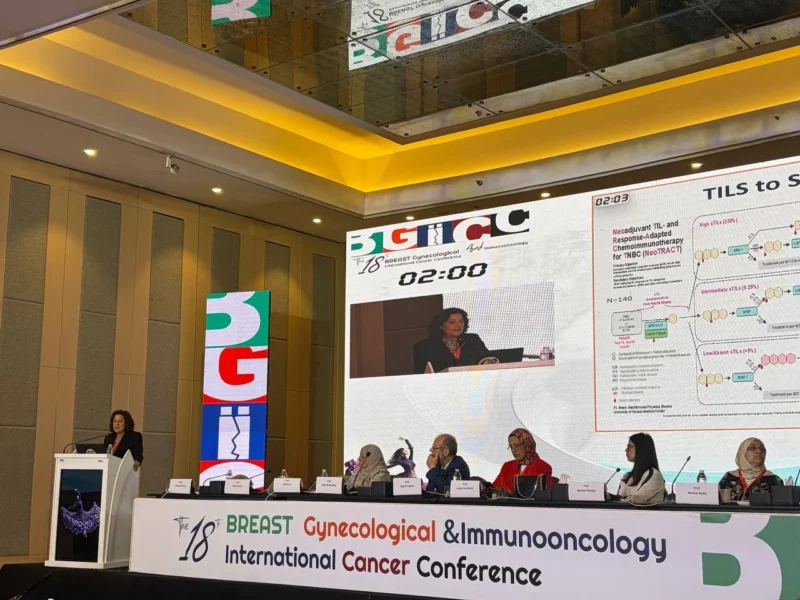
Prof. Rugo emphasized that neoadjuvant therapy provides major advantages for drug development and clinical decision-making. It allows in vivo assessment of pharmacodynamic markers, helping to demonstrate biological effects early in treatment. This setting also enables identification of biomarkers of response and resistance, while testing new agents in treatment-naïve populations, improving understanding of both efficacy and toxicity. Importantly, early surrogate markers such as pathologic complete response (pCR) can be evaluated without waiting years for survival outcomes.
She highlighted the limitations of relying solely on long adjuvant trials to assess benefit, citing the APHINITY study as an example where final overall survival results required more than a decade of follow-up. Such timelines are costly and delay access to effective therapies. Neoadjuvant strategies can shorten development time, reduce costs, and potentially address disparities in access to novel treatments.
A central theme of the talk was optimizing outcomes based on tumor biology rather than relying only on traditional markers such as estrogen receptor or HER2 status. Prof. Rugo discussed residual cancer burden (RCB) as a tool to stratify risk according to the amount of residual disease at surgery. Patients with minimal residual disease (RCB-I) often have outcomes similar to those achieving pCR, while the prognostic impact of residual disease varies significantly by biological subtype. In hormone receptor–positive disease, extensive residual disease may not translate into poor outcomes to the same extent as in highly proliferative tumors.
Ki-67 was discussed as a potential biomarker to guide treatment decisions, particularly in hormone receptor–positive disease, but Prof. Rugo noted its limitations due to variability across laboratories. She emphasized that gene expression testing is generally more accurate and reproducible, underscoring the need for better biomarkers to refine risk assessment.
BGICC Perspective: Rethinking pCR Through Biology, Imaging, and ctDNA
The complexity of using pCR as a surrogate endpoint was also addressed. Although pCR is a strong predictor of outcome in certain subtypes, it is not sufficiently sensitive as a regulatory endpoint on its own. Data from neoadjuvant immunotherapy studies show that improved event-free and overall survival can occur even among patients who do not achieve pCR, likely due to reductions in residual disease burden rather than complete eradication.
Imaging was presented as an important, but complementary, biomarker. Prof. Rugo stressed that imaging should not stand alone but be used alongside pathology and molecular markers. Functional imaging approaches, including FDG-PET and dynamic contrast-enhanced MRI, have shown correlations with surgical outcomes and long-term endpoints. In adaptive trials such as I-SPY, MRI-derived functional tumor volume combined with biopsy data has enabled accurate prediction of pCR, allowing some patients to safely de-escalate therapy and proceed to surgery earlier.
The I-SPY platform was highlighted as a model for adaptive neoadjuvant trial design. By using shared control arms, response-based randomization, and sequential treatment blocks, these studies allow early escalation for poor responders and de-escalation for those predicted to achieve pCR. Prof. Rugo presented examples where antibody–drug conjugates and immunotherapy enabled a substantial proportion of patients to proceed to surgery after limited therapy, particularly in biologically high-risk subtypes.
Circulating tumor DNA emerged as a promising biomarker across subtypes. Early ctDNA clearance during neoadjuvant therapy was described as a strong predictor of pCR, while persistent ctDNA at surgery was associated with higher recurrence risk regardless of hormone receptor status. These findings suggest ctDNA may refine the prognostic value of pCR and inform post-neoadjuvant treatment decisions.
In closing, Prof. Rugo underscored that treatment decisions should be based on both biology and disease stage. Integrating pathology, imaging, and ctDNA offers a path toward truly individualized therapy—one that avoids a “cookbook” approach, reduces unnecessary toxicity, and improves access to effective treatment, particularly in resource-limited settings.