ARCAGEN Trial, presented at the ESMO Sarcoma and Rare Cancers Congress 2026, evaluated the prevalence of actionable genomic alterations and assessed real-world access to matched therapies in patients with advanced rare cancers.
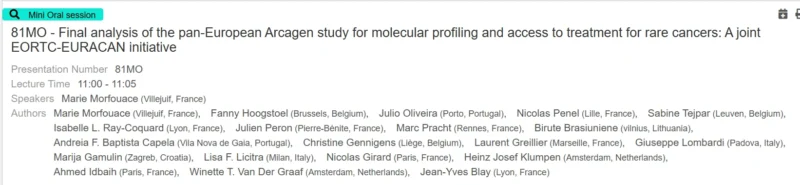
Authors: Marie Morfouace, Fanny Hoogstoel , Julio Oliveira, Nicolas Penel, Sabine Tejpar, Isabelle L. Ray-Coquard, Julien Peron, Marc Pracht, Birute Brasiuniene, Andreia F. Baptista Capela, Christine Gennigens, Laurent Greillier, Giuseppe Lombardi, Marija Gamulin, Lisa F. Licitra, Nicolas Girard, Heinz Josef Klumpen, Ahmed Idbaih, Winette T. Van Der Graaf, Jean-Yves Blay
Background
Rare cancers collectively represent a substantial proportion of oncology diagnoses but remain challenging to treat due to their heterogeneity and limited therapeutic options. Precision oncology approaches based on molecular profiling may help identify targeted treatment strategies.
The ARCAGEN study aimed to assess the prevalence of genomic alterations, their clinical actionability, and the real-world access to matched treatments in patients with advanced rare cancers.
Methods
ARCAGEN is part of the European Organisation for Research and Treatment of Cancer SPECTA program and enrolled 1,235 patients with advanced-stage rare cancers.
Within 3.5 years, 893 patients underwent successful molecular profiling using the FoundationOne Liquid CDx panel and were evaluable for potential access to personalized therapy.
Results of ARCAGEN Trial
Across 11 tumor domains within the EURACAN network, actionable genomic alterations were identified in 69.4% of patients (620/893).
Despite the high prevalence of actionable alterations, only 93 patients (15% of those with actionable findings) received a matched targeted therapy or immunotherapy.
Marked heterogeneity in treatment access was observed across tumor domains. Access to recommended therapies was seen in 19.4% of patients with thyroid or adrenal gland tumors and 16.1% of patients with neuroendocrine tumors, whereas no patients with rare thoracic malignancies received matched therapy, despite treatment recommendations in more than 60% of cases.
Among patients who did not receive matched therapy, 446 deaths were recorded, and the median overall survival was 1.1 years (95% CI 0.9–1.3).
Patients who received targeted therapy following study recommendations demonstrated a median overall survival of 3.3 years (95% CI 1.7–4.9). For those treated with immunotherapy according to study recommendations, the median overall survival was not reached.
Clinical Implications
The ARCAGEN study demonstrates that actionable genomic alterations are common across rare cancers. However, substantial disparities remain in access to precision oncology treatments across Europe.
These findings highlight the importance of expanding genomic profiling programs, improving access to targeted therapies, and developing innovative clinical trial strategies for rare cancers to ensure that patients can benefit from personalized treatment approaches.
Study Details
ARCAGEN is part of the SPECTA program (ClinicalTrials.gov identifier NCT02834884) conducted by the European Organisation for Research and Treatment of Cancer, with funding support from Roche.