As the World Health Organization (WHO) prepares to select its next Director-General, questions about its financial sustainability, institutional reform, and future role in global health are becoming increasingly important.
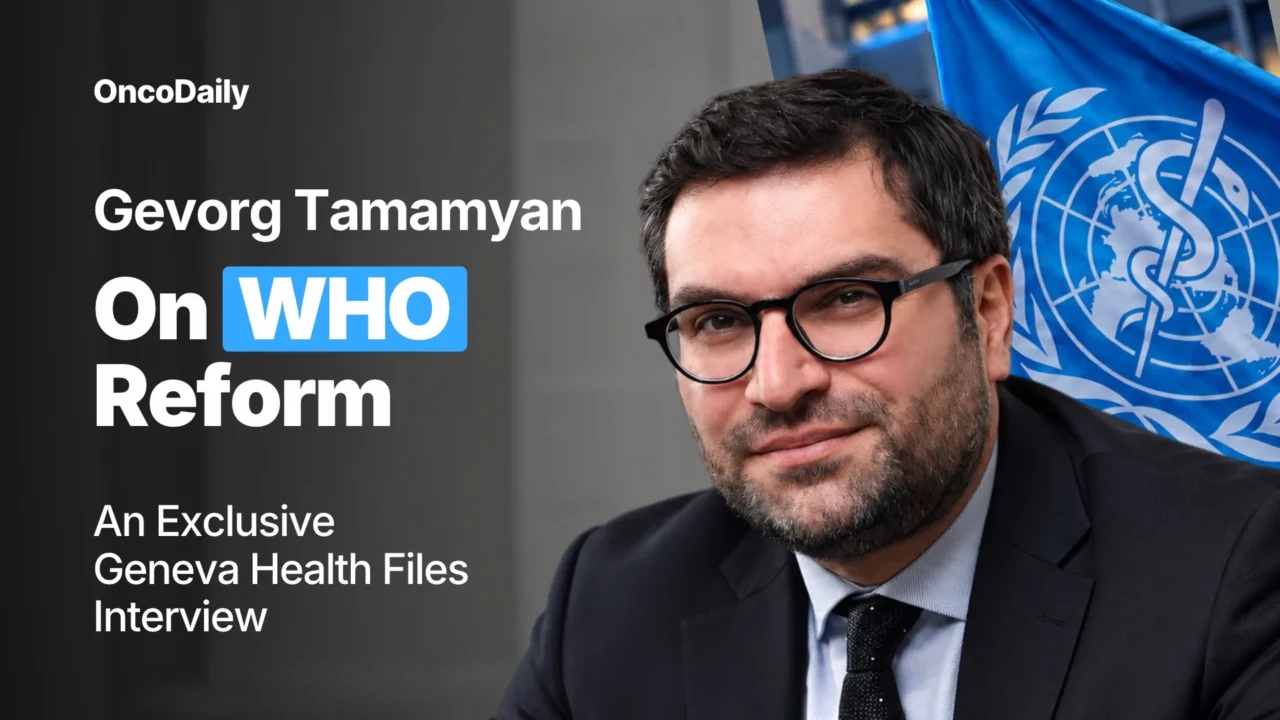
In an exclusive interview published by Geneva Health Files on November 5, 2026, Gevorg Tamamyan, a pediatric oncologist and candidate for WHO Director-General nominated by Botswana, shares his vision for the organization’s future.
Speaking with Priti Patnaik, Founder and Publisher of Geneva Health Files, Tamamyan outlines proposals to strengthen WHO’s financing, accountability, scientific leadership, and global health impact. His plans include mobilizing up to $1 billion annually through the WHO Foundation by 2037, modernizing the workforce, expanding the use of artificial intelligence, and improving healthcare delivery in conflict-affected regions.
The interview also explores his approach to international cooperation, pandemic preparedness, and ensuring that scientific advances translate into equitable access to healthcare.
Below, OncoDaily republishes the full interview with Gevorg Tamamyan, originally conducted and published by Geneva Health Files, with permission from the publication.
Originally published by Geneva Health Files on November 5, 2026.
Interview conducted by Priti Patnaik, Founder and Publisher of Geneva Health Files. Republished with permission.
Introductory Question: Your Specific Experience so Far that Would Help WHO
I have spent my career building the things WHO exists to make possible: a national pediatric cancer service, a research institute, a charity that covers every child, a global knowledge platform, and regional networks that span continents.
I built them in a small country affected by wars, with limited resources, where you learn quickly that the problem is rarely science. The problem is access, equity and delivery.
At 31 I was given the opportunity to consolidate Armenia’s fragmented pediatric cancer services into one national center. We standardized care, started the country’s first pediatric oncology fellowship, mentored a new generation of specialists, and survival rates rose to approximately 80%. With City of Smile, we made sure no family in Armenia pays for a child’s cancer diagnosis or treatment. That is what “universal health coverage” looks like when it is real, and I know what it takes to get there.
I co-founded OncoDaily and built it from zero into one of the world’s largest oncology communication platforms, reaching millions. I have led organizations across the public, private, and non-profit sectors, and I know how to make impact visible, which WHO can do much better.
Internationally, I served as the President of the International Society of Pediatric Oncology Asia Continental Branch (SIOP Asia) and of the POEM Group, which unites 110 centers across 28 countries, and as Co-Chair of the St. Jude Global Alliance regional committee for the WHO European Region, which unites 13 European countries. At SIOP Asia, we created around 45 country ambassador roles in two years, and the engagement grew significantly across the whole continent, making Asia not only the largest, but also one of the most active parts of SIOP. I have studied and worked in seven countries across Asia, Europe and North America, and I have worked on cancer care in conflict settings, including through the Institute of Cancer and Crisis.
I am not an insider of Geneva, and I do not pretend to be. I have never tried to be the smartest person in the room. My job has always been to find the best people, empower them, and hold them accountable. That is the job of the Director-General.
What I bring is the experience of a builder who has delivered results where the odds were against delivery, and who measures success by the lives changed, not the documents produced.
The Future of WHO
How do you view WHO’s role in a changing global health governance architecture?
WHO should lead, not compete. Architecture begins with who we are building for, and we are building for people: the patient, the nurse, the community health worker, the family that should not have to sell its house to buy a medicine.
The architecture has changed. Funding has contracted, two Member States have withdrawn, and countries are rightly demanding ownership of their own health agenda. In this landscape, WHO has four strengths no one else has: global legitimacy, normative authority, convening power, and neutrality in a crisis. These make WHO the natural orchestrator of global action, not another implementer competing for the same grants.
In practice this means three things. First, WHO does fewer things, fully. Together with Member States, we will agree on a limited number of flagship priorities where measurable global impact is possible, while protecting the normative and technical functions that only WHO can perform. Scaling back is not a unilateral decision of the Director-General; it must be done transparently with Member States, because that is how trust is restored and flexible financing unlocked.
Second, WHO turns “working with all stakeholders” into a system that delivers: a tiered partnership model with a small number of accountable implementation partners, a broader network of normative and advocacy partners, and an open civil society platform, each with clear roles and measurable outcomes. We will be inclusive but disciplined, and not afraid to say no when impact or equity are compromised.
Third, WHO stands with countries, not above them. The Accra Reset is right: country ownership, costed national plans, local and regional manufacturing, regional laboratory networks. The Global South is where innovation is born, not only where it lands. Scientists in Botswana were among the first to identify Omicron. WHO’s job is to make that capacity the norm.
Health is not a bloc. A WHO that is faster, more focused and closer to the people it serves is the one the world will keep choosing to fund and to join.
How will you make WHO more secure financially?
Financial security comes from three things: deliver visible results, focus on fewer things, and open a new source of flexible money that does not depend on the political mood.
Results first. Donors do not fund invisibility. Every year the Director-General, ADGs and Regional Directors will present a public report card to the Executive Board on progress against agreed metrics, including what was not delivered and why. I did this every 15 February as head of our national center, and it changed how partners trusted us. Flexible funding follows demonstrated impact.
Fewer things, done fully. Unfunded mandates weaken execution and weaken trust. With Member States, we will match priorities to resources transparently. A smaller, fully funded portfolio delivered end to end is worth more to a finance ministry than a long list of half-funded resolutions.
A WHO Foundation built for mass giving. In its first five years, the WHO Foundation mobilised about $215 million. I propose to turn it into a mass public-giving instrument, the way St. Jude raises billions every year from ordinary people. The target: ten million people giving $100 a year, or $10 a month, so that by 2032 the Foundation contributes $250 million a year in unearmarked support, on the way to $1 billion a year by 2037.
We proved this model works with City of Smile in Armenia. It comes with full transparency on administration costs, donor acquisition, and net transfers to WHO. In parallel, the Foundation should begin building an endowment so that WHO’s core is never again hostage to a single budget cycle.
And the basics. Universal membership, with the United States and Argentina back and paying assessed contributions. Continued progress on the assessed-contribution increases Member States have already agreed. And an organization that treats staff time as seriously as money.
How will you shape WHO’s role in the future of science?
WHO’s authority rests on rigorous, independent science, transparency about uncertainty, and the ability to turn evidence into action. Very often, our failure is not a lack of scientific knowledge, but our inability to translate that knowledge into access and outcomes. Geography must not decide who lives.
My priorities for WHO and science:
- Guidelines that are fast, independent, and usable. WHO’s normative work is its crown jewel. I will protect the independence of WHO’s scientific advice, shorten the time from evidence to guideline, and make more of WHO’s guidelines living, practical and implementable documents that a district hospital can actually follow. Position statements should be issued when evidence moves, not years later.
- Test against real-world evidence, and say when something fails. We will measure whether WHO-recommended interventions are reaching patients and improving outcomes, publish the results, and openly acknowledge where a strategy did not work. Transparency about failure is how science advances and how trust is rebuilt.
- Research capacity in every region. As CEO of the Immune Oncology Research Institute I helped multiply cancer clinical trials in Armenia, a country that had almost none. WHO should help the realization of regional clinical trial networks, regional laboratory networks and local manufacturing so that low- and middle-income countries are producers of science, not only recipients of it.
- Access to the fruits of science. There is no such thing as a miracle drug without access. WHO’s essential medicines work, prequalification and support to regional manufacturing are where science meets equity, and they will be resourced accordingly.
- Young scientists at the table. Many of the best scientific minds are young. They will have real roles in WHO’s leadership, not only internships.
I am a phsyician-scientist. I will surround myself with the best scientists in the world, from every region, and I will hold the Organization to their standard.
What specific steps would you take towards the climate and health agenda?
Climate change is a health emergency that arrives as dengue in new places, heat deaths among the elderly, malnutrition after floods, and interrupted treatment when a clinic loses power.WHO’s job on climate is to help countries keep clinics, medicines, and care working when the weather turns extreme, and to measure how many countries are ready.
- Climate-resilient health systems as the standard. WHO will give countries one practical toolkit: climate-resilient and low-carbon health facilities, heat-health action plans, early-warning systems for climate-sensitive diseases, and supply chains that keep medicines and vaccines moving when roads and power do not. We will measure how many countries have adopted and funded these plans.
- Continuity of care in climate disasters. The same principle I apply to conflict applies to floods and cyclones: a patient on dialysis, insulin or chemotherapy must not lose treatment because of an extreme weather event. Pre-mapping of vulnerable facilities and protected supply routes will be part of national emergency planning.
- Health at the climate table. Health should be the human face of climate negotiations. WHO will make sure health ministers are at the UN climate summits with concrete asks, and will work with partners to unlock climate finance for health systems, which today receives a tiny share.
- WHO’s own footprint. A credible advocate practices what it preaches. We will set and publish a decarbonisation target for WHO’s operations and procurement.
- Science, not slogans. WHO will continue to provide the evidence on climate-sensitive disease burden, air pollution and heat so that governments can act on causes, not only consequences. Clean air, clean water and safe food are prevention at scale.
I will not make the climate agenda a reason to add a hundred new workstreams. I will make it a lens applied across the priorities we already commit to deliver.
How will you get WHO to lead the digital and AI transformation for global health?
While I wrote my vision statement, AI tools on my computer were suggesting edits. At the same time, children with cancer who could be cured were not even getting diagnosed. The question for WHO is not whether AI is powerful. It is whether its benefits reach the places that need them most, and whether people can trust what they are told.
WHO cannot and should not build the technology. It should do what only WHO can do:
- Set the standards. Clear, fast global guidance on the safe, ethical and equitable use of AI in health. Regulators in low- and middle-income countries should not have to invent this alone. WHO will help countries adapt and implement them according to their national needs.
- Protect the information ecosystem. Misinformation now travels faster than any pathogen. “Recommended by WHO” was a synonym for trust for generations, and it must be again. I built one of the world’s largest health communication platforms from zero, and I know this is about speed, clarity and credibility, not about press releases. WHO will communicate the way people actually consume information in 2027.
- Close the digital divide in delivery. Digital tools should help a nurse in a rural clinic, not only a hospital in a capital. WHO will prioritise interoperable, open digital health infrastructure, support countries with digital health plans and workforce training, and partner with others rather than duplicate them.
- Modernise WHO itself. An organisation that takes years to fill a funded post cannot credibly lead a digital transformation. We will accelerate the responsible use of digital and AI tools within WHO itself: in recruitment, guideline development, surveillance, translation across the six official languages, and making WHO’s data open and usable in real time.
- Bring in the people who understand it. This is one more reason to bring a new generation into WHO leadership. The people building this technology are mostly young, and WHO today has fewer than 1% of its staff under 30.
My test for any digital or AI initiative is simple: does it shorten the distance between evidence and a patient, and does it do so for the people furthest behind?
The Governance Metrics for the New DG
How will you make WHO more efficient in terms of resources, budgeting and accountability?
What gets measured gets done. What gets delivered builds trust.
- Every year, the Director-General, ADGs and Regional Directors will present a public report card to the Executive Board, by name, against agreed indicators within their responsibilities: what we committed to, what we delivered, what we did not and why, and what we commit to next. My numbers will be the first line.
- Building on WHO’s existing results framework, I will strengthen a common system of accountability across the whole Organization, signed by the Director-General and all six Regional Directors, so that headquarters, regions and country offices work towards shared outcomes, with WHO’s contributions clearly measured and reported to Member States.
- Quarterly public reporting on the operational basics: how long funded posts stay vacant, by department and region; how long recruitment takes; where approvals are stuck. Delaying approval must not become a way to delay accountability.
Budgeting that matches ambition to money. Priorities will be defined, resourced, assigned and measured together. Unfunded mandates will be named as such in the programme budget rather than quietly absorbed. Time, including staff time, will be treated as a finite resource like funding: success is judged by lives improved, not documents produced.
A structure built for action. Align authority with responsibility; empower technical leaders to decide; cut processes that exist only to protect the process; and move more power into the regions and countries where the work is, putting WHO’s expertise next to the ministries and clinics it serves.
Integrity as a measured outcome. WHO’s investigations function handled 1,174 cases in 2025 and closed 636, leaving 538 open at year-end. Zero tolerance cannot be a slogan. I will publish indicators that matter: do people trust the system enough to report, are those who report protected, do survivors receive timely support, and do we learn from what went wrong? Investigations will be independent and timely, and seniority will never buy protection.
How will you address human resources in a restructured and weakened organization?
WHO has extraordinary people working under immense pressure, and the past year has been brutal for them. Roughly a quarter of the workforce has gone in the last years, with entry-level and mid-career professionals among the hardest hit.
My first responsibility will be to the people who stayed: make WHO the best place to work, attract the best global talent, including those exceptional people who left, and align responsibility with accountability.
I will start with the HR system itself, because that is where the bureaucracy begins.
No empty desks. I know of important, fully funded positions at WHO that stayed empty for years, covered on paper by someone “in charge”. Under my leadership, a post covered by an acting arrangement counts as vacant, is reported as vacant, and is filled. For every funded post approved for recruitment, an offer will be issued within 60 calendar days of launch. Recruitment starts the day a departure is known. We will stop rebuilding the process for every vacancy: pre-approved job descriptions for recurring roles, standing interview panels, and pools of candidates already assessed competitively. Every quarter we publish how long each post stayed empty and where delays happened. My own appointments will be measured by the same clock.
A safe workplace, measured. Zero tolerance will be measurable: trust in reporting, protection of those who report, timely support to survivors, independent and timely investigations, and no protection by seniority. These indicators will be published.
Staff voice as a performance metric. My ambition is to make WHO a workplace where more than 90% of staff report that they feel respected, supported and empowered. We will establish the baseline, publish the methodology and track progress transparently. When asked in Berlin what success would look like, my answer was about people, and I meant WHO’s people too.
How will you modernize the workforce in light of new challenges?
Today fewer than 1% of WHO staff are under 30, and recruitment takes 154 days on average. An organization that cannot hire fast and cannot hire young cannot lead on AI, climate, or the next pandemic.
- A new generation in leadership now. There are outstanding young global health leaders already running institutions, programs, and movements at scale. They should not wait for their biological age to become “acceptable”. At WHO, they will hold real decision-making authority and governance seats, accountable for results from day one, alongside experienced experts. I led a national pediatric cancer center at 31; I know what young people can deliver when trusted.
- An experience ladder and rotation. Clear pathways from early career to senior technical and country leadership, with structured rotation between headquarters, regions and countries so that no one leads a country programme without having worked in one.
- Performance that is addressed. A culture where excellence is recognised and under-performance is dealt with fairly and promptly, rather than managed around.
- Skills for the decade ahead. Data science, digital health, communication and partnership management will be core competencies, not add-ons, supported by the WHO Academy and by secondments with academic and industry partners.
- Open doors. You never start looking for great people only when a desk becomes empty. My door, and those of every ADG and director, will be open to the talent WHO will need next, so that recruitment draws from a known pool rather than starting from zero.
How will you reform technical support to make WHO’s engagement at the country level more meaningful?
At the centre of every health system are patients and the doctors, nurses, community health workers and public health professionals who serve them. WHO’s country presence should be a force multiplier for those people, supporting national systems, never replacing them.
I will do four things.
- Put the experts where the work is. A country office with real technical depth next door to the ministry is worth more than a mission from Geneva twice a year. Member States, if willing, should be able to host WHO functions or innovation hubs.
- Measure WHO’s contribution to country outcomes. Member States own delivery, but WHO must be accountable for the support it provides and the difference that support makes. We will track three things: what WHO delivered, what the country adopted and implemented, and what changed in people’s health. Does the country have a costed national plan, a functioning disease registry, access to essential medicines, standards of care in use, and the targeted technical help it asked for? These will inform country-office performance, with WHO’s contribution clearly identified and reported in the annual report card, not simply the number of workshops held.
- Be the place a country can call. When a health minister has a problem, WHO should be the first call, even when the problem is not neatly inside our mandate. We should not hesitate to take the call, to call someone we know, and to help.
- Respect ownership. Technical support means leaving a country stronger than we found it: specialists trained, a registry that works, a laboratory network and regional manufacturing that stay after WHO leaves the room. It means helping a country turn its own plan into something finance ministries and development banks will fund. Aid that perpetuates dependency is not support. The Accra Reset, led from Africa, has this right, and I will make WHO its most practical partner.
How do you see the role of the regional offices? What reforms are necessary?
Stronger regions mean a stronger headquarters. I do not propose to centralise the appointment of Regional Directors; regions and their Member States should keep choosing their own leaders, and I welcome Regional Directors who run for Director-General. Proximity to Member States is the regional offices’ greatest asset.
The reform needed is shared accountability, not a change of ownership:
- One accountability framework, signed by seven people. The Director-General and all six Regional Directors sign a single set of outcomes and report against it to Member States together. Headquarters, regions and countries are then measured on the same scoreboard, and friction between tiers becomes visible and fixable rather than hidden.
- Clear division of labour. Headquarters sets norms and standards and holds the global convening role; regions adapt and coordinate technical support; country offices support nationally led implementation, working closely with ministries. Functions that are duplicated across the three levels will be consolidated at the level closest to the people served.
- Regions as technical homes. Regional offices become the home of a significant part of WHO’s technical expertise, which also makes them more attractive to the best professionals of their own regions.
- The same transparency rules everywhere. Vacancy reporting, recruitment deadlines, misconduct indicators and the annual public report apply to every region, by region, so that Member States can compare.
The test is simple: a minister in Gaborone, Ulaanbaatar or Panama City should feel that WHO’s regional office is theirs, fast, and accountable to them.
To improve internal governance, which reforms are necessary, for example with respect to the Executive Board?
The Director-General does not control the governing bodies, and I will not promise reforms that belong to Member States. What I can promise is a Secretariat that gives the Executive Board what it needs to govern well: clear priorities, honest numbers, and results it can hold us to.
Give the Board results to govern, not documents to note. Every year the Director-General, ADGs, and Regional Directors will stand before the Board with a public report card against agreed metrics. Board sessions should spend less time receiving reports and more time holding leadership to account for outcomes. I will ask the Board to treat that report card as the core of its oversight.
Fewer, better papers. Member States drown in documentation. The Secretariat will cut the volume and length of governing-body papers and lead each with the decision requested, the cost and the measure of success. Success is judged by lives improved, not by the number of documents produced.
Resolutions that are costed and owned. The Secretariat will provide, wherever feasible, transparent estimates of costs, implementation requirements, responsibilities and measurable results for proposed resolutions before WHO’s governing bodies. Member States retain their authority to propose and adopt resolutions. Unfunded mandates weaken execution and unimplemented resolutions weaken trust. I will propose that the Board review, every year, which resolutions remain unfunded and decide transparently what to do about them.
Radical transparency to the Board. Vacancy data, recruitment times, misconduct indicators, Foundation transfers and partnership agreements will be reported to the Board on a fixed calendar, not on request.
The Ability to Take On Difficult Political Equations
How will you provide leadership on WHO’s operational activities in conflict settings?
I come from a small country affected by wars. I have treated children with cancer while a conflict was underway; I chair the Institute of Cancer and Crisis, and I co-authored the manifesto on cancer care in conflict-impacted populations with Dr Tedros and HRH Princess Dina Mired. I know what it means when the drugs do not arrive.
WHO’s neutrality is not silence. It is active engagement with every party to a conflict in order to protect patients and health workers. My leadership will rest on four commitments.
Be there. WHO must maintain a direct physical presence in conflict zones. When WHO evacuates thousands of people from a conflict zone or vaccinates against polio under bombardment, it is doing some of the most important work on earth. We will do more of it, and we will make sure the world knows.
Keep care going. Emergencies are measured in outbreaks; chronic disease deaths in crises are rarely counted. A child on chemotherapy, a patient on dialysis or insulin, a woman in labour must not lose care because a front line moved. WHO will map vulnerable chronic-care facilities in real time before conflicts escalate, negotiate protected health corridors for essential medicines and evacuations, and make continuity of care a standard part of every emergency response.
Defend health care from attack. Attacks on hospitals and health workers have become routine. WHO will continue to document every attack publicly and in real time, and I will use the Director-General’s voice, with heads of state, to make the protection of health care a political cost for those who violate it. Dr Hans Kluge’s proposal for a heads-of-state committee against attacks on health care is a great idea, and I would pursue it.
Speak. When lives are at risk, we cannot remain passive. When our voice can make a difference, we must use it, with facts, with every party, and without fear. Persistence will define my leadership in these settings as it has defined my career.
As a pediatric oncologist, I learned that we must always do our best even when success is uncertain. That is exactly the discipline conflict settings demand.
How will you address the relationship with countries that are not part of the WHO, such as the U.S., Argentina, and potentially other countries?
We need the United States back in WHO. We need Argentina back in WHO. Universal membership is not a slogan; it is what makes WHO’s norms global and its surveillance complete. Within my first 100 days, I will travel to Washington and Buenos Aires to listen, to understand why they left, and to ask them to return.
I will go with three things.
- Listening first. The concerns raised by departed capitals about duplication, bureaucracy, transparency and accountability are largely the same concerns raised by the Member States who stayed. I do not need to agree with every criticism to take it seriously. Earning trust back starts by changing what needs to change, not by lecturing.
- Reforms already underway. No empty desks. Quarterly vacancy reporting. An annual public report card from the DG, ADGs and Regional Directors. Measurable zero tolerance on misconduct. These are not concessions to any one country; they are the reforms WHO needs anyway, and they answer the stated reasons for leaving.
- A candidate without a bloc. I am an Armenian nominated by Botswana, the only cross-regional candidacy in this race. I belong to no regional caucus and no great-power camp. That lets me sit across the table in Washington, Buenos Aires, Beijing, or Brussels as an honest broker whose only interest is the health of their people and the strength of the Organization.
I studied and trained in the United States, and I was inspired by Paul Farmer. I want Americans and Argentinians to feel again that WHO is theirs. The world is stronger together.
Supplementary: How will you support the PABS negotiations and the subsequent implementation of the Pandemic Agreement?
COVID-19 showed what extraordinary science can achieve: vaccines were developed in record time. But it also exposed our failure to ensure equitable access. Countries shared pathogens and scientific information, yet many waited at the back of the queue for vaccines and treatments. PABS must ensure that this never happens again.
The Director-General does not negotiate for Member States, but must help them succeed.
These negotiations have already taken longer than Member States intended, and they may still be under way when the next Director-General takes office. If the PABS annex has been adopted, my priority will be implementation. If it has not, I will give the Intergovernmental Working Group the technical and legal support it needs, and use WHO’s convening power, including with heads of state and government, to help countries find common ground without reopening what has already been agreed.
My nomination is cross-regional, and I come to this discussion to listen to everyone and help find solutions.
The principle is simple: rapid sharing of pathogens and sequence information must be matched by binding commitments to equitable access to vaccines, diagnostics and treatments.
An agreement that is adopted but not implemented weakens trust. From my first day, I will prepare a clear WHO delivery plan, developed with Member States and brought to the Executive Board, with responsible leadership, financing proposals and public milestones. It will support countries in signature and ratification, prepare the Secretariat to carry out the functions Member States assign to WHO under the Annex, and prepare for the contractual responsibilities assigned to WHO under the final agreed framework. Once the Agreement enters into force, this work will serve the Conference of the Parties. Our measure of success must be whether vaccines, diagnostics and treatments actually reach the countries that need them, not simply whether agreements are signed.
We must also address misinformation. The Agreement explicitly protects national sovereignty, and WHO cannot impose lockdowns, vaccination mandates, travel restrictions or domestic measures on any country. We must explain clearly what it does and does not do.
Every year, I will report publicly to the Executive Board and the World Health Assembly on what has been achieved, what remains unresolved and what we are doing about it.
Read the original interview: Exclusive Q&A With WHO DG Candidate Gevorg Tamamyan – Geneva Health Files
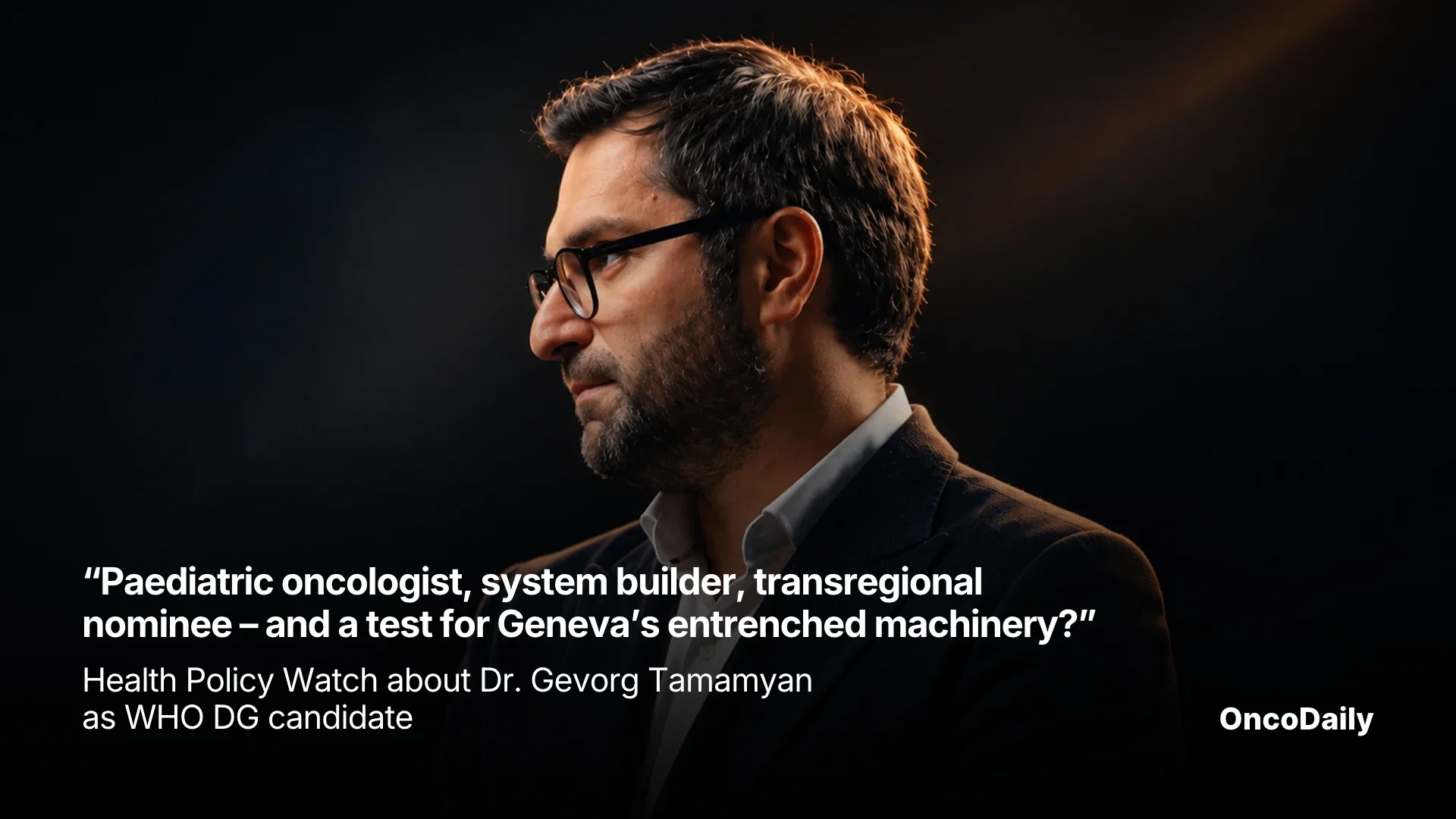
Read further on OncoDaily: Health Policy Watch Examines Gevorg Tamamyan’s WHO Bid
Disclosure: Gevorg Tamamyan is Co-Founder and Editor-in-Chief of OncoDaily. This article reports on his interview with Geneva Health Files, an independent publication, and includes publicly available context about the WHO Director-General selection process.