


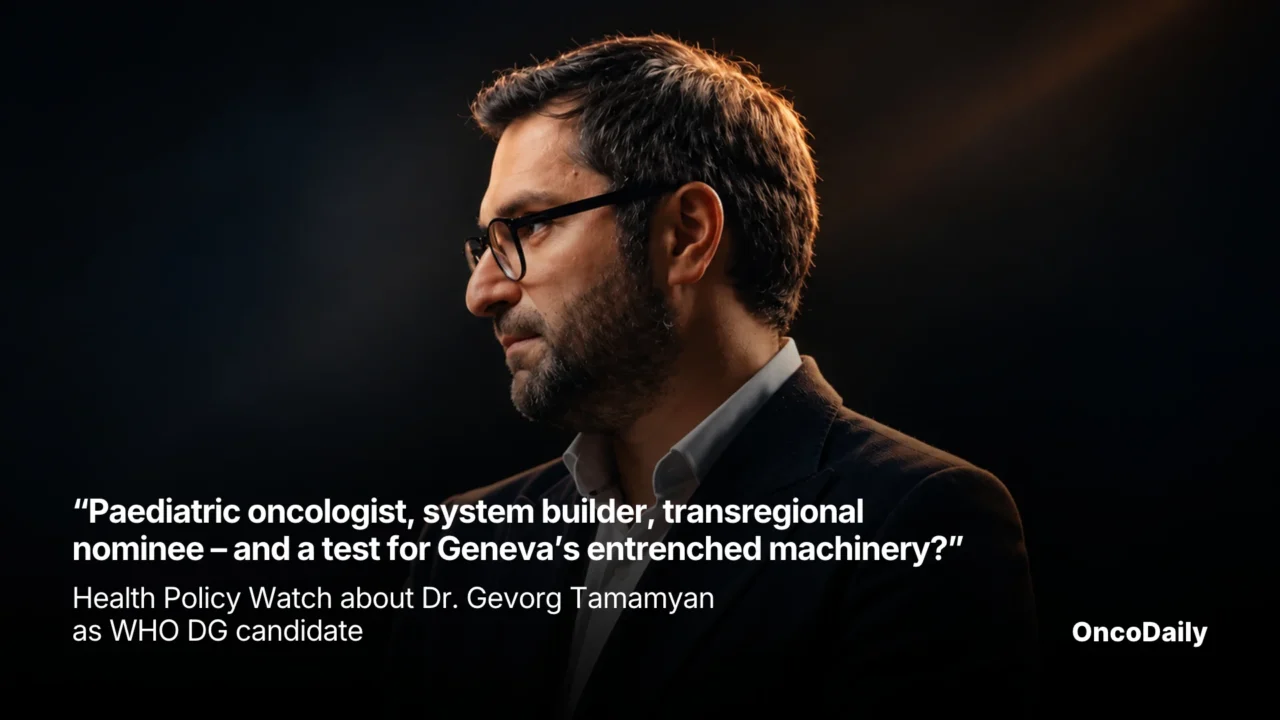
Can a pediatric oncologist who has built healthcare systems lead the world’s most influential health organization? This is the central question raised in a new Health Policy Watch analysis of Gevorg Tamamyan’s candidacy for WHO Director-General.
Published on October 28, 2026, the article by Felix Sassmannshausen examines Tamamyan’s professional record, his unconventional nomination by Botswana, and his proposals to reform the World Health Organization (WHO).
The analysis presents Tamamyan as a candidate whose experience differs considerably from that of traditional WHO leadership contenders. At 39, he is the youngest of seven candidates, entering the race with a background in pediatric oncology, healthcare system development, and international medical cooperation rather than ministerial or UN executive leadership.
But the article goes beyond his biography, examining whether his ambitions for a more patient-centered WHO can survive the political, administrative, and financial realities of Geneva.
From Pediatric Oncology to Global Health Leadership
Health Policy Watch traces Tamamyan’s journey from consolidating Armenia’s pediatric cancer services to building international oncology networks.
At 31, he led the unification of fragmented pediatric oncology services into Armenia’s Pediatric Cancer and Blood Disorders Center. Under his leadership, the center introduced standardized multidisciplinary care, established the country’s first dedicated pediatric oncology fellowship program, and reportedly achieved childhood cancer survival rates approaching 80%.
His international leadership spans the Pediatric Oncology East and Mediterranean (POEM) Group, a network of 110 cancer centers across 28 countries, and his role as President of SIOP Asia. He also co-founded the City of Smile Charitable Foundation and OncoDaily, and established two institutions in Armenia: the Immune Oncology Research Institute and the Institute of Cancer and Crisis.
These experiences form the foundation of his WHO for U campaign, built around the principle that geography should not determine who lives.
His reform agenda includes a 60-day recruitment target to address WHO’s reported 154-day average hiring process, stronger national ownership of healthcare systems, expanded local biomanufacturing, and greater transparency in institutional financing.
The analysis also highlights his proposals to maintain healthcare delivery in conflict zones through protected medical corridors, and to reform the WHO Foundation by attracting millions of individual donors to provide more flexible financial support.
His first 100 days roadmap includes direct diplomatic outreach to the United States and Argentina, with the aim of encouraging their full participation in WHO.
Botswana’s Nomination Challenges Traditional WHO Politics
One of the most unusual aspects of Tamamyan’s candidacy is its geopolitical structure: an Armenian physician nominated by Botswana.
According to Health Policy Watch, this cross-regional nomination challenges established voting blocs and traditional assumptions about which regions should produce WHO leadership candidates.
The partnership reflects shared priorities around health sovereignty, country ownership, and the Accra Reset, an initiative advocating a shift away from aid dependency toward locally led health systems.
Yet the publication also identifies potential political obstacles. Botswana’s nomination places Tamamyan outside conventional African regional consensus-building, while his Armenian nationality introduces another candidate from WHO’s European Region.
For a candidate positioning himself as independent of established political blocs, building the diplomatic support necessary to win the election may be as demanding as implementing his proposed reforms.
The Geneva Question: Can a System Builder Manage WHO?
Perhaps the strongest part of the Health Policy Watch analysis concerns the gap between an ambitious reform agenda and the practical responsibilities of leading WHO.
The organization faces financial pressures, administrative constraints, competing national interests, and growing demands to demonstrate measurable results.
Tamamyan proposes addressing these challenges through more accountable management, faster recruitment, transparent financing, and a stronger focus on country-level outcomes.
However, the analysis questions whether someone without senior ministerial or UN executive experience can manage an international organization governed by complex legal frameworks, civil service regulations, and political compromises.
Addressing concerns about leadership experience, Tamamyan explained his approach to building effective teams:
“I have never tried to be the smartest person in the room.”
He argues that effective leadership depends on assembling capable people, empowering them, and holding them accountable.
Health Policy Watch also identifies a potential tension in his philosophy: his commitment to responding to patients and countries beyond rigid institutional boundaries could conflict with calls for WHO to narrow its responsibilities and reduce unfunded mandates.
The question is not simply whether reform is needed, but whether an outsider can deliver it without creating additional institutional pressures.
Tamamyan Responds: Answers, Not Slogans
Following the publication, Tamamyan shared a LinkedIn post thanking Health Policy Watch and Felix Sassmannshausen for their examination of his candidacy.
He welcomed the analysis for addressing the challenges behind his vision rather than focusing exclusively on his professional achievements.
“I appreciate that the article does not stop at the biography. It asks the right questions: Can an outsider to ministries and UN headquarters run the world’s health agency?”
Tamamyan also acknowledged the tension between providing support to countries in need and maintaining WHO’s institutional focus, as well as the practical difficulties of implementing ambitious reforms under existing financial and administrative rules.
Rather than dismissing these concerns, he emphasized that his campaign would provide concrete responses.
“These are fair questions, and they deserve answers rather than slogans. Over the coming months I will address them one by one, with numbers, with names, and with what we have actually built.”
He concluded by emphasizing the importance of an informed and transparent election process.
“Member States should have the full picture before they choose. That is what this election is for.”
A Test of Vision and Execution
The Health Policy Watch profile places Tamamyan’s candidacy within a broader question about the future of global health leadership: Does WHO need another experienced political executive, or could a leader from outside its traditional structures bring a different model of governance?
His experience in pediatric oncology and international healthcare development provides examples of system-building in resource-constrained settings. Whether those achievements can translate into the management of a multibillion-dollar international organization remains the central question.
His candidacy presents the possibility of a positive disruptor: a leader who questions established practices, brings experience from frontline care and institution building, and seeks practical improvements in how WHO serves countries and patients.
As the 2027 WHO Director-General election approaches, the test is whether that patient-centered reform agenda can move beyond its vision and demonstrate a credible pathway to implementation.
For now, the challenge is clear: convincing WHO Member States not only that change is necessary, but that he can deliver it.
Read the full Health Policy Watch profile.
Read further on OncoDaily: “Stronger Regions, Stronger Countries…” – Dr Gevorg Tamamyan
Disclosure: Gevorg Tamamyan is Co-Founder and Editor-in-Chief of OncoDaily. This article reports on the analysis published by Health Policy Watch and Tamamyan’s public response to it.