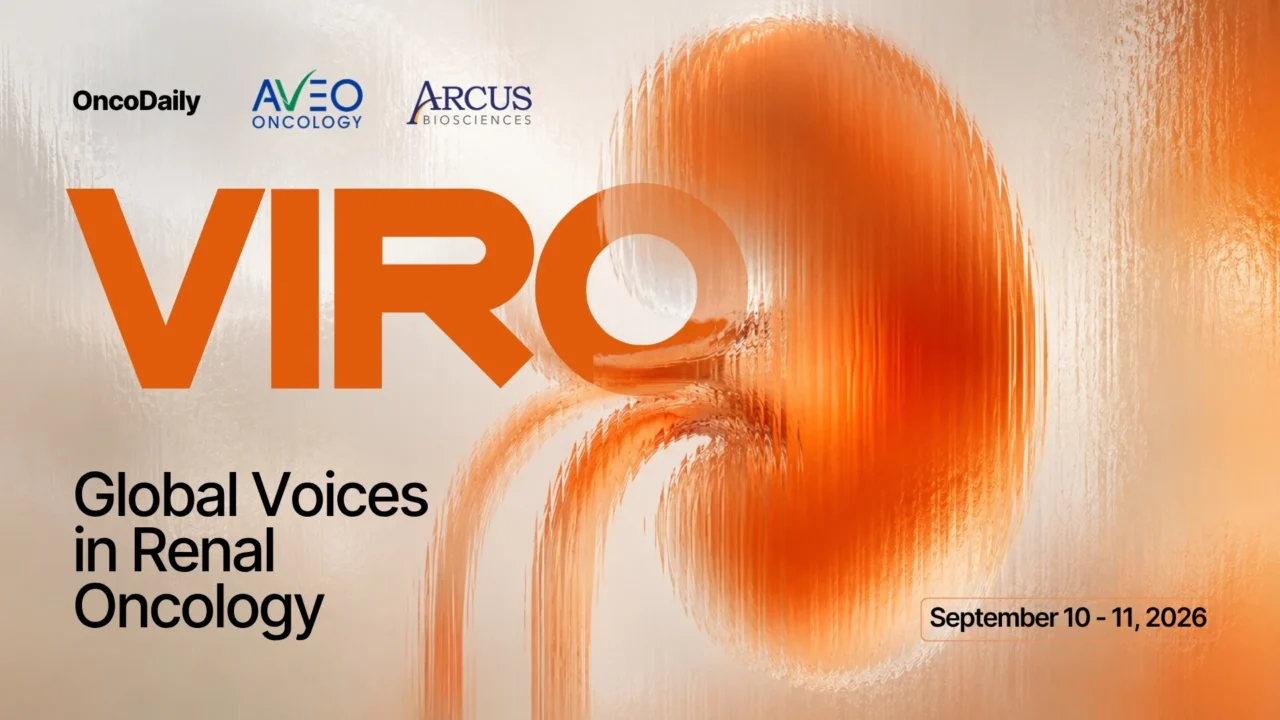
On September 10–11, 2026, VIRO 2026 – Global Voices in Renal Oncology will bring together an international community of specialists for a virtual congress dedicated to renal oncology, renal cell carcinoma, and the changing management of kidney cancer.
Organized as part of the OncoDaily O Series, VIRO 2026 will examine renal cancer care across the full disease spectrum, from localized and high-risk disease to advanced and metastatic renal cell carcinoma. The Congress will focus on the clinical decisions that increasingly define daily practice: treatment selection, sequencing, toxicity management, biomarkers, multidisciplinary care, and access to innovation across different healthcare systems.
At the center of the program is a practical question: how can emerging evidence be translated into better decisions for patients with renal malignancies?
Renal Cancer Care Is Becoming More Complex
Renal cell carcinoma accounts for approximately 430,000 new cases and 155,000–180,000 deaths worldwide each year, based on global cancer estimates.
Although outcomes are favorable for localized disease in high-resource settings, survival declines considerably once disease becomes advanced, particularly in the metastatic setting. A significant proportion of patients continue to develop advanced disease, where achieving durable disease control remains challenging.
At the same time, treatment options have expanded.
Immune checkpoint inhibitors, VEGF-targeted therapies, and combination regimens have reshaped the management of advanced and metastatic renal cell carcinoma. These developments have improved outcomes for many patients, while also creating a more demanding decision-making environment for clinicians.
Choosing a first-line strategy is only one part of that challenge. Questions surrounding treatment after progression, long-term toxicity, patient selection, and the application of evidence across different healthcare settings remain central to contemporary renal oncology.
VIRO 2026 has been developed around these practical clinical uncertainties.
Beyond the First-Line Decision
The scientific program will examine current approaches to diagnosis, risk assessment, systemic therapy, multidisciplinary care, and follow-up across renal cell carcinoma.
Expert-led sessions will address immunotherapy-based combinations, VEGF-targeted strategies, adjuvant treatment, and management following disease progression.
Particular attention will be given to several questions clinicians encounter regularly: how to select an appropriate first-line regimen, how to manage immune-related and other treatment-related adverse events, and how to individualize therapy according to disease biology, patient characteristics, and available resources.
The Congress will also explore the future role of biomarker-informed decision-making, an area increasingly relevant to attempts to refine treatment selection and move renal cancer care toward greater precision.
Rather than considering each treatment in isolation, VIRO 2026 will focus on how therapeutic choices connect across the course of disease.
One Disease, Multiple Disciplines
Renal cancer management extends well beyond systemic therapy, and the VIRO 2026 faculty reflects that multidisciplinary reality.
The Congress brings together medical oncologists, urologic oncologists, radiation oncologists, pathologists, clinical researchers, and specialists involved in translational research, biomarkers, surgery, radiotherapy, immunotherapy, targeted treatment, and precision oncology.
International experts participating in the Congress include Viktor Grünwald, Maria Bourlon, Arnab Basu, Giuseppe Procopio, Ulka Vaishampayan, Eric Jonasch, Steven Seyedin, Francesco Massari, Arpita Desai, Payal Kapur, Ciro Franzese, Michael B. Atkins, James Brugarolas, Hans Hammers, Yüksel Ürün, and many other specialists working across renal and genitourinary oncology.
The faculty represents institutions and healthcare systems across the United States, Europe, Latin America, Asia, and other regions, creating a setting in which renal cancer can be discussed from different clinical and geographic perspectives.
Their expertise covers a broad range of areas, including renal cell carcinoma, immunotherapy, VEGF-directed treatment, HIF-2 targeted therapy, biomarker development, pathology, kidney-sparing surgery, robotic surgery, stereotactic body radiation therapy, clinical trials, translational oncology, and treatment resistance.
Where Radiation Oncology Fits Into Modern Renal Cancer Care
Radiation oncology is also represented within the multidisciplinary program.
Faculty including Steven Seyedin, Medical Director of Genitourinary Radiation Oncology at the University of California, San Francisco, and Ciro Franzese, Associate Professor of Radiation Oncology at Humanitas University and Director of the Radiation Oncology Unit at Humanitas San Pio X in Milan, bring expertise in stereotactic body radiation therapy, advanced radiation techniques, radiosurgery, oligometastatic disease, and the integration of radiation with systemic and targeted therapies.
Their participation reflects the wider multidisciplinary approach of the Congress, in which treatment decisions are considered across medical oncology, surgery, radiation oncology, pathology, and translational research.
Pathology and Biomarkers Remain Central to Precision Care
The program also recognizes the importance of pathology and molecular characterization in modern renal oncology.
Faculty members such as Payal Kapur, Professor of Medical Science and Professor of Pathology and Urology at UT Southwestern Medical Center, and Eva Compérat, Professor of Urologic Pathology at the Medical University of Vienna, bring expertise in kidney cancer pathology, immunohistochemistry, tumor biology, and predictive and prognostic biomarkers.
Other participating experts focus on biomarker-guided therapy, molecular classification, tumor evolution, treatment resistance, cancer genetics, and precision oncology.
Together, these perspectives will contribute to discussions on how biological information can be incorporated into diagnosis, prognosis, clinical trial development, and treatment selection.
A Global Question: Who Can Access Progress?
VIRO 2026 will not examine therapeutic progress without also considering who can benefit from it.
Access to advanced diagnostics, systemic therapies, clinical trials, multidisciplinary expertise, and supportive care continues to vary substantially between regions and healthcare systems.
The Congress therefore places global equity in renal cancer care among its central themes.
By bringing together experts from different countries and clinical environments, VIRO 2026 aims to create discussion not only around what constitutes evidence-based renal cancer care, but also around how those advances can be implemented more effectively across diverse healthcare settings.
The objective is to connect innovation with clinical reality.
From Clinical Trials to Real-World Practice
Clinical evidence continues to redefine renal oncology, but applying trial results to an individual patient requires more than knowing the latest regimen.
Disease biology, toxicity, previous therapy, patient characteristics, multidisciplinary input, and local treatment availability all influence clinical decisions.
VIRO 2026 will focus on that space between published evidence and everyday practice.
Through expert discussion, the Congress will address how clinicians can interpret new evidence, navigate treatment sequences, manage adverse events, and make decisions when several reasonable therapeutic options are available.
The aim is to support a more practical understanding of contemporary renal cancer care while creating opportunities for international clinical exchange.
Who Is VIRO 2026 For?
VIRO 2026 is designed for professionals involved across the continuum of renal cancer care, including medical oncologists, urologists, radiation oncologists, surgeons, pathologists, radiologists, researchers, trainees, nurses, and other healthcare professionals working with patients with renal malignancies.
By connecting these disciplines, the Congress seeks to strengthen communication between specialists who contribute to renal cancer diagnosis, treatment, research, and follow-up.
Two Days Focused on the Decisions That Matter
VIRO 2026 – Global Voices in Renal Oncology will take place virtually on September 10–11, 2026.
Across two days, the Congress will bring together global expertise around the questions shaping renal oncology in 2026: how to select treatment, what to do after progression, how to manage toxicity, where biomarkers can inform decisions, how multidisciplinary care can improve management, and how advances can reach patients across different healthcare systems.
The central goal remains clear: to help bridge emerging evidence and real-world clinical practice while supporting more personalized, effective, and equitable care for patients with renal malignancies worldwide.
Stay informed with more articles like this on OncoDaily