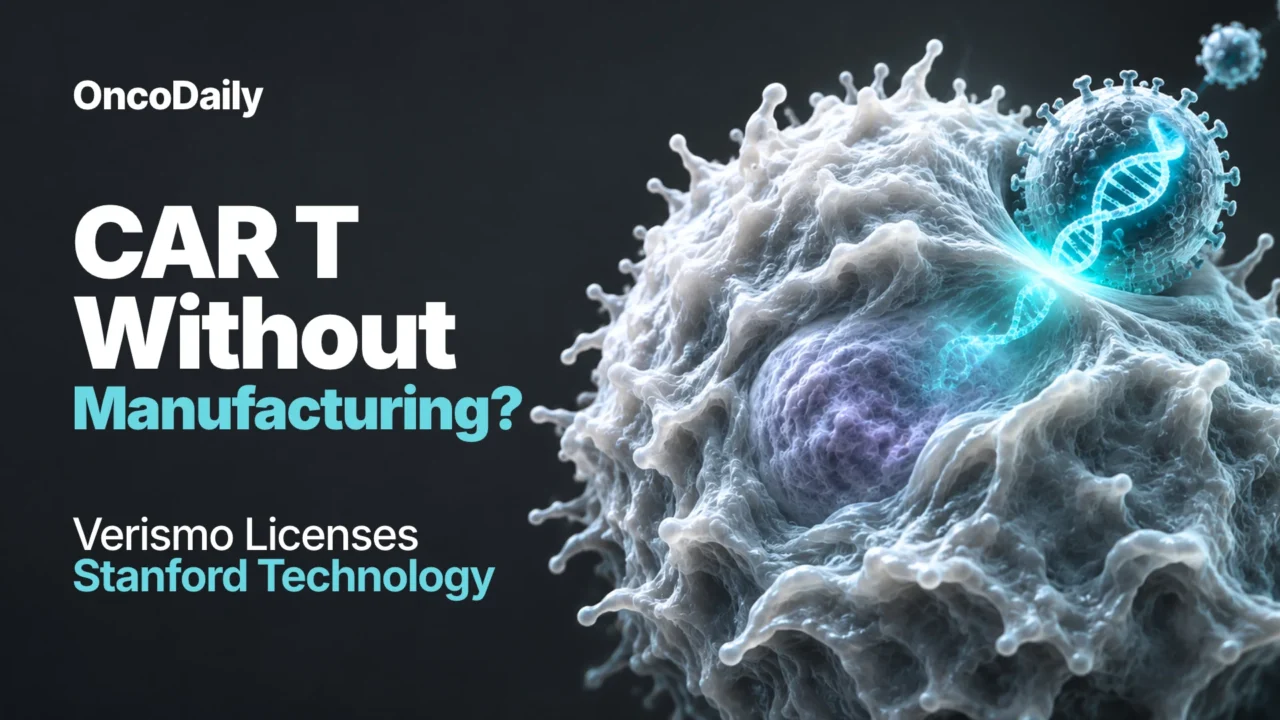
Verismo Therapeutics has licensed an in vivo CAR T-cell engineering technology from Stanford Medicine, aiming to develop cancer therapies that could be administered without the lengthy, patient-specific manufacturing process required for conventional CAR T treatments.
Announced on November 18, 2026, the agreement gives Verismo access to PACK-IT technology, developed in the laboratory of Crystal Mackall, MD, at Stanford Medicine. The company plans to combine the technology with its multi-chain KIR-CAR platform to develop ready-to-administer therapies that engineer a patient’s own T cells directly inside the body.
The approach could potentially reduce treatment delays, lower manufacturing costs, and expand access to cellular immunotherapy. However, its application to Verismo’s KIR-CAR platform remains at an early development stage.
How PACK-IT Technology Could Change CAR T Manufacturing
CAR T-cell therapy has become an established treatment option for several hematologic malignancies, but its manufacturing process remains complex.
Currently approved CAR T therapies require patients to undergo leukapheresis, followed by laboratory modification and expansion of their T cells. The engineered cells must then undergo quality testing before being transported back to the treatment center for infusion.
This process can take several weeks, creating challenges for patients with rapidly progressing cancers.
The PACK-IT platform, short for Programmable Antigen-Mediated Cellular Knock-in of T cells, offers a different approach.
Developed at Stanford Medicine, the technology uses engineered lentiviral particles designed to target T cells and deliver genes encoding chimeric antigen receptors.
It can be applied through two approaches:
- In vivo engineering: CAR T cells are generated directly inside the patient’s body.
- Accelerated ex vivo engineering: T cells are modified outside the body using a potentially faster manufacturing process.
Verismo intends to focus primarily on the in vivo approach, potentially replacing a multi-week individualized manufacturing workflow with a same-day administration step.
Preclinical findings presented at the AACR Annual Meeting 2025 demonstrated that PACK-IT could generate CD19-directed CAR T cells capable of controlling leukemia in experimental models. The findings provide an early scientific rationale for further development, although clinical validation remains necessary.
What Makes Verismo’s KIR-CAR Platform Different?
Verismo is developing a multi-chain CAR T-cell platform designed to address limitations associated with conventional CAR T-cell therapies, including premature T-cell exhaustion and insufficient activity against solid tumors.
Traditional CAR T constructs generally combine antigen recognition and intracellular activation signaling within a single receptor architecture.
Verismo’s KIR-CAR platform instead incorporates a signaling mechanism derived from natural killer cells.
The platform uses killer immunoglobulin-like receptors (KIRs) and the signaling adaptor DAP12 to separate antigen recognition from T-cell activation.
This architecture is designed to reduce continuous background signaling, which can contribute to T-cell exhaustion, while maintaining antitumor activity.
Preclinical studies have suggested that the platform may improve T-cell persistence and tumor control compared with conventional single-chain CAR constructs. However, these potential advantages require confirmation in larger clinical studies.
Combining this receptor architecture with PACK-IT would introduce a second innovation: generating KIR-CAR T cells directly in patients rather than manufacturing them individually in specialized facilities.
Two KIR-CAR Therapies Are Already in Phase 1 Trials
Verismo currently has two investigational CAR T-cell therapies in Phase 1 clinical development, both manufactured using conventional ex vivo engineering.
SynKIR-110 for Solid Tumors
SynKIR-110 is being evaluated in the Phase 1 STAR-101 trial (NCT05568680) in patients with advanced mesothelin-expressing solid tumors, including:
- Ovarian cancer
- Mesothelioma
- Cholangiocarcinoma
Initial results presented at AACR 2026 indicated early signals of antitumor activity and an encouraging preliminary safety profile, with no dose-limiting toxicities reported in the initial cohorts.
More recently, preclinical findings presented at SITC 2026 suggested reduced cytokine production and lower expression of T-cell exhaustion markers compared with conventional single-chain CAR T designs.
SynKIR-310 for B-Cell Lymphoma
SynKIR-310, a CD19-directed KIR-CAR therapy, is being investigated in the Phase 1 CELESTIAL-301 trial (NCT06544265) for relapsed or refractory B-cell non-Hodgkin lymphoma.
In an early clinical analysis reported by Verismo in November 2026, the therapy demonstrated:
- An objective response rate of 80% (4 of 5 evaluable patients).
- A complete response rate of 60%.
- No reported cytokine release syndrome or immune effector cell-associated neurotoxicity syndrome in the first two dose cohorts.
- No dose-limiting toxicities in the initial cohorts.
These findings involve a small number of patients and require confirmation with longer follow-up and expanded enrollment.
Importantly, neither ongoing trial is evaluating the newly licensed PACK-IT delivery technology.
Could In Vivo CAR T Therapy Improve Patient Access?
The licensing agreement reflects growing interest in developing CAR T treatments that can be administered without individualized cell manufacturing.
For patients, the potential benefits extend beyond convenience. Manufacturing delays may be particularly consequential in aggressive cancers, where disease progression can prevent patients from receiving an intended cellular therapy.
An in vivo approach could potentially reduce dependence on specialized manufacturing facilities, simplify logistics, and shorten the interval between treatment selection and administration.
Commenting on the agreement, Bryan Kim, CEO and Co-Founder of Verismo Therapeutics, said that adding PACK-IT technology is intended to extend the company’s platform into an off-the-shelf in vivo delivery approach.
However, generating CAR T cells inside the body introduces additional questions about delivery specificity, control of engineered T-cell expansion, safety, and consistency between patients.
Whether the combined technologies can deliver the anticipated manufacturing and clinical advantages remains to be established.
What Comes Next for Verismo Therapeutics?
The agreement expands Verismo’s development strategy beyond its existing ex vivo CAR T programs.
The next challenge will be demonstrating that PACK-IT can successfully deliver the company’s multi-chain KIR-CAR constructs and generate functional engineered T cells in vivo.
Further preclinical development will also need to establish the safety, specificity, and persistence of the resulting cells before human studies can begin.
Meanwhile, Verismo is continuing clinical evaluation of SynKIR-110 and SynKIR-310, with additional SynKIR-310 data scheduled for presentation at ASH 2026 in December.
The licensing agreement does not establish improved clinical outcomes or reduced treatment costs. Instead, it provides a technological pathway that could eventually simplify how KIR-CAR therapies are manufactured and delivered.
As research into in vivo cellular engineering advances, the key question will be whether these approaches can reproduce the clinical activity of existing CAR T therapies while overcoming the manufacturing barriers that continue to restrict patient access.
Read further on OncoDaily: CAR T-Cell Therapy Recovery Time: Timeline After Infusion and Follow-Up