New translational analyses of setidegrasib, Astellas’ investigational KRAS G12D-targeted protein degrader, are providing a closer look at why pancreatic cancers driven by the same mutation may respond differently to treatment.
Data presented at the AACR Conference on Pancreatic Cancer integrated clinical outcomes with circulating tumor DNA (ctDNA), tumor biopsies, molecular profiling, patient-derived organoids, and artificial intelligence modeling from patients with KRAS G12D-mutated pancreatic ductal adenocarcinoma (PDAC).

The exploratory analyses were based on samples from 124 patients treated in a Phase 1 study of setidegrasib.
Among responders with available data, 90% experienced a major molecular response by cycle 2 day 1, with a median 91.3% reduction in KRAS G12D ctDNA variant allele frequency. The analyses also identified differences in signaling pathways and co-mutations between responders and non-responders, while end-of-treatment testing pointed to multiple potential mechanisms of resistance.
In written responses to OncoDaily, Wungki Park, MD, Gastrointestinal Medical Oncologist and Assistant Attending at Memorial Sloan Kettering Cancer Center, and the senior author of the study, discussed what the findings may reveal about response, resistance and the biological complexity of KRAS G12D-driven pancreatic cancer.
Looking Beyond Whether a Patient Responds
Earlier Phase 1 data published in The New England Journal of Medicine showed evidence of substantial KRAS G12D protein degradation with setidegrasib. In patients with KRAS G12D-mutated PDAC treated at the 600 mg dose, the median reduction in KRAS G12D protein was 95.5%.
The new translational analyses sought to go a step further by examining what was happening molecularly in tumors alongside clinical response.
Park told OncoDaily:
“Integrating clinical and molecular data allowed us to look beyond whether patients responded to setidegrasib and begin to understand what was happening biologically during those responses.”
Among responding patients with available samples, molecular changes appeared early.
“Among responders with available data, major molecular responses were seen early, by cycle 2 day 1: 90% of these patients showed a median 91.3% reduction in KRAS G12D circulating tumor DNA (ctDNA) variant allele frequency and sustained reduction in ctDNA throughout treatment.”
The findings provide evidence that the drug was affecting its intended molecular target, although reductions in ctDNA should not be interpreted as equivalent to tumor response or improved survival.
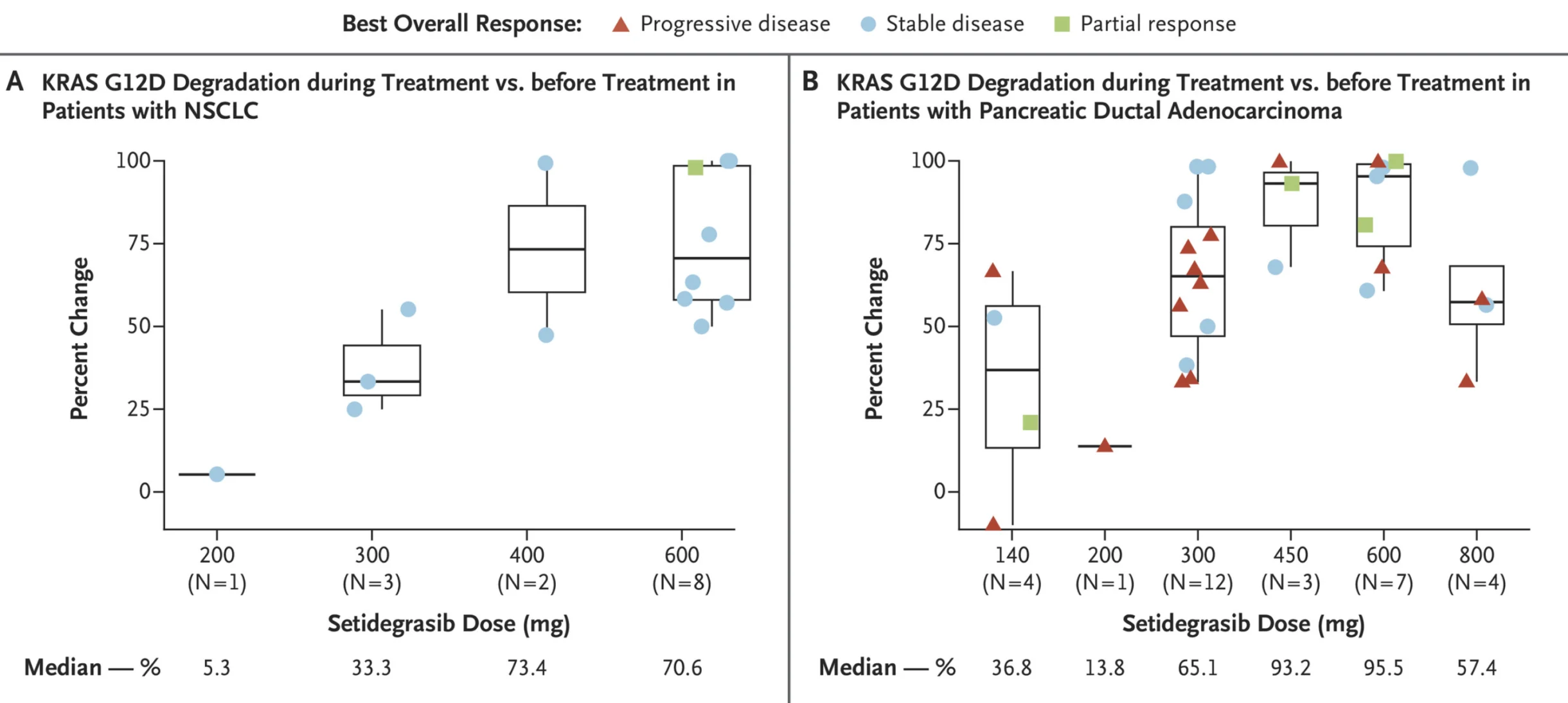
KRAS G12D protein degradation with setidegrasib across dose levels in patients with NSCLC and pancreatic ductal adenocarcinoma. At the 600 mg dose, median degradation from baseline was 70.6% in NSCLC and 95.5% in PDAC. Source: Park W, et al. N Engl J Med. 2026;394:1409–1420.
Changes Beyond KRAS Signaling
The analyses also suggested that the effects associated with KRAS G12D degradation may extend beyond tumor-intrinsic MAPK signaling.
Paired tumor biopsies showed changes involving Fas/FasL signaling, Granzyme B-positive CD8 T cells and PD-L1 expression, pointing to potential changes within the tumor microenvironment.
Park said:
“Together, the new analyses showed evidence that setidegrasib is acting on KRAS G12D as designed, reducing this key cancer-driving protein and affecting tumor-growth signals and the tumor environment in ways that may influence response.”
Setidegrasib is designed to use the cell’s protein degradation machinery to bring KRAS G12D together with an E3 ligase, triggering degradation of the mutant protein rather than simply inhibiting its activity.
The drug remains investigational, and its safety and efficacy have not been established for the uses currently under study.
The Same KRAS G12D Mutation Does Not Mean the Same Tumor
One of the central findings from the translational work was the biological diversity observed among cancers carrying the same KRAS G12D driver mutation.
Researchers identified differences in mTORC1, MYC, RAS, and cell-cycle signaling between responders and non-responders. Patients whose tumors did not respond also had a higher number of baseline co-mutations.
According to Park, these findings illustrate why the presence of a single driver mutation may not fully predict how an individual cancer behaves.
“This shows that tumors driven by the same KRAS G12D mutation can still be biologically diverse. The differences in co-mutations and signaling pathways may help explain why response varies among patients whose cancers share the same KRAS G12D driver.”
He added:
“KRAS G12D may be the shared driver, but it exists within a broader molecular context that can differ considerably between tumors.”
That broader molecular context could become increasingly important as KRAS-directed therapies move through clinical development.
“This suggests that the presence of KRAS G12D is only one part of the biological picture. The broader molecular context, including other mutations and differences in signaling pathways, may help explain why tumors sharing the same KRAS G12D driver can behave and respond differently.”
Resistance May Not Follow a Single Pathway
The study also examined molecular patterns that emerged at the end of treatment.
Rather than pointing to one dominant mechanism of resistance, the analyses identified heterogeneous alterations involving pathways including RTK–RAS and PI3K signaling.
Park explained:
“Rather than identifying a single dominant resistance mechanism we observed heterogeneous alterations involving pathways including RTK–RAS and PI3K signaling suggesting that tumors may find multiple routes around KRAS G12D degradation.”
This heterogeneity could complicate efforts to develop a single strategy for overcoming resistance.
“This suggests that resistance may involve different biological pathways in different tumors, rather than one common mechanism across patients.”
Park emphasized that these findings remain exploratory and require further investigation before they can guide treatment decisions.
Could Molecular Data Help Guide Combination Strategies?
One aim of the analyses was to identify potential approaches for improving responses and addressing resistance.
The study incorporated molecular profiling, tumor biopsies, blood-based analyses, patient-derived organoids and AI modeling.
According to Park, AI modeling that integrated organoid drug-screening results with patient-level and molecular characteristics showed concordance with individual clinical outcomes and supported further evaluation of setidegrasib plus FOLFIRINOX.
The potential importance of combination treatment was also highlighted in the broader analyses.
Park said:
“These findings are exploratory, but they identify biological differences and potentially targetable pathways that warrant further investigation and may help inform future combination strategies.”
Setidegrasib is already being evaluated alongside chemotherapy in a Phase 3 study in patients with previously untreated KRAS G12D-mutated PDAC.
The Phase 3 study, NCT07409272, is evaluating setidegrasib in combination with either modified FOLFIRINOX or NALIRIFOX in the frontline setting.
From One Mutation Toward a More Personalized Picture
For Park, one of the broader implications of the study is the potential for translational research to move KRAS-directed treatment beyond simply establishing whether a mutation is present.
“Translational research can help us move beyond identifying the presence of a KRAS G12D mutation to build a more complete picture of the biology of an individual tumor.”
The analyses brought together samples and information from 124 patients, allowing investigators to compare biological characteristics with individual clinical outcomes.
“We brought together information from tumor biopsies and blood samples with molecular profiling, assessment of the tumor microenvironment, patient-derived organoids and AI modelling. Looking across these different types of data alongside clinical outcomes can help us understand the biological differences between tumors that share the same KRAS G12D driver.”
Such approaches could eventually help researchers identify biological characteristics associated with response and generate hypotheses for treatment combinations tailored to different tumor profiles.
Park cautioned, however, that this remains an emerging area of research.
“We are still at an early stage, and these findings are exploratory. But they are helping inform future research into setidegrasib and combination approaches in KRAS G12D-mutated pancreatic cancer, while building the biological understanding that may ultimately support more personalized approaches.”
Setidegrasib Advances Into Phase 3 Development
Setidegrasib is a targeted protein degrader designed to selectively eliminate KRAS G12D, a cancer-driving mutant protein found frequently in pancreatic cancer and in subsets of other solid tumors.
The drug is now being evaluated in Phase 3 studies in both KRAS G12D-mutated PDAC and NSCLC.
For pancreatic cancer, however, the new translational findings highlight a challenge that may extend well beyond setidegrasib itself: even when patients share the same oncogenic driver, the surrounding molecular landscape can differ substantially.
Understanding those differences may become increasingly important as researchers work to determine not only which tumors carry KRAS G12D, but which patients are most likely to respond, why resistance develops, and which combinations could potentially overcome it.
Read further on OncoDaily: Inside Setidegrasib’s Phase 3 Development: Targeting KRAS G12D Through Protein Degradation