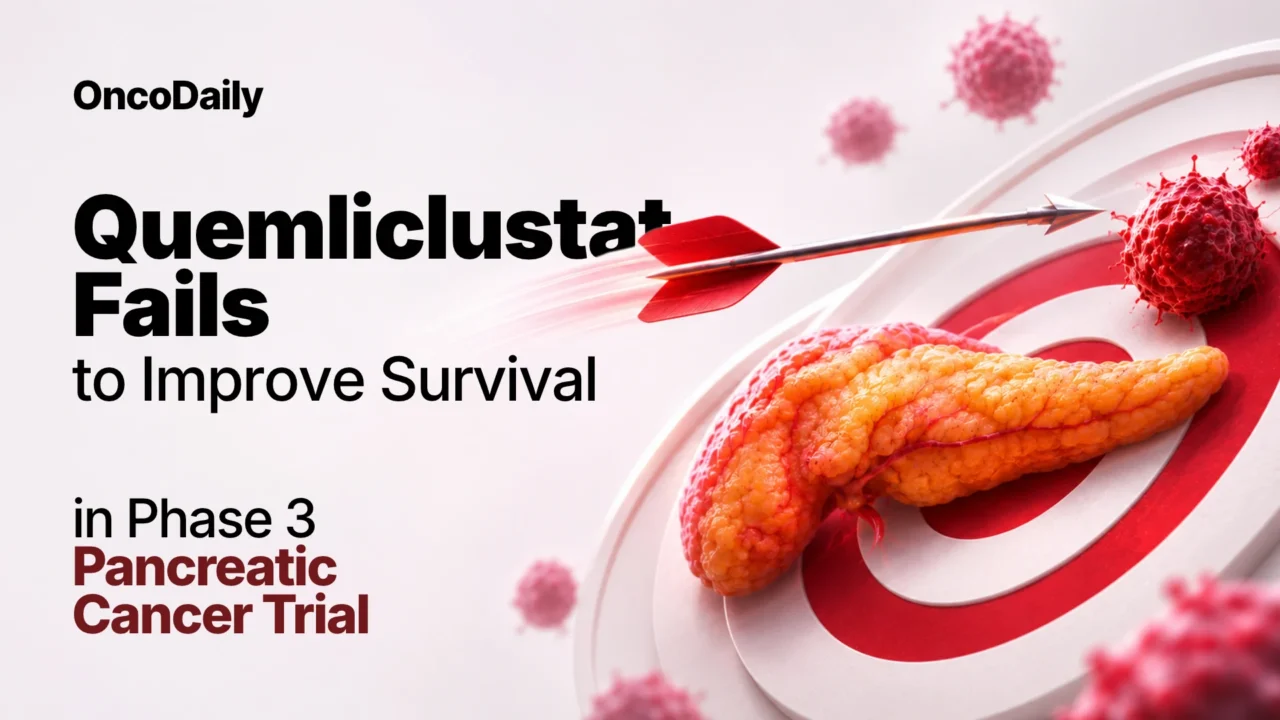
A promising experimental treatment for metastatic pancreatic cancer has suffered a major setback. Arcus Biosciences announced on November 23, 2026, that it is discontinuing its Phase 3 PRISM-1 trial after the investigational drug quemliclustat failed to demonstrate the anticipated improvement in overall survival when added to standard chemotherapy.
The decision follows a pre-specified interim analysis reviewed by an Independent Data Monitoring Committee (IDMC), which found that the study had not met its required overall survival efficacy threshold.
The findings are particularly disappointing because earlier clinical research had suggested that quemliclustat could substantially extend survival in patients with advanced pancreatic cancer.
What Happened in the PRISM-1 Trial?
PRISM-1 (NCT06608927) was a global, randomized, double-blind, placebo-controlled Phase 3 clinical trial involving approximately 650 patients with previously untreated metastatic pancreatic ductal adenocarcinoma (PDAC).
Patients were randomly assigned in a 2:1 ratio to receive either:
- Quemliclustat combined with gemcitabine and nab-paclitaxel chemotherapy.
- Placebo combined with gemcitabine and nab-paclitaxel chemotherapy.
The primary endpoint was overall survival (OS), while secondary endpoints included progression-free survival (PFS), objective response rate (ORR), duration of response (DOR), disease control rate (DCR), and safety.
According to the company’s announcement, the interim analysis showed that the quemliclustat combination produced efficacy outcomes similar to chemotherapy alone across the primary and secondary endpoints. Importantly, no differences in adverse events or toxicity were observed between the treatment groups.
However, the addition of quemliclustat did not demonstrate sufficient survival benefit to meet the trial’s pre-specified efficacy boundary.
Arcus has not yet released detailed survival figures, hazard ratios, or statistical results from the Phase 3 analysis.
A Surprising Finding: Both Groups Achieved Historically Long Survival
Despite the disappointing results for quemliclustat, Arcus highlighted an unexpected observation.
Richard Markus, MD, PhD, Chief Medical Officer at Arcus Biosciences, stated:
“We are deeply disappointed with the results, even though participants in both arms of the study reached the longest overall survival observed to date in a global, first-line metastatic pancreatic cancer study”
He added that the company believes the PRISM-1 data will contribute to a better scientific understanding of pancreatic cancer and reaffirmed its commitment to sharing the findings. He also expressed gratitude to the patients, families, and investigators who participated in the study.
This observation raises important questions about survival outcomes in the contemporary treatment landscape.
However, without detailed numerical results, patient characteristics, and subsequent-treatment information, it remains unclear what contributed to these survival outcomes.
The company’s statement does not change the central finding: quemliclustat has not demonstrated an additional survival advantage over chemotherapy in PRISM-1.
Why Was Quemliclustat Considered Promising?
Quemliclustat is an investigational small-molecule inhibitor of CD73, an enzyme involved in producing adenosine within the tumor microenvironment.
Adenosine can suppress immune responses against cancer, contributing to an environment that allows tumors to escape immune surveillance. By inhibiting CD73, quemliclustat was designed to reduce adenosine production and potentially restore antitumor immune activity.
This approach was particularly interesting in pancreatic cancer, where the immunosuppressive tumor microenvironment has been a major obstacle to effective immunotherapy.
Early findings had provided a reason for optimism. In the Phase 1b ARC-8 study, published in Nature Medicine in April 2026, patients receiving quemliclustat-based regimens demonstrated encouraging survival outcomes.
Among 122 patients treated with quemliclustat 100 mg alongside chemotherapy, with or without zimberelimab, the median overall survival was 15.7 months, compared with 9.8 months in a matched external control group receiving chemotherapy.
In the smaller cohort of 29 patients receiving quemliclustat with gemcitabine/nab-paclitaxel without zimberelimab, median overall survival reached 19.4 months. However, these findings came from an early-phase trial without a concurrent randomized chemotherapy-only control group. The historical comparisons therefore could not establish a definitive treatment benefit.
The Phase 3 PRISM-1 trial was designed to provide the more rigorous evidence needed to determine whether adding quemliclustat genuinely improved survival. The interim findings have not confirmed that earlier promise.
What Does This Mean for Pancreatic Cancer Treatment?
Pancreatic cancer remains one of the most difficult malignancies to treat, particularly when diagnosed at an advanced stage. Although chemotherapy combinations have improved outcomes, the prognosis for metastatic pancreatic cancer remains poor, highlighting the urgent need for new treatment strategies.
The PRISM-1 findings represent another setback in efforts to improve outcomes by targeting the tumor microenvironment.
They also illustrate an important challenge in oncology drug development: promising survival outcomes in early-phase studies do not always translate into benefit in large, randomized trials.
The biological rationale for targeting CD73 remains an area of scientific interest, but the PRISM-1 results do not support adding quemliclustat to gemcitabine/nab-paclitaxel as a new treatment standard for unselected patients with metastatic pancreatic cancer.
What Happens Next?
Arcus Biosciences confirmed that PRISM-1 is being discontinued and that the company is communicating with study investigators to determine appropriate next steps for enrolled patients.
Quemliclustat remains an investigational agent and has not received regulatory approval.
Although the trial will not proceed as planned, its data may still provide insights into pancreatic cancer biology, treatment responses, and the role of CD73 inhibition.
Further publication of the trial’s survival data, subgroup analyses, and biomarker findings will be important for understanding why the encouraging earlier results did not translate into a demonstrated Phase 3 benefit.
For now, PRISM-1 serves as another reminder of the difficulty of developing effective therapies for metastatic pancreatic cancer and the importance of confirming early clinical signals through rigorous randomized evidence.
How I Treat Pancreatic Cancer in 2026
Join leading experts on November 24, 2026, for OncoDaily’s virtual summit exploring the latest advances in pancreatic cancer treatment.