
What if the effectiveness of a cancer vaccine depended not only on which tumor antigen it targeted, but also on how that antigen was presented to the immune system?
Researchers at the Massachusetts Institute of Technology (MIT) have developed an engineered nanoparticle platform that could open new possibilities for personalized cancer vaccines. By precisely controlling the number of tumor antigens displayed on the surface of a nanoscale carrier, the team generated stronger cancer-specific T-cell responses and significantly suppressed tumor growth in preclinical models.
The findings, published on October 29, 2026, in Advanced Healthcare Materials, suggest that antigen density may be a critical and previously underexplored factor in designing effective cancer vaccines.
The study, titled “Engineering Antigen Density on M13 Bacteriophage for Personalized Nanovaccine,” was led by Shengnan Huang, a research scientist at MIT’s Koch Institute for Integrative Cancer Research, with Angela M. Belcher, professor of biological engineering and materials science and engineering at MIT, serving as senior author.
In mouse models of colorectal cancer, the optimized vaccine increased the frequency of neoantigen-specific CD8+ T cells by approximately sevenfold, delayed tumor progression, and prolonged survival.
Although the findings remain preclinical, they introduce an important possibility: future cancer vaccines could be customized not only according to the molecular characteristics of a patient’s tumor, but also according to how immune targets are displayed to the immune system.
Turning a Bacterial Virus Into a Cancer Vaccine
At the center of the technology is M13, a bacteriophage, or virus that infects bacteria but is not known to cause disease in humans.
For more than two decades, Belcher’s laboratory has explored how M13 bacteriophages can be engineered into nanostructures for applications ranging from batteries and solar cells to biomedical technologies.
Now, researchers are adapting that engineering expertise to cancer immunotherapy.
M13 has a long, filament-shaped structure surrounded by a protein shell called a capsid. One of its major structural proteins, pVIII, occurs in numerous copies along the viral surface.
By genetically modifying pVIII, the researchers can display tumor-associated antigen peptides on the outside of the particle.
These antigens serve as molecular targets that the immune system can learn to recognize. After vaccination, antigen-presenting cells, particularly dendritic cells, can take up the particles, process their contents, and present antigen-derived peptides through major histocompatibility complex (MHC) molecules to activate CD8+ T cells.
These activated T cells can subsequently recognize cells displaying the corresponding antigen.
Importantly, the bacteriophage also contains single-stranded DNA capable of activating Toll-like receptor 9 (TLR9), an innate immune receptor involved in recognizing microbial DNA.
This gives the platform a dual function: the protein shell carries the tumor antigen, while the internal DNA provides an immunostimulatory signal.
Unlike vaccine systems that require separately formulated adjuvants, the M13 platform allows researchers to genetically program both antigen display and aspects of immune stimulation within the same particle.
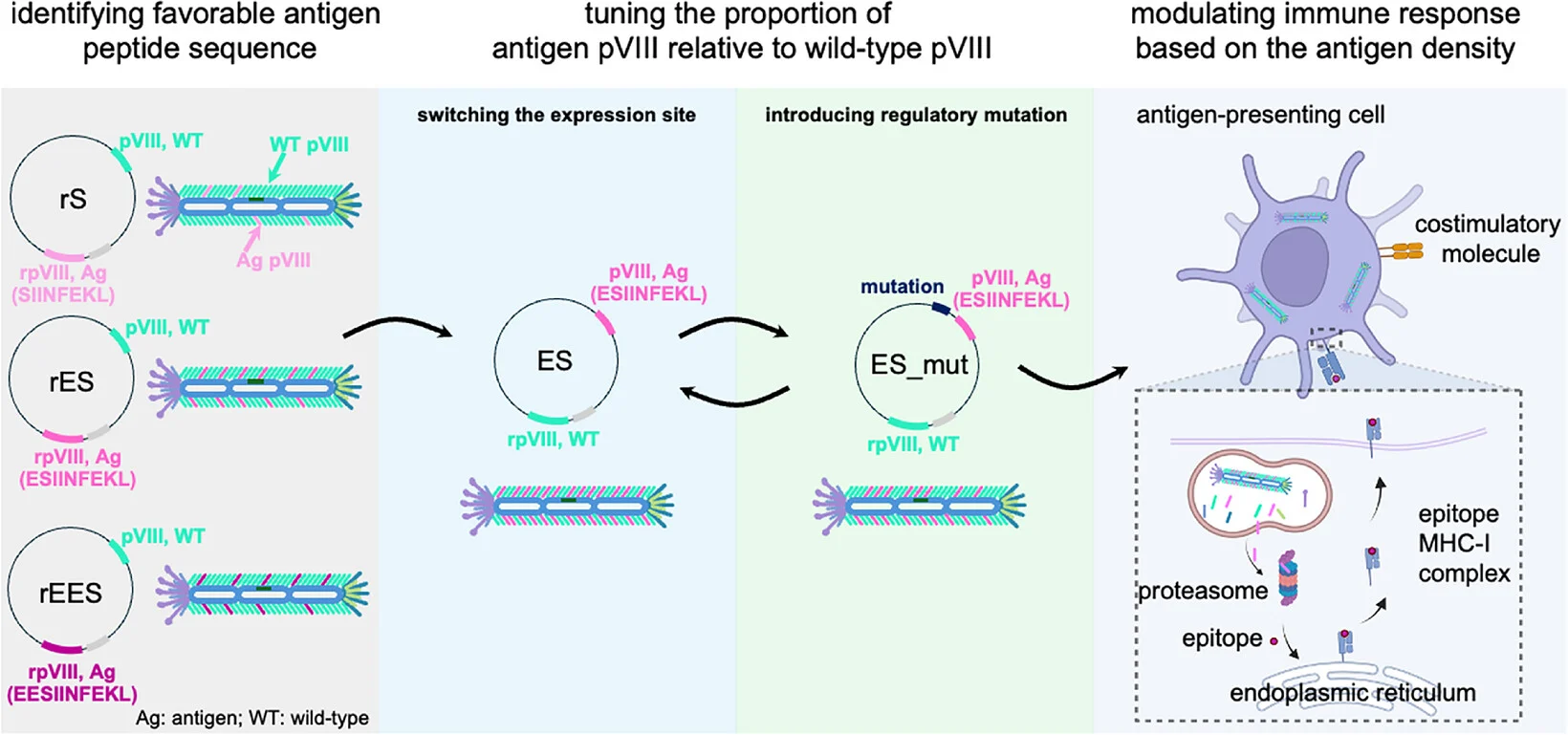
Engineering an M13 bacteriophage nanovaccine: researchers modified antigen density on the phage surface to influence antigen presentation and CD8+ T-cell responses. Source: Huang S, et al. Engineering Antigen Density on M13 Bacteriophage for Personalized Nanovaccine. Advanced Healthcare Materials. 2026. Figure [number]. CC BY. https://doi.org/10.1002/adhm.71811
Why Antigen Density Matters
One of the central challenges in cancer vaccine development is generating sufficiently strong and durable T-cell responses against tumor-specific antigens.
Traditionally, much of the research has focused on antigen selection, delivery systems, adjuvants, and improving immune-cell targeting.
The MIT team investigated another variable: how the density of antigens displayed on a vaccine particle influences its immunogenicity.
Using molecular engineering techniques, the researchers adjusted the proportion of antigen-bearing pVIII proteins on the bacteriophage surface.
They achieved antigen display levels ranging from approximately 6% to 70.4%, corresponding to roughly 36–420 antigen-bearing coat proteins on a 200-nanometer phage particle.
This was accomplished through modifications to the antigen sequence, including the addition of negatively charged amino acids, as well as changes in gene expression that influenced how frequently the modified proteins were incorporated into the phage capsid.
The researchers initially tested a well-characterized experimental antigen, SIINFEKL, derived from ovalbumin and frequently used in immunological studies.
When antigen density increased from approximately 6% to 34.7%, the frequency of SIINFEKL-specific CD8+ T cells in vaccinated mice increased from around 7.4% to 17.5%.
Further experiments demonstrated that particles with greater antigen density were more efficiently taken up by dendritic cells and supported increased antigen presentation through MHC class I molecules.
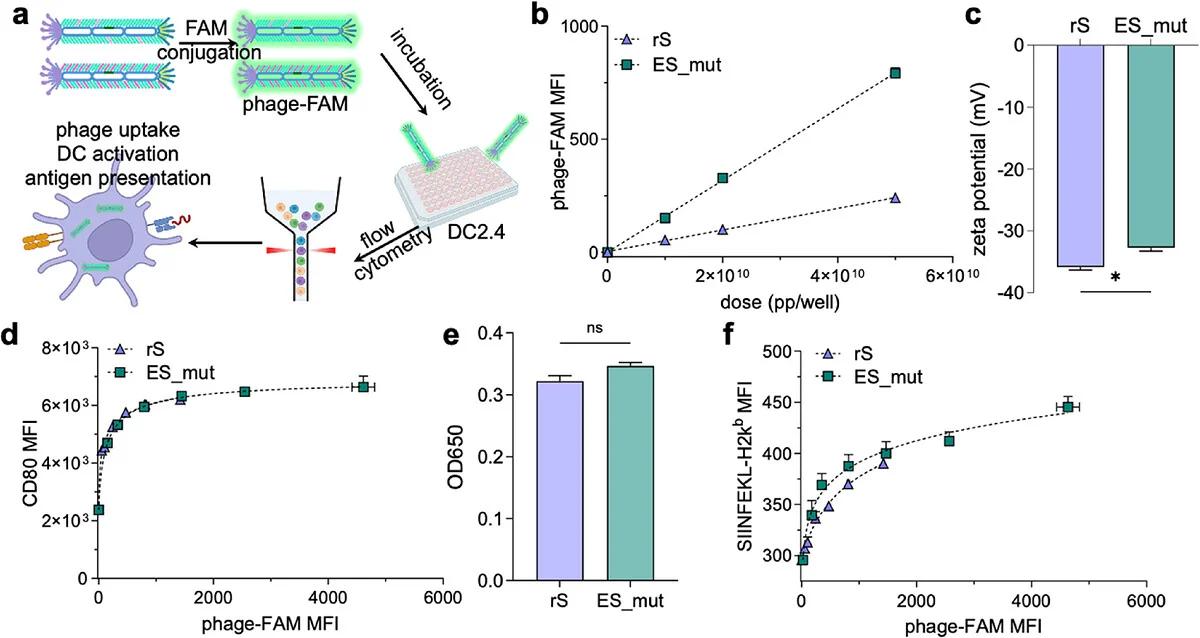
Higher antigen density on the engineered M13 nanovaccine improved dendritic-cell uptake and antigen cross-presentation in preclinical experiments, supporting stronger immune activation. Source: Huang S, et al. Engineering Antigen Density on M13 Bacteriophage for Personalized Nanovaccine. Advanced Healthcare Materials. 2026. CC BY.
The resulting enhancement of T-cell responses translated into greater suppression of tumor growth when vaccinated mice were subsequently challenged with SIINFEKL-expressing melanoma cells.
However, the researchers also identified an engineering trade-off. Increasing antigen density to very high levels reduced bacteriophage production yields, highlighting the need to balance immune potency with manufacturing efficiency.
The Colorectal Cancer Experiment: A Sevenfold Increase in Cancer-Specific T Cells
To evaluate the relevance of their approach beyond an artificial model antigen, the researchers turned to a naturally occurring tumor neoantigen.
Neoantigens are abnormal peptides produced as a consequence of tumor-specific genetic mutations. Because they are absent from most healthy tissues, they represent attractive targets for personalized cancer vaccines.
The team selected a mutated peptide derived from ADPGK, a neoantigen associated with the MC-38 murine colorectal cancer model.
Researchers generated M13 particles displaying the ADPGK neoantigen at different densities, including approximately 12.2% and 53.2%.
Mice received two vaccine doses, on days 0 and 7, before being challenged with colorectal cancer cells on day 15.
The higher-density formulation produced a substantial increase in neoantigen-specific CD8+ T cells.
The proportion of ADPGK-specific CD8+ T cells increased from approximately 1.1% with the lower-density formulation to 7.4% with the higher-density vaccine.
This immune response was associated with significantly slower tumor progression and improved survival.
Median survival was:
- 38 days in mice receiving the higher-density vaccine.
- 28 days in mice receiving the lower-density formulation.
- 25.5 days in unvaccinated controls.
The higher-density vaccine therefore extended median survival by approximately 49% compared with unvaccinated animals.
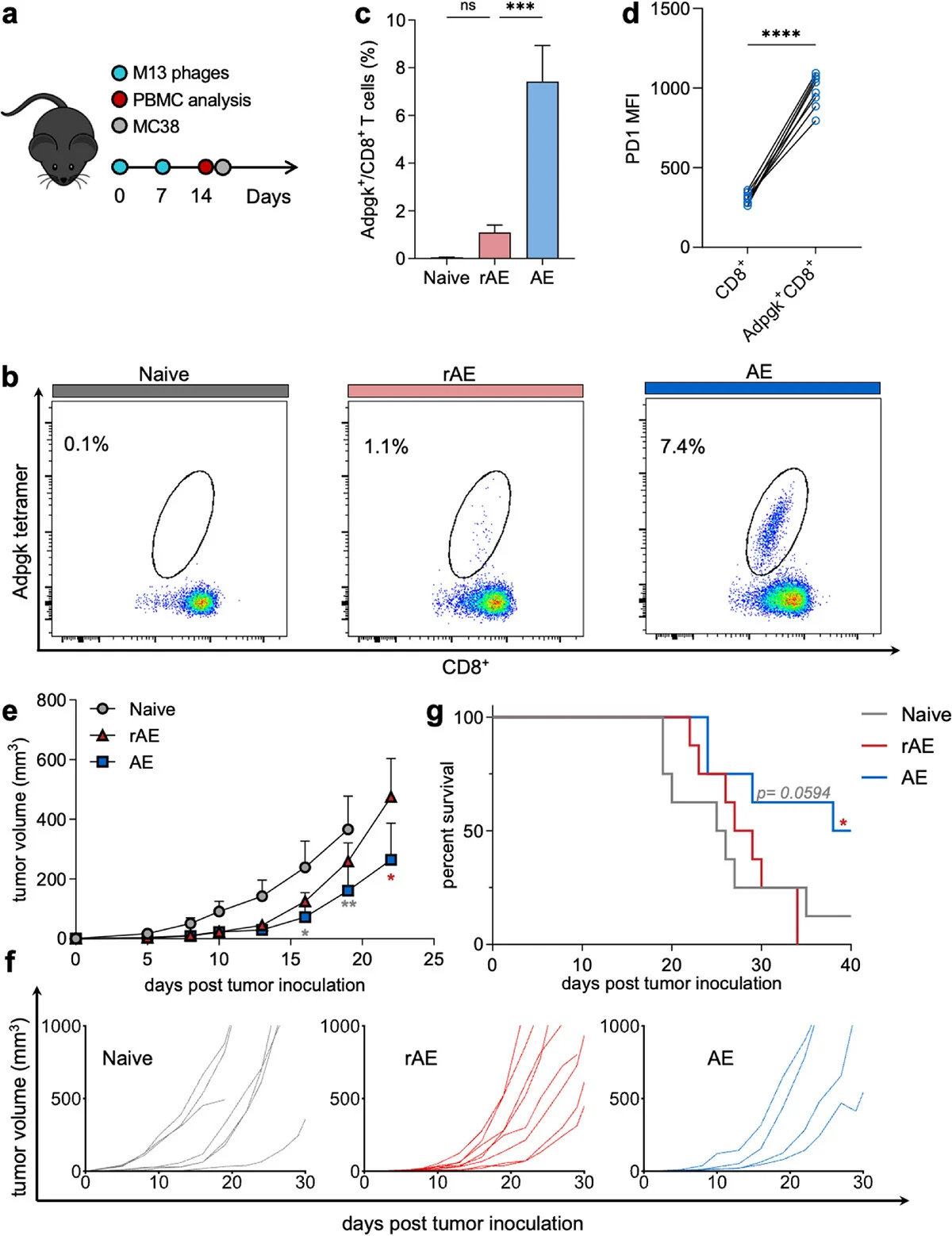
In a preclinical MC-38 colorectal cancer model, increasing neoantigen density on the engineered M13 nanovaccine enhanced antigen-specific CD8+ T-cell responses, slowed tumor growth, and improved survival. Mice were vaccinated before tumor challenge. Source: Huang S, et al. Engineering Antigen Density on M13 Bacteriophage for Personalized Nanovaccine. Advanced Healthcare Materials. 2026. CC BY.
These results demonstrate that modifying the organization and abundance of tumor antigens on a vaccine carrier can influence both the magnitude of the immune response and subsequent tumor control.
Notably, the experiments used a prophylactic tumor-challenge design: mice were vaccinated before cancer cells were introduced. The current study did not establish that the optimized formulation can successfully treat pre-existing tumors.
Building on Earlier Research: Can the Platform Treat Established Tumors?
The new findings build on an earlier MIT study published in Advanced Materials in 2025 (doi.org/10.1002/adma.adma.202510229), which investigated a programmable M13 bacteriophage vaccine platform.
In that study, researchers demonstrated that the bacteriophage’s genetic material could be engineered to regulate its immunostimulatory activity, while modifications to its protein shell could control antigen display.
When combined with anti-PD-1 immune checkpoint blockade, the experimental vaccine eradicated established MC-38 colorectal tumors in approximately 75% of treated mice.
The combination also generated durable immune memory in surviving animals.
These findings provide a rationale for investigating whether antigen-density optimization could further strengthen therapeutic vaccines, particularly when combined with checkpoint inhibitors.
An additional observation in the 2026 study may be relevant to this strategy: neoantigen-specific CD8+ T cells showed increased expression of PD-1.
Although PD-1 expression can reflect recent antigen-driven T-cell activation, it can also participate in inhibitory signaling that limits antitumor immunity. Consequently, combining optimized nanovaccines with PD-1 blockade may represent a promising direction for future studies.
How Does This Fit Into the Personalized Cancer Vaccine Landscape?
Recent clinical advances have reinforced the growing interest in personalized cancer vaccines. At ESMO 2026, Moderna and Merck presented Phase 3 results from the INTerpath-001 trial, demonstrating that intismeran autogene (mRNA-4157/V940), an individualized mRNA-based neoantigen therapy, combined with pembrolizumab reduced the risk of recurrence or death by 42% compared with pembrolizumab alone in patients with completely resected stage IIB–IV melanoma.
The findings build on the earlier KEYNOTE-942 Phase 2b trial and provide Phase 3 clinical evidence supporting personalized neoantigen vaccination. While Moderna and Merck use an mRNA-based approach, MIT’s experimental platform uses engineered bacteriophages to display tumor antigens, highlighting different technological strategies to achieve the same objective: stronger tumor-specific immune responses.
Meanwhile, a 2025 study published in Nature demonstrated that personalized RNA neoantigen vaccination could generate long-lived tumor-specific CD8+ T-cell responses in patients with pancreatic cancer.
The MIT approach differs in its delivery architecture.
Rather than relying on lipid nanoparticles to deliver mRNA encoding tumor antigens, the M13 platform directly displays selected antigen peptides on a genetically engineered bacteriophage scaffold.
Its modular structure could potentially allow different neoantigens to be incorporated into the same basic manufacturing platform.
However, whether this approach can accommodate multiple clinically relevant neoantigens while maintaining consistent immunogenicity remains to be established.
What Needs to Happen Before Clinical Translation?
Despite the encouraging experimental results, several questions remain unanswered.
First, the 2026 study was conducted in mouse models using defined experimental antigens. Human tumors are considerably more heterogeneous, and neoantigen recognition depends on patient-specific HLA molecules and immune characteristics.
Second, antigen density and total antigen dose are related. In the mouse experiments, animals received the same number of bacteriophage particles, meaning higher-density formulations also delivered a greater total amount of antigen. Additional experiments would help clarify the relative contributions of antigen quantity, spatial organization, and particle uptake.
Third, successful vaccine development will require evaluation of safety, pharmacokinetics, immune durability, reproducible manufacturing, and activity against established tumors.
The tumor microenvironment presents another challenge. Even when vaccines produce strong tumor-specific T-cell responses, immunosuppressive mechanisms within established cancers may limit their therapeutic activity.
Finally, translating a modular delivery technology into a genuinely personalized treatment will require efficient neoantigen identification, reliable vaccine manufacturing, and compatibility with clinically relevant treatment schedules.
A New Dimension of Precision in Cancer Vaccination
The MIT findings highlight an emerging principle in cancer vaccine design: selecting the correct antigen may be only part of the challenge. The physical and molecular presentation of that antigen can also determine how effectively the immune system responds.
The research suggests that precise control over antigen density could become another tool for optimizing antitumor immunity.
For now, the M13 nanovaccine remains an experimental technology, with its most compelling results demonstrated in preclinical models. Nevertheless, the work provides a foundation for future development of more programmable, adaptable, and potentially patient-specific cancer vaccines.
The broader message is that personalized cancer vaccination may eventually involve more than choosing the right tumor target. It may also require engineering exactly how that target is delivered, displayed, and recognized by the immune system.
Original research: Huang S, et al. Engineering Antigen Density on M13 Bacteriophage for Personalized Nanovaccine. Advanced Healthcare Materials. Published October 29, 2026. DOI: 10.1002/adhm.71811
Read further on OncoDaily: Agentic AI for Immune-Related Adverse Event Detection in Cancer Immunotherapy