Daiichi Sankyo and Merck have voluntarily withdrawn the U.S. Biologics License Application (BLA) seeking accelerated approval of ifinatamab deruxtecan (I-DXd) for adults with extensive-stage small cell lung cancer (ES-SCLC) whose disease progressed on or after platinum-based chemotherapy.
The decision followed discussions with the U.S. Food and Drug Administration (FDA), which indicated that the available data supporting the application, including findings from the Phase 2 IDeate-Lung01 trial, were not sufficient to support accelerated approval for the proposed indication.
The BLA had previously been granted Priority Review by the FDA, with a Prescription Drug User Fee Act target action date of October 10, 2026.
Ifinatamab deruxtecan is an investigational B7-H3-directed DXd antibody-drug conjugate (ADC) discovered by Daiichi Sankyo and jointly developed with Merck.
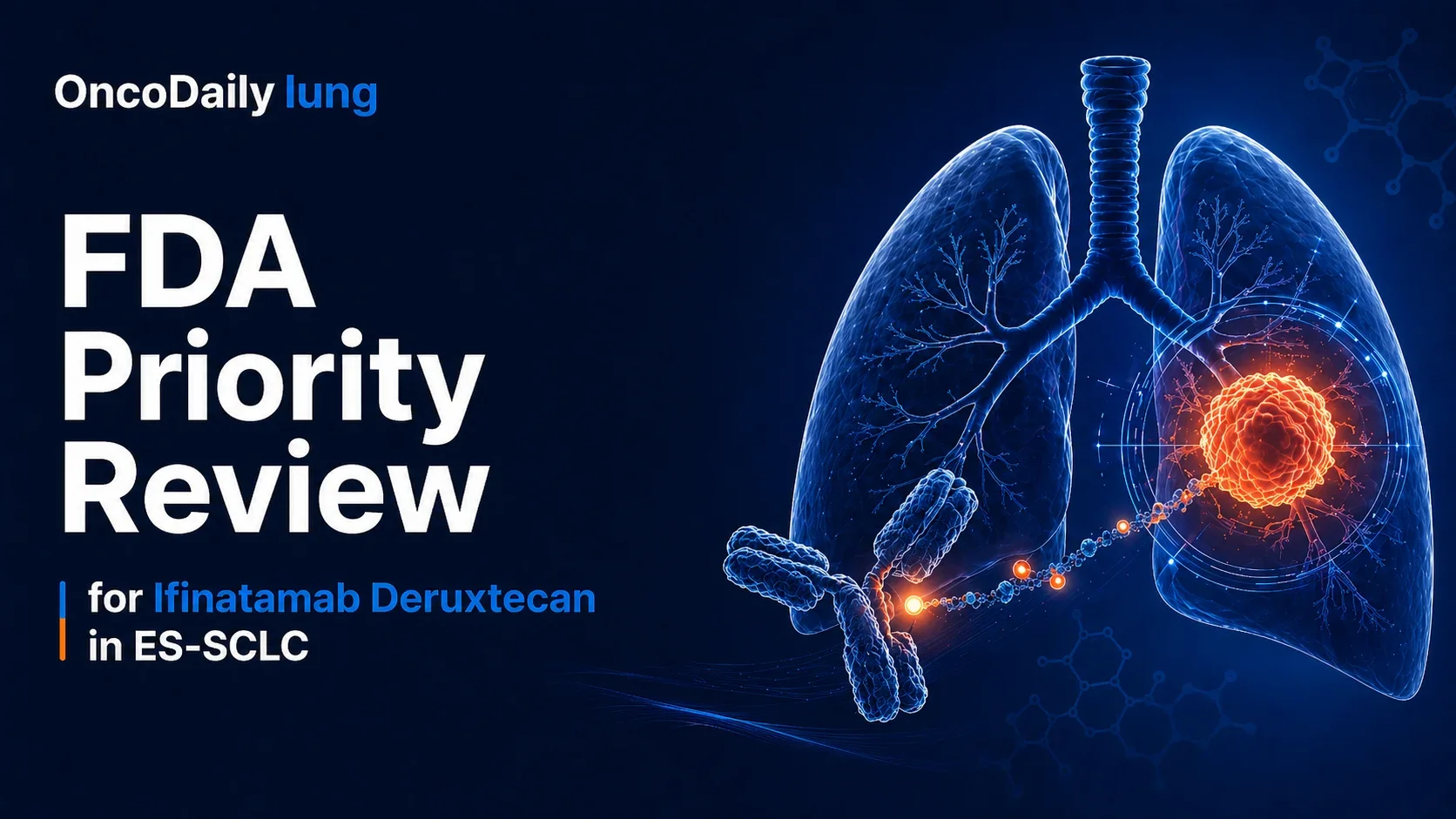
Ifinatamab Deruxtecan Receives FDA Priority Review In Previously Treated ES-SCLC
IDeate-Lung01 Results
The regulatory application was supported by results from the global Phase 2 IDeate-Lung01 trial (NCT06203210) evaluating ifinatamab deruxtecan in patients with previously treated ES-SCLC.
At the 12 mg/kg dose, the primary analysis showed a confirmed objective response rate (ORR) of 48.2% (95% CI, 39.6–56.9) by blinded independent central review.
The median duration of response was 5.3 months (95% CI, 4.0–6.5), while the disease control rate was 87.6% (95% CI, 80.9–92.6). Median progression-free survival was 4.9 months (95% CI, 4.2–5.5), and median overall survival was 10.3 months (95% CI, 9.1–13.3).
Among patients receiving ifinatamab deruxtecan as second-line treatment, the confirmed ORR was 56.3%, with a median duration of response of 7.2 months, median progression-free survival of 5.6 months, and median overall survival of 12.0 months.
An exploratory analysis among patients with brain metastases at baseline also showed an intracranial ORR of 46.2%.
In the primary analysis, Grade 3 or higher treatment-related adverse events occurred in 36.5% of patients. The most common Grade 3 or higher treatment-related adverse events included neutropenia, lymphopenia, and anemia. Treatment-related interstitial lung disease/pneumonitis was reported in 12.4% of patients, including two Grade 5 events.
Phase 3 Development Continues
Despite the withdrawal of the BLA, development of ifinatamab deruxtecan in SCLC is continuing.
Patient enrollment remains ongoing in IDeate-Lung02, a randomized Phase 3 trial comparing ifinatamab deruxtecan with physician’s choice of chemotherapy, amrubicin, lurbinectedin or topotecan, in patients with relapsed ES-SCLC following progression after one prior line of platinum-based chemotherapy.
Abderrahmane Laadem, MD, Head, Therapeutic Area Oncology Development at Daiichi Sankyo, said:
“Extensive-stage small cell lung cancer is a challenging disease to treat, leaving patients in need of new options.”
Laadem added that enrollment in the Phase 3 IDeate-Lung02 trial is nearing completion. Daiichi Sankyo and Merck plan to evaluate whether the results from the trial could support a future regulatory filing for ifinatamab deruxtecan with the FDA and other regulatory authorities worldwide.
Marjorie Green, MD, Senior Vice President, Head of Oncology Global Clinical Development at MSD Research Laboratories, said:
“While we are disappointed that the current dataset are not supportive of an approval at this time, we are continuing to evaluate the role of ifinatamab deruxtecan in patients with extensive-stage small cell lung cancer and other types of difficult-to-treat cancer.”
Green also thanked the patients, their families and investigators who have participated or continue to participate in the clinical studies.
The companies will continue evaluating ifinatamab deruxtecan in ES-SCLC and other difficult-to-treat cancers while awaiting results from the Phase 3 development program.
About Ifinatamab Deruxtecan
Ifinatamab deruxtecan is a potential first-in-class B7-H3-directed antibody-drug conjugate consisting of a humanized anti-B7-H3 IgG1 monoclonal antibody linked to a topoisomerase I inhibitor payload.
The drug has received Orphan Drug Designation for SCLC from regulatory authorities including the FDA, European Commission and Japan’s Ministry of Health, Labour and Welfare. The FDA has also granted the agent Orphan Drug Designation for esophageal cancer.
Beyond SCLC, ifinatamab deruxtecan is being investigated across several other cancers, including esophageal and prostate cancers.
Daiichi Sankyo and Merck entered into a global collaboration in 2023 to jointly develop and commercialize ifinatamab deruxtecan and other DXd ADCs, with Daiichi Sankyo retaining exclusive rights in Japan.
Read further on OncoDaily: AstraZeneca and Daiichi Sankyo’s Enhertu Improves PFS in First-Line HER2-Mutant Advanced NSCLC in Phase III DESTINY-Lung04