Cancer is the leading cause of death among Hispanic and Latino people in the United States, according to a new American Cancer Society (ACS) report published in CA: A Cancer Journal for Clinicians. An estimated 229,900 new cancer cases and 54,200 cancer deaths are projected in this population in 2026, excluding Puerto Rico.
The report, “Cancer statistics for Hispanic/Latino people, 2026,” describes a pattern that overall cancer statistics can obscure. Hispanic people have lower overall cancer incidence and mortality than non-Hispanic White people, yet experience substantially higher rates of several cancers with established opportunities for prevention.
Liver and stomach cancer incidence rates are approximately twice those of White people, while cervical cancer incidence is 36% higher in Hispanic women. These disparities occur alongside gaps in insurance coverage, screening, and timely diagnosis.
Led by Anatu H. Saka, MPH, the study draws on population-based cancer registries, national mortality records, and survey data to examine cancer occurrence, risk factors, and preventive care. The finding that cancer leads all causes of death is based on observed mortality data from 2024, while the 2026 case and death totals are modeled projections.
Cancer statistics for Hispanic/Latino people, 2026
Authors: Anatu H. Saka, Tyler B. Kratzer, Angela N. Giaquinto, Natalia Mazzitelli, Paulo S. Pinheiro, Ana P. Ortiz, Dinorah Martinez Tyson, Ahmedin Jemal, Rebecca L. Siegel
CA: A Cancer Journal for Clinicians, 05 October 2026, DOI: https://doi.org/10.3322/caac.70107
Lower Overall Cancer Rates Conceal Important Differences
Compared with non-Hispanic White people, Hispanic people have approximately 20%–25% lower overall cancer incidence and 30% lower cancer mortality. Lower smoking prevalence contributes to this difference, with lung cancer incidence approximately half that of White people.
However, the pattern changes when individual cancers are examined. In addition to higher liver, stomach, and cervical cancer incidence, Hispanic people have approximately twice the rate of gallbladder cancer and 61%–65% higher rates of acute lymphocytic leukemia.
These findings show why a population’s overall cancer rate provides an incomplete picture of its prevention and treatment needs. Lower rates of tobacco-related cancers coexist with substantial disparities in other diseases, some of which can be reduced through vaccination, infection control, and screening.
Infection Prevention Offers an Opportunity to Reduce Cancer Burden
The higher incidence of liver, stomach, and cervical cancers brings infection prevention and control into focus.
Persistent Helicobacter pylori infection is a major risk factor for noncardia stomach cancer. Hepatitis B and hepatitis C contribute to liver cancer, while persistent infection with high-risk human papillomavirus (HPV) causes cervical cancer.
The report emphasizes opportunities to reduce this burden through infection prevention, testing, and treatment, alongside vaccination where available. These interventions depend on access to care before cancer develops, including the ability to obtain testing, complete treatment, and receive appropriate follow-up.
Infections do not explain the entire burden. Liver cancer risk is also influenced by excess body weight, metabolic disease, and alcohol consumption. Prevention therefore needs to address the broader risk profile within different communities.
In the ACS announcement accompanying the report, Saka highlighted the barriers that can prevent people from receiving timely care:
“However, barriers to timely care, especially the lack of insurance coverage, play a major role. We must do better.”
Cancer Incidence Among Women Is Approaching That of Men
One of the report’s most notable findings is the narrowing difference in overall cancer incidence between Hispanic men and women.
Between 1998 and 2022, the age-adjusted incidence rate declined among Hispanic men from 471 to 389 cases per 100,000 people, while increasing among Hispanic women from 345 to 385 per 100,000. By 2022, the rates were nearly equal.
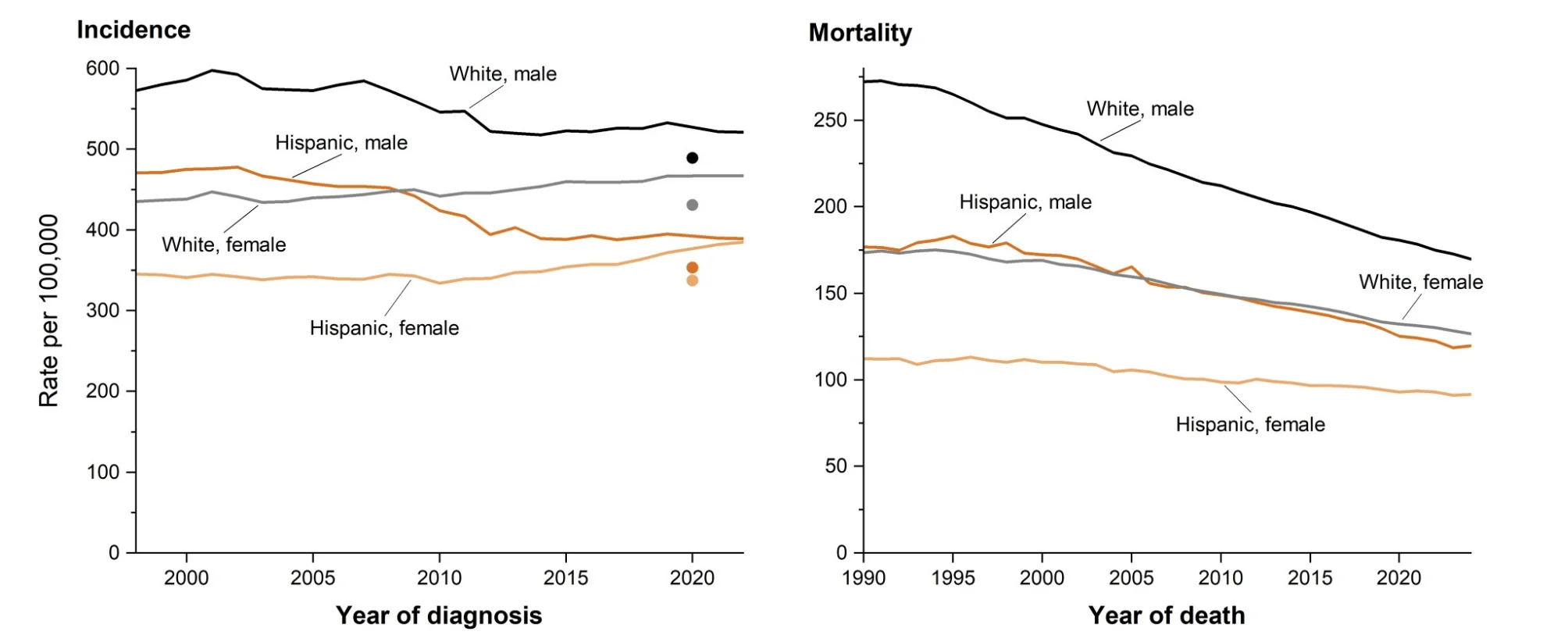
Cancer incidence trends converge among Hispanic men and women. Age-adjusted cancer incidence increased among Hispanic women and declined among Hispanic men between 1998 and 2022, reaching nearly equal rates in 2022. The figure also presents cancer mortality trends from 1990 to 2024 and comparisons with non-Hispanic White people. Puerto Rico is excluded. Source: Saka AH, et al. Cancer statistics for Hispanic/Latino people, 2026. CA Cancer J Clin. 2026;e70107, Figure 3. doi:10.3322/caac.70107. © 2026 The Author(s). Reproduced unchanged under CC BY-NC-ND 4.0.
This shift partly reflects declining lung and prostate cancer incidence in men and increasing breast and uterine corpus cancer incidence in women. During 2013–2022, breast cancer incidence among Hispanic women increased by 1.8% annually, while uterine corpus cancer incidence increased by 2.6% annually.
Uterine corpus cancer, most commonly endometrial cancer, is particularly concerning because mortality is also increasing. Death rates among Hispanic women rose by 2.3% annually during 2015–2024.
The authors discuss rising obesity as one contributor to increasing incidence. However, the rise in mortality is largely driven by nonendometrioid subtypes, underscoring the importance of considering tumor characteristics as well as population-level risk factors.
Insurance and Screening Gaps Remain Substantial
In 2024, 25% of Hispanic adults aged 18–64 years lacked health insurance, compared with 8% of White adults. One in five Hispanic adults in this age group had no usual source of medical care.
Screening uptake was also lower across several major cancers:
- Cervical cancer: 71% of eligible Hispanic women were up to date with screening, compared with 82% of White women.
- Breast cancer: Screening prevalence was 64% among Hispanic women versus 69% among White women.
- Colorectal cancer: Screening prevalence was 56% among Hispanic adults versus 67% among White adults.
The cervical screening estimates refer to 2021, while the breast and colorectal screening estimates refer to 2023.
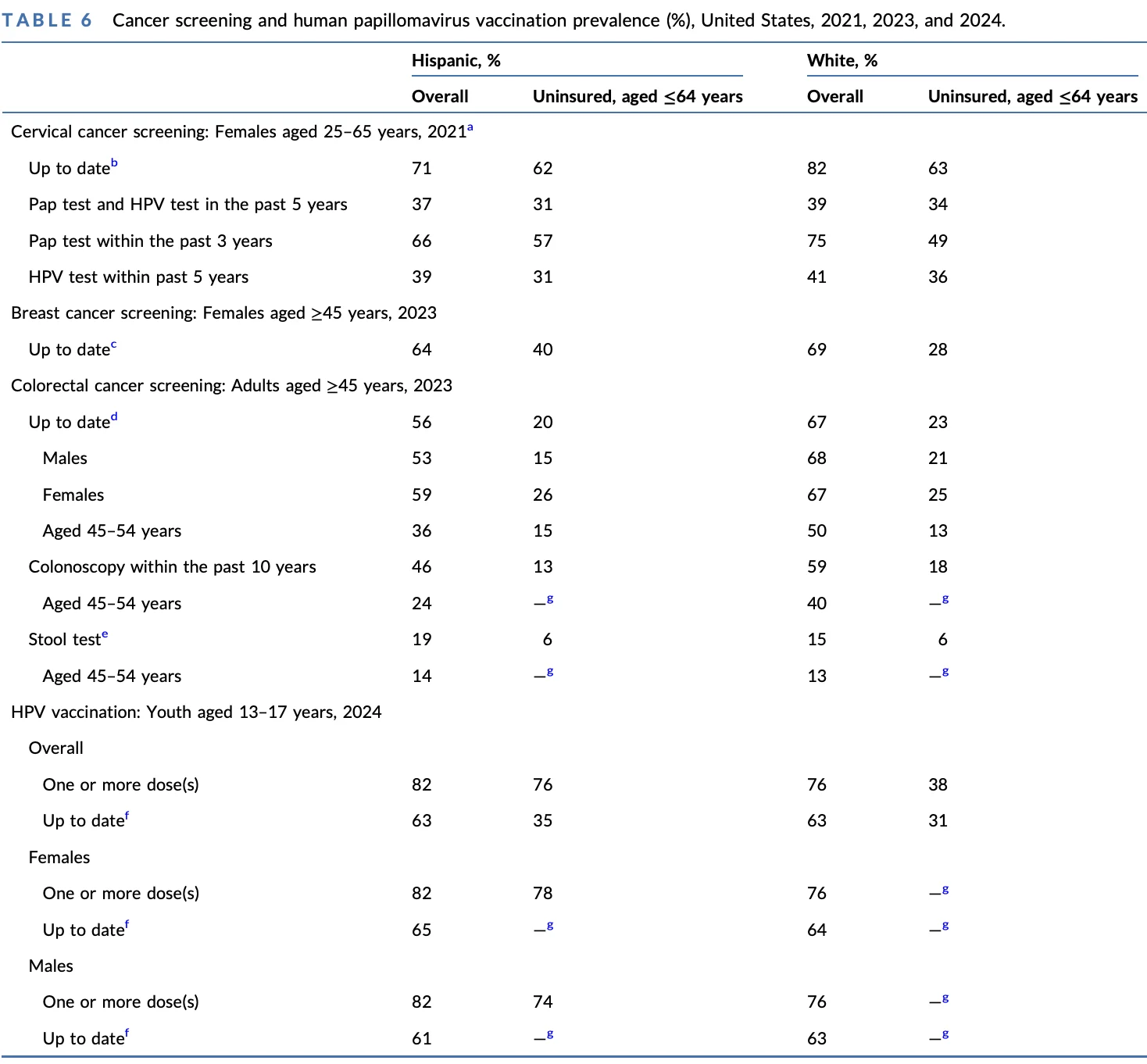
Cancer screening uptake differs between Hispanic and non-Hispanic White populations. The table compares cervical, breast, and colorectal cancer screening prevalence, alongside adolescent HPV vaccination coverage, and includes estimates for uninsured individuals. Cervical screening data are from 2021, breast and colorectal screening data from 2023, and overall HPV vaccination data from 2024. Puerto Rico is excluded. Source: Saka AH, et al. Cancer statistics for Hispanic/Latino people, 2026. CA Cancer J Clin. 2026;e70107, Table 6. doi:10.3322/caac.70107. © 2026 The Author(s). Reproduced unchanged under CC BY-NC-ND 4.0.
These differences have implications beyond early detection. Cervical and colorectal screening can identify precancerous changes that can be treated before invasive cancer develops. Lower uptake therefore represents missed opportunities both to diagnose cancer earlier and to prevent some cancers altogether.
The report identifies multiple barriers to timely care, including lack of insurance, language difficulties, caregiving responsibilities, perceived discrimination, and difficulty taking time off work.
Later Diagnosis Contributes to Unequal Outcomes
Hispanic people were less likely than White people to receive a diagnosis at a localized stage for several cancers.
For breast cancer, 60% of cases among Hispanic women were diagnosed at a localized stage, compared with 69% among White women. For melanoma, the proportions were 65% and 78%, respectively.
Reported five-year relative survival across cancers was 64% among Hispanic people and 71% among White people, although outcomes varied by cancer type.
The authors caution that survival estimates for Hispanic populations are affected by ethnicity misclassification and incomplete follow-up, including return migration. The reported survival figures may consequently be overestimated and should be interpreted with these limitations in mind.
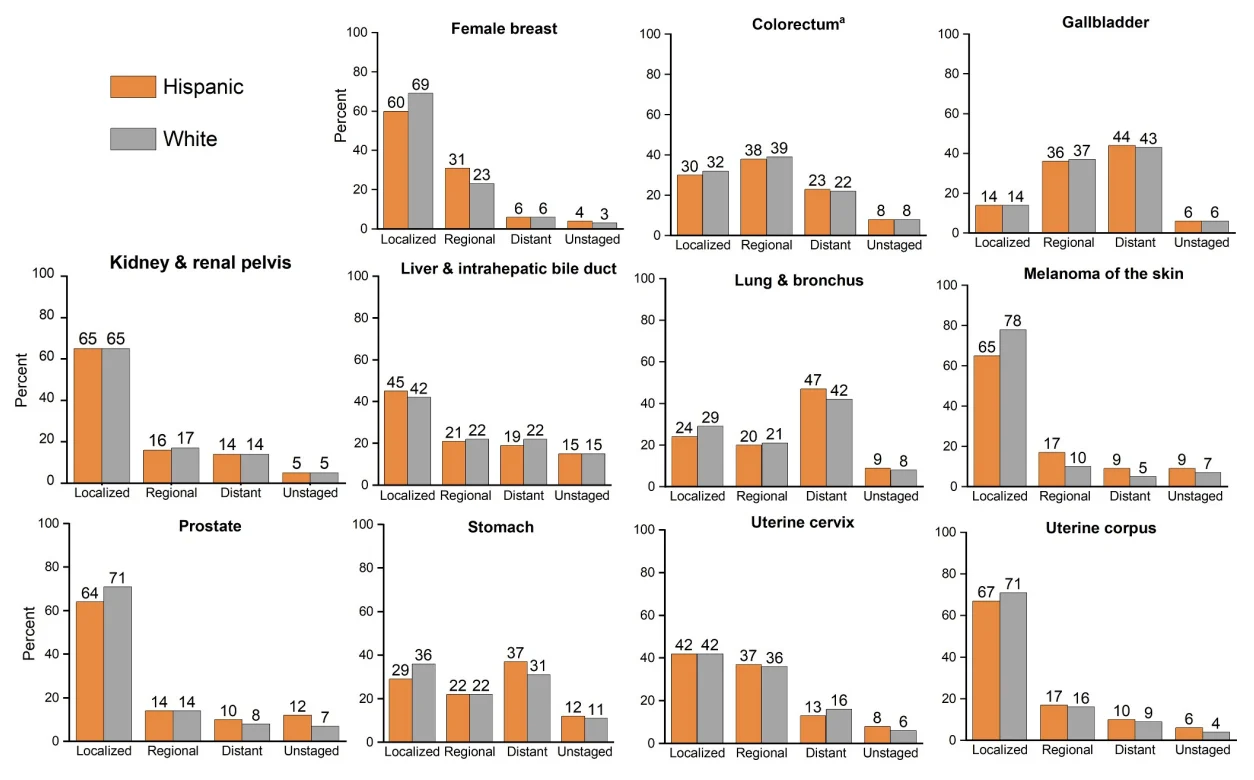
Stage at diagnosis varies by cancer type and population. The figure compares localized, regional, and distant-stage diagnoses among Hispanic and non-Hispanic White people during 2018–2022. Hispanic people were less likely to be diagnosed with localized disease for several cancers, including breast cancer and melanoma. Cases diagnosed in Puerto Rico are excluded. Source: Saka AH, et al. Cancer statistics for Hispanic/Latino people, 2026. CA Cancer J Clin. 2026;e70107, Figure 5. doi:10.3322/caac.70107. © 2026 The Author(s). Reproduced unchanged under CC BY-NC-ND 4.0.
Puerto Rico Has a Distinct Cancer Profile
The report analyzes Puerto Rico separately, highlighting a cancer burden shaped by different disease patterns and health system challenges.
Using incidence data from 2015–2019, the researchers found that cervical cancer rates in Puerto Rico were 73% higher than among White women and 32% higher than among other US Hispanic women.
The authors also describe lasting disruption to cancer services associated with hurricanes, health workforce migration, and the COVID-19 pandemic. These pressures can interrupt screening, delay diagnosis, and complicate continuity of treatment.
Comparisons require caution. Puerto Rico’s incidence data cover an earlier period than the contemporary mainland estimates, and the comparisons presented were not adjusted for socioeconomic differences that can influence cancer risk and access to care.
Prevention Needs to Reflect Population Diversity
The Hispanic and Latino population includes communities with different countries of origin, migration histories, exposures, and access to health services. Aggregated statistics cannot fully capture these differences, a limitation acknowledged by the authors.
The report supports community-based cancer control that combines culturally and linguistically appropriate education with access to screening, vaccination, infection prevention and treatment, and timely follow-up.
Its findings point to a practical priority: making established prevention and early detection services accessible to the communities facing the greatest gaps. Lower overall cancer rates do not diminish the need to address the specific cancers and barriers that continue to drive unequal outcomes.
Read further on OncoDaily: ACS National Lung Cancer Roundtable Sets Priorities for Advanced Imaging in Lung Cancer