International Childhood Cancer Day is observed every year on February 15 to raise awareness about childhood cancer and to support children and adolescents battling the disease, survivors, and their families. The day also highlights the urgent need for equitable access to diagnosis, treatment, and care worldwide.
Marked by the gold ribbon, a symbol of childhood cancer awareness, the day unites communities, healthcare professionals, policymakers, and advocacy groups in a shared mission: to improve survival rates and quality of life for every child diagnosed with cancer.
Why Childhood Cancer Deserves Global Attention
Cancer in children is rare compared to adult cancers, but its impact is profound. Unlike many adult cancers, childhood cancers are generally not preventable and often cannot be detected early through screening. They require specialized and timely treatment.
According to the World Health Organization, hundreds of thousands of children and adolescents are diagnosed with cancer each year worldwide. While survival rates in high-income countries can exceed 80%, in many low- and middle-income countries, survival may be as low as 20% due to delayed diagnosis, lack of access to treatment, and insufficient healthcare infrastructure.
A Global Movement for Equity and Hope
The day is led globally by organizations such as Childhood Cancer International, working alongside partners to advocate for better policies and resources. Campaigns often focus on closing the survival gap between countries and ensuring that no child is left behind because of where they live.
International Childhood Cancer Day is not only about statistics, it is about stories of courage, resilience, and hope. It is a reminder that every child deserves a chance at a healthy future.
A Call to Action
Raising awareness is the first step toward change. Whether through education, advocacy, fundraising, or simply wearing a gold ribbon, individuals and communities can play a role in supporting children with cancer.
Because when we stand together, we move closer to a world where every child, everywhere, has an equal chance to survive and live a full life.
Not To Miss from International Childhood Cancer Day
Here are the top highlights from International Childhood Cancer Day, a global observance dedicated to raising awareness and supporting children and adolescents battling cancer. These posts shine a light on courage, hope, and the ongoing fight to ensure every child has access to life-saving care.
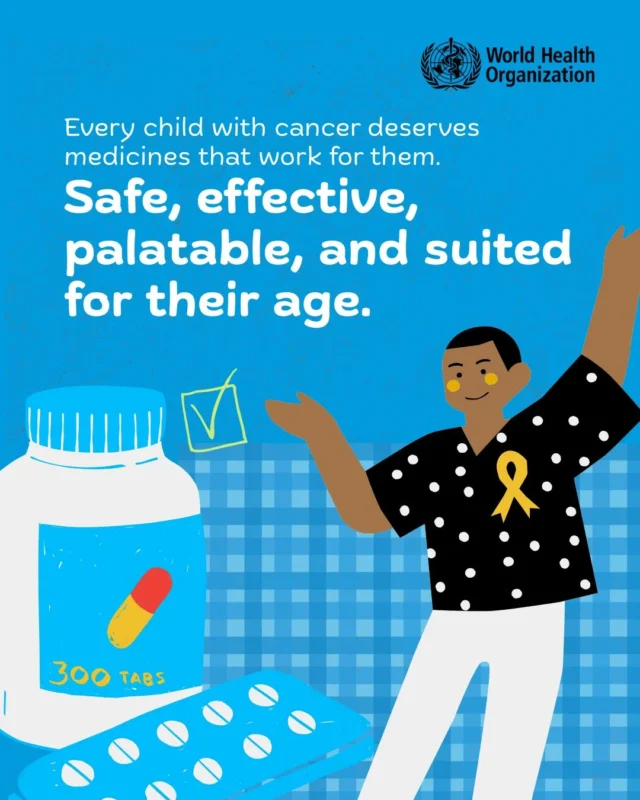
“Children with cancer often rely on adult medicines; tablets that are too large, or liquids that taste unpleasant.
Without age-appropriate options, children face the risk of inaccurate dosing and unnecessary side effects.
Today, manufacturers are working — with WHO guidance — to develop flexible, palatable, and child-friendly cancer medicines that make treatment safer and kinder.
Learn more: https://bit.ly/4qhssfW ”
SIOP Europe, the European Society for Paediatric Oncology (SIOPE):
“On International Childhood Cancer Day, we highlight the importance of equal access to high-quality care for children with cancer across Europe.
The European Standard Clinical Practice (ESCP) project, led by ERN PaedCan and SIOP Europe, brings together experts from across Europe to develop evidence-based, expert-reviewed treatment recommendations for childhood cancers – especially where access to clinical trials may be limited.
Watch our short video to learn more about the ESCP project!”
“Today, on International Childhood Cancer Day, we stand with children and families in every corner of the world who are facing cancer — not as a statistic, but as a daily reality.
Each year, more than 400,000 children and adolescents are diagnosed with cancer globally. In high-income countries, survival rates now exceed 80%. In many low- and middle-income countries, survival can still be below 30%. This gap is not a medical mystery. It is an equity failure.
World Health Organization has launched the Global Initiative for Childhood Cancer with a clear target: reaching at least 60% survival for all children with cancer by 2030. The knowledge exists. The medicines exist. The protocols exist. What must exist everywhere is ACCESS.
International Society of Paediatric Oncology – SIOP and partners around the world continue to strengthen collaboration, training, and standards of care. Regional networks across Asia, Africa, Europe, the Americas and Oceania are proving that when countries work together, survival improves.
But progress requires more than protocols.
It requires:
– Sustainable national financing
– Access to essential medicines
– Trained multidisciplinary teams
– Psychosocial support for families
– Data systems that measure outcomes
– Political commitment at the highest level
Children with cancer do not need sympathy. They need systems that work.
OncoDaily was built on the belief that information democratizes care. When knowledge is shared, when best practices travel faster than disease, when voices from all regions are heard — survival follows.
Today we honor:
The courage of children
The strength of parents
The dedication of nurses and physicians
The scientists pushing boundaries
The advocates who refuse to accept inequity!
International Childhood Cancer Day is not only a day of awareness. It is a day of responsibility.
Every child, everywhere, deserves the same chance to survive — and to thrive.
Let us move from words to measurable action.
Because childhood cancer is curable. Inequity is not!”
Sunday 15 February is International Childhood Cancer Day. 14,000 children live with cancer in Europe, and 400,000 around the world, with systemic inequalities in treatment, diagnosis and care around the world.
In our latest edition of Transform Talks, we’re proud to showcase the work of Childhood Cancer International – Europe, and discuss in depth with Teresa Pais why the Biotech Act is so important for Unmet MedicalbNeed in paediatric care.
“International Childhood Cancer Day 2026
I am proud to stand with Childhood Cancer International in support of the ICCD 2026 theme: Demonstrating Impact; From Challenge to Change, right here in South Africa.
Each year, around 1,000 children and teenagers in our country are diagnosed with cancer. Behind every number is a child, a teenager a family, and a future that depends on timely, quality care. It is a powerful reminder of why this work matters and why acting with urgency is essential. I am encouraged by the South African Department of Health’s support of the UN Political Declaration on Non-Communicable Diseases and Mental Health, a significant milestone for children with cancer globally and locally.
At the end of 2025, world leaders committed to improving childhood cancer survival by scaling up interventions to achieve at least a 60% global survival rate by 2030, aligned to the WHO Global Initiative for Childhood Cancer. For the first time, childhood cancer is firmly embedded within the global NCD and mental health agenda, with a clear and measurable target.
At CHOC Childhood Cancer Foundation SA , our role is to ensure these global commitments translate into meaningful impact for families here at home. Through integrated, multidisciplinary support, accommodation near treatment centres, transport assistance, psychosocial services, we work to reduce the burden on families and strengthen the continuum of care.
As one village, we carry both the responsibility and the opportunity to ensure that no child or teenager is left behind.
From challenge to change, I see that courage in our children, teenagers and families every single day. Let us keep moving forward, together.”
“International Childhood Cancer Day is here and you have the power to do something incredible https://lnkd.in/empcDHJN
This video highlights one of the many challenges children face when trying to receive cancer treatment in low- and middle-income countries – getting to hospital.
Care can be hundreds of miles from home. Journeys can be expensive. Crowded public transport can increase infection risks.
Hundreds of children do not complete their cancer treatment, because care is simply out of reach.
You have the power to change that though.
Donate this International Childhood Cancer Day and help us reach our £2,500 target!
We want care to reach the children who desperately need it, but we need your support urgently if we want to make an impact this International Childhood Cancer Day.
£6 Could pay for a return journey to hospital from local accommodation in Kathmandu for a child undergoing treatment
£33 could supports transportation costs for a child and caregiver to travel between home and hospital for a chemotherapy appointment in Cameroon
£50 could cover 2 weeks of accommodation for a family in Bangladesh whilst their child receives care, so that they can be closer to the hospital during ongoing treatment.
£80 could cover return transportation costs from a remote region to a major care centre in Ghana.
Donate now, https://lnkd.in/empcDHJN ”
“Today marks World Cancer Day, and childhood cancer is a cause close to my heart.
As a Leo with Tema Supreme Leo Club, I’ve seen firsthand how showing up with time, presence, and compassion can bring joy and hope to children battling cancer.
This February, I’m committed to taking action, supporting district initiatives like the Sunshine House Teaching Project and blood donation drives, and sharing their stories.
Because awareness alone isn’t enough every child deserves care, hope, and a fighting chance.
Read more here https://lnkd.in/d3DwV-Mp? ”
“International Childhood Cancer Day At Cancer Patients Aid Association (CPAA), we believe care must go beyond medical treatment. Through our Shiksha (Education) Program, we ensure that a child’s learning, confidence, and sense of normalcy continue even during treatment. Because survival is essential — but so is preserving childhood, dignity, and the promise of a future.”
Written by Nare Hovhannisyan, MD