Yan Leyfman, MD, Hematology-Oncology Fellow at NewYork-Presbyterian Brooklyn Methodist Hospital, shared on LinkedIn:
“Can a CD20×CD3 bispecific antibody meaningfully treat lymphoma within the central nervous system?
New multicenter retrospective data suggest the answer may be yes.
In 84 heavily pretreated patients with relapsed/refractory CNS lymphoma, glofitamab-based therapy produced remarkably high response rates across both primary CNS lymphoma (PCNSL) and secondary CNS lymphoma (SCNSL).
Overall:
- PCNSL: ORR 92%, CR 68%
- SCNSL: ORR 90%, CR 68%
- Median PFS: 19.5 months in PCNSL and 13.5 months in SCNSL
- Median prior therapies: 2.5 lines
Activity was seen with both glofitamab monotherapy and combination approaches, with CR rates reaching 81% in PCNSL treated with combination therapy.
The toxicity profile was also encouraging for a population with CNS involvement:
- ICANS occurred in only 8%
- CRS occurred in 40%, but all cases were grade 1–2
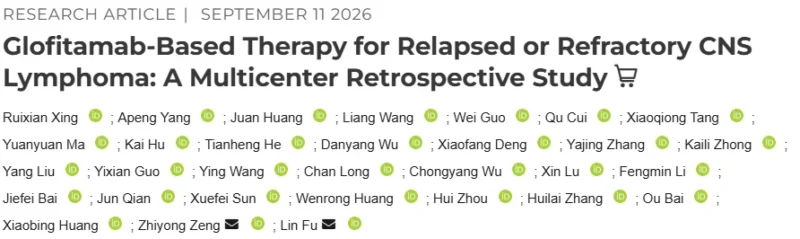
Title: Glofitamab-Based Therapy for Relapsed or Refractory CNS Lymphoma: A Multicenter Retrospective Study
Authors: Ruixian Xing, Apeng Yang, Juan Huang, Liang Wang, Wei Guo, Qu Cui, Xiaoqiong Tang, Yuanyuan Ma, Kai Hu, Tianheng He, Danyang Wu, Xiaofang Deng, Yajing Zhang, Kaili Zhong, Yang Liu, Yixian Guo, Ying Wang, Chan Long, Chongyang Wu, Xin Lu, Fengmin Li, Jiefei Bai, Jun Qian, Xuefei Sun, Wenrong Huang, Hui Zhou, Huilai Zhang, Ou Bai, Xiaobing Huang, Zhiyong Zeng, Lin Fu.
Read The Full Article.
The bigger story is that bispecific T-cell engagement appears capable of generating substantial antitumor activity in CNS lymphoma, despite the unique biological and pharmacologic challenges of treating malignancy in the CNS.
These data are retrospective and heterogeneous, so prospective validation will be important.
But the magnitude of response-and particularly the durability of disease control-raises an exciting possibility:
Could bispecific antibodies become an important part of the next generation of CNS lymphoma therapy?
As immunotherapy continues moving beyond the traditional boundaries of the peripheral immune system, the CNS may no longer be viewed simply as an immunologically inaccessible sanctuary-but as a compartment that can be therapeutically engaged.”
You can also read: Fixed-Duration Glofitamab in R/R MCL With or Without Prior BTKi Exposure: Updated 3.5-Year Findings