Suk Hyun, Scientific Analyst and Patent Agent (Volunteer) at Salk Institute Office of Technology Development, shared on LinkedIn:
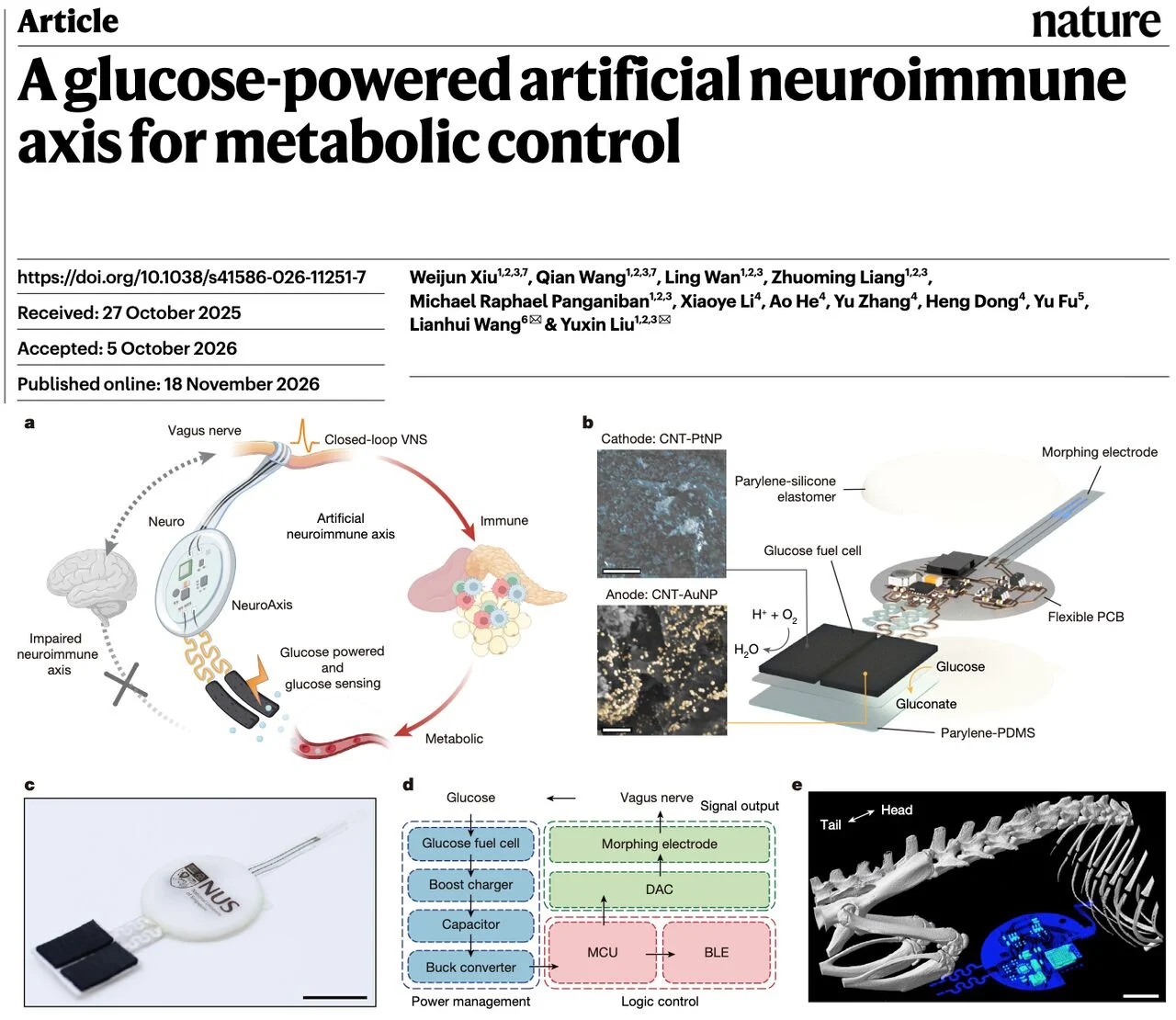
“Nature paper (18 Nov 26) introduces NeuroAxis, a battery-free implant that uses glucose as both fuel and feedback signal for closed-loop vagus nerve stimulation in diabetic rats.
Vagal stimulation can reduce inflammation and improve insulin sensitivity, but existing systems lack metabolic feedback or rely on surrogates such as heart rate variability, and continuous electrochemical sensing strains implant power budgets.
NeuroAxis merges sensing and power in one glucose fuel cell: a carbon nanotube anode carrying 9.33 nm gold nanoparticles with glucose oxidase-like activity, and a platinum nanoparticle cathode. A flexible circuit reads the fuel cell terminal voltage every 30 minutes.
If it stays above 0.6 V (11.1 mM glucose) for five consecutive readings, a self-healing polymer electrode with a PEDOT:PSS conductor, wrapped around the oesophageal vagal trunk, delivers 3 minutes of 10 Hz, ±2 V biphasic stimulation. The nanozyme cell kept 79.7% of baseline power after 31 days in glucose buffer, versus about 0.5% for an enzyme-based cell after 30 days.
In obesity-associated type 2 rats, active devices brought non-fasting glucose near healthy levels within 2 weeks and lowered food intake, body weight and HOMA-IR. Benefits persisted beyond week 6 despite device standby. A sham group with a fully built device but a disconnected electrode did not improve, arguing against glucose depletion by the fuel cell.
The α7 nicotinic receptor antagonist methyllycaconitine blunted the macrophage shift and glycaemic gains. Vagotomy cut weight loss, yet vagotomized rats controlled glucose better than antagonist-treated rats, and pair feeding gave only modest gains. The authors interpret this as afferent signalling mainly shaping feeding and weight, and α7 signalling mainly shaping inflammation, insulin sensitivity and glycaemia.
In multiple-low-dose streptozotocin type 1-like rats, treatment lowered HbA1c, raised insulin, expanded regulatory T cells and raised β-cell mass, with glycaemia reported normal by week 8. Reviewers noted that fuel cells, self-powered sensors, vagal stimulators and flexible circuits are individually known, so novelty lies in the integrated autonomous loop.
Limitations: male rats only, 3 to 7 per group, no human data. Streptozotocin models are chemical, not spontaneous autoimmune. Antagonist dosing was systemic, limiting organ-level attribution. Active devices stopped at about 32 days as glucose normalized and fuel cell output decayed. Sampling every 30 minutes is a design choice, the signal is a loaded terminal voltage, and the authors softened glucose selectivity to a larger response than tested interferents because gold nanoparticles also oxidize other molecules.”
Patent doc: application 10202602065R filed on 06/17/2026 per IPOS
Title: A glucose-powered artificial neuroimmune axis for metabolic control
Authors: Weijun Xiu, Qian Wang, Ling Wan, Zhuoming Liang, Michael Raphael Panganiban, Xiaoye Li, Ao He, Yu Zhang, Heng Dong, Yu Fu, Lianhui Wang, Yuxin Liu
You may also be interested in:
Suk Hyun: Science Introduces a New Approach to Protein Degradation
Could Drugs Developed for Diabetes and Obesity Help Slow Cancer Spread? – CancerWorld