Key takeaways
- Global oncology workforce disparities may worsen by 2050 despite projected increases in the overall number of oncologists.
- Low-income countries could face 8,732 annual new cancer cases per oncologist, compared with 285 in high-income countries.
- Geographic averages may conceal critical workforce shortages, particularly in economically disadvantaged settings.
- Africa and Asia are projected to experience increasing workforce burden, with substantial differences between subregions.
- - Economic stratification, standardized workforce monitoring, and targeted investment are essential for more equitable cancer care planning.
New paper alert! A new study published in JCO Oncology Practice examines how the global oncology workforce may evolve by 2050, revealing substantial disparities in the availability of oncologists across geographic regions and economic settings. Despite projected growth in the global oncology workforce, low-income countries may face increasingly severe shortages as cancer incidence continues to rise.
The study, led by Arkadi Asaturyan et al., analyzed historical workforce trends and compared two approaches to projecting future oncology workforce burden: geographic regional classification and economic stratification based on World Bank income groups. The findings suggest that regional averages may conceal critical workforce shortages in countries with limited healthcare resources.
By 2050, the projected burden could reach 8,732 new cancer cases per oncologist annually in low-income countries, compared with 285 in high-income countries. The authors emphasize that increasing the total number of oncologists worldwide may be insufficient without addressing inequalities in workforce distribution.
Seeking to Project the 2050 Oncologists’ Workforce Through Historical Regional Trends and Economic Stratification: Challenges and Findings
Authors: Arkadi Asaturyan, Sergey Badalyan, Arina Aghajanyan, Davit Zohrabyan, Liana Safaryan, Armen Avagyan, Lilit Harutyunyan, Amalya Sargsyan, Nune Karapetyan, Miqayel Pilosyan, Maria Gharagulyan, Sanik Sadyan, Eliz Baloyan, Arkadik Petrosyan, Gevorg Tamamyan, Samvel Bardakhchyan, and Elen Baloyan.
Published in: JCO Oncology Practice, November 18, 2026
DOI: 10.1200/OP-26-00432
Why Is the Global Oncology Workforce Becoming a Critical Concern?
Cancer incidence is projected to increase substantially over the coming decades. According to GLOBOCAN estimates cited in the study, the annual number of new cancer cases worldwide is expected to rise from approximately 20 million in 2022 to more than 35 million by 2050, representing a 77% increase.
Meeting this growing demand requires not only advances in cancer treatment and diagnostics but also an adequately trained oncology workforce.
However, the availability of oncologists differs significantly between countries. Workforce shortages are particularly concerning in low- and middle-income settings, where limited training capacity, healthcare infrastructure, and specialist availability may restrict access to cancer care.
Previous research has highlighted these inequalities, including David J. Benjamin’s analysis of the global medical oncology workforce presented at ESMO 2025, which addressed disparities in access to oncology specialists across different economic settings.
The new study investigates whether conventional geographic classifications adequately capture these inequalities or whether economic stratification provides a more informative assessment of future workforce needs.
How Did Researchers Project the Oncology Workforce to 2050?
The researchers collected historical oncologist workforce data from peer-reviewed publications, government and Ministry of Health reports, and professional organizations, including ASCO and ESMO.
Cancer incidence and population projections were obtained from GLOBOCAN, United Nations sources, and other national and international databases.
Workforce information was identified for 100 countries, with 61 countries included in the final regional analysis and 88 in the income-based analysis.
The study evaluated two projection models:
- Regional model: Countries were grouped geographically to examine historical workforce trends across Europe, Asia, Africa, Latin America, Northern America, and Australia and New Zealand.
- Economic model: Countries were classified into high-income, upper-middle-income, lower-middle-income, and low-income groups using World Bank classifications.
The primary measure was oncology workforce burden, defined as the annual number of new cancer cases per clinical oncologist.
Historical changes in workforce burden or workforce size were estimated using compound annual growth rates and extrapolated to 2050.
What Did the Regional Workforce Projections Reveal?
Regional projections demonstrated substantial variation in future oncology workforce burden.
By 2050, the estimated annual number of new cancer cases per oncologist was:
- Asia: 729 cases
- Africa: 627 cases
- Latin America: 315 cases
- Australia and New Zealand: 204 cases
- Europe: 185 cases
- Northern America (United States and Canada): 134 cases
Northern America and Australia and New Zealand demonstrated relatively stable or improving workforce burden trends, while Europe showed a modest projected increase.
In contrast, Africa and Asia experienced increasing historical workforce pressure, suggesting that cancer incidence may continue to outpace oncology workforce capacity.
Particularly striking differences were observed within individual regions.
In sub-Saharan Africa, the projected burden reached 11,593 new cases per oncologist by 2050, compared with 135 in Northern Africa.
Similarly, projected workforce burden varied substantially within Asia, reaching 1,303 cases per oncologist in South Asia compared with 318 in Western Asia.
These findings illustrate how broad regional estimates may obscure severe workforce shortages in specific populations.
Why Does Economic Stratification Change the Picture?
One of the study’s most important findings was the substantial difference in projected workforce burden when countries were grouped by economic status rather than geographic location.
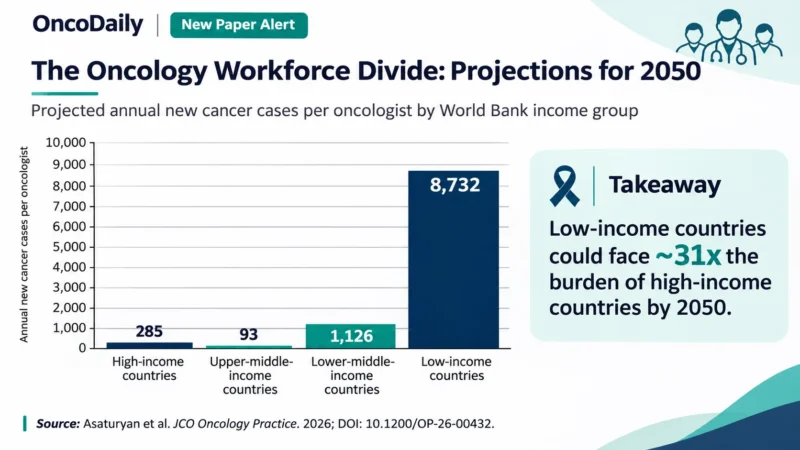
The income-based model estimated the following annual new cancer cases per oncologist by 2050:
- High-income countries: 285 cases
- Upper-middle-income countries: 93 cases
- Lower-middle-income countries: 1,126 cases
- Low-income countries: 8,732 cases
These projections indicate that the burden in low-income countries could be approximately 31 times higher than in high-income countries and nearly 94 times higher than in upper-middle-income countries.
The findings also revealed differences in projected workforce development.
Upper-middle-income countries demonstrated comparatively strong historical workforce growth, with an estimated increase from 46,142 oncologists in 2022 to 127,173 by 2050.
Conversely, the workforce in lower-middle-income countries was projected to decline from 6,377 oncologists in 2022 to 5,216 by 2050.
The most concerning projections involved low-income countries, where the estimated workforce increased only from 70 oncologists in 2022 to 97 by 2050 across the 15 countries included in the analysis.
Although these estimates depend on the continuation of historical trends, they suggest that the greatest workforce challenges may emerge in countries already facing limited oncology capacity.
Can Global Workforce Averages Conceal a Future Crisis?
Despite substantial inequalities between countries, both projection models produced global workforce burden estimates within a previously suggested manageable range of approximately 150–300 new cancer cases per oncologist annually.
The regional model projected 247 cases per oncologist globally by 2050, while the income-based model estimated 170 cases per oncologist.
However, these averages contrast sharply with the projected burdens exceeding 1,000 cases per oncologist in lower-middle-income countries and 8,000 in low-income countries.
This distinction highlights a central finding of the study: the global oncology workforce may appear sufficient in aggregate while remaining critically inadequate in the countries with the greatest needs.
The authors also emphasize that workforce burden depends on the relationship between cancer incidence and available oncology specialists rather than the absolute number of oncologists alone.
Consequently, an increase in specialist numbers does not necessarily translate into improved access to care if cancer incidence grows more rapidly.
What Are the Implications for Global Cancer Care?
The findings suggest that future oncology workforce planning should incorporate economic disparities rather than rely exclusively on geographic classifications or global workforce totals.
Countries with limited oncology capacity may require targeted investments in specialist training, workforce development, healthcare infrastructure, and long-term retention strategies.
Improved national workforce monitoring is also essential. The study identified substantial differences in the availability and quality of workforce data, including inconsistent definitions of oncology specialties and incomplete national reporting.
More standardized reporting could help policymakers identify workforce shortages earlier and develop strategies tailored to local healthcare needs.
The authors caution that the projections should be interpreted in light of several limitations. Historical workforce data were heterogeneous, long-term growth rates may not remain constant, and workforce estimates did not explicitly account for retirement or the entry of new trainees.
Furthermore, workforce burden was estimated using annual cancer incidence rather than cancer prevalence, potentially underestimating the total clinical workload associated with cancer survivorship and ongoing treatment.
Therefore, the estimates should be viewed as indicators of potential workforce trajectories rather than precise predictions of future staffing levels.
What Needs to Change Before 2050?
The study underscores the importance of moving beyond global workforce totals toward more equitable and sustainable oncology workforce planning.
Income-based stratification may help identify countries where growing cancer incidence, limited specialist availability, and constrained healthcare resources create the greatest vulnerabilities.
Strengthening workforce surveillance, expanding training opportunities, and developing targeted national cancer workforce strategies could help address these challenges.
Ultimately, the findings suggest that the future of global cancer care will depend not only on how many oncologists are trained, but also on where they practice and whether healthcare systems can meet the needs of their populations.
Read more New Paper Alerts on OncoDaily.