
Qurient has announced the publication of a study in Science Advances showing that its selective CDK7 inhibitor, mocaciclib (Q901), enhanced the antitumor activity of topoisomerase I inhibitor-based antibody-drug conjugates in preclinical models. The findings provide a mechanistic rationale for combining the two approaches and support further development of the company’s dual-payload ADC strategy.
The research was conducted in collaboration with scientists at Pohang University of Science and Technology (POSTECH), the U.S. National Cancer Institute, and the University of Maryland.
The study, titled “Sensitizing tumor response to topoisomerase I antibody-drug conjugate by selective CDK7 inhibition,” examines how inhibiting CDK7 can make tumor cells more vulnerable to the DNA damage caused by TOP1 inhibitors. The results establish a preclinical foundation for further investigation; they do not demonstrate improved patient survival or clinical efficacy of the combinations.
How Mocaciclib Increases Tumor Sensitivity to TOP1 Inhibitors
The researchers found that mocaciclib disrupted transcriptional programs driven by MYC and E2F, reducing the expression of genes involved in cell cycle regulation and DNA damage repair.
These effects included suppression of genes associated with homologous recombination repair, a pathway that helps cells repair DNA damage. By weakening these repair programs, CDK7 inhibition increased tumor-cell sensitivity to TOP1 inhibitors.
The study also identified a complementary mechanism involving RNA polymerase II, the enzyme responsible for transcribing DNA into RNA. Mocaciclib suppressed its transition from transcription initiation to elongation, helping stabilize TOP1–DNA protein crosslinks and increasing susceptibility to TOP1-directed treatment.
According to Qurient’s release, reduced transcriptional elongation limited collisions between RNA polymerase II and these crosslinks, which would otherwise promote their clearance. The crosslinks consequently persisted longer, amplifying DNA damage within tumor cells.
Together, the findings suggest that mocaciclib can interfere with both the removal of TOP1-associated DNA lesions and the cellular repair processes that help tumors survive them.
Enhanced Antitumor Activity With Trastuzumab Deruxtecan and Sacituzumab Govitecan
In preclinical models, mocaciclib enhanced antitumor activity when combined with TOP1 inhibitor-based ADCs, including trastuzumab deruxtecan and sacituzumab govitecan, according to the company.
The findings support further investigation of CDK7 inhibition as a strategy for increasing the activity of ADCs carrying TOP1 inhibitor payloads. They also offer a rationale for exploring whether this approach could help address resistance to these therapies.
Qurient reported that mocaciclib demonstrated high selectivity for CDK7 in kinome profiling and formed a covalent interaction with the protein at Cys312. These characteristics underpin its development as a selective inhibitor of CDK7-dependent processes.
However, the observed combination activity remains preclinical. Clinical studies are needed to determine whether the mechanisms translate into meaningful patient benefit and to establish suitable dosing and safety profiles.
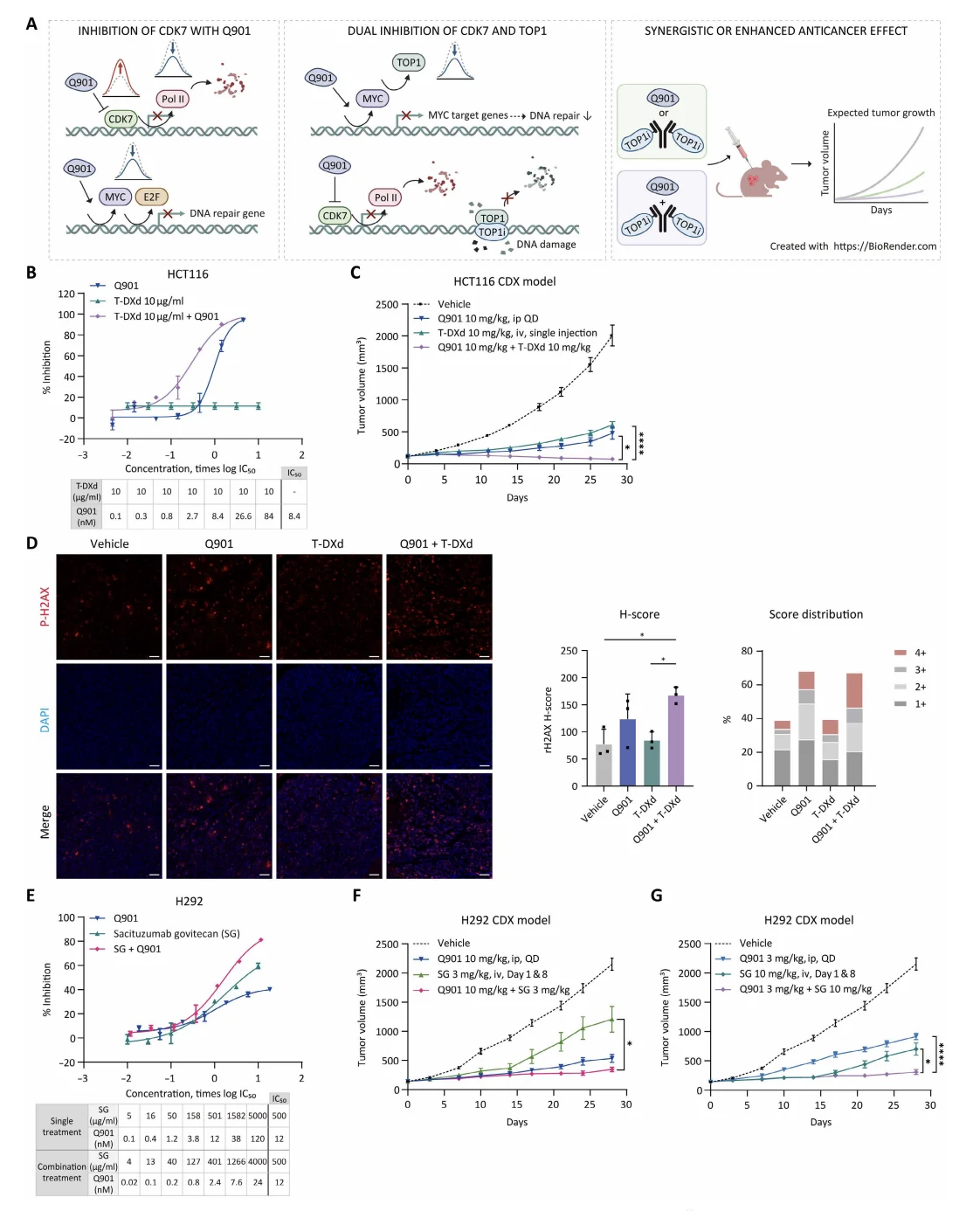
Combining Q901 with TOP1 inhibitor-based ADCs enhances antitumor effects. (A) Schematic illustrating how Q901 enhances the activity of TOP1 inhibitors and TOP1 inhibitor-based ADCs. Q901 increases CDK7 accumulation at transcription start sites while reducing RNAPII, MYC, and E2F1 binding, thereby decreasing the expression of DNA damage response genes. Combined inhibition of CDK7 and TOP1 impairs the repair of TOP1 inhibitor-induced DNA damage, promoting cell death. The combination also demonstrates cytotoxic activity in vitro and tumor suppression in vivo. (B) HCT116 cells were treated for 72 hours with Q901, trastuzumab deruxtecan (10 μg/ml), or their combination. Dose-response curves were plotted using log-transformed concentrations normalized to IC50. Cell viability was measured using the ATP Lite assay (n = 2; mean ± SD). (C) HCT116 xenograft models received Q901 (10 mg/kg), trastuzumab deruxtecan (10 mg/kg), or their combination. Statistical significance was assessed using two-way ANOVA followed by Tukey’s multiple comparisons test (*P ≤ 0.05; **P ≤ 0.0001). (D) Tumor DNA damage was assessed by γH2AX immunofluorescence. Representative γH2AX, DAPI, and merged images are shown alongside H-scores and score distributions. Scale bars represent 20 μm. H-score data are presented as mean ± SD, with significance assessed using two-way ANOVA followed by Šidák’s multiple comparisons test (*P ≤ 0.05). (E) H292 cells were treated with Q901 and sacituzumab govitecan for 72 hours. Dose-response curves were plotted using IC50-normalized, log-transformed concentrations. Cell viability was measured using the ATP Lite assay (n = 2; mean ± SD). (F–G) H292 xenograft models received Q901 (10 or 3 mg/kg), sacituzumab govitecan (3 or 10 mg/kg), or their combination. Tumor volumes are presented as mean ± SEM. Statistical significance was assessed using two-way ANOVA followed by Tukey’s multiple comparisons test (*P ≤ 0.05; ****P ≤ 0.0001). Abbreviations: CDX, cell line-derived xenograft; ip, intraperitoneal; iv, intravenous. Source: Jung et al., Science Advances, 2026;12, Fig. 6C. CC BY 4.0. Panel extracted from the original figure.
Qurient Links Findings to Its Dual-Payload ADC Strategy
Qurient said the research supports two development directions: combining mocaciclib with existing TOP1 inhibitor-based ADCs and developing ADCs that incorporate CDK7 and TOP1 inhibitor payloads within a single therapy.
Kiyean Nam, PhD, Chief Executive Officer of Qurient and a co-corresponding author of the study, said:
“This publication elucidates the complementary molecular mechanism between CDK7 and TOP1 inhibition.”
Nam added that the findings provide a scientific rationale for both combination treatment and the company’s next-generation dual-payload ADC programs.
The company linked the research to QP101 and its broader ADC platform, which is intended to apply complementary payload combinations across multiple antibody targets. Qurient said it is using this framework to expand its internal pipeline and support future strategic partnerships.
The publication provides mechanistic support for that development strategy. It does not, by itself, establish the clinical efficacy or safety of QP101.
A Preclinical Foundation for Further ADC Research
The study connects selective CDK7 inhibition with greater sensitivity to TOP1-mediated DNA damage, offering a biological explanation for the enhanced antitumor activity observed in the combination models.
For Qurient, the findings support continued investigation of mocaciclib alongside existing ADCs and the development of dual-payload candidates. The next step is to determine whether this preclinical activity can translate into effective and tolerable treatment approaches for patients.
Read further on OncoDaily: New Paper Alert: Antiseizure Drug Levetiracetam Linked to Longer Survival in Diffuse Midline Glioma