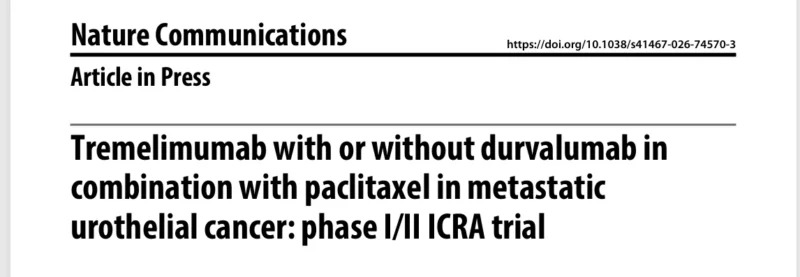
The ICRA trial evaluated whether CTLA-4 blockade, with or without durvalumab, could help restore antitumor immune activity in a setting where treatment options remain limited. This phase I/II trial has reported encouraging activity for paclitaxel combined with high-dose tremelimumab in patients with metastatic urothelial carcinoma previously treated with platinum chemotherapy and PD-(L)1 inhibition.
The study, published in Nature Communications, found that paclitaxel plus tremelimumab 750 mg achieved a confirmed objective response rate of 26% in the expanded study arm.
Can Immunotherapy Still Work After PD-(L)1 Failure?
A major question in metastatic urothelial cancer is whether patients who progress after PD-1 or PD-L1 inhibition can still benefit from another immune-based strategy.
Tremelimumab targets CTLA-4, a checkpoint involved in early T-cell priming. This mechanism differs from PD-1 and PD-L1 blockade, raising the possibility that CTLA-4 inhibition could reactivate or broaden antitumor immune responses after PD-(L)1 treatment failure.
The ICRA trial tested this idea in patients with therapy-refractory metastatic urothelial carcinoma.
All enrolled patients had previously received platinum-based chemotherapy and anti-PD-(L)1 therapy.
ICRA Trial- Designe
ICRA was a multicenter, open-label phase Ib/II trial conducted in the Netherlands. A total of 53 patients were enrolled between May 2019 and May 2023.The main phase included three treatment arms:
- Arm A: Paclitaxel plus tremelimumab 750 mg
- Arm B: Paclitaxel plus tremelimumab 300 mg and durvalumab 1500 mg
- Arm C: Tremelimumab 750 mg alone
The primary endpoint was confirmed objective response rate by RECIST 1.1 in the two paclitaxel-containing arms.Paclitaxel was administered weekly, while tremelimumab and durvalumab were given according to the study schedule.
Paclitaxel Plus High-Dose Tremelimumab Met the Primary Endpoint
The paclitaxel plus tremelimumab 750 mg regimen was expanded to 20 patients after meeting the trial’s predefined response criteria.In this arm, 5 of 20 patients achieved a confirmed objective response, corresponding to an estimated objective response rate of 26% with an 88% confidence interval of 14% to 36%.The lower confidence-bound exceeded the predefined 10% threshold, meeting the study’s primary endpoint.
In the other groups:
- Paclitaxel, tremelimumab 300 mg, and durvalumab produced a confirmed objective response rate of 17%.
- Tremelimumab alone produced a confirmed objective response rate of 8%.
- Clinical benefit, defined as confirmed response or stable disease lasting at least 24 weeks, was reported in 32% of patients in the paclitaxel plus tremelimumab 750 mg arm.
Survival Findings Need Careful Interpretation
Median overall survival was 16.1 months with paclitaxel plus tremelimumab 750 mg, 14.5 months with paclitaxel plus tremelimumab plus durvalumab, and 8.3 months with tremelimumab alone.Median progression-free survival was 4.5 months, 7.4 months, and 2.8 months, respectively.
However, the trial was small and was not designed for formal comparisons between the treatment arms. Subsequent anticancer therapies, including enfortumab vedotin, may also have influenced long-term outcomes.
These findings should therefore be interpreted as a clinical signal rather than definitive evidence that one regimen is superior to another.
What Did the Translational Analyses Show?
Tumor analyses suggested that baseline inflammation may be associated with durable benefit from CTLA-4-based treatment.Patients with durable responses had higher baseline expression of CD8-positive T-cell effector and interferon-gamma gene signatures than non-responders.Paired pretreatment and on-treatment samples also showed increases in these immune-related signatures after treatment.
This suggests that immune induction may still be possible in some patients whose cancer has already progressed after PD-(L)1 inhibition.
Why Add Paclitaxel?
Paclitaxel may contribute more than direct cytotoxic activity. The investigators explored whether the chemotherapy could promote immunogenic cell death, releasing tumor antigens and creating a more favorable environment for immune activation.In a murine bladder cancer model, paclitaxel-treated tumor cells delayed subsequent tumor growth in a vaccination assay. Paclitaxel combined with anti-CTLA-4 also suppressed tumor growth more than either treatment alone.
These preclinical observations support the biological rationale for pairing chemotherapy with CTLA-4 blockade.
Safety Profile
Grade 3 or 4 treatment-related adverse events occurred in 45% of patients receiving paclitaxel plus tremelimumab 750 mg and in 75% of patients receiving the paclitaxel, tremelimumab, and durvalumab combination.
Immune-related adverse events were most commonly gastrointestinal, dermatologic, or endocrine. No grade 5 treatment-related adverse events were reported.
The study authors noted that toxicity was manageable, but the higher rate of serious treatment-related events in the triplet arm remains important when considering future development.
What Does This Mean for Metastatic Urothelial Cancer?
The ICRA trial suggests that high-dose CTLA-4 blockade combined with paclitaxel may have activity in metastatic urothelial carcinoma after platinum chemotherapy and PD-(L)1 inhibitor treatment.
The results do not establish a new standard of care. The cohort was small, and the study was non-comparative.
Still, the findings support further research into treatment strategies that combine an agent capable of producing short-term tumor control with immunotherapy designed to generate more durable immune responses.