David Antonio Pérez, Radiation Oncologist at AUNA, Expert Consultant and Lecturer at International Atomic Energy Agency, shared on LinkedIn:
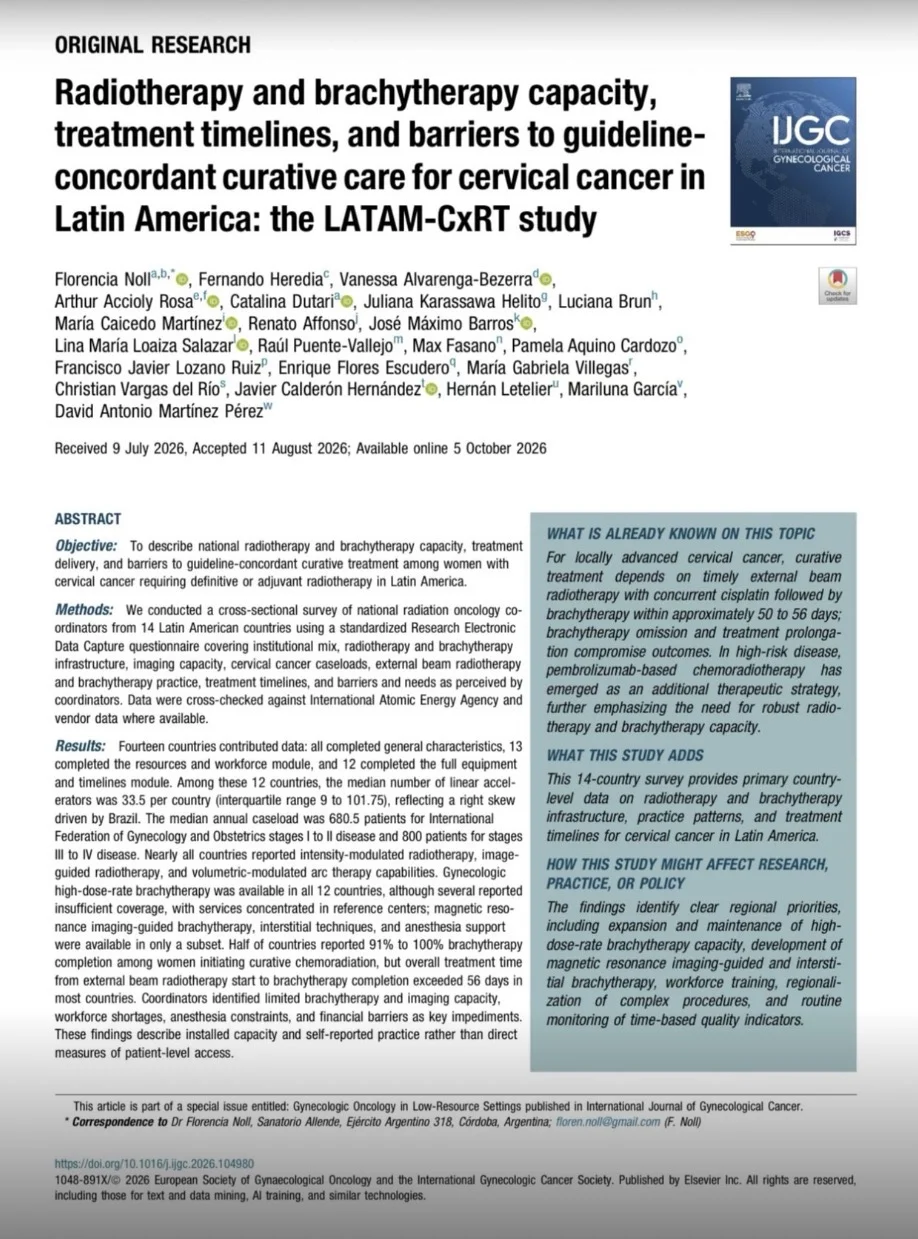
“I’m pleased to share our new publication of ‘Radiotherapy and brachytherapy capacity, treatment timelines, and barriers to guideline-concordant curative care for cervical cancer in Latin America: the LATAM-CxRT study.’
A very special recognition to Florencia Noll for her leadership in this project, and to every colleague who made it possible to build a regional picture of an issue we know well in clinical practice: having technology available does not necessarily mean having timely access to complete curative treatment.
The objective of the study was to characterize, at the national level, radiotherapy and brachytherapy capacity, patterns of practice, treatment timelines, and barriers to delivering guideline-concordant curative care for cervical cancer across 14 Latin American countries.
The findings convey several important messages. Although advanced external beam radiotherapy techniques – including IMRT, IGRT, and VMAT – are widely available, and the participating countries reported gynecologic HDR brachytherapy capability, access remains heterogeneous and is often concentrated in referral centers. MRI-guided brachytherapy, interstitial techniques, and anesthesia support remain available only in a subset of the evaluated systems.
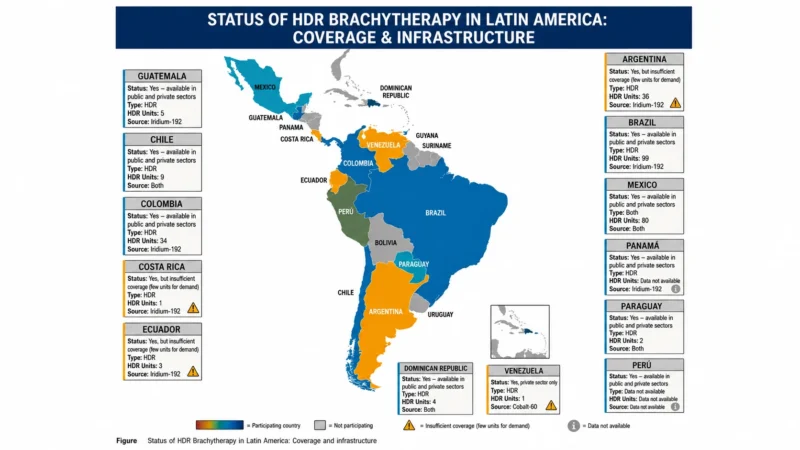
Even more importantly, in most countries, the overall treatment time from the start of EBRT to completion of brachytherapy exceeded 56 days – a quality indicator directly associated with treatment effectiveness and the potential for cure.
The study also identifies specific barriers: insufficient brachytherapy and imaging capacity, shortages of trained personnel, limitations in anesthesia support, fragmented service organization, and financial barriers.
For me, the conclusion is particularly relevant: the next major improvement in cervical cancer care in Latin America will not come from installing more equipment alone. We need to build complete, reliable care pathways: appropriate imaging, high-quality external beam radiotherapy, timely access to brachytherapy, interstitial capability when clinically indicated, anesthesia support, trained professionals, efficient regional referral systems, and systematic monitoring of overall treatment time.
My sincere thanks again to Florencia and to this outstanding Latin American team. Generating regional data is the first step; translating those data into decisions, investment, training, and access is the responsibility that comes next.
I invite radiation oncology centers, scientific societies, payers, and healthcare decision-makers across our region to measure three things in every cervical cancer program: real access to brachytherapy, IGABT/interstitial capability, and overall treatment time. What we measure, we can improve. And what we build together can change outcomes for thousands of patients.”
Title: Radiotherapy and brachytherapy capacity, treatment timelines, and barriers to guideline-concordant curative care for cervical cancer in Latin America: the LATAM-CxRT study
Authors: Florencia Noll, Fernando Heredia, Vanessa Alvarenga-Bezerra, Arthur Accioly Rosa, Catalina Dutari, Juliana Karassawa Helito, Luciana Brun, María Caicedo Martínez, Renato Affonso, José Máximo Barros, Lina María Loaiza Salazar, Raúl Puente-Vallejo, Max Fasano, Pamela Aquino Cardozo, Francisco Javier Lozano Ruiz, Enrique Flores Escudero, María Gabriela Villegas, Christian Vargas Del Río, Javier Calderón Hernández, Hernán Letelier, Mariluna García, David Antonio Martínez Pérez.
Read the full article here.
You may also be interested in: KEYNOTE-A18 and INTERLACE: Immunotherapy and Treatment Intensification in Cervical Cancer