Ariella Hanker, Associate Professor at UT Southwestern Medical Center, shared AACR Journals’ post on LinkedIn, adding:
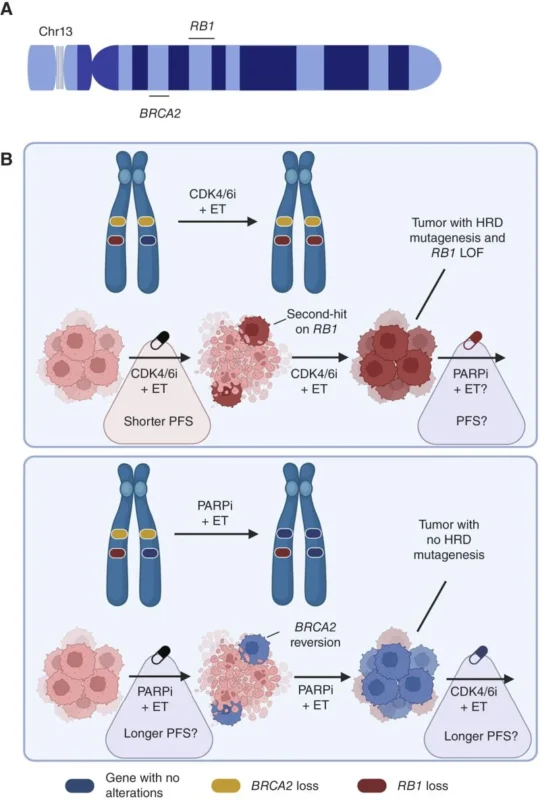
“This was a fun commentary to write with Dr. Fabiana Napolitano, who also created the fantastic figure!
We had the opportunity to highlight a brilliant Nature paper from Anton Safonov, Minna Lee, and colleagues at MSKCC-a wonderful example of how observations from patients can inspire laboratory discoveries that may ultimately improve care.
Using data from nearly 6,000 patients with breast cancer, the team found that germline BRCA2 mutations can influence how tumors evolve during treatment. These tumors were more likely to develop resistance to CDK4/6 inhibitors via inactivation of RB1, a key route of escape from CDK4/6 blockade. In contrast, the tumors remained particularly sensitive to PARP inhibitors, suggesting BRCA2-mutant patients may derive greater benefit from first-line PARP inhibitors than first-line CDK4/6 inhibitors, a hypothesis currently being tested in a clinical trial.
What’s especially exciting is the idea that we could use genomic context to anticipate resistance instead of waiting for it to happen-and choose treatments that stop resistance before it emerges.”
Quoting AACR:
“New in the August 1 issue of Cancer Research-Shaping CDK4/6 Inhibitor Resistance: BRCA2 Germline Alterations Bias toward RB1 Inactivation.
Title: Shaping CDK4/6 Inhibitor Resistance: BRCA2 Germline Alterations Bias toward RB1 Inactivation Available to Purchase
Authors: Fabiana Napolitano, Ariella B. Hanker.
Read The Full Article.
This In the Spotlight commentary by Fabiana Napolitano and Ariella Hanker highlights a recent Nature article from Anton Safonov and colleagues.”