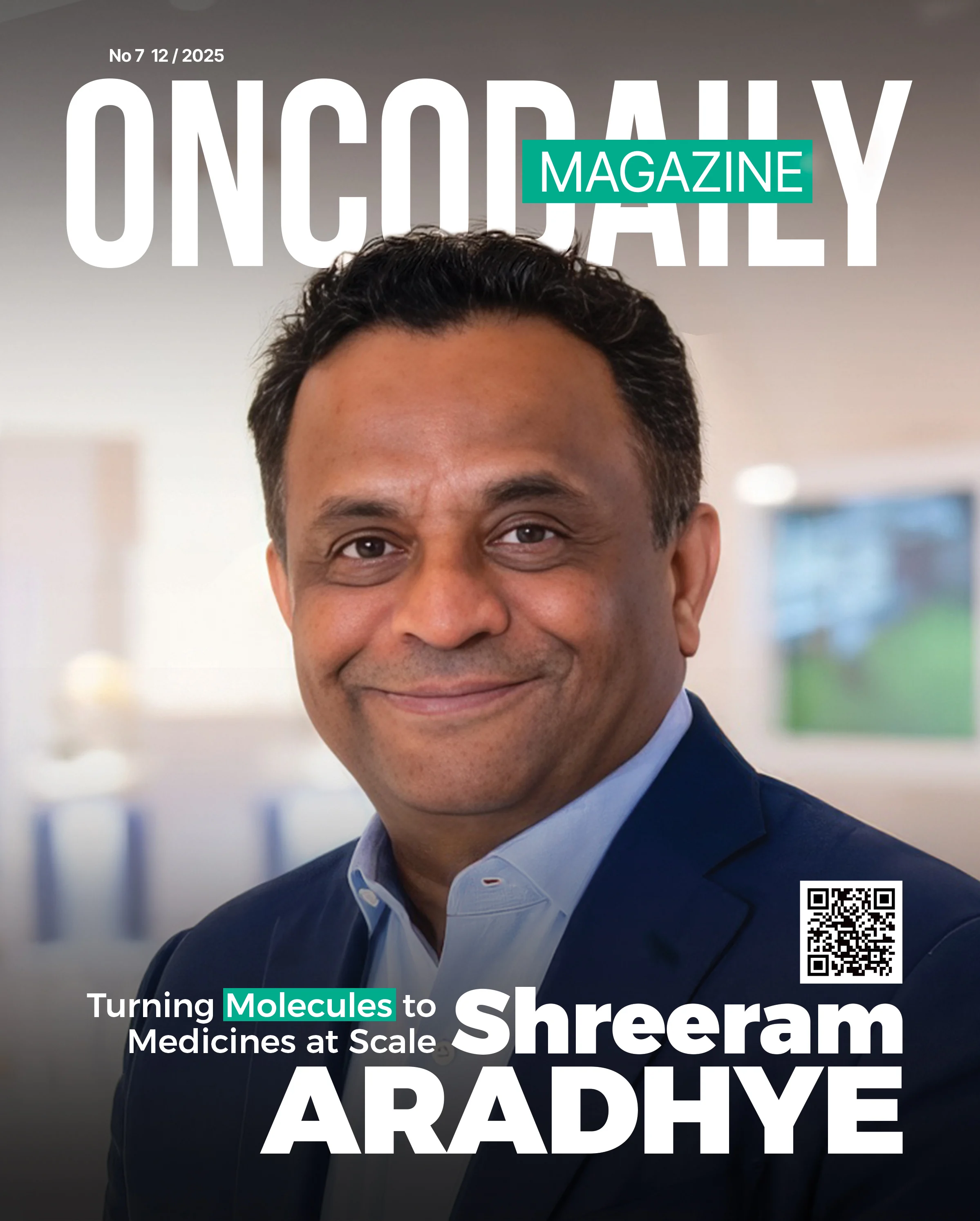
When I met Shreeram Aradhye, it was immediately clear that this would not be a story about titles or hierarchy. Despite being President of Development and Chief Medical Officer of Novartis, one of the largest and most influential healthcare companies in the world, his narrative did not begin with power or scale. It began with curiosity and with perseverance.
So I asked him to go back. All the way back.
From New Delhi to the World
“The journey begins in New Delhi,” he said simply.
Like many physicians trained in India, his path into medicine started early. At eighteen, he entered the All India Institute of Medical Sciences, an institution so competitive that admission borders on improbable. At the time, around 50 seats were available for nearly 150,000 applicants.
“It takes competence,” he said, “but it also takes luck.”
Yet what mattered more than admission was what followed. AIIMS, he explained, was not just an education, it was a transformation. Training in internal medicine, surrounded by some of the finest teachers in the country, he developed a discipline grounded in knowledge, rigor, and responsibility. The decision to train in Nephrology changed everything and led to the choice to leave India and continue training in the United States
For many international medical graduates, the transition is not just geographic, it is existential.
“You lose your pedigree overnight,” he reflected. “You become an FMG, a three-letter acronym that carries assumptions. Everything you’ve built before suddenly doesn’t count.”
“We’ll figure it out”
The road was anything but smooth. He applied to hundreds of programs. He was granted a single interview, by phone, at a Columbia-affiliated hospital in New York. When the acceptance letter arrived, it came with a caveat: no salary support.
“I tore it up,” he admitted.
It was his girlfriend at the time, now his wife, herself an MD-PhD, who insisted he say yes. “We’ll figure it out,” she told him.
Four months later, the funding came through.
What followed was a familiar immigrant physician’s journey: proving oneself again, and again, and again. Completing training. Applying for another 150 jobs to remain in the country. Accepting a position at a VA hospital in Louisiana, where immigration rules allowed him to stay, while simultaneously working in a transplant program under a mentor who believed in him.
That belief changed everything.
It led to the University of Pennsylvania. Not a common transition, but one enabled by people who had watched him work, trusted his ability, and chose to support his potential.
“That,” Shreeram Aradhye said, “becomes the theme of life.”
A Lattice, Not a Ladder
When I asked him what ultimately drove his success from New Delhi to Penn, from transplant nephrology to leading global R&D, Shreeram paused.
“People say the dots connect looking backward,” he said. “But the question is: what are you doing while you’re creating the dots?”
For Shreeram Aradhye, the answer was twofold. First, an uncompromising commitment to knowledge: content matters. But second, an inner confidence: the belief that one can learn what is needed, adapt, and succeed.
Over time, his view of career progression evolved. “I don’t think of careers as ladders,” he said. “They’re lattices.”
Professional growth, in his view, follows personal growth. Each experience builds capacity for the next, preparing a person not for status, but for impact at scale.
That insight shaped a defining choice: whether to become a business leader in industry, or to remain an enterprise-level R&D leader. He chose the latter, and not because it was easier, but because it aligned with who he was.
“My job now,” he said, “is to help lead teams that turn molecules into medicines and generate the evidence that allows you to call them medicines.”
Mentorship as a Way of Life
When the conversation turned to mentors, his answer was expansive.
“There has always been someone,” he said. “At every stage.”
Mentorship, for him, was never hierarchical or fixed. It required openness and humility, the willingness to learn from anyone, at any time.
He spoke of his early teachers with deep respect. At AIIMS, Professor J.S. Bajaj instilled two inseparable values: relentless pursuit of knowledge, and the ethical responsibility that comes with patient trust.
“That combination,” he said, “is what makes medicine, medicine.”
Throughout his career mentors helped him see himself more clearly. They held up mirrors. They guided not just decisions, but self-understanding.
And that, Shreeram Aradhye believes, is the highest function of mentorship: not to direct, but to enable others to realize their full potential.
The Best Advice
“What’s the best career advice you’ve ever received?”
He didn’t reach for something flashy.
“Be yourself,” he said. “Be authentic. But be curious enough to evolve.”
It was a deceptively simple sentence, because it carries tension. Authenticity without growth becomes stagnation. Growth without authenticity becomes performance. His point was clear: stay rooted, but keep moving.
The 5 C’s
When I asked what he would tell younger colleagues today, he offered what he called his principles, the five C’s, not as slogans, but as a map.
- Curiosity: not only curiosity about content, but about people.
- Commitment: if you commit, you live up to it.
- Courage: action in the face of the unknown, or fear.
- Collaboration: not the buzzword version, but the real one. Because impact at scale is never an individual deliverable.
- Compassion: the most human advantage in an increasingly tech-enabled world.
He lingered on compassion.
“Human-centricity is going to be the thing that gives you the competitive edge,” he said. “Machines can imitate many things. But compassion is ultimately human – toward others, and toward yourself.”
“the magic happens in landscape”
People love asking leaders about schedules, as if calendars explain meaning.
“My day is extraordinarily energizing,” he said. Then he smiled and added a phrase one of his coaches uses for him:
“I’m the chief energy multiplier and belief builder.”
At his scale, the requirement isn’t simply intelligence, it is cognitive presence for an extended period: people problems, content problems, decisions across therapeutic areas, across geographies, across time zones. A day built on meetings, yes, but meetings as a mechanism for alignment, not bureaucracy.
And then Shreeram pulled out his phone.
He said every competency has a portrait identity, your core expertise, your discipline, your craft. But his job, he explained, is to remind everyone that the magic happens in landscape.
It was one of those metaphors that lands instantly: alone, you can be excellent. Together, you can be consequential.
He also acknowledged something few executives say out loud: the role demands ongoing self-renewal. He has to keep expanding his own knowledge base, and keep thinking about the forward-looking responsibilities that belong to him alone.
Books: Why Fiction Makes Better Doctors
When I asked what he was reading, Dr. Aradhye didn’t name a leadership manual. He named a book that had moved him.
The one he had just finished was Mother Mary Comes to Me by Arundhati Roy, the Booker Prize-winning author of The God of Small Things.
He read it partly because his wife was reading it, but also because the idea of reading fiction had recently taken on new meaning for him. Shreeram recalled a French physician-professor who had argued that medical students should read fiction, not as a prescription, but as a reflection of something Shreeram already believed. Science, the professor had said, builds competence; fiction builds an understanding of human life. And that deeper understanding, Shreeram agreed, is what ultimately makes better physicians.
Roy’s book, he said, about her mother after her death, about memory, relationship, and life, it was “an extraordinary experience.”
He still reads nonfiction, especially material that supports synthetic thinking, on how organizations work, how systems run, how things get built. But lately, he has become “obsessed” with fiction and with language itself.
Because in the last three and a half years, he has learned something that sounds almost too obvious until you live it:
Nothing matters more than the careful choice of words.
He called it, half joking, fully serious – “return on words used.”
Stop for two seconds in a busy world
Then the conversation shifted from words to light.
“My hobby is photography,” he said.
Shreeram Aradhye had studied photography in high school. Life interrupted it. Thirty years later, at a reunion, friends asked if he kept it up.
“No time for a dark room,” he told them.
They laughed. “It’s digital now,” they said. “It’s called Lightroom.”
Around that time, his father had died. And he remembered something: after retirement, in the absence of a hobby, his father felt lost. So he returned to photography, not as nostalgia, but as a decision.
Over the last fifteen years, it became something deeper than a pastime. It became a vehicle for perspective. A discipline of presence. A practice of noticing.
Shreeram Aradhye shared his work on Instagram, and people began telling him the photos made them pause. That was his ambition: not to impress, but to offer others what he noticed, so they could stop for two seconds in a busy world and notice something too.
One of the most striking reactions came from an intensely scientific former boss.
He said Shreeram was “the only person who sends him a landscape,” and the first thought is always:
“This feels different.”

Photo by Shreeram Aradhye: Optimism and Resilience (more photos on his Instagram)
The Hard Moments
I asked him about difficult periods, how he handles challenges, and what has been most challenging.
He didn’t go distant. He went personal.
He told me a recent story: after twenty years at Novartis, he left in 2019 to explore biotech, returning to Boston. And there, he experienced what he called an identity quake, the sudden recognition that you’ve lost something that had become a core part of who you are.
How did he deal with it?
Partly, he said, through an inherent optimism shaped by philosophical training, an awareness of the transience of everything. What looks overwhelming today may not be so tomorrow.
But also through something practiced: the ability to observe, to ask for help, to learn.
He described the move from Novartis to biotech with a metaphor that captured the difference between scale and scarcity, between structure and improvisation:
“It was like leaving a well-funded Alpine expedition to go free solo climbing on a rock face.”
In biotech, you learn focus. Prioritization. Operational excellence. You learn what it means to build in a resource-constrained environment, to move fast, to be scrappy.
At the time, he didn’t know what it would become. In retrospect, it was almost a sabbatical.
Because three years later, he returned to Novartis with those learnings and used them to evolve what the organization is doing today.
Again: dots connecting, but only after the fact.
What’s the Plan at Novartis?
When I asked about his plan with Novartis, his answer was both proud and grounded.
He spoke about the transformation of Novartis into a pure-play company, from conglomerate to a focused, innovative pharmaceutical company built around key therapeutic areas and an “extraordinary portfolio.”
He emphasized momentum: the progress of the last three years, the responsibility of delivering transformative medicines, and the seriousness with which they take both patient outcomes and shareholder value.
He pointed to oncology, specifically to breast cancer and prostate cancer; hematology, including CML; and the pioneering effort in precision radiation and radioligand therapeutics.
“We’re on a roll,” he said; not triumphantly, but as someone who wakes up feeling the weight of expectation and the privilege of possibility at the same time.
“Every Day Feels Like We’re Just Getting Started”
Before closing, I asked if there was anything else he wanted to share.
He paused, then smiled.
“It’s been a great journey,” he said. “And yet every day feels like we’re just getting started.”
One Sentence
I asked him what I often ask my guests: describe yourself in one sentence.
“Someone committed to do everything he can every day to live his purpose.”
Who Should I Interview Next?
For the final question, who should I interview next, Dr. Aradhye offered two names.
First: Michelle Longmire, CEO of Medable. Not directly oncology, he noted, but leading a company that provides “office data and trial services,” and an entrepreneur’s multi-year journey of building in a new world.
And then he mentioned Siddhartha Mukherjee, almost as a reflex, before stopping himself.
“I was going to say Siddhartha Mukherjee,” he said, “but you’ve probably interviewed him.”
I told him we hadn’t, though Mukherjee was featured in our CancerWorld magazine.
He smiled.
“Because if you asked me my favorite book,” he said, “I would have told you his book.”
And we both named it instantly—The Emperor of All Maladies.
Interview by Gevorg Tamamyan, the Editor-in-Chief of OncoDaily