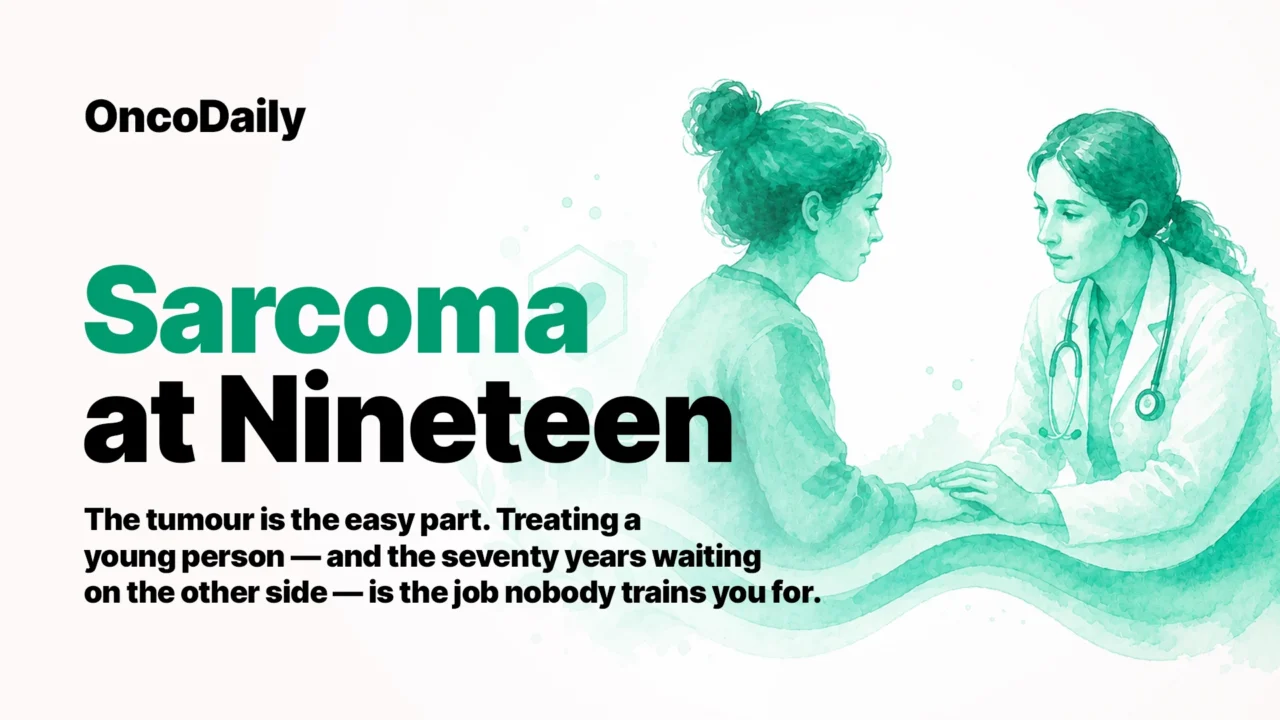
The tumour is the easy part. Treating a young person – and the seventy years waiting on the other side – is the job nobody trains you for.
She is nineteen, and this cycle she is worse. Not a little worse. She cannot get out of bed, she is not eating, she says everything hurts and she cannot tell me where. Her mother is in the corridor asking me to do something, anything, and meaning it in the way only a mother in a corridor means it.
So I do what I was trained to do. I go through the counts. I check the liver enzymes, the creatinine, the electrolytes. I re-read the imaging. I think about dose reduction, about growth factor support, about whether we are pushing too hard. I have a plan for every abnormal number on that screen.
Nothing on the screen explains her.
It takes sitting down, and time I had not planned to spend, to find out that her boyfriend ended things four days ago. That is the whole finding. That is the entire pathophysiology of that week.
I held the chemotherapy for a day. We talked instead. She took the next cycle without incident.
Nothing on the screen explained her. The finding was that her boyfriend had left four days ago. That was the entire pathophysiology of that week.
I have thought about that day for years, because it is the clearest example I have of something the literature says badly and clinicians learn late: with a nineteen-year-old, the medicine is often not the intervention. And there is no protocol for the intervention that is.
The line nobody drew
We have guidelines for almost everything in this disease. Margins. Grading. Neoadjuvant sequencing. Surveillance intervals. We have none for how to talk to someone who is failing a course of chemotherapy because they are heartbroken, or who stops taking oral medication because taking it makes them feel like a patient in front of their friends.
Paediatric oncologists are trained to work through a parent. Adult oncologists are trained to work with an autonomous adult. The nineteen-year-old is neither, and is often both in the same conversation – legally autonomous, financially dependent, medically adult, developmentally mid-flight. Nobody hands you the rules for that room, because nobody has written them. The consequences are measurable. Adolescents and young adults have higher rates of treatment nonadherence than either children or older adults. In one comparative study, AYA patients were markedly more likely than older patients to have considered stopping treatment altogether, and markedly more likely to report that communication with their doctors was poor (Kleinke and Classen, 2018). Among AYA patients with advanced cancer, most understand that they might die and say that talking about it would help – yet only 53% have that conversation (Rosenberg et al., PRISM).
Read those together. The patients are willing. The conversation is not happening. The gap is on our side of the desk.
And the psychosocial is not a soft add-on to the oncology; it is the oncology. A young person who stops their medication has had their dose reduced to zero, and no protocol amendment will tell you that.
Seventy more years
Here is the reframing that changes how the whole encounter feels.
When I treat a seventy-five-year-old, I am trying to give them good years. When I treat a nineteen-year-old, I am trying to give them a life – a degree, a job, a body they are willing to live in, children if they want them, a marriage, a mortgage, decades in which today’s decisions keep being paid for.
That changes the arithmetic of every choice. The dose of anthracycline is also a decision about a heart that has to last until 2090. The radiation field is also a decision about a second cancer in 2055. The amputation is a decision about a body they will inhabit for longer than I have been alive.
Fertility is the sharpest example, because it is the one we most reliably drop. Between 70% and 75% of AYA cancer survivors want to become parents. Only about half report ever having had a conversation about fertility preservation before treatment started (Keller et al., JAMA Network Open, 2024). A 2026 systematic review found reported discussion rates ranging from 9% to 75% depending on where a patient happened to be treated (Algave et al., Cancer, 2026).
9%
The lowest reported rate of fertility-preservation discussion before treatment in a 2026 systematic review of young women with cancer. The conversation takes fifteen minutes and cannot be had retrospectively.
The dose of anthracycline is also a decision about a heart that has to last until 2090
The cancer of growing up
Sarcoma earns its place in this argument because it is disproportionately a disease of the young. In adults, sarcoma is roughly 1% of cancers. In adolescents it is one of the defining diagnoses – osteosarcoma and Ewing sarcoma arrive with the growth spurt, and in France bone sarcoma incidence in this age band runs at 14.6 per million against 12.6 per million for soft tissue, an inversion of the adult pattern (Raze et al., 2021). Globally, AYA cancer is not a niche: more than 1.3 million new cases a year, a 79% rise between 1990 and 2019 (Hughes et al., Lancet Oncology, 2024).
These cancers arrive at exactly the age our institutions were built to hand over. Europe wrote the handover into its own architecture: of the four European Reference Networks for cancer, PaedCan covers children and EURACAN covers rare adult solid cancers. A seventeen-year-old with Ewing sarcoma and a twenty-two-year-old with the same fusion and the same chemotherapy backbone sit in two different European networks. The bone sarcoma guidelines are cobadged ESMO–PaedCan–EURACAN precisely because everyone involved knows this (Casali et al., 2018). The guideline built a bridge. The institutions still sit on opposite banks.
Research access falls off that bridge. In France, 39.5% of sarcoma patients aged 15 to 18 were entered onto studies; between 18 and 25 it dropped to 16.8% (Desandes et al., 2018). In the United States, roughly 14% of patients aged 15 to 39 enrol on trials, against more than 90% of young children.
None of that gap is pharmacological. By around age twelve, metabolic and excretory function broadly matches an adult’s – the exclusion was administrative from the start. ASCO, Friends of Cancer Research and the FDA spent a decade shifting trial design from default to exclude to default to include, and ASCO’s TAPUR study dropped its age floor to twelve (Kim et al., 2017). The floor was always movable. It took twenty years for anyone to move it.
What the first operation costs
None of the above matters if the first operation has already gone wrong.
For every soft tissue sarcoma there are roughly a hundred benign lumps. A clinician examining a swelling in a young person’s thigh is, on arithmetic alone, almost certainly looking at nothing. That is why the wrong door is the default, and why blaming individual doctors misses the point entirely.
The French national database, NETSARC, records every incident sarcoma in the country after central pathology confirmation. Researchers pulled the 15-to-30-year-olds diagnosed between 2010 and 2017 and split them by where the first surgery happened (Kubicek et al., 2023). In reference centres, 85.9% had a biopsy before treatment; outside, 48.1%. Pre-treatment imaging: 86.8% against 56.5%. Clear margins: 57.6% against 20.2%.
68% of young sarcoma patients operated outside a French reference centre had no biopsy before surgery, and the same date recorded for diagnosis and resection. The tumour came out before anyone knew what it was.
That has a name – the whoops procedure – and a price. Residual tumour is found in roughly half of re-excision specimens after unplanned excision. Where residual disease is present, five-year disease-specific survival falls to 68.8% from 92%, and the amputation rate rises to 18.5% from 1.8% (Charoenlap et al., 2016). For a twenty-year-old, that last figure is not a statistic. It is a leg they will use for sixty years.
The pathology carries the same warning. Across three European regions, expert second reading changed more than 40% of first histological diagnoses (Ray-Coquard et al., 2012). In a Brazilian reference centre, discordance on review reached 60% (JCO Global Oncology, 2024). A young patient can receive impeccable treatment for a disease they do not have.
They arrive having already read everything
The nineteen-year-old in front of you has read more about her sarcoma subtype than most of the doctors she has met. She has read it at two in the morning, on her phone, and increasingly she has read it from a chatbot.
Scolding her about this is both futile and wrong. Internet use is one of the features that most distinguishes AYA patients from older ones, and it reflects something healthy – she is trying to become competent in her own case.
The problem is precision. Large language models perform reasonably well on general cancer questions and considerably worse on newer therapies and on treatment decision-making (Taylor et al., Future Science OA, 2025; ASCO GI 2025). That is a description of the exact profile of a rare sarcoma: fusion-defined subtypes, fast-moving trial landscapes, subtypespecific decisions where a plausible-sounding generic answer is worse than no answer at all. The tool is weakest precisely where these patients need it most.
The useful response is not a warning. It is a better source. Ask what she read and what she asked it. Tell her which questions are worth bringing to a chatbot – what does this word mean, what does this trial phase mean, what should I ask at my appointment – and which are not: what should my treatment be, what are my chances. Then hand her something specific. This field is unusually well served by patient organisations that write properly, and almost nobody tells patients they exist.
She has read more about her sarcoma subtype than most of the doctors she has met. Scolding her about that is futile and wrong.
What the networks proved
Across all ages, the case for specialist referral is settled. Surgery in a reference centre cut relapse risk by roughly a third across nearly 36,000 French patients (Blay et al., 2019). Ten years in, with 43,975 patients registered, survival improved period on period, with a hazard ratio of 0.78 for death in the most recent cohort; macroscopically incomplete resections ran at 1.9% inside the network and 12.9% outside (Blay et al., 2024).
In the AYA subgroup specifically, the honest result is more interesting. Local control was clearly better in reference centres – three-year local recurrence-free survival of 83.2% against 71.3%, hazard ratio 0.58 – but overall survival was not different at a median follow-up of 39 months, with the reference centres carrying the larger, higher-grade, more often metastatic tumours.
I would rather print that than hide it. A young person’s arithmetic was never only three-year mortality. It is the limb, the local recurrence, the number of operations collected before thirty, and whether anyone offered a trial. On every one of those, the reference centre wins by margins that would stop a drug study early.
And there is a finding in the French data that deserves far more attention: over ten years, guideline compliance and surgical quality improved both inside and outside the network. A network does not only move patients. It teaches the hospitals it does not contain. That is the version of centralisation a health ministry can say yes to – nobody closes, and the floor rises everywhere.
Europe built networks: EURACAN links around a hundred expert centres across twenty-five countries; France mandates tumour board discussion and second pathological reading; the UK and Nordic countries require referral from the point of suspicion. The United States built centres instead – superb institutions, no national referral rule, and a young patient’s route decided by insurance and distance. SELNET, spanning Europe and Latin America, is the most instructive case of all: EU-funded from 2019, and when the grant ended in 2023 its members refused to let it die and reconstituted it as an independent association. Networks are not infrastructure. They are people who keep showing up after the money stops.
What a nineteen-year-old built
In March 1977, an eighteen-year-old Canadian was diagnosed with osteosarcoma above the right knee. He had an above-knee amputation and sixteen months of chemotherapy, and what changed him was not his own treatment but the wards he sat in.
Terry Fox began running across Canada on 12 April 1980. He covered close to a marathon a day for 143 days and 5,373 kilometres before lung metastases stopped him, and he died the following June at twenty-two. He had wanted one dollar from every Canadian. He got it four months before he died.
The run that failed has since raised more than a billion Canadian dollars for cancer research, and the Terry Fox Run is the largest single-day cancer fundraiser in the world, held in more than sixty countries.
I raise this not for inspiration. I raise it because it is a fact about how this field got built. A great deal of sarcoma research funding, sarcoma advocacy and sarcoma patient information exists because young patients and their families made it exist, often while still on treatment, and usually because nobody else was going to. When we ask why sarcoma has such unusually good patient organisations, that is the answer.
The month, and what it’s for
Awareness campaigns are aimed at the wrong person. The patient already knows something is wrong – that is why she came. The month is for the rest of us: the doctor with a lump on the list, the surgeon with a free afternoon, the ministry with a budget line, the trainee deciding what to spend a career on.
To that last group especially: this is a field where the unglamorous intervention has the largest effect. A biopsy before the operation. A second pathologist. A phone call to a reference centre. Fifteen minutes on fertility. And, sometimes, holding the chemotherapy for a day and asking a nineteen-year-old what actually happened this week.
She is going to have another seventy years. All of it is treatment.
Take-away four things worth keeping
For clinicians
Talking to a young adult: what actually helps
No guideline covers this. These are the things experienced AYA teams do.
- Ask for time alone with them, every visit, from the first one. Say it is routine, so it does not read as a signal. Parents accept it far better when it is standard practice rather than negotiated case by case.
- Ask what changed this week before you order more tests. School, work, relationships, money, living situation. Ask plainly, not as small talk.
- Give them the decision that is genuinely theirs. Scheduling, order of scans, who is told what. Autonomy over something real buys enormous cooperation.
- Ask what they’ve been reading, without judgement. It tells you what they are frightened of, which is often not what you assumed.
- Raise fertility in the first week, and document that you did. It cannot be raised retrospectively.
- Ask directly about oral medication. “Most people your age miss doses – how’s it going?” gets a truthful answer. “Are you taking it?” does not.
- Name the future out loud. Study, work, sport, children. Young patients frequently assume the answer is no because nobody said otherwise.
- Say the hard thing if they open the door. Most AYA patients with advanced disease want that conversation; only about half get it.
For patients and families
Five questions every young sarcoma patient should ask
- Has my case been discussed by a specialist sarcoma multidisciplinary team – and can that be written in my notes?
- Has my biopsy been reviewed by a pathologist who specialises in sarcoma? Not a second look at the same hospital – a sarcoma pathologist.
- Am I having imaging and a biopsy before any operation? If the plan is to remove it and find out afterwards, ask why.
- What is being done about my fertility, and does it need to happen before treatment starts?
- Which trials am I eligible for – including any with a different age threshold than this hospital normally uses?
For patients and families
Where to look for a trial when you’re twenty-two
- ClinicalTrials.gov – the largest registry. Filter by condition and age, then read the actual age criteria rather than trusting the label.
- The EU Clinical Trials Information System (CTIS) public portal – since January 2025, every trial running in the EU and EEA is registered here.
- ISRCTN and Be Part of Research – for the UK, which sits outside CTIS.
- Disease-specific consortia – EuroEwing Consortium, FOSTER (osteosarcoma), SARC, and national sarcoma groups list studies that never rank highly in a general registry search.
- Ask the tumour board directly. The highestyield single step: request that your case be sent to a reference centre for a trial-eligibility opinion. Molecular profiling can open basket trials that no diagnosis-based search will find.
On age limits: many adult trials open at 18; many paediatric protocols close at 21. Falling between them is common, and it is not a medical finding. Ask explicitly whether a study has an adolescent cohort or an expanded age criterion.
For clinicians
Guides worth handing over
No guideline covers this. These are the things experienced AYA teams do.
- Sarcoma UK, Sarcoma Foundation of America, and SPAEN (Sarcoma Patients EuroNet) – patientwritten, subtype-specific, and unusually good.
- Your national sarcoma group’s patient pages, where one exists – and the honest admission where one does not.
- Reference-centre patient information, often better than anything on the open web and almost never surfaced by a general search.
- A written list of their own diagnosis in full – subtype, grade, fusion or molecular result. Most patients search badly because nobody has ever told them the precise words.
That last one costs nothing and changes what every subsequent search returns.
SOURCES
Kubicek et al., BMC Cancer, 2023 · Blay et al., Annals of Oncology, 2019 and 2024 · Ray-Coquard et al., Annals of Oncology, 2012 · Charoenlap et al., Cancer Medicine, 2016 · Desandes et al., Pediatric Blood & Cancer, 2018 · Bleyer et al., Pediatric Blood & Cancer, 2018 · Kleinke and Classen, Adolescent Health, Medicine and Therapeutics, 2018 · Keller et al., JAMA Network Open, 2024 · Algave et al., Cancer, 2026 · Hughes et al., Lancet Oncology, 2024 · Kim et al., JCO, 2017 · Casali et al., Annals of Oncology, 2018 · van der Graaf et al., Lancet Oncology, 2017 · Taylor et al., Future Science OA, 2025 · JCO Global Oncology, 2024 · Terry Fox Foundation; Mayo Clinic Proceedings, 2014.
Written by Amalya Sargsyan,
MD, MSc Medical oncologist · Head of Sarcoma Service, D’Clinic · VP Research & Intelligence, OncoDaily
Read the full OncoDaily Magazine July Issue