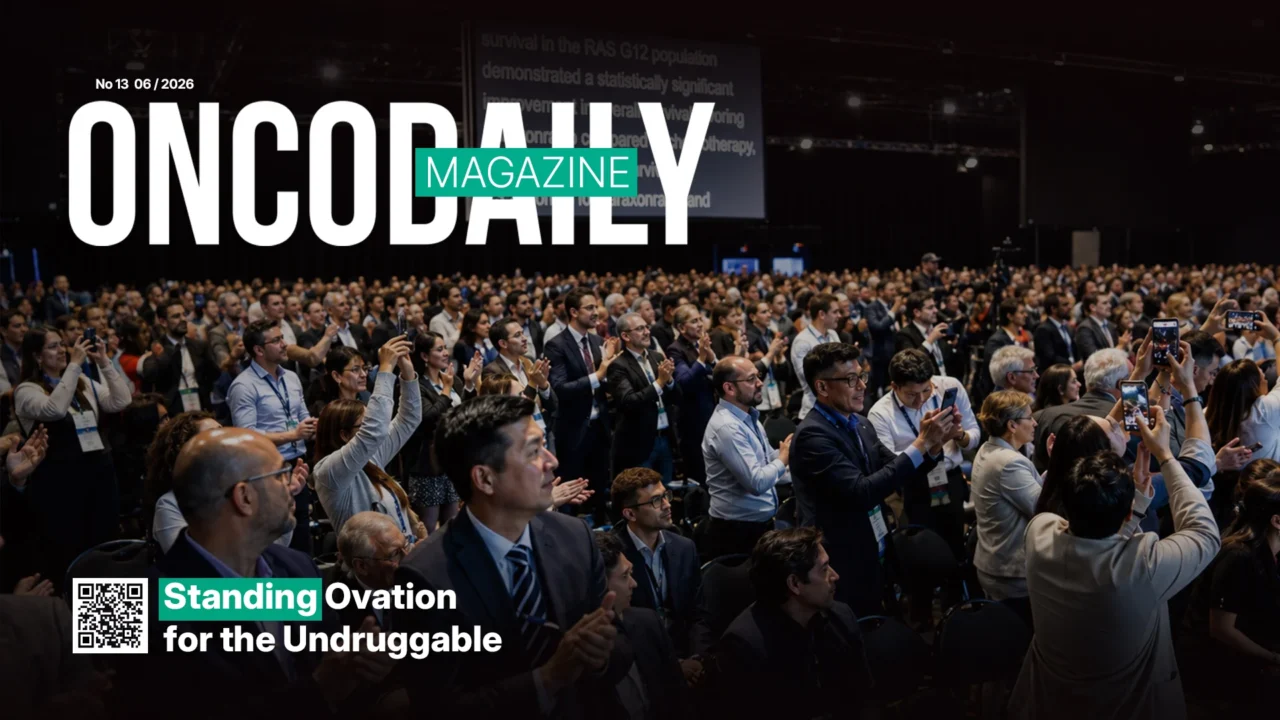
The applause began before the presentation was finished.
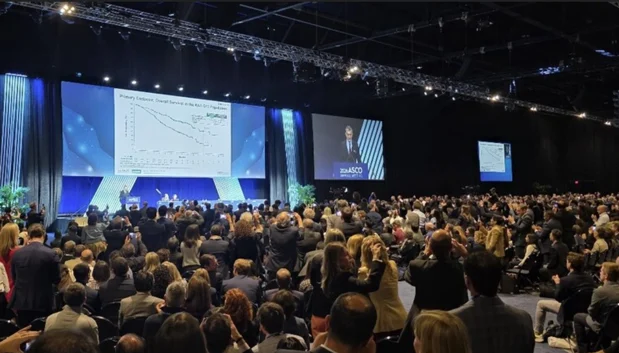
When the survival curve appeared on the screen during the plenary session at the 2026 ASCO Annual Meeting, the audience immediately understood what they were seeing. Murmurs spread across the room. Then came clapping. Then cheering. Finally, something rarely witnessed in oncology: a standing ovation.
For decades, pancreatic cancer has been one of medicine’s most unforgiving diseases. Drug development programs have failed repeatedly. Promising therapies have disappeared. Scientific optimism has often collided with biological reality.
Yet on that day at ASCO, a Phase III trial evaluating daraxonrasib delivered something the field had been waiting for: a result so striking that it altered expectations for what might be possible in pancreatic cancer.
“It was a monumental moment,” recalls Dr. Alan Sandler, Chief Development Officer of Revolution Medicines. “You had a cancer such as pancreatic cancer, which literally has been a graveyard for drug development, and suddenly you had an outcome where median survival doubled.”
The numbers were difficult to ignore. Patients receiving daraxonrasib achieved a median overall survival of 13.2 months compared with 6.6 months in the control arm – a 60% reduction in the risk of death.
In second-line pancreatic cancer, those figures represent more than statistical significance. They represent a challenge to decades of therapeutic pessimism.
And for Revolution Medicines, they represent the culmination of a scientific journey that began with a question many believed could never be answered.
Drugging the Undruggable
To understand why the ASCO presentation generated such emotion, it helps to understand the target.
More than 90% of pancreatic cancers are driven by RAS mutations. For decades, oncologists knew that RAS sat at the center of the disease’s biology. The problem was that knowing the culprit and stopping it were two very different things.
“RAS was discovered in 1980, but it was felt to be undruggable,” Sandler says.
As a thoracic oncologist earlier in his career, Sandler was familiar with KRAS mutations in lung cancer. Physicians understood their significance, but they had little ability to intervene.
“There was nothing we could do about it.”
The challenge stemmed from the structure of the protein itself. Traditional drug discovery approaches struggled to identify suitable binding sites capable of shutting down RAS signaling.
What changed was not the biology of cancer, but the ingenuity of scientists.
Revolution Medicines developed a tri-complex inhibitor approach that does not bind directly to RAS in the conventional sense. Instead, daraxonrasib first binds to cyclophilin A, a chaperone protein. That complex then engages RAS and effectively blocks its downstream signaling.
The result is a strategy that many scientists once considered impossible.
“I hope people will say that we drugged the undruggable,” Sandler says. “Something that was thought not to be possible became possible in a very dramatic way.”
A Four-Year Sprint
Scientific breakthroughs often appear inevitable in hindsight.
They never feel that way in real time.
One of the most remarkable aspects of the daraxonrasib story is the speed at which it unfolded.
The first patients entered human testing in 2022. By 2026, the program had already produced a positive global Phase III study.
In oncology drug development, that timeline is extraordinary.
“We’ve gone pretty rapidly from first-in-human testing in 2022 to a positive Phase III trial in 2026,” Sandler says.
The acceleration was driven in part by what investigators observed during the earliest clinical studies.
The first signs were not necessarily scans or response rates. Sometimes they were phone calls.
Investigators would contact the company to report that patients felt better. Others described tumors shrinking on imaging. In a disease where expectations are often measured rather than enthusiastic, those early signals carried enormous weight.
“Investigators would call and let us know about a patient who had just had a scan,” Sandler recalls. “Or a patient who was taking therapy and feeling better.”
Those observations created confidence that something meaningful was happening.
The company moved rapidly from an expanded Phase I program directly into a global Phase III trial, comparing daraxonrasib against chemotherapy in previously treated pancreatic cancer.
The gamble paid off.
More Than Survival
The standing ovation at ASCO was driven by survival data.
But survival was not the entire story.
Patients receiving daraxonrasib not only lived longer; they also reported meaningful improvements in quality-of-life outcomes.
Pain progression was delayed. Overall quality of life deteriorated more slowly. For patients facing pancreatic cancer, those measures matter profoundly.
“Not only are patients living longer,” Sandler says, “but they’re also feeling better along that time as well and for longer periods of time.”
In an era increasingly focused on patient-reported outcomes, the findings provided an important reminder that meaningful oncology advances extend beyond Kaplan-Meier curves.
The Risk That Had to Be Taken
Looking back, the success can seem logical. Pancreatic cancer is driven by RAS. Daraxonrasib inhibits RAS. The drug works.
Reality was more complicated.
One of the greatest concerns facing the program was toxicity. RAS is not important only in cancer. It also plays critical roles in normal human biology. Blocking RAS broadly raised legitimate fears about tolerability.
Researchers approached the first clinical studies cautiously.
“We started at very low doses because of those concerns,” Sandler says.
What they discovered was encouraging. While patients experienced side effects such as rash, diarrhea, and oral mucositis, most toxicities proved manageable and were typically low grade.
Over time, physicians became increasingly comfortable with supportive care strategies, allowing patients to remain on treatment.
That balance – meaningful efficacy combined with manageable toxicity – ultimately became one of the foundations of the program’s success.
The Beginning, Not the End
For many companies, a positive Phase III study would represent the culmination of years of work.
At Revolution Medicines, leadership views it differently.
“This is just the beginning,” Sandler says.
Daraxonrasib is already being evaluated in earlier-stage pancreatic cancer, including first-line metastatic disease and the adjuvant setting following surgical resection.
The company is also expanding its broader RAS-focused portfolio, with additional agents targeting specific RAS variants across pancreatic, lung, and colorectal cancers.
The vision extends beyond a single drug.
The ASCO presentation validated not only daraxonrasib, but the broader concept that RAS-driven cancers can be systematically targeted through Revolution Medicines’ platform.
“We’re only in maybe the second or third inning at this particular point,” Sandler says, borrowing an analogy often used by Revolution Medicines CEO Mark Goldsmith.
For a company built around challenging scientific dogma, that perspective feels appropriate.
The Human Meaning of a Scientific Breakthrough
Perhaps the most striking aspect of the daraxonrasib story is that it combines two things oncology rarely sees together: scientific elegance and dramatic clinical impact.
Researchers solved a problem that many considered unsolvable.
Patients benefited in a way that was impossible to ignore.
The standing ovation at ASCO was not simply recognition of a successful clinical trial. It was recognition of what the trial represented. For decades, pancreatic cancer has been a symbol of oncology’s limitations.
For one afternoon in Chicago, it became a symbol of what can happen when persistence, science, and courage converge.
And for Revolution Medicines, that may be the ultimate legacy. Not merely developing a drug. But helping prove that even the most stubborn assumptions in cancer research can be rewritten.
“It always starts with the patients,” he says. “We’re trying to get successful therapies out to patients as quickly as possible.”
At ASCO 2026, the audience stood because they recognized something rare. In a disease long defined by what could not be done, they were witnessing proof of what finally could.
Article by Elen Baloyan, MD, Editor-in-Chief, OncoDaily Magazine, based on an interview by Shushan Hovsepyan, MD, Editor-in-Chief of OncoDaily Medical Journal, Senior Vice President of OncoDaily
OncoDaily Magazine, June Issue
The full interview is available on OncoDaily TV.
You can also read:
RASolute 302 Trial at ASCO 2026 Plenary Session: Daraxonrasib Improves Survival Versus Chemotherapy in Previously Treated Metastatic PDAC