Michael Bailey did not begin with a dream of becoming a biotech CEO.
He grew up in a house where science was already part of everyday life.
“My dad was a medicinal chemist at Sterling Drug,” he told me. “He was a pioneer in some of the MRI breakthroughs back then. So I kind of grew up with science in the house.”
At first, medicine seemed like the natural road. He entered college pre-med, imagining himself becoming a physician. But something felt incomplete.
“The science I understood,” he said. “But it was a lot of memorization. Meanwhile, the economics, strategy, marketing, and business side just thrilled me. It came easy.”
It was the 1980s — the era of Wall Street excess, ambition, and corporate power. Michael followed that current into the field of finance.
But after several years, something started bothering him.
“What I really missed was the science I’d grown up with,” he said. “And also really doing something important for patients, for society. I didn’t feel like making millions for millionaires was really doing that.”
So he changed course entirely.
“The best way,” he decided, “was to apply my business talents with science by going into pharmaceuticals.”
That decision eventually led him to business school at the University of Notre Dame.
“It was actually right when EU consolidation was coming together,” he remembered. “So I chose Notre Dame because they had an exchange program in Europe. I could be there during this milestone event in Europe.”
What followed became the foundation of a career that would move through SmithKline Beecham, Genentech, ImClone Systems, Synta and ultimately AVEO Oncology.
But more importantly, it formed a philosophy: science matters only if it reaches patients.
“Bring the patient to early development”
At SmithKline Beecham, Michael Bailey quickly found himself inside strategic discussions far beyond what most young executives experience.
During an internship in Europe shortly after the SmithKline–Beecham merger, he was asked to evaluate CNS drugs for acquisition.
“I identified a couple opportunities,” he said. “They ended up in-licensing two of them.”
The company noticed.
He was recruited into what was then a newly created executive development program.
“There were two people brought into that program,” Michael remembered. “Myself and Ron Squarer.”
He smiled while listing the names that emerged from that environment.
“Alexander Hardy was the year behind us in the program. Obviously it was a good program.”
But Bailey’s most important lesson from that period did not come from finance or acquisitions. It came from watching drugs fail commercially despite regulatory approval.
“There wasn’t really a strong ‘why this is a better therapy’ built into the data,” he said.
That realization changed how he viewed drug development.
“It seemed to me we should be putting a lot more thought into early development,” he said. “Bringing the patient into that process. Understanding what their needs are aside from just the therapeutic benefit.”
He brought this idea to legendary pharma executive Jerry Karabelas.
The response surprised him.
“The people going into early development from commercial,” Michael Bailey recalled, “were viewed as people who couldn’t cut it on the front-line marketing side.”
Karabelas gave him a different recommendation:
“Go to biotech. They think differently.”
That advice changed his life.
Genentech: “These people were going to change the world”
Bailey arrived at Genentech in the late 1990s, at a time when biotech still felt experimental and rebellious compared to big pharma.
“It was clear to me back then,” he said, “that these were going to be the leaders of the industry in the future.”
He remembers not just the science, but the people.
“Ted Love. Sue Desmond-Hellmann. Hal Barron, Dave Stump,” he listed. “Wonderful people who really have gone on to change the world in my mind.”
But life interrupted career momentum.
His mother was diagnosed with ALS.
“She was on the East Coast,” he said quietly. “And she wanted her family around her.”
So Michael moved east and joined ImClone Systems.
That decision would place him in the middle of one of biotech’s most difficult and instructive journeys.
The brutal lessons of biotech
At ImClone, Bailey worked on cetuximab, then known as Erbitux, the EGFR antibody that would later become one of oncology’s landmark targeted therapies.
He remembers how one physician unexpectedly changed the direction of the entire program.
“There was a doctor in Florida,” he said, “who combined Erbitux with irinotecan in irinotecan-refractory patients.”
One patient in particular stayed in his memory.
“I remember her name — Ms. Campbell,” he said. “She had a tremendous response.”
That single response helped redirect development toward colorectal cancer.
But Bailey also remembers the chaos and imperfections behind biotech development — realities often erased from polished corporate narratives.
At one point, they designed a study around a very simple limitation:
“We designed the study based on how much drug we had,” he said, laughing.
“We could only do a hundred patients.”
The trial produced excellent data but narrowly missed statistical significance.
“So we had to redo another study,” he said.
For Michael Bailey, these experiences revealed something fundamental about biotech:
“You take shortcuts because you’re capital constrained,” he said. “But if the shortcut doesn’t work out, it actually costs more and takes longer.”
That lesson would later define the biggest challenge of his career.
“The drug really works”
When Bailey joined AVEO in 2010, the company was built around tivozanib, a VEGF inhibitor later commercialized as FOTIVDA®.
The pivotal study had already completed enrollment.
On paper, everything initially looked promising.
The progression-free survival data was strong.
“We were all excited,” Bailey remembered.
Then came the problem.
“Our chief medical officer put up the overall survival hazard ratio,” he said. “And it was going the wrong way.”
The issue, Bailey explained, came from trial design.
The study used a one-way crossover design and enrolled heavily in Russia and Ukraine, where second-line therapies were largely unavailable.
“Effectively,” he said, “we studied tivozanib followed by nothing versus sorafenib followed by tivozanib.”
The drug worked.
The study design failed.
The FDA issued a Complete Response Letter.
The company collapsed into crisis.
“We had class-action lawsuits. SEC investigations. Our partnership with Astellas collapsed. Investors were furious.”
Many believed the story was over.
Michael did not.
“I acknowledged we screwed up tivozanib from a development perspective,” he said. “But the drug really works.”
That distinction became everything.
“Why don’t you become CEO?”
At the time, AVEO’s strategy shifted away from tivozanib toward earlier-stage pipeline assets.
Bailey disagreed.
“I thought we should continue developing the clinical-stage assets,” he said, “and out-license the preclinical ones to ensure they would also be developed.”
He brought his concerns to chairman Henri Termeer.
Then came the unexpected question.
“He asked me, ‘What would you do?’”
Bailey laid out his strategy clearly: acknowledge the mistakes, continue development, and focus on the patients who still needed the drug.
Henri’s response was immediate.
“Do you want to become CEO?”
Michael laughed remembering the moment.
“You’re sitting there saying: okay… I’ve got close to a $250 million liability, lawsuits, SEC investigations…”
Then he smiled.
“It’s an obvious yes.”
Many thought he was crazy for taking the job.
But Michael Bailey kept returning to one central belief:
“There was an important offering this drug had for patients,” he said. “And that’s why we’re in this business.”
“I don’t think this is going to work”
The next challenge became the TIVO-3 trial.
The idea was risky: use tivozanib in third-line kidney cancer patients, where most believed patients were already too sick to meaningfully benefit.
One conversation stayed with him forever.
Bob Young — former president of ASCO and one of the most respected figures in oncology — looked at Bailey during a board meeting and said:
“Michael, I don’t think this is going to work.”
Michael remembered feeling trapped between instinct and expertise.
“You’re in a situation where it’s tough for a non-scientist to argue,” he said.
Then he asked Bob a simple question:
“Do you have a better idea to save this company?”
Bob paused.
“No,” he replied. “Let’s go for it.”
The company moved forward.
But the board wisely imposed one condition:
Do not start the trial unless the company had enough money to finish it.
“We didn’t want to be in the middle of the study and run out of money,” Bailey said. “That would have wasted patient resources.”
Raising the money became a brutal grind.
“We were doing very small raises because that was all we could muster,” he remembered. “Nobody does that.”
The financings were painful, heavily dilutive, and often structured around survival rather than growth.
“You knew some investors were just going to flip the stock,” he said. “But you had to do it.”
What kept him going was not optimism alone.
It was conviction. “It is what it is….we needed to find a way to win” Bailey mused
“Believe in what you’re doing,” he said. “And remember why you’re doing it.”
Then he added his favorite line:
“There’s a fine line between perseverance and insanity.”
“We invest in people”
Michael Bailey speaks about investors differently than many biotech executives.
For him, fundraising is not mainly about presentations or spreadsheets.
“It’s about gaining trust,” he said.
“Investors invest in people.”
He believes transparency and character matter more than perfection.
“Sell with data and evidence,” he said. “But also be transparent. Be honest about the risks.”
That same philosophy shapes how he builds teams.
When I asked how he hires people, he surprised me.
“I’m less about needing somebody with one particular experience,” he said.
Instead, he looks for character.
“Smart. Driven. Socially adept. Collaborative.”
And he believes people are capable of becoming more than their resumes suggest.
“They can learn anything,” he said.
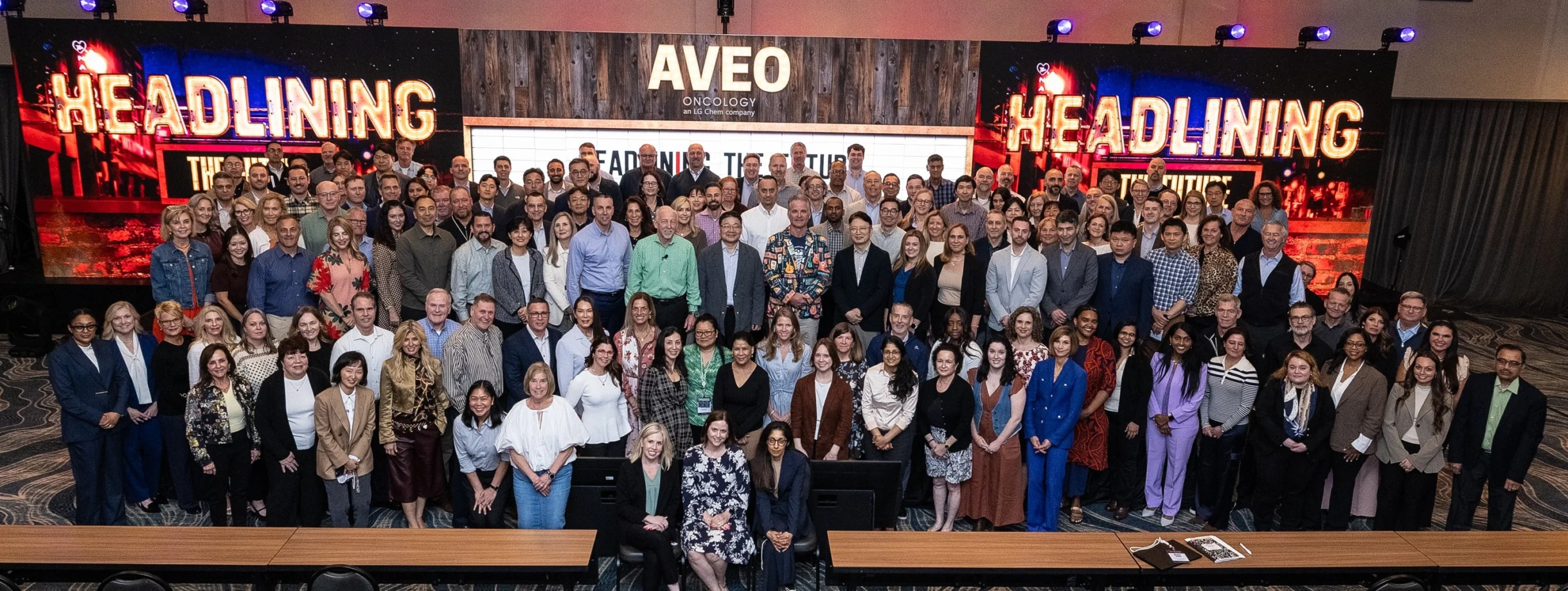
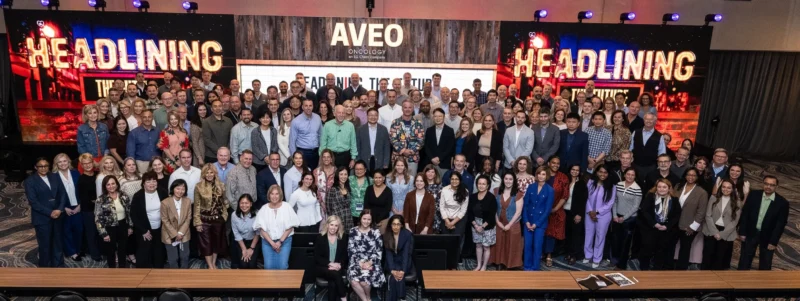
Inside AVEO, those principles evolved into a recognizable culture.
In 2022 and 2023, the company was recognized as one of the best workplaces in biotech.
Bailey seemed genuinely proud of that.
“One of the things I learned at Genentech was work hard and play hard,” he said.
Then he laughed remembering the legendary Genentech parties.
“They used to have these massive parties called ho-hos that were just over the top.”
At AVEO, he tried to recreate that same spirit.
Not by taking themselves too seriously.
“I don’t mind saying I don’t know something,” he said.
“If you think you’re the smartest person in the room, then you are not in the right room.”
CXO: the biotech battle of the bands
Music, surprisingly, became one of the defining themes of Michael Bailey’s leadership style.
He still plays drums — an inspiration dating back to fifth grade, when legendary jazz drummer Buddy Rich visited his elementary school.
“He did things I could never imagine,” Michael remembered.
Years later, during a difficult period at another biotech company running low on cash, management canceled the usual holiday celebration.
Michael had another idea.
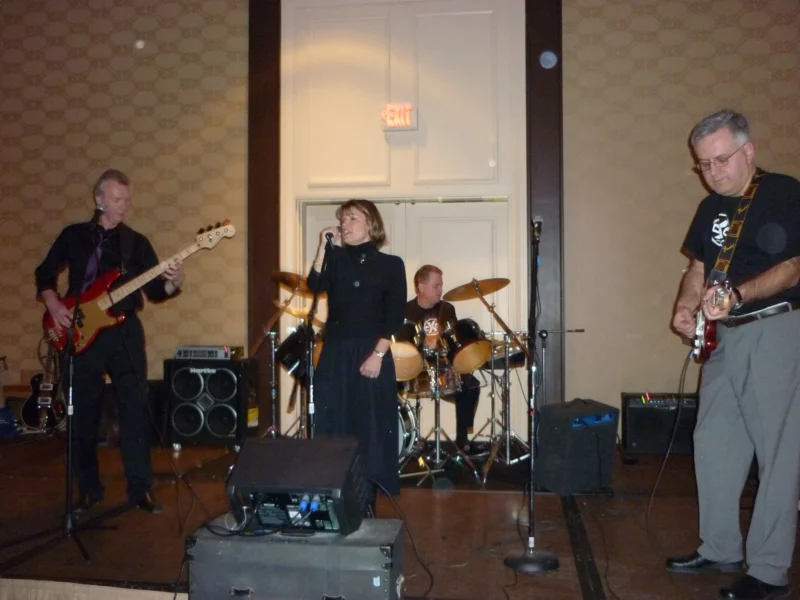
The executive team would challenge the rest of the company in a battle of the bands.
The executives formed their own band:
CxO.
“Our CFO was basically a near-professional bass player,” Bailey laughed. “Our CMO played keyboards but learned to play the guitar for this gig…risky move. The CEO was going to sing… but he wasn’t very good.”
So Bailey’s wife stepped in as vocalist.
“She covered a lot of sins from the rest of the band,” he joked.
The employees crushed the executives musically.
But Bailey came prepared.
“Being the marketing guy,” he said, “I had an ace in the hole.”
They printed concert T-shirts and threw them into the audience.
“It was probably one of the best parties we ever had,” he said.
Today, music still shapes AVEO culture.
At leadership retreats, Michael Bailey hosts jam sessions around his backyard firepit.
“We bring all the instruments out,” he said. “Drink beers and wine. Great time.”
At company meetings, executives sometimes perform together live.
His office walls now hold instruments from around the world signed by top sales representatives from the company.
“Music is inspiring. Relaxing. Energizing. Fun.”
“Don’t take yourself too seriously”
Michael Bailey’s leadership philosophy contains an unusual amount of humor for biotech.
“I don’t want to be the CEO that walks into the room and everybody freezes,” he said.
Instead, he wears Hawaiian shirts during the summer and eccentric blazers at conferences.
At an Oktoberfest-themed company event, he showed up fully dressed in lederhosen.
“I’ve got a collection of incriminating pictures of your CEO wearing embarrassing outfits,” one investigator joked during an AVEO meeting.
Michael Bailey loved it.
“Don’t take yourself too seriously,” he said again.
That philosophy, he believes, creates trust and openness.
And openness matters.
Because biotech is built as much on failure as on success.
“Some of the most valuable things I share are failures”
When I asked about mentoring, Michael immediately turned toward mistakes rather than victories.
“I think one of the things people benefit from most,” he said, “is my failures.”
He described recently advising another biotech CEO considering a one-way crossover design — exactly the mistake that had nearly destroyed AVEO years earlier.
“They were thinking about doing a one-way crossover,” he said. “And I shared our story.”
The temptation in biotech, he explained, is understandable.
You want patients on the control arm to eventually receive the investigational drug.
You want enrollment to move faster.
You believe your drug works.
But belief is not evidence.
“You have to ask yourself,” Michael Bailey said, “have we really proven this drug works?”
That distinction — between hope and proof — may be one of the deepest lessons of his career.
“Never lose sight of the patient”
Near the end of our conversation, Michael became emotional.
At AVEO company meetings, they often invite patients and caregivers to speak directly to employees.
“The rooms are always full of tears,” he said quietly.
For him, those moments reset everything.
“You see the gratitude. The joy. The impact on caregivers and families.”
Then he paused.
“Never lose sight of the patient,” he said. “That’s the first and most important thing.”
He leaned back and smiled again.
Then, almost instinctively, he added the line that seems to summarize his entire worldview:
“There’s always somebody smarter than you. Seek them out. Listen to them.”
Interview by Gevorg Tamamyan, Editor-in-Chief of OncoDaily