





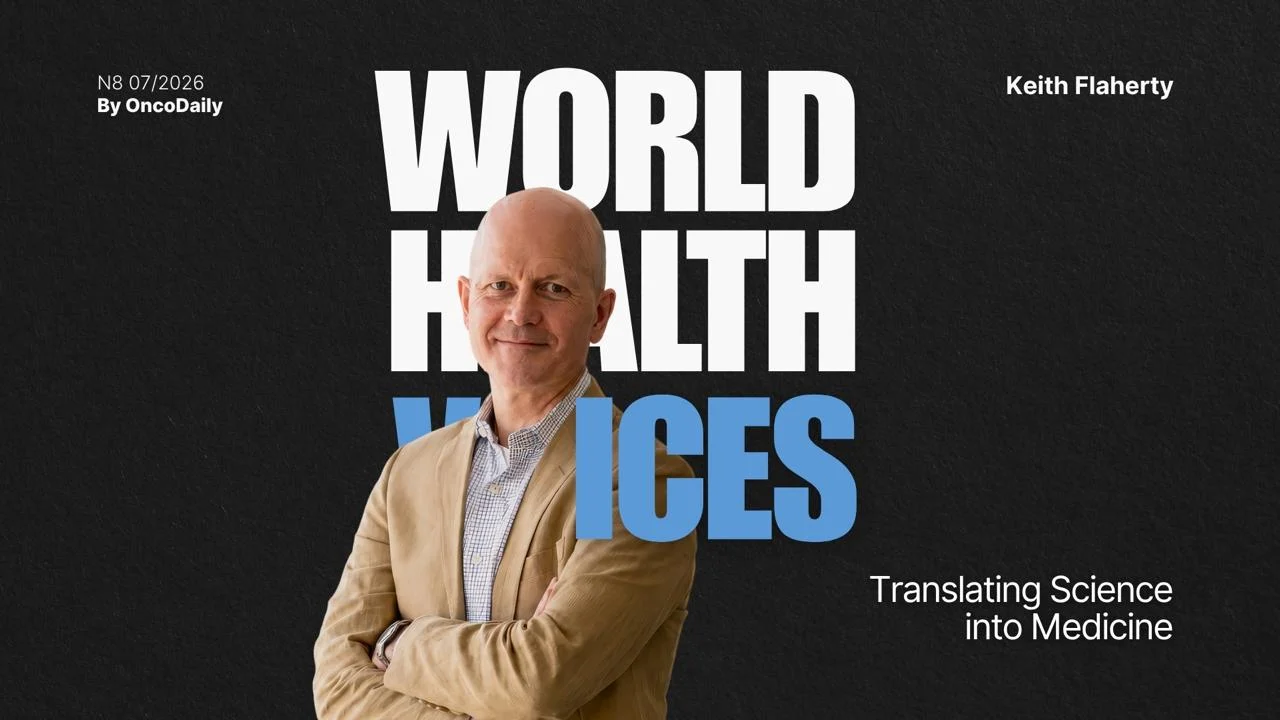
Keith Flaherty did not enter oncology because he loved oncology.
He entered oncology because neuroscience disappointed him.
That sounds strange coming from a physician-scientist who would go on to help redefine melanoma treatment, build one of the most successful targeted therapy companies in oncology, lead major academic centers, mentor a generation of investigators, and become President of the American Association for Cancer Research.
But when he arrived at medical school in the mid-1990s, neuroscience and neurology felt disconnected.
“I was really intending to try to find a way to translate my neuroscience interest into a clinical research path in neurology,” he recalls.
Instead, he found a gap.
“Basically neuroscience and clinical neurology really had essentially nothing to do with each other.”
The science was fascinating.
The translation was not.
And that realization would shape everything that followed.
“I quickly went in search of a discipline where it might be more plausible that the science might translate into medicine.”
He found oncology.
Raised by two physician-scientists
Keith Flaherty grew up in a household where medicine was never simply about taking care of the patient in front of you. His father was an academic cardiologist. His mother was an academic adolescent psychiatrist.
“The thing I learned from watching them was that they both had this two-pronged approach.”
Taking care of patients. Moving the field forward.
“There was something certainly in common between the two of them in terms of their interest in taking care of people who were in front of them, but at the same time trying to contribute to moving their fields forward.”
His parents never pushed him toward medicine. In fact, he remembers almost the opposite.
“By the time I came along, they had a very hands-off approach.”
And what they gave him was autonomy.
The beauty of molecules
At Yale University, Keith although became fascinated by neuroscience, but two courses ended up changing his intellectual trajectory. Organic chemistry and cell biology.
“There was something about the visual nature of depicting molecules and their interaction that I found really quite satisfying.”
Then came cell biology.
“This is where molecules were kind of doing their work. I really loved learning about and thinking about the extremely complex ecosystem that is a single cell.”
Years later, that fascination with signaling pathways, receptors, and molecular interactions would become the foundation of targeted oncology.
Perfect timing
Keith Flaherty often jokes that his timing was excellent. He entered medical oncology fellowship in 2000. One year later, the first major clinical results with imatinib in chronic myeloid leukemia were presented.
“To me that was exactly the kind of watershed moment I was looking for.”
For years he had believed oncology might become the field where biology could finally be translated directly into medicine and now it was happening. Imatinib showed that understanding a cancer’s molecular dependency could lead to dramatic clinical benefit.
But many people remained skeptical.
“The rest of cancer is essentially like blast crisis CML,” critics argued.
Too complex. Too genetically chaotic. Too many mutations. Then came gastrointestinal stromal tumors. Imatinib worked there too. And suddenly the idea of targeted therapy felt less like an exception and more like a framework.
When BRAF mutations were discovered in melanoma in 2002, Dr. Flaherty saw an opportunity.
“That was my imagination at the time.”
Could melanoma have its own imatinib moment?
Melanoma was supposed to be too complicated
The challenge was obvious.
“Melanoma was perhaps one of the very most genetically complex of all cancers.”
Many scientists wondered whether BRAF was merely an epiphenomenon. Maybe it was present. Maybe it was important earlier.
But perhaps by the time advanced melanoma developed, BRAF no longer mattered.
Keith Flaherty disagreed.
He and a handful of investigators pushed forward. The first attempt was sorafenib. It failed! But failure became information.
The work eventually led to more selective BRAF inhibitors, including vemurafenib and dabrafenib. Then came understanding resistance. Then BRAF-MEK combinations. Then the next generation of questions.
For Keith, this became the template for modern translational oncology. Not a single breakthrough, but a continuous process.
“Understand the limits of a therapy at a molecular level and nominate what the next generation of therapies should be.”
Teams would solve cancer, not individuals
If there is one theme that appears more than any other throughout Flaherty’s career, it is teams. The idea emerged early. Long before “team science” became fashionable.
“I had this deeply developed notion that teams were going to be the only way to actually crack this very, very complex problem.”
His first mentoring structure reflected that philosophy. Rather than relying on a single mentor, he assembled four. Clinical trial expertise. Melanoma expertise. Melanoma biology. Kidney cancer biology.
Each mentor provided something different. Together they formed a system. That same idea later became the foundation for the Termeer Center for Targeted Therapies at Massachusetts General Hospital.
His goal was not to build a laboratory. His goal was to build careers.
“I proposed trying to scale exactly that same approach broadly across cancer.”
The quality he looks for most
When selecting trainees, Flaherty looks for intelligence. He looks for curiosity. He looks for team players. But the quality he talks about most passionately is creativity.
“People think careers in science are not about creativity.”
He believes the opposite.
“Creativity is absolutely critical.”
Scientific education often teaches facts.
“Scientific discovery requires suspension of judgment, living at the frontier of the known and the unknown, asking questions at that boundary.”
That, he says, is what separates technicians from innovators.
Entrepreneurship as hypothesis testing
Most physician-scientists eventually choose. Academia or industry. Flaherty chose both.
His entrepreneurial journey began when former colleague and venture capitalist Josh Bilenker approached him about creating a company. That company became Loxo Oncology. The idea was surprisingly simple. Build better drugs, more selective, more potent. Purpose-built for the biology.
“Maybe we should only bring forward the ones that actually check all the boxes.”
The result was extraordinary. The first three Loxo drugs ultimately reached FDA approval. For Keith Flaherty, company building never felt separate from science.
“It turned out to be fairly natural for me to pose many of the same questions that I do in the academic nonprofit domain in the private sector.”
To him, both environments revolve around the same activity. Generating hypotheses, testing them, learning and repeating.
Focus is not what people think
One of the most revealing moments of the interview came when we discussed focus. On paper, Keith Flaherty’s life appears almost contradictory.
Scientist.
Physician.
Mentor.
Entrepreneur.
AACR President.
Former NCAA lacrosse player.
Builder of centers and companies.
Where exactly is the focus?
He laughed.
“You might say this looks like chaos.”
But he argues that focus is not about limiting your life to one activity. It is about being fully present in whatever stage you are in.
“When I was an intern and resident, my sole focus was learning how to take care of patients.”
When he needed to learn chemistry, he focused on chemistry. When he needed to build teams, he focused on teams. When he played lacrosse, that was his focus.
“Focus shifted.”
For young scientists, his advice is simple.
“Focus on the stage you’re in.”
What gets you out of bed?
Keith Flaherty often asks mentees a question. What gets you out of bed in the morning?
Not what looks prestigious. Not what is fashionable. Not what everyone else is doing.
What is intellectually irresistible?
“What is the domain of cancer biology that you just can’t imagine not being permitted to delve into?”
For him, that answer was oncogenic signaling. For others, it might be metabolism.
Epigenetics. Immunology. Computational biology.
The specific answer matters less than the passion behind it. Because careers in cancer research are long. And difficult. And frustrating.
“You need something that is intellectually irresistible.”
The next frontier
Despite everything he has accomplished, Keith Flaherty speaks most enthusiastically about the future. He points toward chemistry, systems biology, computational approaches. Toward understanding cancer in all its complexity.
And increasingly, toward disparities.
“Teams are still needed.”
Perhaps bigger teams than ever before. Not only to understand cancer biology, but to understand why entire communities continue to benefit less from progress. For Keith Flaherty, the challenge remains the same one he discovered as a medical student.
How do we translate science into medicine?
The tools are changing. The questions are becoming bigger. The teams are becoming larger. But the mission remains unchanged.
And more than twenty-five years after entering oncology, Keith Flaherty still sounds fascinated by the same thing that first drew him into the field:
the possibility that understanding biology can change the lives of patients.
Interview by Gevorg Tamamyan, Editor-in-Chief of OncoDaily and World Health Voices