“When you tell a patient, ‘I cannot treat you — go home,’ that is one of the hardest sentences a doctor can say. I wanted to stop saying that.”
The fifth cover story of World Health Voices features Dr. Jigjidsuren Chinburen, Minister of Health of Mongolia — a liver cancer surgeon by training, a pioneer of complex oncologic surgery in his country, and a public health reformer shaped by firsthand experience with suffering, scarcity, and resilience.
In this in-depth conversation with OncoDaily, Minister Chinburen reflects on his journey from a young medical student in a country undergoing political transformation to leading Mongolia’s health system; on building national capacity for cancer care where patients were once told there was “nothing more to do”; and on why honesty, patience, and prevention matter as much as technology.
Dr. Chinburen grew up and studied medicine in Ulaanbaatar during a period of profound national transition — from a socialist system to democracy and a free market economy.
The decision to become a doctor was deeply personal.
“My grandmother had uterine cancer,” he recalls. “She suffered a lot. It was very stressful for our family, and it made me think seriously about becoming a doctor, especially to treat cancer.”
That early experience coincided with another powerful influence. As a teenager, he watched a film about Avicenna, the medieval physician and scholar.
“It showed medicine not just as healing the body, but also healing the mind, restoring balance and dignity. That idea stayed with me,” he says. “It pushed me toward medicine, and specifically oncology.”
Learning Medicine Abroad and Seeing the Gap
Dr. Chinburen’s postgraduate training took him far from Mongolia. He completed surgical residency training in Switzerland at Lausanne University, working in a general hospital in a small city.
“At that time, Mongolia was going through very difficult economic years,” he says. “For Mongolians, studying abroad was a huge challenge.”
What he encountered in Switzerland was eye-opening.
“There were large libraries, excellent textbooks, modern equipment, and systems that worked smoothly,” he recalls. “Even basic things — gloves, disposables — were sometimes lacking back home.”
Swiss surgeons, including Dr. Smith and colleagues, not only trained him but repeatedly traveled to Mongolia to teach local surgeons and donate essential surgical supplies.
“It opened my eyes to what was possible,” he says. “And it made the gap between systems very clear.”
His training continued across continents: Australia, Austria, and later Japan, where he specialized in liver and pancreatic cancer surgery at Nagoya University.
“In the Western world, I learned general surgery. In Japan, I learned extremely precise, highly specialized liver and pancreatic surgery,” he says. “Operations lasting 12 hours, managing the most complex cases — it was another level.”
Returning Home: Where the Real Challenge Began
Returning to Mongolia brought both opportunity and frustration.
Liver cancer was — and remains — the most common cancer in the country, largely driven by widespread hepatitis B and C infections. Patients often presented at very late stages.
“In those days, many patients came when nothing could be done,” he says. “Telling someone there is no treatment — that is devastating.”
A turning point came in 2004, when French liver surgeon Professor Michel Gillet arrived at Mongolia’s National Cancer Center.
“He performed the first major liver resection ever done in Mongolia,” Dr. Chinburen recalls. “I assisted him. Then he said, ‘I will teach you and you will teach others.’, I try to live by that.”
For nearly two decades, Professor Gillet returned once or twice a year, acting as a personal mentor.
“He is now 90 years old,” Dr. Chinburen says, “but for years he came regularly, transferring his lifetime of knowledge to us.”
Between 2004 and 2008, Dr. Chinburen focused intensively on liver surgery. By 2008, he expanded into pancreatic cancer surgery. Together with his colleagues, he established Mongolia’s first dedicated liver–pancreas surgical team at the National Cancer Center.
“It was the first real step in fighting these cancers at home,” he says.
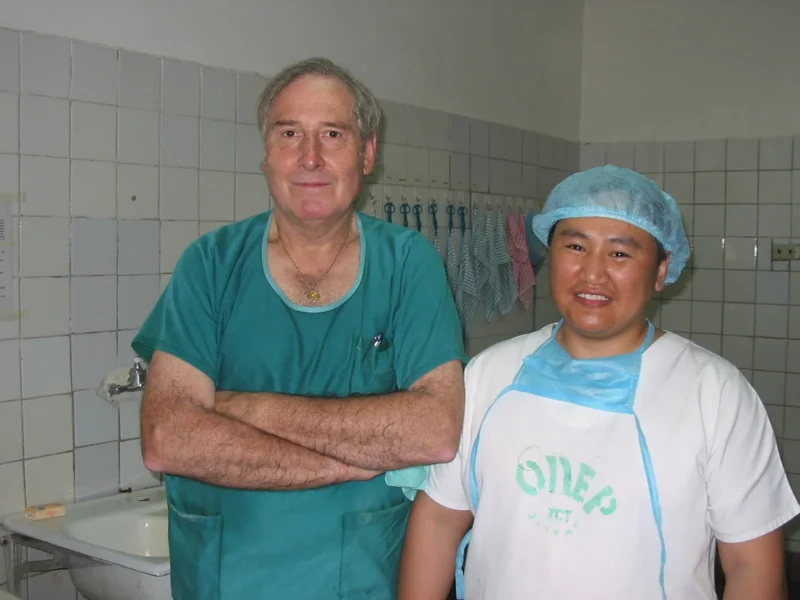
With Prof. Michel Gillet
From Surgeon to System Builder
Recognition followed — Best Young Physician, Polar Star, Red Banner of Labor, Merited Physician of Mongolia — but titles were never his goal.
“I never planned to become director of the National Cancer Center,” he says. “My goal was simple: to make all possible treatments available in Mongolia.”
Sending patients abroad because care did not exist locally felt unacceptable.
“It was shameful for us as doctors,” he says plainly.
International collaboration became essential. Experts from Switzerland, France, Japan, South Korea, India, and the United States traveled to Mongolia to train local teams.
But Dr. Chinburen soon realized that surgery alone was not enough.
“Liver cancer is caused largely by hepatitis B and C,” he explains. “If you only operate, you are treating the result, not the cause.”
That realization pushed him toward public health.
“When I am treating patients, I am a doctor. When I put down the scalpel and take the pen, I must be a public health professional,” he says.
Entering Public Service
In 2016, Dr. Chinburen helped launch the Healthy Living for Mongolians program together with NGOs, clinicians, and policymakers — a national effort to address preventable disease, including hepatitis C.
Government funding followed, enabling large-scale action against viral hepatitis.
His move into parliament, and later into the role of Minister of Health, was driven by one insight:
“Policy change can help millions. One law, one financing decision, can benefit doctors, nurses, and patients all at once.”
As Director of the National Cancer Center, he finally achieved a long-held dream: launching Mongolia’s liver transplantation program in 2018.
“To do that, you need authority over resources — human, financial, organizational,” he explains. “And we succeeded.”
Minister of Health: Priorities That Matter
Asked what success would look like when he eventually leaves office, Dr. Chinburen is direct.
“Every Minister of Health has the same main goal: reduce death — especially preventable death.”
His priorities are clear:
- Focusing on prevention of diseases, reducing risk factors
- Reducing preventable mortality
- Ensuring treatment regardless of income or social status
- Protecting patients from financial catastrophe
- Introducing new technologies without delay
“Prioritizing public health and preventing disease is one of the most important investments. By focusing on prevention strategies, such as vaccination, early screening, health education, and healthy environments can reduce the burden of diseases and protect vulnerable populations, improve quality of life, and strengthen resilience against future health threats.”
“In some countries, cancer makes people poor,” he says. “Treatment is long and expensive. In Mongolia, oncology care is free of charge. Organ transplantation is almost free — patient co-payment is minimal.”
Equally important to him is technological equity.
“Mongolians should not receive technology years later than developed countries,” he says. “We are a small population — 3.6 million — spread across a vast land. Every corner must have access to good medical services.”
Despite his political role, he hopes to return fully to medicine one day.
“After public service, I want to be a doctor again — until I retire.”
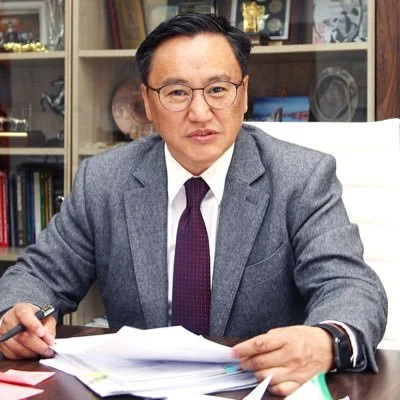
Still a Surgeon at Heart
Before becoming Minister, Dr. Chinburen continued operating and teaching young surgeons. As Minister, that is no longer possible, but his connection to surgery remains.
“At the end of December, we performed the first robotic surgery in Mongolia,” he says. “I served as a consulting surgeon.”
It was a milestone and a symbol of long-term investment.
Mongolia on the Global Health Map
On Mongolia’s role internationally, he emphasizes experience and data.
“About 90% of cancer patients in Mongolia come to the National Cancer Center,” he explains. “That gives us very strong data, especially for common cancers like liver cancer.”
Dr. Chinburen has personally performed more than 3,000 liver surgeries and has trained surgeons from neighboring countries, including Kazakhstan and Russia.
He also reflects on Mongolia’s nomadic culture.
“We are quick learners. We adapt fast. To survive our climate, you must be resilient,” he says. “That resilience shapes our doctors too.”
The Core of Leadership: Patience and Honesty
What does he consider the key to his own success?
“Patience,” he answers without hesitation. “And strong motivation to learn.”
He recalls turning down lucrative private-sector offers.
“I always said no. My focus was clear: transplantation, national capacity, technology for Mongolia.”
For young doctors, his expectations are demanding:
- Will you come to see patients on weekends?
- Do you speak English — the language of global medicine?
- Are you honest about mistakes?
“Honesty is essential — with professors and with patients,” he says. “And a surgeon must be calm. I can feel how my assistant is breathing during an operation. Calmness matters.”

Books, Belief, and Respect
Among the books that shaped him most is a work by the Dalai Lama on patience.
“There is no universal drug for all diseases,” he recalls from the book. “And there is no single religion for everyone. Wisdom is respecting difference.”
That philosophy informs how he sees medicine.
“A doctor should treat every patient as a mother, father, sister, or brother.”
Looking Ahead
As the conversation closes, Dr. Chinburen recommends Dr. Price, an American surgeon from Utah who spent 20 years in Mongolia teaching laparoscopic surgery.
“He witnessed the transformation — from no capacity to robotic surgery,” he says. “It took 20 years.”
Today, all 21 provinces in Mongolia have laparoscopic surgical services — a quiet success story built on persistence, teaching, and trust.
“If you are honest with yourself, patient, and focused,” Dr. Chinburen says, “change is possible — even in the most difficult conditions.”
Interview by Gevorg Tamamyan, Editor-in-Chief of OncoDaily