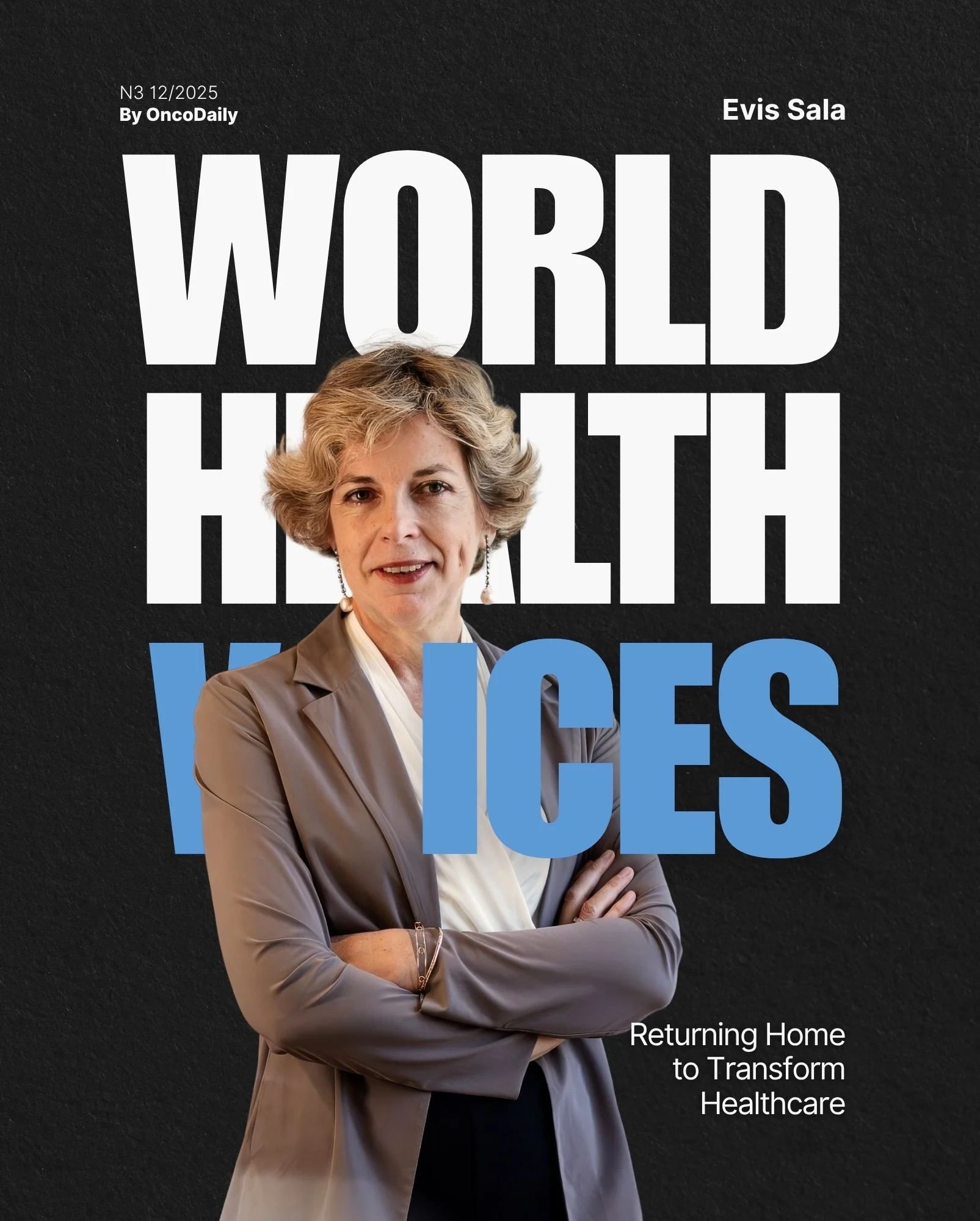
The third cover story of World Health Voices features Professor Evis Sala, Minister of Health and Social Welfare of Albania, an internationally respected cancer imaging expert whose career has spanned Cambridge, Memorial Sloan Kettering Cancer Center, Policlinico Gemelli, and now national leadership. In this conversation, she reflects on a lifelong calling to medicine, a scientific journey rooted in innovation and cancer research, and her commitment to building a more equitable, modern, and patient-centered health system for Albania.
“I Wanted to Be a Doctor Since Day One”
Medicine, she recalls, was never a question, it was a certainty.
She decided on medicine in a very different Albania, a fully communist country, where admission required exceptional academic performance and applicants could list only three university preferences. She chose the same field for all three.
“All my choices were medicine.”
What drew her in was not only science, but impact.
“I liked contact with patients. I liked making changes. I liked that the work we do, with the team, has an impact on individuals and on society.”
Interestingly, she never played with toy medical kits as a child. The motivation was deeper, a belief that health care is more than treatment.
“Health is holistic. You cure with tools, but you also cure with communication.”
From Tirana to Cambridge, From Surgery to Radiology
After completing her medical degree at the University of Tirana, Evis Sala began training in general surgery, completing nearly the entire program.
“I almost finished my training, only six months short.”
That surgical foundation shaped her decisiveness:
“I don’t sit on the fence; that’s a surgical approach.”
Her scientific direction shifted when she received a WHO Fellowship in Epidemiology and Biostatistics, which aligned with her contribution to Albania’s first cancer registry in 1996.
This experience took her to the University of Cambridge, where she completed a master’s degree and then a PhD focused on breast cancer, examining genetic mutations, lifestyle factors, and environmental exposures such as smoking, alcohol, and diet. It was a transformative period.
“It was a time when the genomic field was emerging. Cambridge is a place where discoveries happen.”
Her PhD introduced her to imaging, specifically mammography, and early computational research, laying the foundation for her later work in AI.
Minister Sala completed her radiology training in Cambridge, a specialty she describes as both analytical and integrative. The field carried personal meaning: her father-in-law was the founder of radiology in Albania.
She then completed an oncology research fellowship at Memorial Sloan Kettering Cancer Center (2004–2005), returning afterward to Cambridge as a university lecturer (now equivalent to assistant professor) and later senior lecturer.
Her research expanded far beyond breast cancer, encompassing prostate cancer, gynecologic tumors, especially ovarian cancer, genomics, and computational oncology.
Eventually, she was recruited back to Memorial Sloan Kettering to lead the body imaging service, the largest within the institution. There, she worked at the forefront of an emerging era:
“Integrated care, combining imaging, genomics, pathology, and clinical data, and the early foundations of AI.”
She created a research group exploring 3D tumor modelling, spatial heterogeneity, and new forms of collaboration between radiologists, computer scientists, and molecular experts.
In 2018, Evis Sala accepted a role at Cambridge as Full Professor of Oncological Imaging and co-lead of the Cancer Research UK Cancer Advanced Imaging Program and Integrated Cancer Medicine Program, leading teams working across imaging, AI, translational oncology, and emerging cancer technologies, including PET, hyperpolarized MRI, and computational modelling.
The COVID-19 pandemic expanded her scope further, as her AI teams applied their expertise to chest imaging and diagnosis.
She then moved to Rome, where she became the Head of Radiology and Nuclear Medicine at Policlinico Gemelli, Full Professor at the Catholic University of Rome and later the Head of Diagnostic Imaging and Radiotherapy Department— overseeing radiology, nuclear medicine, radiotherapy, hematology, hemato-oncology, and medical physics.
“but bring two possible solutions”
Throughout her career, Evis Sala has viewed success as collective.
“The key to success is the team you build, the resilience you develop, and the ability to turn challenges into opportunities.”
She leads with a principle she expects from herself and from others:
“Come with problems if you must, but bring two possible solutions.”
Mentorship, she says, is not optional, it is a responsibility.
“One of the greatest joys of my career has been bringing up the new generation. Their success becomes your success.”
Mistakes, she emphasizes, are not failures, they are part of growth.
“They need to know they have my backing. Without mistakes, there is no progress.”
A Return With Purpose
It is this combination, scientific rigor, international leadership, resilience, and commitment to people, that made her appointment as Minister of Health a moment of collective hope for Albanian clinicians.
Returning home, she says, feels both natural and meaningful.
“When there is a challenge ahead of you, you grasp it and turn it into an opportunity.”
Mentors, Supporters, and a Life Built Across Borders
When asked about mentors, Professor Evis Sala doesn’t separate professional life from personal support. For her, both matters equally.
“I’ve had several mentors in my life, professionally, and I have had great supporters. I want to talk about both, because you can’t have one without the other, especially if you move around as much as I have.”
Her first major professional mentor was Professor Nicholas Day, Professor of Epidemiology and Biostatistics and Head of the Institute of Public Health in Cambridge.
“I was coming out of Albania with not much statistical training. He gave me the space and the creative environment to show what I was good at.”
It was Professor Day who, after seeing her excel in her exams, asked if she would stay on and do a PhD.
“I couldn’t believe it when he said, ‘You’ve done so well! Would you like to stay and do a PhD?’ He gave me the confidence I needed at that time. Moving to another country with a small child is not easy. Everything is different.”
An Oxford-trained mathematician, he shaped her scientific thinking and gave her the foundation for rigorous, quantitative work.
Another early influence was Dr. Ruth Warren, the radiologist she worked with in Cambridge.
“She was a strong female figure who taught me resilience. She always said, ‘You look forward. There are going to be tough times in your career, but you just look forward.’ She was tough, stable, and incredibly supportive, and she really brought radiology alive for me again.”
During radiology training, Professor Adrian Dixon, Head of Department in Cambridge, became a model of integrity and mentorship.
“He was amazing. I learned so much from him and not only about radiology, but about how to mentor others. He taught me that you only put your name on papers you’ve truly worked on. With him, there was no guest authorship. His transparency was extraordinary.”
Her research in MRI and metabolic imaging was shaped by another Cambridge luminary, Professor David Lomas.
“That’s where I learned the MRI and metabolic imaging in depth.”
When she moved to the United States, she found another powerful mentor in Dr. Hedvig Hricak, then Chair of Radiology at Memorial Sloan Kettering.
“She was inspirational and tough. Very tough. She taught me resilience in a different way. I built a lot of resilience along the way thanks to her.”
The relationship continues today.
“Sometimes I still text her and say, ‘I need your help, I need your opinion.’ And she’s there, just a WhatsApp message away.”
Back in Cambridge, Professor Richard Gilbertson, Director of the Cancer Center and Head of the Cancer Research Institute, played a pivotal role in shaping her vision of integrated cancer care.
“He is a brilliant mind. That’s where we developed our integrated cancer medicine projects. It was wonderful to have someone with whom you could have discussions at that level.”
Beyond individuals, she emphasizes the importance of collaborations with industry and other departments.
“Those collaborations broadened my perspective on how clinical work and research should function together. That integration is really key.”
A Family That Moves With Her
Professor Evis Sala is equally clear that her professional journey would not have been possible without her family.
“I am very, very lucky.”
Her husband, a surgeon who recently retired, has been a constant pillar.
“I owe him a lot. Whenever I said, ‘We have an offer to go,’ he would say, ‘Let’s go.’ He had his career in the UK, but to a certain extent, he took a step back and let me have my full-blossom career. That’s not something to take lightly.”
Their son is now a bioinformatician at Memorial Sloan Kettering.
“It’s a real joy. In a way, he continues the tradition, not as a doctor per se, but by combining maths and biology in an innovative way.”
She speaks with equal warmth about her parents.
“My mother and father, they’re wonderful.”
And she smiles when she mentions her brother.
“My brother is an artist. We both work in imaging, but from completely different angles. I do the scientific and functional part. He does imaging through art and creativity. So we have different creative angles when it comes to imaging.”
“My Success Is Through Their Success”
Evis Sala lights up when she speaks about the people she has mentored.
“Oh, gosh, a lot of them. And it’s really wonderful.”
At major conferences, she says, one of her greatest pleasures is seeing former mentees presenting and leading.
“I feel so privileged when I go to big conferences and see so many of my mentees, from medical students and radiologists to oncologists and computer scientists.”
Because her work has always sat at the intersection of specialties, her mentees come from across disciplines, including many non-medical trainees.
“I have a lot of computer scientists as mentees. I always tell them: you don’t develop AI just because you like developing algorithms. You find a problem and then you develop something to solve that problem. Otherwise, whatever you develop will stay on the shelf forever.”
She cites one striking example from the COVID-19 era.
“We reviewed the first algorithms published on chest X-ray and chest CT during COVID to detect changes and prognosis; this was published in Nature Machine Intelligence. None of them reached clinical practice, because none of them had been developed in close collaboration with clinicians. People were taking chest X-rays off the web and building something in isolation.”
Her definition of a mentee is broad.
“My mentees range from medical students to senior clinicians, and even to my secretaries. I like mentoring in any way I can, with anyone who needs it. I’m very open to mentoring.”
Professor Evis Sala is especially committed to mentoring young women.
“Sometimes they find it difficult to progress. I think I am an example that you can progress in many countries while fully preserving your integrity.”
Her advice is direct:
“You need to be loyal to yourself. Know yourself well. Be resilient. Accept that sometimes you will get hurt, but then you bounce back and take that as an opportunity to change or rethink your path. That’s how you move forward.”
Resilience and Focus: Her Recipe for Overcoming Challenges
With a career built across multiple countries and institutions, challenges were inevitable.
Asked about her “recipe” for overcoming them, her answer is concise:
“Resilience.”
“When challenges came, I tried to resolve them. If something didn’t work, I went back again. I am very resilient by nature, and I am very focused.”
For her, focus is essential.
“You cannot do everything. It’s fine, when you’re starting, to explore and see what you like. During training, you need that. But once you’ve chosen your path, you must remain focused, while staying open to change and advances in your field. You can’t spread yourself too thin.”
In managerial roles, she uses a structured approach to priorities.
“I always write down what I want to achieve in my 100 days, my six months, my two years, and my four or five years in the position. And I really try to prioritize.”
Communication with the team, she says, is non-negotiable.
“It’s very important to meet with your team, to communicate, and not lose touch with reality.”
A Minister of Health and Social Welfare: Three Pillars of Reform
As Minister of Health and Social Welfare, Evis Sala oversees not only health but also social welfare, a portfolio she describes as “huge”.
On the health side, she has defined three major priorities, aligned deliberately with her expertise, to maximize impact.
“If I tried to do everything at once, no one would believe it. So I’ve chosen three big arenas.”
1. Oncology and the Albanian Cancer Network
First is oncology.
“We need to improve cancer services in Albania.”
She plans to establish an Albanian Cancer Network, with an Oncology Institute in Tirana at its center.
“The network is in the making and will be established in the next six months, and the institute will follow in the coming year.”
The goal is decentralization of cancer care.
“We want to bring cancer medicine to the patient, not the patient to the medicine.”
This will be accompanied by:
- Standardization of oncology protocols, and
- Laying the groundwork, over roughly two years, for clinical trials capacity in Albania.
“We want Albania to have the capacity to run clinical trials, to open the door for innovation in a structured way.”
2. A Unified Diagnostic System
The second priority is diagnostics, another area deeply connected to her professional background.
“I have built diagnostic systems everywhere I’ve worked, at different scales. Now I want to build a diagnostic system that is well integrated throughout the country.”
With a population of about 2.4 million, she notes:
“Albania is like a big city, not even a very big city, when you think of some global urban centers.”
That scale, she argues, is an advantage.
“Albania can and will have a unified diagnostic system in the medium to longer term.”
An integrated diagnostic system will reduce duplication and increase efficiency.
“You don’t have to repeat everything. It’s all integrated.”
3. AI and Digital Integration
The third pillar is AI and digital health, closely linked with both oncology and diagnostics.
“We want to create an integrated core backbone system that connects different systems and ensures interoperability.”
This is a long-term endeavor with short-, medium-, and long-term milestones.
“In the short term, we are already improving conditions and protocols in oncology. In three months you cannot change everything, but you can start.”
By the beginning of next year, Prof. Evis Sala expects to have a complete mapping of these three strategic areas and concrete action plans:
“We will have mapped the areas, defined the actions, and identified the teams and we will have planned the funding, because funding has to be planned in advance.”
Social Welfare and the Road to Europe
Beyond health, Minister Sala is acutely aware of the challenges and opportunities in social welfare.
“We absolutely need to do more in social welfare.”
She speaks with appreciation of her team.
“We have a great team and a lot of collaboration with international organizations, the UN, UNICEF, EU and others.”
Albania is preparing for a historic step: accession to the European Union in 2029.
“These four years are a very historical moment for us to concentrate both on health and social welfare.”
A major focus is legislative alignment, particularly in social welfare.
“We are working intensely on legislation, especially in social welfare, to align with the EU.”
Pediatric Oncology and Subspecialization: Planning for the Future of Cancer Care
When asked specifically about pediatric oncology, Evis Sala is clear: it is an integral part of her oncology vision.
“When I say oncology, that includes pediatric oncology and hematologic malignancies. Everything.”
She praises existing expertise.
“We have very good professionals and doctors working in these areas.”
Within the future National Cancer Network, three key centers will function under the umbrella of the Oncology Institute in Tirana:
- Hemato-oncology
- Pediatric oncology
- General oncology
She also wants to introduce a more structured model of subspecialization.
“Hemato-oncology and pediatric oncology are, by definition, subspecialties. But the rest of oncology in Albania is still not specialized.”
While there will still be a place for general oncologists, she believes the country must move with global trends.
“The world is going towards subspecialisation. I want to start thinking in terms of sub-cancer treatment areas — for example, oncologists specializing in lung cancer, gastrointestinal cancers, breast cancer, and so on.”
Subspecialized oncologists, she argues, are better positioned to integrate data and plan care for patients.
Integrating Research Into the Heart of the Health System
“I think this is probably the most challenging part.” She replies, when asked about how to bring research closer to the Albanian health system.
Her vision follows two parallel routes, both dependent on stronger data infrastructure.
First, she wants to build interoperable systems that can generate high-quality, country-level data.
“Research is not going to come immediately. It’s not a short-term goal, because as we both know, you need data and interoperable systems in order to use that data for research.”
As Albania upgrades and integrates its health information systems, research capacity will grow alongside.
A key pillar of this strategy is AI and data-driven innovation.
“We are going to encourage a lot of AI spin-offs to come to Albania and work with us, because we will create a country-level unit dataset that is quite Mediterranean-specific, in terms of lifestyle and disease patterns.”
The second route is more traditional but equally important: competitive grants and international consortia.
“I have very good experience in applying for grants. I now want to start introducing Albania to some of the EU initiatives, like the Innovative Health Initiatives. We are not eligible for some, because we’re not yet an EU member, but there are others where we can slowly introduce ourselves.”
She values grants that create consortium structures, where exposure and collaboration become as important as funding.
“Those grants form consortiums. That’s where you build collaborations, and before you know it, there is attraction.”
Evis Sala is realistic about timelines:
“This is not something for three or six months. It will come more in the second year.”
“Who wants to count lung nodules anymore?” Radiology, AI, and the Future Diagnostician
As a global leader in oncologic imaging, Evis Sala is often asked a question many in her field quietly fear: Will AI replace radiologists?
She replies without hesitation.
“If I had to reimagine myself now, with AI taking over some tasks, I think the radiologist will be more of an orchestra conductor, orchestrating various AI tools.”
She firmly rejects the notion that radiology as a specialty will disappear.
“Geoffrey Hinton was wrong, and that has been proven, despite his Nobel-level impact and brilliant mind. AI is not going to replace the radiologist. But it will certainly replace the radiologist who doesn’t use AI.”
Her message to the next generation is clear, and extends beyond imaging.
“If you don’t know how to use AI, if you don’t use AI, you’re obsolete. This is true for oncology and for any field.”
She sees AI as a liberating force, rather than a threat.
“A lot of tasks are boring and repetitive. Who wants to count lung nodules anymore? All of that will be done by AI, integrated into our systems.”
Looking ahead, she imagines new hybrid roles.
“I envisage a diagnostician, a merging of some subspecialties to create a new kind of expert. That diagnostician could come from pathology or radiology, but we need to think carefully about how we train the future generation.”
For her, the shift has to begin early.
“We definitely need to change the way we train, even from medical school.”
Small Country, Global Ambition
Coming from a small country, both she and many colleagues have often faced the implicit question: What can a small country contribute to the world?
Her own ambition, she says, was never framed in political terms.
“Being Minister of Health and Social Welfare was not my ambition at all. When I was asked, I felt very honored, but I had to think hard, and a lot.”
She did not accept the role as the pinnacle of her career.
“I think I already had the pinnacle of my career, and more. I accepted it because this was a chance to give back.”
Her motivation is to use the full breadth of her experience, nearly 30 years across different countries, health systems, and situations, to make a difference at home.
“It’s not just radiology or one field. I’m using my whole career to try to make a difference at country level. That opportunity doesn’t come every day, and not to everyone.”
If she is to be remembered for something as Minister, she hopes it will be for the three areas she has chosen as pillars:
“If I can make a difference, with the team, in oncology, digital AI, and diagnostics, then I will have done a good job.”
As for what comes after this four-year term, she leaves the future open.
“I don’t know what I’m going to do in how many years this job will last. Right now, I don’t immediately miss radiology as much, there is a lot of adrenaline in this new job.”
What remains constant is her love of learning.
“I really love learning new things. I get fascinated by anything new. I have a lot of energy, and it’s great, because I can use it for good. It’s always positive energy.”
Her default mode, she says, is to start from “yes”.
“It is always a yes, and then you work towards it. Sometimes things don’t happen for various reasons, but a positive approach is important.”
On a personal level, Evis Sala feels at peace with her path.
“I’m happy with my career. I’m happy that I can help. I am very blessed with a wonderful family. What better?”
Advice to the Next Generation: See the World, Build Resilience, Stay Humble
When asked what she would tell young people at the start of their careers, Evis Sala returns to themes that shaped her own life: mentors, mobility, resilience, and character.
“It is very important in life to have a good mentor. That has helped me enormously, especially when you move.”
She strongly encourages seeing the world.
“You’ve got to see the world. It was a big deal when I went to do my fellowship at Sloan Kettering, my son was 11. When I did my training, he was four. It’s tough, especially with a family. But see the world. Don’t stay in the same place.”
For her, working in different countries was a school of adaptation.
“You learn what you’re supposed to learn in your field, but you also learn to adapt to different situations. You build resilience, because wherever you go, you have to start proving yourself again.”
She remembers her move from Cambridge to Memorial Sloan Kettering.
“The clinicians there had never worked with me. I had to prove myself again. It was good, it kept me on my toes.”
Minister Evis Sala warns that lack of confidence is dangerous.
“Lack of confidence is something horrible. If you have a chip on your shoulder, if you lack confidence, your character starts changing. You become not you.”
That, she says, has never happened to her and never will.
But she draws a sharp line between insecurity and humility.
“Being nice and being humble is very different from being under-confident. They are completely different things. Usually, when you are confident and knowledgeable, you are humble.”
“when you are confident and knowledgeable, you are humble”
Her advice is both practical and philosophical: build resilience; go and see how things are done elsewhere, both well and poorly; and learn from what isn’t done well, and understand how not to repeat it.
“I learned a lot from things that were not done well in other places. I learned to identify them — and how to correct them or avoid doing them that way somewhere else.”
She encourages young people to:
“Choose good mentors, pull hard, but race fast and steadily, and enjoy the experiences in life.”
Looking back, she is able to say:
“You really want to be able to say, ‘What a life I’ve had.’ And I can say that about my life so far, and I’m looking forward to the next chapter.”
Interview by Prof. Gevorg Tamamyan, the Editor-in-Chief of OncoDaily