


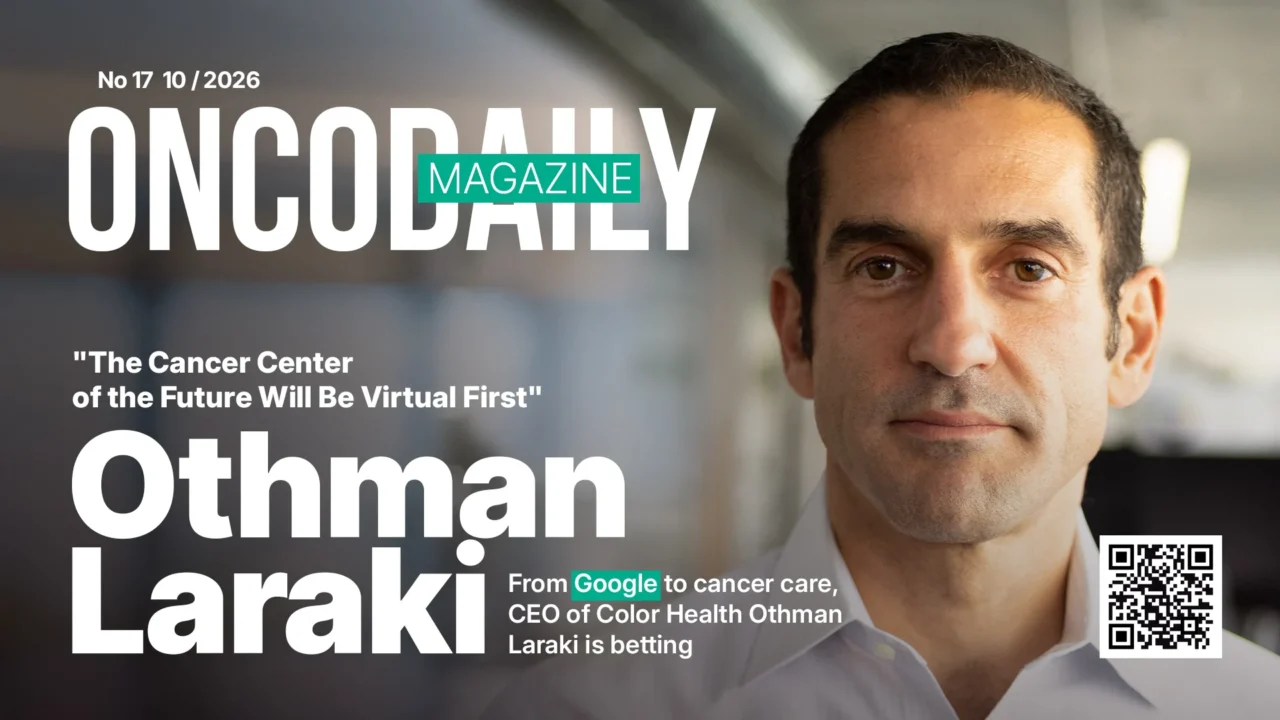
From Casablanca to Silicon Valley, from Google to cancer care, Othman Laraki has spent his life at the intersection of technology and opportunity. Now, the co-founder and CEO of Color Health is betting that the next great cancer center will not begin with a building.
There is a painting hanging behind Othman Laraki.
It depicts Essaouira, an old port town on Morocco’s Atlantic coast.
“It’s one of my favorite places in Morocco,” Othman says. “This painting reminds me of it and the feeling of being there.”
Othman was born into different worlds. His father is Moroccan, his mother French. He grew up in Casablanca, studied at Stanford and MIT, joined Google, became a Silicon Valley entrepreneur – and eventually entered healthcare.
Today, he is co-founder and CEO of Color Health.
And his ambition is bigger than digital health.
“The top cancer centers of the future are going to be virtual-first cancer centers.”
Not replacing hospitals.
Not replacing oncologists.
But creating a clinical layer around patients – before diagnosis, during treatment and long after treatment ends.
Casablanca
Othman’s father was an entrepreneur.
“When people talk about the challenges of being a startup entrepreneur in the US, it’s nothing in comparison to what it used to be in places like Morocco.”
There was no venture capital safety net.
“You went to the bank and got a loan, and that loan was collateralized against all of your assets. If your business went belly up, you lost your house.”
“That was entrepreneurship with no seat belt, no airbag.”
Casablanca shaped him in another way.
Arab, Amazigh, Jewish, European and sub-Saharan cultures lived alongside each other.
“Growing up in a place like Casablanca, you feel like an outsider everywhere, but you also feel like you can belong everywhere.”
But perhaps the most important influence was closer to home.
“My mother is a two-time breast cancer survivor.”
He was under five when she first developed breast cancer.
Years later, after a career in technology, cancer brought him back.
“That lived family experience really came full circle to leading me to start Color.”
The Computer With No Games
His journey into technology began almost accidentally.
When Othman was five or six, his father brought home an Amstrad computer.
Othman wanted games.
There were none.
Instead, magazines contained pages of BASIC code that had to be manually entered into the computer.
“Sometimes it was 50 pages of code that you had to retype into the computer to play the game.”
So he typed.
And learned to program.
Eventually, he arrived at Stanford in 1996 – just as the internet revolution was exploding.
Larry Page and Sergey Brin were there. He met Jerry Yang. He once invited Masayoshi Son to speak at a seminar he organized.
Othman calls much of it luck.
“I always like the quote: better be lucky than smart.”
But luck is only useful when you recognize it.
“The combination of luck, but also not missing those opportunities when luck shows up, is very key to some of these big success stories.”
When Google Was Just Another Search Engine
Othman later joined Google when it had fewer than 1,000 employees.
Ironically, when he first encountered the company, he was skeptical.
“We already had Yahoo and Excite. Who needs another search engine?”
Then he used Google.
“You realized: wow, this is actually a very big step.”
It taught him an important lesson.
Sometimes something that looks like one small feature becomes the entire platform.
And sometimes simplicity wins.
Marissa Mayer was his boss for much of his time there.
“One of the most important things she did was keep all the junk off the Google homepage.”
One search box.
Almost nothing else.
Years later, that lesson would return.
This time in cancer.
Building the Cancer Center Again
Color began around 13 years ago in cancer genetics, working to expand access to testing for hereditary cancer risk.
But Othman says the goal was never simply testing.
“We wanted to deliver the impact of information in cancer.”
The bigger question gradually became:
If you were designing the cancer center today, what would you build?
Modern cancer centers concentrate enormous expertise inside buildings.
But the patient’s journey begins long before treatment.
Was the patient screened?
Was cancer prevented?
What happened after an abnormal result?
How quickly did diagnosis happen?
And after treatment, who manages survivorship, recurrence risk and long-term complications?
“We make almost all of the investments around cancer treatment.”
Yet, Othman argues:
“Most of the dice get thrown around your cancer outcome before your diagnosis.”
His conclusion was radical but simple.
“If you were building the cancer center of the future, you would not actually start by building buildings and putting expensive equipment in them.”
You would start virtually.
Put the Cancer Center in the Cloud
“Imagine you take a top cancer center and you just put it in the cloud.”
The patient enters through something as simple as a link.
Color establishes where that person is in the cancer journey.
Healthy but high risk?
Abnormal screening?
Newly diagnosed?
In treatment?
Survivor?
A clinical team – physicians, genetic counselors and care advocates – then surrounds the patient.
Othman emphasizes one point.
“It’s not AI sitting back there.”
Color uses AI extensively.
But, he says:
“It is a medical group.”
If a patient needs a home test, it can be shipped.
If the patient needs mammography or another physical procedure, the platform helps find nearby options, coordinate insurance and schedule the appointment.
“You just choose a date and show up.”
The philosophy is straightforward.
Take care to people.
Do not let people to navigate care alone.
The Dangerous Space Before Diagnosis
One of the biggest problems begins when screening finds something abnormal.
A positive test appears.
Then the patient waits.
A colonoscopy takes months.
A suspicious mammogram leads to appointment after appointment.
The patient becomes the coordinator of a healthcare system they do not understand.
Color tries to compress that time.
“Our goal is, if you have a positive, within two weeks to get your colonoscopy.”
Because delay can change everything.
“Making someone who has colon cancer wait six months for a colonoscopy can be a whole stage or more of a difference.”
Once cancer is diagnosed, Color does not replace the treating oncologist.
Instead, it adds another clinical layer.
“We run a multidisciplinary tumor board for 100% of patients, no matter where they’re getting treated.”
Othman says those reviews have identified missing molecular testing, incomplete work-ups and even incorrect diagnoses.
“Think of us as putting an overlay of top cancer center quality analysis on your case, but that is available no matter where you’re getting treated.”
Geography Should Not Decide Cancer Care
“The same cancer, the same person, 20 miles down the road might have a very different level of access to top experts.”
That can mean different treatment. And different outcomes.
Othman calls the goal “up-leveling the baseline.”
Because cancer care is not only chemotherapy, surgery or radiation.
It is nutrition. Mental health. Financial toxicity. Symptom management. Survivorship. And access to expertise.
“Your odds of getting cutting-edge cancer treatment should not be proportional to how far you are from MSK or Stanford or UCSF.”
In other words:
Democratizing access to cancer care.
Twenty Years Between Science and Patients
Ask Othman where he wants Color to be in five years and he returns to the same vision.
“The highest-volume and highest-impact cancer service in the world will be a virtual-first cancer service.”
He hopes Color builds it.
But the idea matters more than the company.
“I hope that vision and that impact get delivered. And I hope that we are the ones who are able to do that, or at least influence it happening.”
He sees another fundamental problem in medicine.
Discovery does not automatically become delivery.
“Guidelines are trailing science by 10 years.”
Then:
“The practice trails guidelines by another 10 years.”
His conclusion:
“Today, practice is trailing the science by 20 years or more.”
Meanwhile, the scientific frontier is moving faster than ever.
Cancer vaccines.
Precision oncology.
New targeted therapies.
New diagnostics.
“The frontier is moving at an incredible pace.”
But innovation has little meaning if patients cannot access it.
“It should not take 10 or 20 years for people to experience the impact of what science has established.”
“The Future Has Never Been Built by the Skeptics”
At the end of our conversation, I asked Othman what advice he would give the younger generation.
His answer surprised me.
“I’m very jealous of people who are just coming of age now.”
His generation had the internet revolution.
This generation has AI.
There are risks.
But Othman worries that fear can become paralyzing.
“The most scarce thing all of us have is time.”
His message is simple.
Build. Try. Fail. Try again.
“Focus on making the things that are unconditionally positive for humanity.”
AI can be misused.
But it can also transform medicine.
“AI can help us save millions of people from cancer.”
And optimism, for him, is not naïveté.
It is a prerequisite for action.
“Pessimism drives inaction.”
Then comes the sentence that perhaps best summarizes his journey — from Casablanca to Silicon Valley, from Google to cancer care.
“The future has never gotten built by the skeptics.”
“It’s always gotten built by the optimists.”
Interview by Gevorg Tamamyan, Editor-in-Chief of OncoDaily