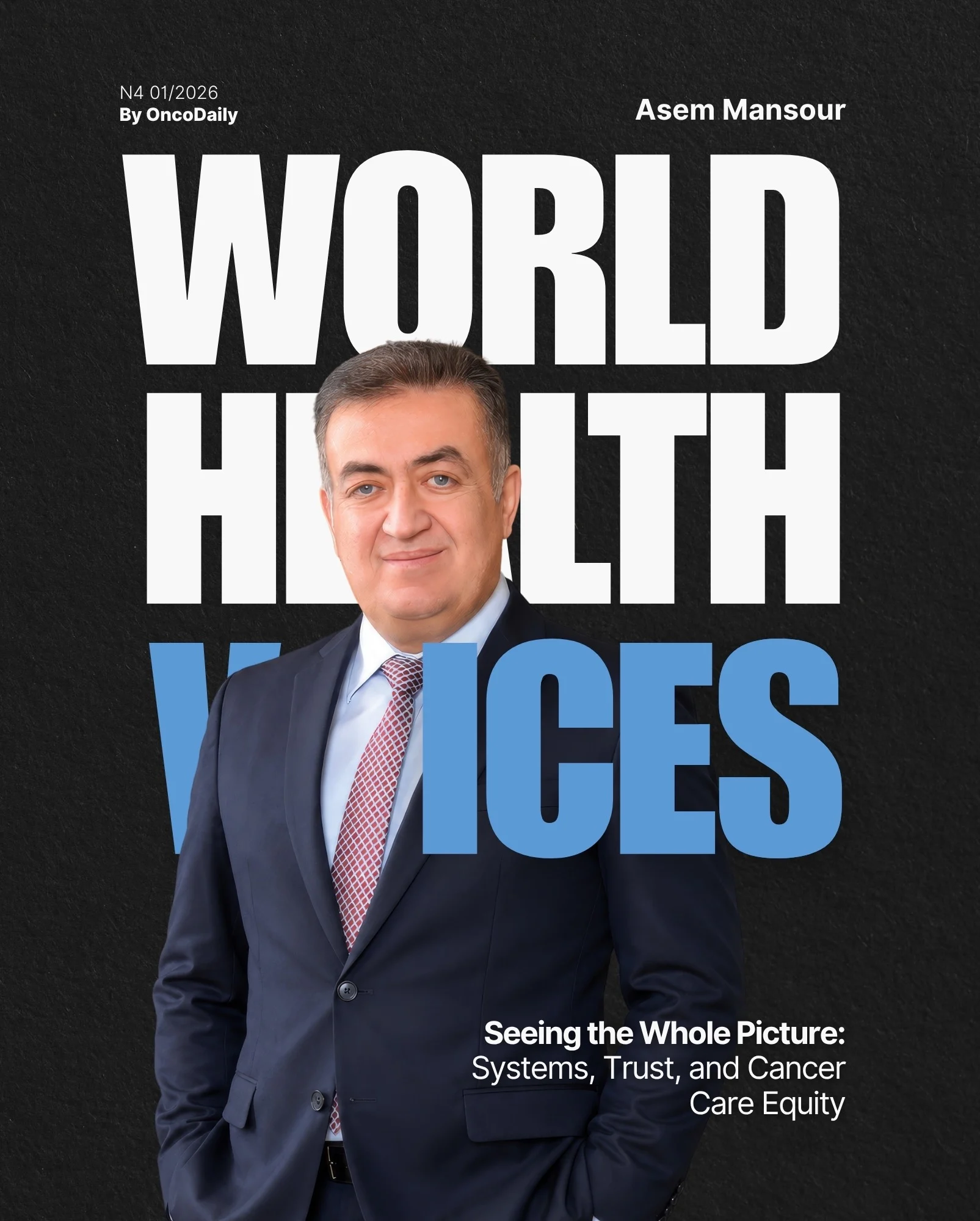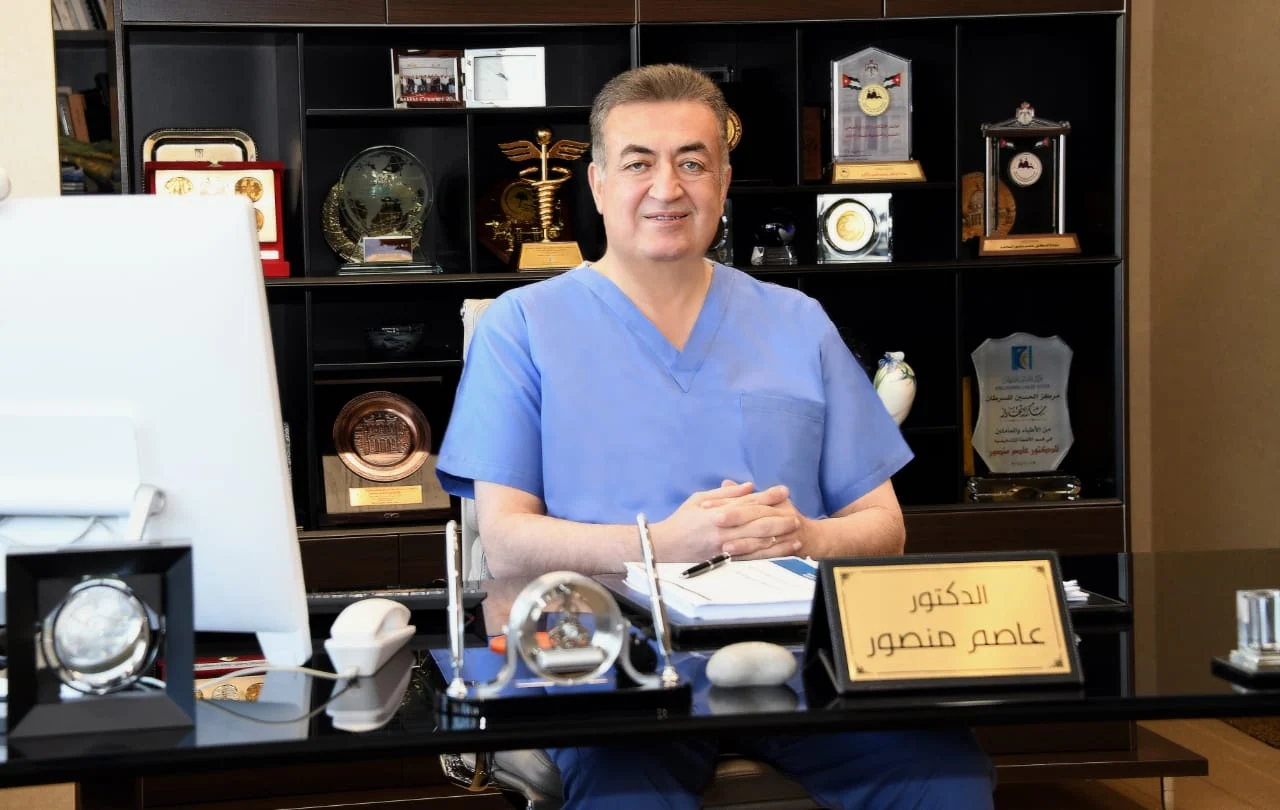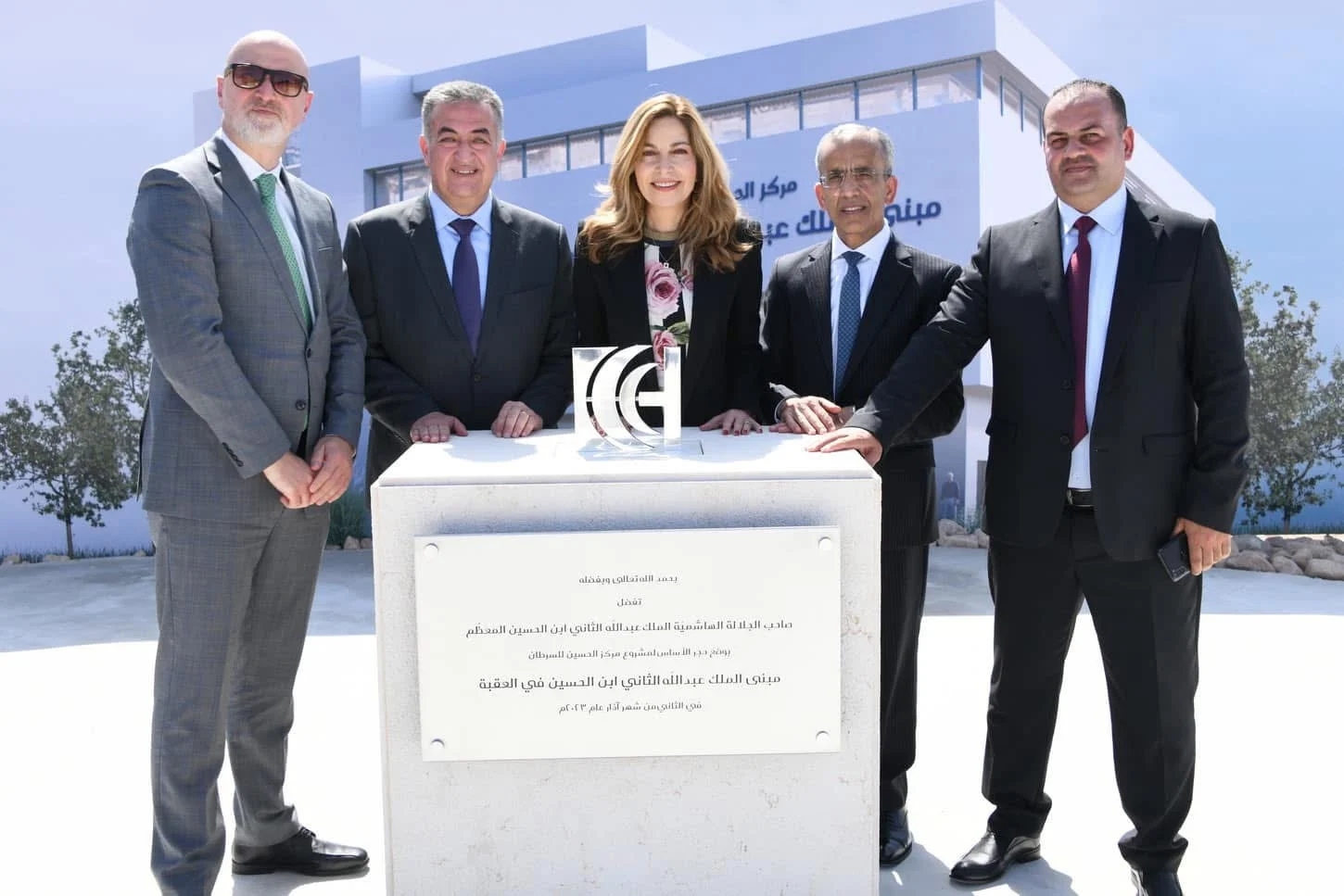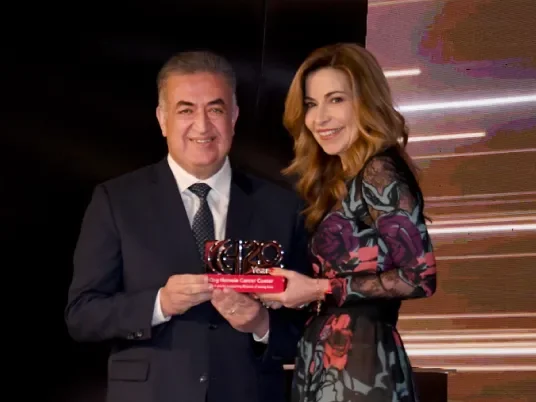
Despite leading one of the most important cancer institutions in the Middle East, Dr. Asem Mansour’s story did not begin with ambition or power. It began with circumstance, culture, and a quiet, deeply personal relationship with medicine.
“It’s not an easy question,” he said, when I asked why he chose medicine.
In Jordan, as in many countries in the region, medicine was not simply a career choice. It was an expectation, “deeply rooted in the subconscious” of his generation. Cultural norms played their part. But culture alone does not explain a life.
As a child, Asem Mansour lived with chronic illness. Clinics were familiar places. Doctors were not distant figures of authority, but symbols of reassurance and safety. “I came to associate physicians with healing,” he recalled, “with relieving suffering and restoring normal life.” Over time, the cultural expectation and the personal experience converged, guiding him, almost naturally, toward medicine.
Learning Resilience
His medical education was anything but comfortable.
He entered medical school before the age of eighteen, leaving his family behind to study in the former Soviet Union, in Belarus, a closed and isolated system. He arrived young, far from home, not yet fluent in Russian, and immediately immersed in complex subjects, an intense academic workload, and fierce competition.
“My classmates’ first language was Russian,” he said. “I had to double my effort just to match them.”
There were other challenges too: the harsh Russian winters, the emotional weight of first encounters with cadavers, and the quiet loneliness that accompanies early independence. None of it was easy. But in retrospect, he sees those years as formative.
“They helped me build resilience, discipline, and determination,” he said. “Those qualities shaped my medical career later on.”
Finding Radiology
Radiology was not an obvious choice.
In fact, it was not a choice at all, at least not initially. Like many medical students at the time, he imagined a future in surgery, internal medicine, or pediatrics. Radiology, he admitted candidly,“did not leave me with a good impression” during medical school. The field was not yet what it is today.
After graduation, Dr. Asem Mansour worked briefly as a general practitioner in a peripheral hospital. It was there, during long emergency room shifts, that something changed. He found himself spending time in the radiology department, reviewing X-rays, ultrasounds, images that quietly but decisively altered diagnoses and treatment plans.
“That’s where the love story with radiology started,” he said. It was 1992.
What he saw was not just technology, but inevitability. “No patient would come to any healthcare facility, clinic or hospital, without stopping at the radiology department.” Imaging, he realized, was becoming the backbone of modern medicine.
“I knew this was the future,” he said. “And I knew it was the specialty that fit me the most.”
Growing From Within
Today, Dr. Asem Mansour is the Director General and CEO of King Hussein Cancer Center, leading more than 3,000 staff members, including over 400 oncologists and consultants. But his leadership story is not one of arrival from outside. It is a story of growth from within.
“I joined KHCC in 1998 as a very young radiologist,” he said.
From there, he moved step by step: Chair of Radiology, Deputy Director General, then Director General. He knows the institution intimately: its strengths, its weaknesses, its culture. “I’m from within the system,” he said simply. “I know the system.”
That continuity, he believes, matters. Many of today’s staff joined while he was already part of the organization. Trust was built over time, not imposed.
But institutional familiarity alone was not enough. Along the way, he made a deliberate decision to reshape himself as a leader.
“I worked on myself,” he said, “to complement personal qualities with science.”
He pursued a master’s degree in medical management at Carnegie Mellon University in Pittsburgh, USA, an experience he describes as transformative. There, he was exposed to different health systems, governance models, and leadership philosophies. He learned about quality, safety, conflict management, and strategic thinking.
“It helped me reshape my leadership,” he said.
What Builds a World-Class Cancer Center
When I asked what made King Hussein Cancer Center what it is today, his answer was precise and simple.
First: governance.
“Strong governance,” he said, “provides vision, accountability, and stability.” It allows institutions to make long-term decisions in the best interest of patients, rather than reacting to short-term pressures.
He paused to acknowledge the support that made KHCC’s achievements possible. “The vision of HRH Princess Ghida Talal, her ambition for Jordan, and her leadership in spearheading this center have been foundational. Her unwavering commitment to advancing cancer care and supporting patients and staff alike has shaped every aspect of our institution.”
Second: people.
“Our multidisciplinary team of physicians, nurses, allied health professionals, administrative staff, they all share a common mission.” Their willingness to go the extra mile, he said, is the backbone of KHCC.
Third: transformation.
The early decision to transform the center into a comprehensive cancer institution was not easy. But what made it successful was acceptance. “The acceptance from the staff made our journey fruitful,” he said.
And finally: trust.
“The trust from patients and families in Jordan and the region,” he emphasized, “carried the center into a world-class cancer institution.”
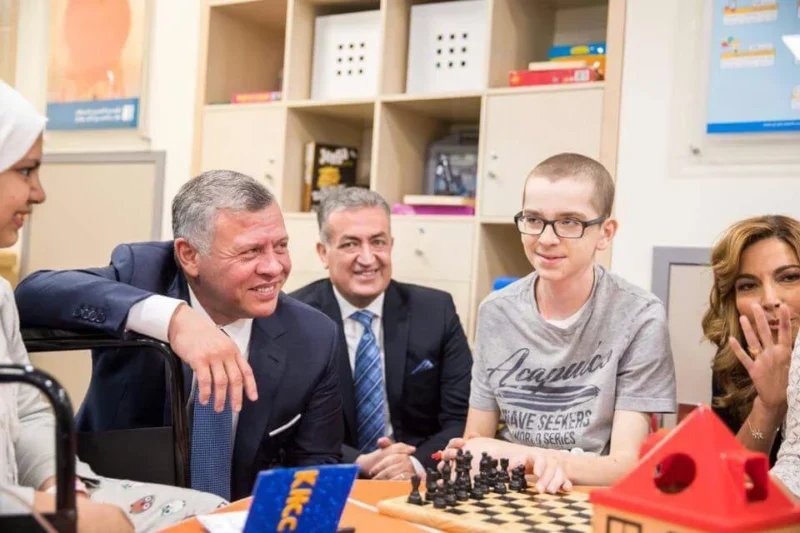
His Majesty King Abdullah II, HRH Princess Ghida Talal and Dr. Asem Mansour with a patients
Why Radiologists Lead
At one point, I shared an observation with him. Several transformative healthcare leaders, from ministers of health to academic giants, had one thing in common: radiology.
He paused, then smiled.
“This never crossed my mind,” he said. But as he reflected, the explanation emerged naturally. Radiology, he explained, trains the mind to operate on two levels at once. An image is both a vast representation of the body and a collection of tiny data points. “You have to train your eyes to details,” he said, “and at the same time to the big picture.”
Miss either, and you miss the diagnosis.
Radiology is also about differential diagnosis, linking fragments, assembling puzzles. And leadership, he suggested, is not so different.
“It’s about linking things together,” he said. “Putting puzzles together to come up with a clear picture. That’s how you become visionary, set strategy, and follow it over time.”
Learning Across Systems
When we spoke about his years spent across the Soviet Union, the United Kingdom, and the United States, Dr. Mansour was clear that geography was never incidental. Each country entered his life at a different moment, and each left a different imprint.
“Every international experience came at a different stage of my career,” he said. “And each contributed something different.”
The earliest years, spent in the Soviet Union, were foundational. He was young, impressionable, and immersed in a uniquely global environment. Students had come from everywhere, from Africa, Asia, Europe, Latin America, each carrying their own histories, assumptions, and ways of thinking.
“I was exposed to their perspectives, their cultures,” he said. “I learned a lot.”
Those years also opened another door. He found himself drawn deeply into Russian literature and culture. He read extensively. He absorbed not just language, but worldview. Looking back, he sees that period as formative not only professionally, but humanly.
“It helped me as a human being first,” he reflected. “It made me more accommodative, more open to people from different backgrounds. It enriched my knowledge.”
Later came management training in the United States, practical, structured, and deliberately transformative. It reshaped how he thought about leadership.
“It armed me with the basic tools required to be a true leader,” he said, “in an organization like KHCC, or any similar institution.”
And then public health, in Liverpool. That experience sharpened his research methodology, but more importantly, shifted his lens.
“It trained me to think beyond individual patients and individual institutions,” he said. “To think about systems, outcomes, and evidence.”
Taken together, these experiences, cultural immersion, leadership science, and population health, formed a composite skill set. “They equipped me with cultural awareness, leadership and management skills, and strong public health foundations, all of which were crucial in addressing cancer care challenges in Jordan and the region.”
“I find something to learn from everyone”
When the conversation turned to mentors, his answer did not begin in academia or administration. It began at home.
“My first mentor was my father,” he said.His father gave him something rare: space. Freedom to choose what to study, where to study, and how to shape his path. More importantly, he taught him how to decide.
“You have to understand the consequences,” he said. “You have to study your possibilities.”
Those lessons were not formal. They were absorbed through daily life, through observation, through living under the same roof.
His second mentor was Dr. Mahmoud Fayyad, the founder of radiology in Jordan. Working alongside him shaped not only his clinical identity, but his moral one.
“He didn’t just help me become a radiologist,” Asem Mansour said. “He helped me become a better human being.”
From Dr. Fayyad, he learned that knowledge is not private property. “You have to give it to others,” he said. Precision, humility, patience, especially patience, were values placed deliberately at the center of every decision.
Over time, his definition of mentorship expanded.
“Everyone I worked with became a mentor,” he said. Physicians, nurses, leaders, colleagues at every level. “One of my strengths,” he reflected, “is that I find something to learn from everyone.”
Equity as a Moral Imperative
Cancer care equity is not an abstract concept for Dr. Asem Mansour. It is the work he returns to, day and night.
“We have to recognize,” he said plainly, “that cancer outcomes are still largely determined by where a patient is born and what resources they can access.”
For him, equity begins with structure. Every country, he believes, should have at least one comprehensive cancer center, a true center of excellence providing prevention, early detection, diagnosis, treatment, and palliative care.
“This center becomes the heart of knowledge for the country and the region,” he said. Around it, networks can be built. Capacity can spread.
But structure alone is not enough. Accessibility matters.
“It’s not enough to have state-of-the-art machines or medications in one country,” he said.
“These technologies must be accessible to every patient, everywhere.”
Then comes human capital. The world, he noted, is facing a profound shortage of healthcare professionals, especially in oncology. This is even more acute in resource-limited settings.“We must invest in training,” he said. Not only physicians, but nurses and allied health professionals. “Otherwise, we end up with cutting-edge technology and no one who can operate it.”
And finally, financial protection.
“It’s not acceptable,” he said firmly, “that someone goes bankrupt because of a cancer diagnosis.”
His conclusion was unequivocal: universal health coverage is not optional. It is foundational.
“At King Hussein Cancer Center, we recognize that our responsibility extends beyond Jordan,” he added. “We remain committed to supporting the region by providing training, sharing expertise, and offering treatment to patients who may not have access to specialized care locally. Our doors are open to collaborate with institutions across the Middle East, because cancer knows no borders, and neither should care.”
Building the Future of KHCC
Looking ahead, Asem Mansour spoke not in abstractions, but in blueprints.
KHCC is currently working on its Strategy 25–30, anchored in several major pillars. One of the most ambitious is space expansion, beginning with a stand-alone, 100-bed comprehensive pediatric cancer center.
“All pediatric cancer cases in Jordan,” he said, “will be treated under one roof.” Oncology, hemato-oncology, bone marrow transplantation, diagnostics, laboratories—fully integrated.
Following that will come the Blood Institute, centralizing adult hematologic malignancies in a single, specialized structure.
Research is another priority. KHCC aims to expand its role in global clinical trials through new collaborations. At the same time, care will be decentralized.
The first satellite center, focused on early diagnosis and awareness, will open in eastern Amman, with more to follow across the country. Training programs will expand in both quality and quantity, with international accreditation as a goal.
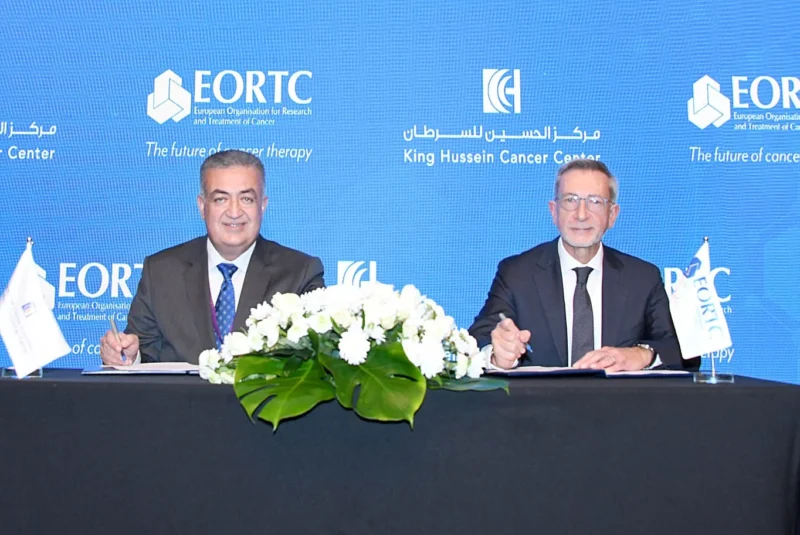
Dr. Asem Mansour and Dr. Denis Lacombe, CEO of EORTC
Writing in Times of Crisis
Beyond medicine and leadership, Asem Mansour writes.
His first book, Two Years of Solitude, was written during the COVID-19 pandemic. It is a reflection on what the pandemic revealed: systemic weaknesses, social injustice, and the vulnerability of cancer patients facing a “double hit”, infection and malignancy.
“I focused on the social aspects of healthcare,” he said. “On how we treat the most vulnerable.”
His second book, Cancer Care in Areas of Conflict, emerged from lived experience. Drawing on wars across the Middle East, it examines the human and professional challenges of delivering cancer care amid instability, and the responsibility of comprehensive cancer centers during times of war.
Reading the World
His reading habits mirror his life: wide, curious, unconstrained.
He immersed himself deeply in Russian literature, Tolstoy, Dostoevsky, Chekhov, reading
everything he could. He reads Arabic literature as well, including Naguib Mahfouz.
“I read across the board,” he said simply.
“difference you make in people’s live”
He hesitated when asked for advice.
“I don’t usually like to give advice,” he said. “Each of us learns during his own journey.”
But if pressed, he offered something simple and demanding: work hard. Stay serious. Follow your ambition. And above all, keep your integrity, even when it is difficult.
“Real success,” he said, “is not measured only by title, but by the difference you make in people’s lives.”
One Sentence
When asked to describe himself in one sentence, he did not overthink it.
“A radiologist and healthcare leader, shaped by diverse global experiences, passionate about building cancer care institutions and a dreamer who believes that one day we will defeat cancer.”
Interview by Gevorg Tamamyan, Editor-in-Chief of OncoDaily