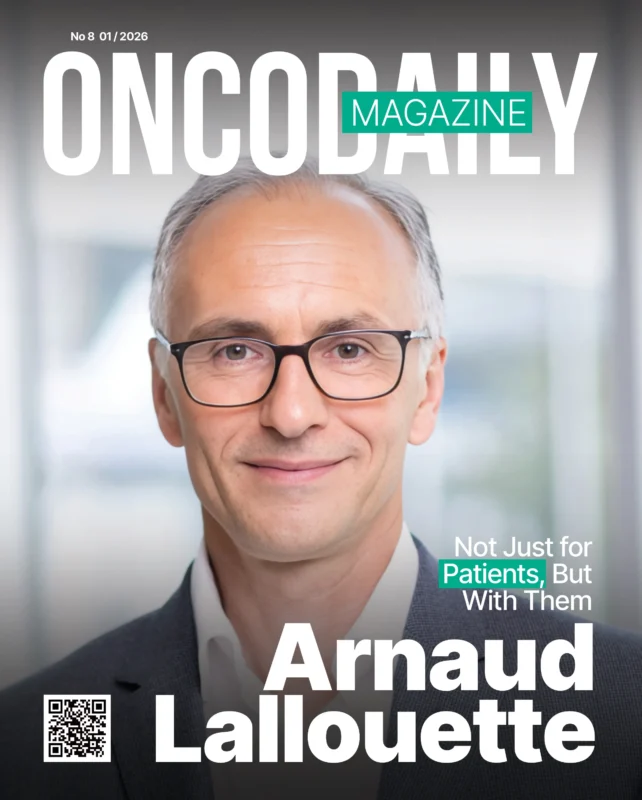
When I welcomed Dr. Arnaud Lallouette, Executive Vice President for Global Medical and Patient Affairs at Servier, it was immediately clear that this would not be a conversation about titles.
It would be a conversation about scale and how not to lose humanity while pursuing it.
Falling Into Medicine
“I think I fell into medicine as a child.”
His father was the head of a psychiatric department, caring for both children and adults. What stayed with Arnaud was not only the intensity of the work, but the passion behind it, the way medicine extended beyond the patient to families, to lives shaped and reshaped by illness.
“I always saw how hard he worked,” he said, “but also how deeply he cared about the impact he could have. That’s what inspired me, to be part of that change.”
Medicine, for him, was never abstract. It was relational from the start.
Early Years: Science With Tangible Impact
Medical school reinforced what instinct had already suggested. He was drawn to science, to therapeutic progress, to the possibility that knowledge could translate into real, measurable change.
Very early on, he rotated across specialties, treating both adults and children. Pediatric oncology. Pediatric cardiology. Different diseases, different ages, but a common thread.
“I wanted a specialty where the impact on patients could be tangible,” he said. “Where you could really see the difference you were making.”
That search for tangible impact would become a recurring theme.
Choosing the Heart
In the 1990s, cardiology felt inevitable.
“The heart fascinated me,” he said. “The brain too, but the heart in particular.”
It was also a moment of extraordinary transformation in cardiovascular medicine. ACE inhibitors. Beta blockers. Antithrombotic therapies. Devices that were changing outcomes in ways that had seemed impossible just years earlier.
“All these innovations were reshaping how we treated patients,” he recalled. “Choosing cardiology felt natural.”
But even then, another question was forming, one that would eventually pull him beyond the clinic.
From Individual Patients to Global Health
The decision to move into the pharmaceutical industry was not a departure from medicine, but a recalibration of scale.
“What excited me,” he said, “was the possibility to change scale.”
From treating individual patients, he moved toward influencing global health. The ambition remained the same: improve patient care. The canvas became larger.
It also meant discovering an entirely new ecosystem: research and development, regulatory affairs, medical and patient affairs, production, supply chains.
“Different métiers,” he said, “but the same purpose.”
Why Servier
Before speaking about his own trajectory, Arnaud paused to speak about the organization itself, because, in his view, it mattered deeply.
Servier is an international pharmaceutical group governed by a nonprofit foundation. No shareholders. All profits reinvested, primarily into research and development.
“This governance changes everything,” he said. “It allows a long-term vision. It allows focus on transformative medicine rather than short-term results.”
Precision medicine. Targeted therapies. A growing focus on oncology and neurology. For someone trained in cardiology, it was also a natural fit: Servier has long been a global leader in hypertension and cardiovascular disease.
“That alignment mattered,” he said simply.
Around the World
Over time, his career expanded across therapeutic areas—cardiology, diabetology, venous disease, oncology, neurology—and across functions, from medical affairs to more commercial roles.
But perhaps most formative was geography.
He has lived and worked across seven countries.
The Nordic region—Denmark, Sweden, Finland, with activities in Norway—was his first lesson that even neighboring systems are not culturally homogeneous.
“I learned that culture shapes how people think, interact, and make decisions,” he said. “Physicians, patients, colleagues—all of them.”
Then came the UK. Australia. Canada. France.
Each experience reinforced the same conviction: healthcare inequity is not theoretical. Underserved communities exist everywhere, in different forms.
“These experiences strengthened my desire to improve care for all patients, regardless of country, socioeconomic status, or background.”
People
When asked about mentors, he resisted naming individuals.
Instead, he described qualities.
In cardiology, his mentors were scientists of international standing, but also clinicians of rare humanity. Exceptional diagnosticians. Thoughtful communicators. Physicians who took time to ensure patients understood their disease and their treatment.
“That humanity,” he said, “left a deep impression on me.”
In industry, particularly at Servier, other mentors taught him something different but equally essential: that his strongest asset was not strategy or structure, but people.
“My teams. My colleagues,” he said. “That’s what stays with me.”
Advice to the Next Generation
His advice unfolded like a framework.
First: patients.
“Listen to them. Work with them. Patients are the real experts of their disease.”
Not just for patients, but with them. Across every stage of the medicine lifecycle.
Second: curiosity.
“We live in a fast-moving world,” he said. “Innovation comes quickly, and not only from pharma.”
Automotive. Food. Technology. Other industries often move faster, and there is much to learn from them.
Third: enthusiasm.
“Keep the enthusiasm you had as a child. The passion. The joy of discovery.”
And finally: humility and risk.
“Remain humble. And take risks. Change functions. Change countries. Start from scratch sometimes.”
Risk, he believes, is not instability, it is growth.
“Keep the enthusiasm you had as a child.”
What Differentiates Servier
When we returned to Servier itself, his answer echoed everything that came before.
First: governance.
Being a foundation allows long-term thinking, sustainability, and patient-centered innovation without the pressure of quarterly shareholder expectations.
Second: patients.
“Our Chief Patient Officer says it best,” he noted: patients speak, we listen, and we act together.
Patients are involved from the earliest stages of molecule development, throughout the entire lifecycle of a medicine.
That commitment has been recognized externally. Servier has ranked among the most favored pharmaceutical companies globally, and number one in oncology among patient organizations it works with.
“For me,” he said, “that combination—the foundation model and true partnership with patients—is what differentiates us.”
Being Focused Where the Need Is Huge
When I asked Dr. Arnaud Lallouette what Servier is building in oncology right now and where it intends to go next, his answer began with a word that rarely appears in corporate ambition, yet defines serious strategy: focus.
They are not trying to be everywhere. They are trying to matter where the need is greatest.
“In oncology today,” he told me, “our plan is really to be focused… in order to deliver innovation and bring it to patients.”
The focus, he explained, is on rare and hard-to-treat diseases, areas where medical need remains immense, and where a foundation-governed group believes it can make a meaningful difference.
Servier’s oncology strategy, as he described it, rests on three pillars.
The first is gastrointestinal cancers—not as a broad category, but as a precise set of high-mortality diseases: gastric cancer, colorectal cancer, pancreatic cancer, and cholangiocarcinoma. These, he emphasized, are conditions where outcomes remain devastating and the unmet need is obvious.
The second pillar is brain cancers, with an expanding focus on glioma across grades 2 to 4.
And the third pillar is hemato-oncology, with particular attention to leukemia in both children and adults, specifically acute myeloid leukemia (AML) and acute lymphoblastic leukemia (ALL).
It was a clear map: defined territories, not vague ambition.
The Next Accelerator: Data, Digitalization, and AI
But he also pointed to what he sees as the next force multiplier, not a molecule, but a capability.
“Where we want to be better tomorrow,” he said, “will be around data, data digitalization and artificial intelligence.”
To him, AI is not a slogan. It is a tool to reduce time: between discovery and development, between development and access, between therapy and the patient most likely to respond to treatment. He described concrete ways it could accelerate innovation, helping identify which patient populations are most likely to respond, understanding patient pathways more quickly, and strengthening how value is demonstrated to healthcare systems.
For Servier, he said, this is not peripheral. It is a priority.
ACT for Children: A Coalition Built to Close a Survival Gap
Then I brought the conversation back to a subject that carries moral weight, not only scientific ambition.
He had written a cover letter about it previously, but I wanted our audience to hear it directly from him, what it is, what it has done, and why it exists.
His tone changed. You could hear conviction, not messaging.
“Thank you for highlighting ACT for Children,” he said. “I’m absolutely convinced and highly motivated to be part of this adventure.”
He described it as an initiative that had just marked its first anniversary in September, built as a coalition of nine partners, working together with a singular aim: confronting the stark disparity in childhood cancer outcomes between high-income countries and low- and middle-income countries.
To be effective, he said, such work cannot be reduced to drug donation or one-dimensional support.
“It needs to have a holistic approach,” he explained. “It’s not just providing treatment. It’s access to education. Good diagnosis. Proper nutrition. Quality medicine. Supportive care. Patient support.”
Each element is decisive. Neglect one, and the whole effort fractures.
And that is why, he emphasized, no single organization can do it alone.
What Happened in One Year
So what did they do in twelve months?
He listed five centers got involved in El Salvador, Honduras, Guatemala, Armenia, and Indonesia.
Together with partners, they supported training efforts around the optimal management of childhood cancer, particularly childhood leukemia. He shared an approximate number: close to 800 doctors trained across these sites.
And they provided quality medicines sufficient, he said, to support treatment for up to 2,000 children with ALL.
A “fantastic initiative,” built not as a one-off intervention, but as a coordinated model of care.
Making Cancer Care More Equitable
When I asked what it truly takes to make cancer care more equitable globally, he answered from Servier’s perspective and from a broader system’s perspective.
First, a pharmaceutical company must put in place a structured global health equity strategy—not as a slogan, but as an operational plan across functions: research and development, industrial operations, commercial operations, medical affairs, and patient affairs.
Each function, in his view, needs its own strategy for improving global health.
He offered one example: ensuring clinical trials include a variety of patients, including those from underserved populations.
Second, he emphasized that equity cannot be achieved in isolation.
“To work not in isolation,” he said, “but in a coalition or alliance.”
Different actors bring different expertise. Only together can they create greater impact.
And he pointed back to ACT for Children as his model example: a coalition where vision is translated into action.
Books
When I asked what books he would recommend, he offered two: one more personal, one more practical.
The first was The Royal Game by Stefan Zweig: a powerful exploration of character revealed through chess, and a story shaped by themes of control and survival.
The second was a book by Jean-François Ménard, a coach for Canadian Olympic teams: Train (Your Brain) Like an Olympian. He described it as a set of methods, “recipes”, for structured behavior and performance, with relevance across ages, and especially useful for younger professionals who want to develop themselves in the pharmaceutical world.
In One Sentence: Patient and People-Oriented
Then I asked the hardest question—the one sentence.
He hesitated.
“It’s difficult in one sentence,” he said.
But he reached for what he hopes is visible through action: that he is “profoundly patient and people-oriented,” someone who tries to give his best—at work, in partnerships, and even in sport.
He spoke about his love of sport, collective and individual, and his dislike of isolation—so much so that even in an individual sport like triathlon, he prefers doing it with his son, Louis, using it as a way to discover the world and cultures together.
He mentioned triathlons they had done in Australia and Canada, and one that year in the south of France, in Aix-en-Provence. Next year, he said, they plan to do one in Palma de Mallorca.
Then he returned to the core, the shortest version of the long sentence:
patient- and people-oriented—trying to give his best!
Interview by Gevorg Tamamyan, Editor-in-Chief of OncoDaily