By Carmen Monge, Lead Lived Experience Advocacy Hub
Patient advocacy has evolved significantly in recent years. Today, patient advocates are involved in clinical trials, research projects, advisory boards, cancer care and policy making. Their lived experience and knowledge are increasingly recognized as valuable contributions to patient-centered healthcare.
However, despite this progress, patient advocates still face barriers to participating fully in some of the most important scientific conferences.
This became particularly visible during the European Society for Medical Oncology (ESMO) Congress 2026 in Madrid, when patient advocates were restricted, once again, from entering the industry exhibition area. Similar concerns have been raised at other European medical congresses, including those organized by the European Hematology Association (EHA).
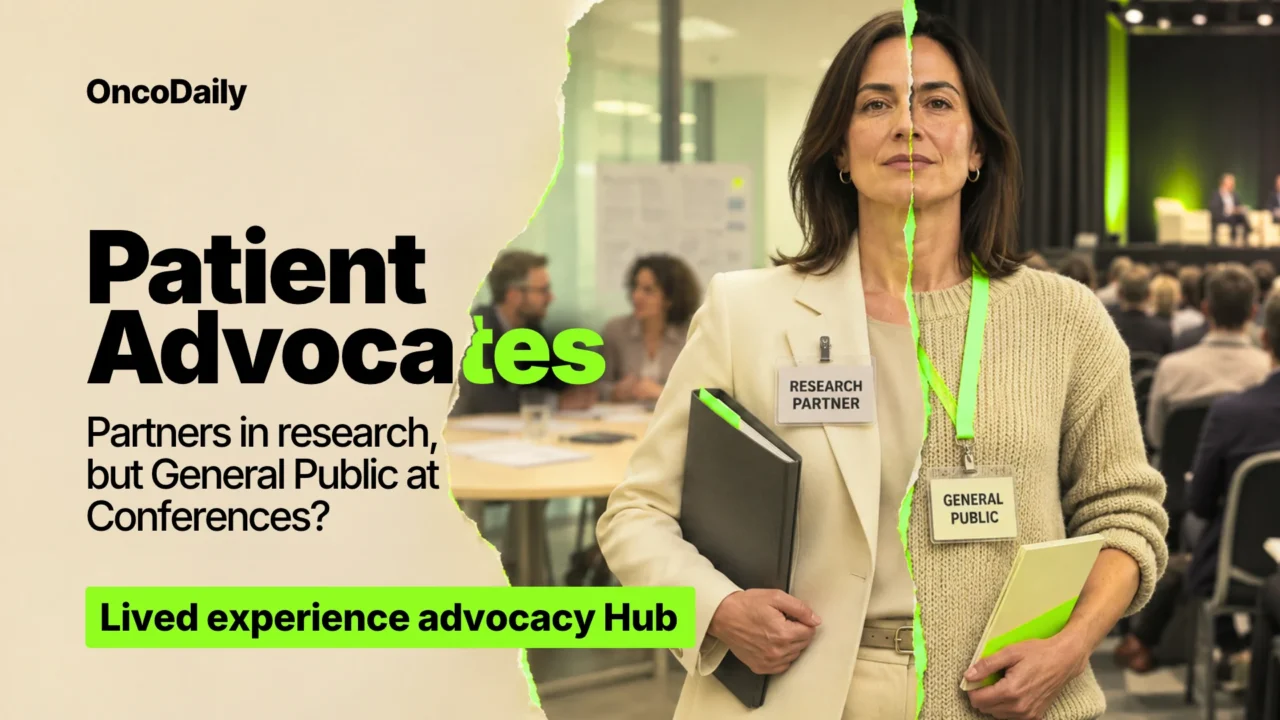
This raises an important question: If patient advocates are recognized as partners in cancer research and important patient-centre decisions, why are they still considered general public when attending certain areas of scientific conferences?
Why Are Patient Advocates Restricted from Exhibition Areas in Europe?
The main reason behind these restrictions is related to European pharmaceutical advertising regulations.
The European Union Directive 2001/83/EC (EU Directive 2001/83/EC) prohibits advertising prescription-only medicines to the general public. Similarly, the European Federation of Pharmaceutical Industries and Associations (EFPIA) Code of Practice establishes rules for pharmaceutical promotion and interactions with healthcare professionals, patient organizations, and other stakeholders.
At medical congresses, pharmaceutical companies may display promotional information about prescription medicines in exhibition areas, subject to applicable regulations.
As a result, congress organizers may restrict access to these areas for attendees who are not licensed healthcare professionals authorized to prescribe medicines.
The objective is to prevent inappropriate promotion of prescription medicines to the general public, which is an important principle of pharmaceutical regulation.
However, the question is not whether pharmaceutical advertising should be regulated, but whether patient advocates should be considered general public. Patient advocates attend conferences as representatives of patient organizations, researchers, advisors, collaborators, and professionals involved in healthcare projects. Many of them are trained and already have direct contact with the pharmaceutical companies due to their work.
Patient Advocates: General Public or Partners?
In previous OncoDaily articles, we explored the definition of patient advocacy, the concept of lived experience advocacy, and the different roles that people affected by cancer and advocates can perform.
European programs such as the European Patients’ Academy on Therapeutic Innovation (EUPATI) and the WECAN Academy provide education and training to strengthen patient advocacy skills, including knowledge of clinical research, regulatory processes, and patient engagement.
In addition, patient representatives collaborate with institutions such as the European Medicines Agency (EMA), pharmaceutical companies, academic institutions, and scientific societies.
Yet, at some medical conferences, these same individuals may be classified as members of the general public for the purpose of accessing promotional exhibition areas.
How can we recognize patient advocates as experts in research and decision-making, but not recognize their professional role when they enter a scientific conferences?
Are Exhibition Areas Only About Pharmaceutical Promotion?
Exhibition areas are often considered commercial spaces, but they are also important locations for networking, collaboration, and professional exchanges.
During conferences, these spaces bring together researchers, healthcare professionals, pharmaceutical companies, patient organizations, and other stakeholders.
For patient advocates, these interactions may provide opportunities to discuss clinical trials, identify potential collaborations, learn about the latest innovation and projects, meet research teams, and contribute to projects that could benefit their organizations or communities.
At ESMO 2026, the Workgroup of European Cancer Patient Advocacy Networks (WECAN) publicly raised concerns about these restrictions and called for solutions that recognize patient advocates as partners in scientific and professional exchanges.
Check video of Jan Geissler Patient Advocates Belong At The Table about this. He also addresses changes to patient advocates’ access to the pharmaceutical exhibition area at ESMO 2026. He discusses how these restrictions affected planned meetings and raises questions about the interpretation of European regulations and industry codes governing access to exhibition spaces.
Is Patient Advocate inclusion the same around the World?
Patient advocacy involvement varies significantly between countries and regions.
In the United States, conferences such as the American Society of Clinical Oncology (ASCO) Annual Meeting and the American Association of Cancer Research (AACR) have established opportunities for patient advocates to participate in scientific activities and interact with different healthcare stakeholders, including within exhibition spaces under applicable congress policies.
In Europe, despite the development of patient advocacy education and engagement initiatives, access to certain exhibition areas remains restricted at some congresses.
In Latin America, there are additional challenges. Some scientific events are designed primarily for healthcare professionals, and patient advocates may not be included in their intended audience.
This highlights a broader issue: the recognition and inclusion of patient advocates are not consistent across countries, organizations, or scientific events.
Although patient advocacy is increasingly discussed as an essential component of patient-centered healthcare, opportunities for meaningful participation remain unequal.
Should training or accreditation determine who can participate?
One possible approach would be to recognize trained or accredited patient advocates as a distinct group of stakeholders at scientific congresses.
Programs such as EUPATI and WECAN Academy have contributed significantly to strengthening patient advocacy knowledge and skills.
However, this approach also raises an important concern: Inequality
Not every country has the same access to patient advocacy training. Some programs require resources, time, language skills, or international connections that are not equally available to all countries. ESMO brings patient advocates from around the world together, and this could mean that only a few of them can enter the exhibition centre if they hold a certificate.
Patient advocacy expertise can be developed through formal training, but also through years of community work, research collaboration, organizational leadership, and lived experience.
How can we create recognition criteria without excluding advocates from countries and communities where training opportunities are limited?
Moving towards more inclusive scientific spaces
Patient-centered healthcare cannot be achieved only by inviting patient advocates to speak at specific sessions or participate in selected clinical trials or projects.
Meaningful involvement also requires opportunities to interact with other stakeholders, establish collaborations, and contribute to discussions that influence cancer research and care.
At the same time, pharmaceutical advertising regulations must continue to be respected.
The challenge is therefore to find solutions that protect patients from inappropriate promotion without limiting the professional participation of advocates. These solutions should include patient advocates from different countries, backgrounds, and levels of experience.
What Can We Do Next?
After the restrictions at ESMO 2026, WECAN initiated discussions with relevant stakeholders and launched an international survey to better understand the experiences of patient advocates at medical congresses.
The survey aims to document access restrictions, their impact on professional activities and collaborations, and possible solutions for future scientific events.
Patient advocates who have experienced these barriers can contribute by sharing their perspectives through the WECAN International Survey on Patient Advocates’ Access to Medical Congresses.
What do you think? Should patient advocates have access to industry exhibition areas at scientific congresses? And how can we ensure that any solution is equitable for advocates across different countries and communities?
References
- European Parliament, Council of the European Union. Directive 2001/83/EC of the European Parliament and of the Council of 6 November 2001 on the Community code relating to medicinal products for human use. Off J Eur Union. 2001;L 311:67-128.
- European Federation of Pharmaceutical Industries and Associations (EFPIA). EFPIA Code of Practice. EFPIA; 2019.
- EFPIA, International Pharmaceutical Congress Advisory Association (IPCAA). Joint Guidance on Medical Congress Participation and Compliance Interpretation. EFPIA / IPCAA; July 2025.
- Workgroup of European Cancer Patient Advocacy Networks (WECAN). Patient advocates are partners, not spectators: statement on medical congress participation. Published October 23, 2026. Available from: https://wecanadvocate.eu/featured/patient-advocates-are-partners/
You may also find this interesting:
Lived Experience Advocacy Hub Scholarship Opportunity: AACR Scientist-Survivor Program® 2027