Miguel Bronchud, Co-Founder and Director of Clinical Research at BO REAL BioTech, shared on LinkedIn:
“The Gut and cellular plasticity- a new example of ‘cancer cells hijacking’s potential‘ ?
Following seminal research in the elucidation of bone marrow stem cell and progenitor blood cells, the first hierarchical branching pathways of differentiation of a human tissue (hemopoietic) was developed and allowed us – among many other things- to clinically develop and use techniques for selective growth factors use and progenitor peripheral blood cells that have been used with curative success in the post high dose chemotherapy management of bone marrow rescue , to avoid or reduce the risk of neutropenic fever and lethal infections .
The first ten years of recombinant human granulocyte colony-stimulating factor (Filgrastim or r-metHuG-CSF) transformed modern hematology and oncology. From its purification in 1984 through the first decade of clinical use ending in the mid-1990s, it successfully reduced chemotherapy-induced neutropenia, enabled peripheral blood stem cell transplantation, and saved lives in chronic neutropenia.
In the past two decades, similar progress has been made (especially in the Low Countries in Europe, but also elsewhere ) in the elucidation of cell differentiation/proliferation in the gastrointestinal crypts , with the confirmation of key cells LGR5+ (and nurturing cells) that allow the physiological process of mucosal regeneration.
Now, a research team from Memorial Sloan Kettering Cancer Center (MSK) in NY has identified a single protein – called ZFP36L2, or ZFP for short – that serves as a ‘molecular switch‘ that directly links the gut’s damage-sensing system to the ability of cells to shift identities to repair an injury.
The findings shed new light on colorectal cancer’s ability to spread and evolve to resist treatment. And this same family of proteins appears to play a similar role in other types of cancer as well.
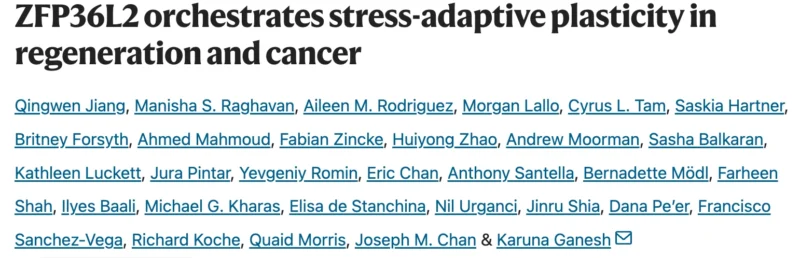
Jiang, Q., Raghavan, M.S., Rodriguez, A.M. et al. ZFP36L2 orchestrates stress-adaptive plasticity in regeneration and cancer. Nature (2026).
‘This is really a critical process that works the same way across many different tissues – allowing cells to detect damage and turn on stem cell renewal programs,’
says physician-scientist Karuna Ganesh, the senior author of the study, which was published August 5 in Nature.
Phenotypic plasticity is a hallmark of cancer- however the molecular switches required for cell-fate reprogramming are poorly understood.
During intestinal wound-healing and colorectal cancer (CRC) metastasis, differentiated cells can dynamically dedifferentiate into an intestinal stem cell (ISC) state to drive epithelial regeneration and metastatic outgrowth
MSK researchers now show that the RNA-binding protein ZFP36L2, which is mutated in ‘only’ 5-10% of CRC is an stress-responsive orchestrator of dynamic dedifferentiation.”
Title: ZFP36L2 orchestrates stress-adaptive plasticity in regeneration and cancer
Authors: Qingwen Jiang, Manisha S. Raghavan, Aileen M. Rodriguez, Morgan Lallo, Cyrus L. Tam, Saskia Hartner, Britney Forsyth, Ahmed Mahmoud, Fabian Zincke, Huiyong Zhao, Andrew Moorman, Sasha Balkaran, Kathleen Luckett, Jura Pintar, Yevgeniy Romin, Eric Chan, Anthony Santella, Bernadette Mödl, Farheen Shah, Ilyes Baali, Michael G. Kharas, Elisa de Stanchina, Nil Urganci, Jinru Shia, Dana Pe’er, Francisco Sanchez-Vega, Richard Koche, Quaid Morris, Joseph M. Chan, Karuna Ganesh
Read The Full Article