Maria Hafez, Assistant Professor at St. Luke’s University Health Network, shared on LinkedIn:
“Camizestrant: the FDA just approved a drug for a scan that hasn’t changed
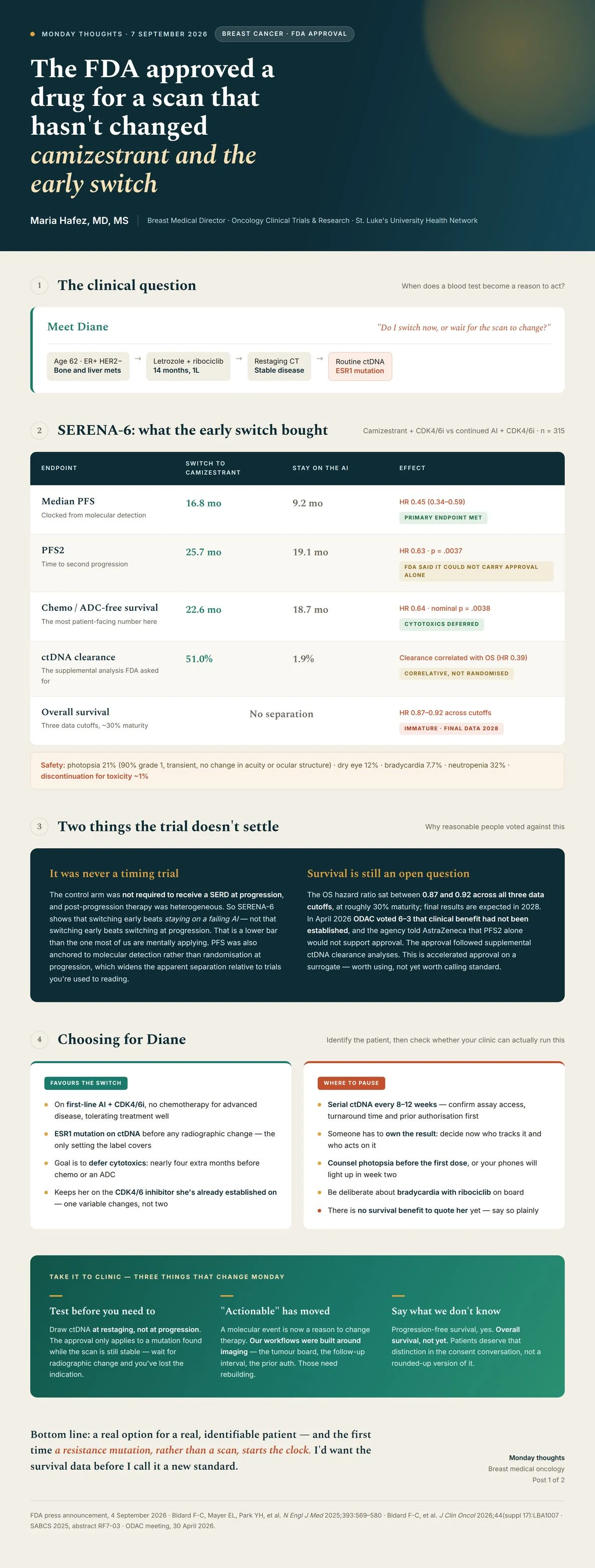
On September 4, the FDA granted accelerated approval to camizestrant (Etcamah), a CDK4/6 inhibitor, for HR+/HER2− advanced breast cancer that develops an ESR1 mutation during first-line AI + CDK4/6i therapy.
Read that again. The trigger for treatment change is a blood test, not progression on imaging.
This is the first FDA approval in oncology based on detecting a resistance mutation in ctDNA before radiographic progression.
Whatever you think of the drug, that precedent matters more than the molecule.
The specifics
- Oral SERD, 75 mg daily, complete ER antagonist
- Partnered with abemaciclib, palbociclib, or ribociclib, you continue the CDK4/6i the patient is already on
- Companion diagnostic: Guardant360 CDx
- Population: no prior chemo for advanced disease, no radiographic progression at the time of the switch
The data (SERENA-6, n = 315)
- Median PFS 16.8 vs 9.2 months (HR 0.45) at 23.5 months of follow-up
- PFS2 25.7 vs 19.1 months (HR 0.63)
- Chemo/ADC-free survival 22.6 vs 18.7 months (HR 0.64), arguably the most patient-meaningful number here
- ctDNA clearance 51% vs 1.9%
- Discontinuation for toxicity ~1%
Where I’d use it The patient on first-line letrozole + ribociclib, 14 months in, scans stable, feeling well, and serial ctDNA turns up an ESR1 mutation.
You switch the endocrine backbone and keep everything else.
No new line, no chemo, no ADC.
You’ve bought roughly seven months before the next decision point and pushed cytotoxics further out.
Where I’d pump the brakes:
Overall survival is not there. HR hovered around 0.87-0.92 across three data cutoffs. Final OS is expected in 2028. This is accelerated approval on a surrogate.
ODAC voted 6-3 against clinical benefit in April 2026. The agency approved anyway after AstraZeneca submitted supplemental ctDNA clearance data. Reasonable people looked at this trial and disagreed.
SERENA-6 is not a clean timing question. The control arm was never required to receive a SERD at progression, and post-progression therapy was heterogeneous. So the trial cannot tell you whether switching early beats switching at progression. It tells you early switching beats staying on a failing AI, a lower bar.
PFS was clocked from molecular detection, which is not a standard anchor and inflates the apparent separation relative to what you’re used to reading.
Operationally it is not free. Serial ctDNA every 8–12 weeks on every first-line patient. Think about your assay access, your turnaround, your prior auth pathway, and who in your practice is actually going to track and act on those results.
Watch the eyes and the heart rate.
Photopsia in ~20% (90% grade 1, transient, no change in acuity or ocular structure, but counsel patients up front or your phones will light up).
Bradycardia ~8%. Be deliberate about that with ribociclib on board.”
You can also read: Camizestrant and ctDNA-Guided Treatment Switching: A New Paradigm in ESR1-Mutant Advanced Breast Cancer