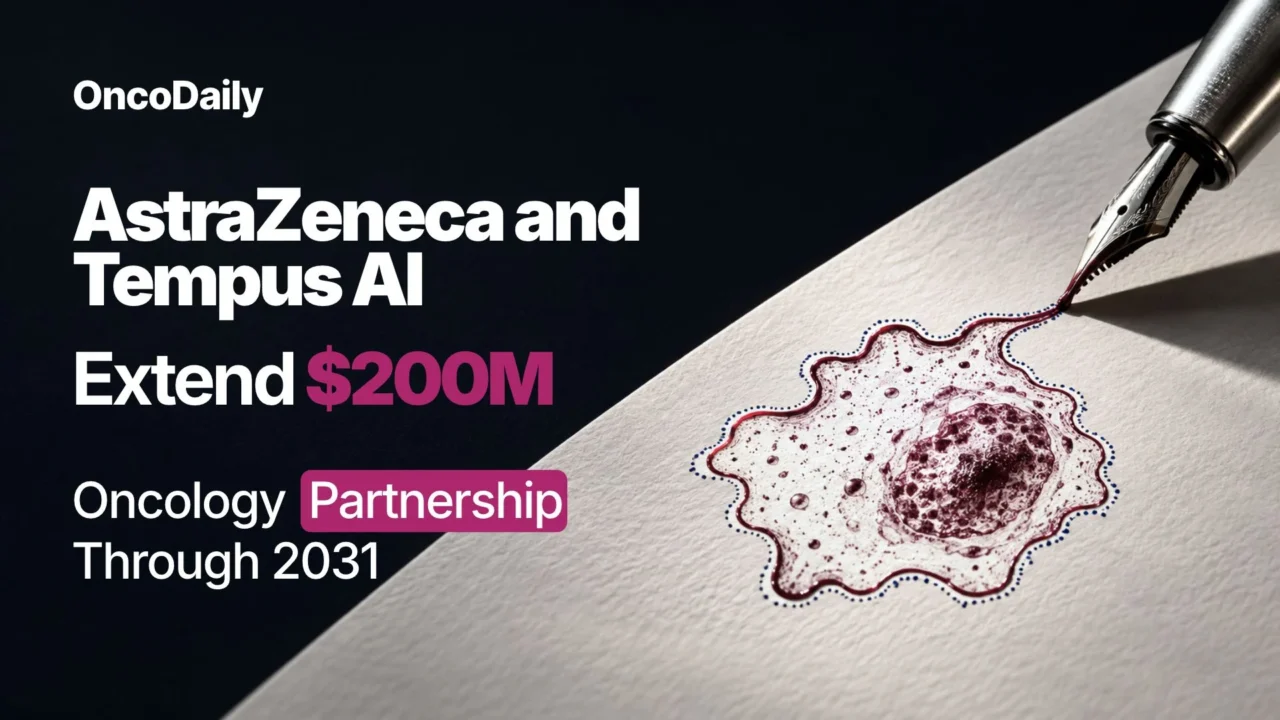
Tempus AI and AstraZeneca have renewed and expanded their strategic oncology collaboration for another five years, with AstraZeneca committing $200 million to support the use of artificial intelligence, multimodal data, and scientific insights in cancer drug discovery and development.
The agreement, signed on November 16, 2026, and disclosed in a US Securities and Exchange Commission (SEC) filing on November 18, extends a partnership established in 2021. The new terms will take effect on January 1, 2027, and continue through December 31, 2031, with a possible additional year under specified conditions.
The renewed collaboration will bring together de-identified patient data, AI-powered research tools, and clinical trial network capabilities to support the identification of drug targets, improve clinical development strategies, and advance precision oncology.
A $200 Million Commitment to Data-Driven Cancer Research
According to the SEC filing, AstraZeneca has committed to $200 million in fees payable to Tempus across the five-year renewal period. This represents an annual target of $40 million, with a minimum commitment of $32 million per calendar year.
The financial commitment covers existing and future Tempus products and services, including licensed oncology data, access to its Lens multimodal data platform, scientific analysis, and other activities supporting AstraZeneca’s research and development programs.
If the full commitment has not been met by the end of 2031, the agreement provides for an additional year to address the shortfall. AstraZeneca also retains the right to terminate the agreement early, subject to provisions concerning outstanding financial commitments.
The scale and duration of the renewed arrangement reflect the companies’ intention to integrate AI and data analysis into ongoing oncology research rather than use them only for individual projects.
From a 2021 Partnership to a Broader Oncology AI Strategy
The collaboration began in November 2021, when AstraZeneca partnered with Tempus to apply AI, machine learning, and de-identified clinical and molecular data to cancer drug discovery.
At the time, the companies focused on generating biological insights, identifying potential therapeutic targets, and supporting the development of new cancer treatments.
Five years later, the partnership has expanded to include research, clinical development, and applications that support oncology practice.
Reflecting on the renewed agreement, Eric Lefkofsky, Founder and CEO of Tempus AI, highlighted the partnership’s evolution from enterprise-wide oncology data access to a broader collaboration in AI-driven drug development.
“We’re proud to extend this strategic collaboration for another five years and are looking forward to the transformational work ahead for patients everywhere.”
Lefkofsky’s remarks follow five years of collaboration during which AstraZeneca became Tempus’s first enterprise-wide data partner across a global oncology portfolio. The renewed agreement now provides a framework for extending that work through 2031, with a greater emphasis on multimodal AI, scientific intelligence, and clinical development.
How the Collaboration Has Already Reached Lung Cancer Care
One example of the partnership’s clinical applications emerged in 2024, when Tempus and AstraZeneca expanded a program designed to improve guideline-directed biomarker testing in non-small cell lung cancer (NSCLC).
The program used Tempus Next, an AI-enabled care pathway intelligence platform, to analyze clinical information and identify patients who might benefit from molecular testing, including testing for EGFR mutations.
The initiative began as a pilot in September 2023. Following its initial implementation, the companies announced plans in June 2024 to expand the technology to a total of 15 provider sites.
For oncologists, the problem being addressed is familiar. Although molecular testing is essential for selecting targeted therapies in advanced NSCLC, patients may not always receive the recommended tests at the appropriate time.
By analyzing information contained in electronic medical records, the platform was designed to identify potential testing gaps and notify treating physicians.
This illustrates how the broader collaboration can connect AI research with practical clinical workflows, although the announcement did not establish a quantified improvement in patient survival or other clinical outcomes from the program.
Building AI Models That Can Learn from Millions of Cancer Records
Another milestone came in April 2025, when Tempus announced expanded agreements with AstraZeneca and Pathos AI to develop a multimodal foundation model for oncology.
Unlike conventional AI models that analyze a single type of information, multimodal models can integrate several sources of data, including clinical histories, molecular profiles, pathology images, and treatment outcomes.
The objective is to identify patterns that could inform biomarker discovery, patient stratification, therapeutic target identification, and clinical trial design.
In July 2026, Tempus reported that it had successfully delivered the first version of its oncology foundation model to AstraZeneca.
The company’s broader foundation model research also produced results presented at the 2026 ASCO Annual Meeting. Tempus reported training a multimodal model using:
- 2.5 million longitudinal patient records
- More than 250 million pages of clinical notes
- 450,000 digitized medical images
- 500,000 genomic and transcriptomic sequences
In a proof-of-concept analysis involving patients with EGFR-mutant NSCLC treated with osimertinib, Tempus reported a C-index of 0.802 for overall survival prediction (p < 0.001), with a hazard ratio of 4.536 (95% CI, 3.289–6.255) between the model-defined high-risk and low-risk groups.
These findings concern the predictive performance of the model, not an improvement in survival resulting from AI-guided treatment. Nevertheless, they illustrate the types of analyses being developed to support more precise patient stratification and potentially inform future clinical trials.
What the Renewed Agreement Means for Precision Oncology
The growing availability of molecular testing, digital pathology, and longitudinal clinical information creates opportunities to investigate cancer biology in greater detail. However, converting large volumes of complex patient data into clinically useful knowledge remains challenging.
The renewed AstraZeneca–Tempus agreement is intended to address parts of this challenge by combining real-world oncology datasets with AI models and pharmaceutical research expertise.
Potential applications include identifying patient populations more likely to benefit from particular treatments, recognizing mechanisms of resistance, informing drug development decisions, and improving clinical trial planning.
Data governance is another important element. The publicly filed agreement includes restrictions against attempting to re-identify patients in licensed datasets, contacting individuals whose records are included, and certain forms of unauthorized data use.
These protections are relevant as partnerships increasingly rely on large collections of de-identified patient information to train and evaluate AI systems.
Five More Years to Demonstrate Clinical Value
The renewed agreement establishes a substantial financial and operational framework, but it does not itself represent a new cancer treatment approval or evidence that AI-guided development has improved patient outcomes.
The next question is what the collaboration will deliver during its second five-year period.
Progress will need to be assessed through identifiable research outputs, validated biomarkers, improvements in trial design, and ultimately clinical studies demonstrating whether AI-assisted approaches can contribute to better treatment decisions or accelerate the development of effective therapies.
For AstraZeneca and Tempus, the partnership that began with oncology data access in 2021 has now developed into a longer-term commitment to AI-supported cancer research through 2031.
Whether that investment translates into measurable benefits for patients will be an important test of the expanding role of artificial intelligence in precision oncology.
Read further on OncoDaily: FDA Grants Priority Review to Sonesitatug Vedotin for Advanced Gastric Cancer